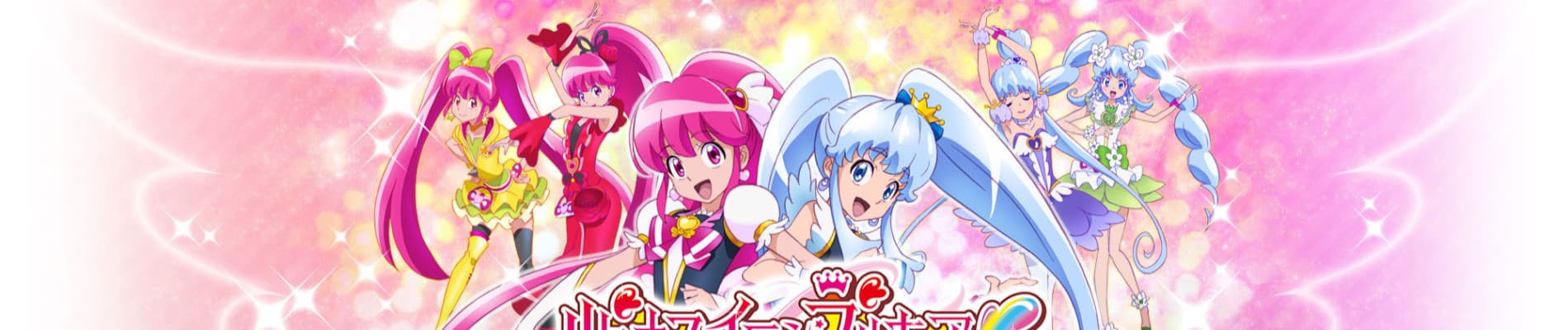
I recently finished this series, and I find it one of the most challenging to evaluate clearly. The anime Happiness Charge Precure! is the 11th season of the Precure franchise. What makes it special in the eyes of the producers is that it was created to celebrate the franchise's 10th anniversary. For the first 34 episodes, a special message aired before the opening, where all the known Precures (except for Cure Echo, RIP) thanked the audience for their support over the decade. Among these, I consider Cure Marine’s message the best—it effectively showcases her personality and is aesthetically well-presented.
From a technical standpoint, the animation quality is inconsistent, with notable highs (especially in the second half) and lows. Artistically, however, it’s an inspired series. This is evident in moments such as the Mirage vs. Lovely fight, the choreography of Red vs. Lovely, Unlovely vs. Lovely, Red tempting Lovely, episode 32’s desaturation effect and several other instances. Additionally, the series is packed with adorable and funny reactions from the main characters (especially Hime), made possible by their charming character designs.
Regarding the music, I like the opening both visually and sonorously, even though it contains a lot of spoilers. As for the endings, I visually prefer the second one, albeit not by much, while musically, I favor the first. Among the henshins, Cure Princess’s is my favorite—it’s fluid and energetic, particularly the bubble-shooting finish. As for the attacks, I appreciated the greater variety compared to DokiDoki, and the phrases during solo finishers were awesome. However, the fully CGI attacks were less impressive. As for the powered-up forms, I’m not a big fan of the make-up transformations and the identical outfits they wear. The singing during the Innocent Purification felt a bit out of place, even though I quite liked it musically.
Now for the characters and plot: I’ll save the ones I have the most to say about for last. Starting with Yuuko, aka Cure Honey—among the protagonists, she’s by far the least interesting. She has virtually no flaws, doesn’t develop as a character, and plays a minimal role in the narrative. The only significant things she does are reaching out to Hime when she was running away and fighting Phantom. Her episode where she gains her Innocent Form, at least, showcases how she brings joy to others through food, and the rice song is cute. Then there are the fairies, who I consider among the best in the franchise. Both speak fluent Japanese, actively assist their partners, and have great personalities. Ribbon acts like a nanny to Hime (I wish we’d seen more of their past), while Glasan has a masculine demeanor, highlighted by her way of speaking.
Another main cast member is Seiji, undoubtedly the most prominent male teenager in Precure’s first 11 seasons. He’s kind, helpful, and hardworking. He forms meaningful relationships with all the protagonists and even fights Choiarks barehanded multiple times. Initially, he sees Megumi only as a childhood friend, almost like a sister. However, as she grows closer to Blue, he becomes confused about his feelings and eventually realizes he loves her. I genuinely like this idea, as romance in Precure hasn’t been approached like this before. However, the subplot was dragged out far too long. In the final arc, it seemed like things were coming to a head. Seiji grows closer to Megumi after she realizes her love for Blue is unrequited, and Red exploits Seiji’s feelings to turn him against her. I would have liked more exploration of Seiji’s negative emotions when Megumi ignores his feelings and for him to openly confess to her. Yet, after Lovely thanks him for loving her all this time and purifies him…nothing is resolved? They say they’ll give their spheres of love to someone precious to them, and then…they just keep walking? I’m confused—was Seiji rejected, and was the arc about helping him move past this unrequited love? If so, it wasn’t executed well. And that’s not even mentioning the love triangle with Hime, which vanished into thin air—I’ll discuss that later.
Speaking of love stories, let’s talk about Blue. He’s clearly one of the most hated characters in Precure, largely due to the Western audience’s exaggerated sensitivity. That said, he’s still not a stellar character. He’s incredibly incompetent in his role and doesn’t provide adequate support: if Red, his brother, can fight so skillfully, why does Blue have almost no utility in battle, save for two shields? His character arc idea is interesting. Being the God of Earth requires him to love everyone equally, preventing him from loving anyone in particular. Imposing this condition on the Precures, who must defend the planet, is a valid concept. I just wish his development had been handled better, considering his narrative importance. Mirage suffers from this, too. She’s a fascinating character due to her tragic backstory and the mental manipulation she endured from Red, but we needed to see what happened between her rejection by Blue and her sealing in Axia (and why is Axia in Blue Sky and described as gentle?). I also wanted to see more of her past as a Precure. As mentioned, I loved her fight with Lovely visually and her overall presence in the story. However, I don’t understand why she became useless after her defeat. She didn’t even transform to offer minimal support in the final battle; she just stood by Blue watching.
The true mastermind behind the events is Red, the God of the Red Planet—a clear reference to Mars. Like Earth, Mars is considered a sibling planet due to their similarities, and Precure reflects this. There was likely once life on Mars, which is now extinct (or undiscovered). I appreciate that Red actually has divine powers, allowing him to manipulate minds from the shadows, cause cataclysms, and be a legitimate threat. After life on his planet disappeared (and it’s never explained how), he fell into despair and envied Blue for how beautiful Earth seemed to him. I like how he acknowledges his own madness, asking to be hated for it. I enjoyed how he infiltrated Megumi’s mind, trying to turn her into a second Mirage. I wish we’d seen a true Dark Lovely as an enemy, given the tease with Unlovely. Red has one major issue, though: he spends three episodes rambling and repeating the same points without offering much new insight. Only afterward does he narrate his story, present meaningful arguments, and explain his murder-suicide plan, embracing Lovely and trying to drag her into despair. Yet, he’s converted to love almost immediately. While still one of the best final villains, this flaw taints his character.
As for the antagonists, the three generals sent to Japan are quite entertaining and bring a fun dynamic to the story, given by the balance between threat and comic component. I would have liked to learn more about their backstory, and it seemed like the time for this was approaching, as there were hints about what they had suffered (except for Hoshiiwa—she just seems like a selfish, idle rich woman to me). However, once the final arc began, they were all taken out in a single episode following very disappointing battles, only to be seen redeemed in the finale. It feels like the writers enjoyed using them and then suddenly discarded them. Oresky was my favorite due to his attitude (and the fact that he was voiced by Takehito Koyasu), while I appreciated Namakeruda for the opposite type of personality. Madam Momiere, on the other hand, is a rather embarrassing character and only appeared once.
The last member of the Phantom Empire is Phantom himself (I honestly have no idea why they have the same name). His role is similar to that of Dark Precure in Heartcatch: he’s the strongest after the boss, his presence significantly raises the danger level, and he has a personal history with the purple Precure. He’s a visually cool antagonist but lacks the same charisma, though he has his merits. It’s notable that he serves as the Precure Hunter and has created a graveyard for the warriors he defeated. It was also great when he transformed into Unlovely and shattered Megumi’s certainties, allowing us to revisit the shocked expressions characteristic of Smile Precure. Intriguing, too, is Iona’s hatred for him for separating her from her sister. However, this relationship lacks a proper conclusion, as it is tied to Yuuko in the final arc, leading to a banal redemption. Still, I was quite surprised to learn that Phantom was a fairy who assumed human form—this explains his strong connection to Mirage, though he is not in love with her.
Since I’ve just mentioned her, it’s time to talk about Iona. At her core, she’s a typical purple Precure—mysterious, serious, diligent, and competent. In the first half of the series, her character revolves around two main elements: her unwillingness to collaborate with others because she sees no benefit in it, and her disdain for Hime and Phantom. Regarding the first point, this doesn’t mean she’s completely uncooperative or unwilling to fight to protect others. She simply doesn’t see the point in forming a team with weaker Precures who can’t provide sufficient support against the real enemy she wants to face. However, after meeting Lovely and Honey, she begins to see potential in them. Recognizing this, she immediately reveals her identity as a Precure and asks them to join her. In her daily life, she doesn’t shy away from others either: she’s popular at school, has had a solid friendship with Seiji for years through karate (a discipline in which she excels), and is very strong in team sports as well. What hinders her collaboration is Hime’s presence, as she demands that Hime be excluded from the team. In the past, Iona had often spoken harshly to her and now even wants her excluded entirely (it’s interesting to see antagonism between Precures). She sees Hime as solely responsible for the liberation of the Phantom Empire, which resulted in her sister being sealed. Gradually, Iona grows closer to Hime and comes to understand that the responsibility for what happened was only partly hers. Iona had been looking for an easy target to direct her anger at, and Hime was a perfect scapegoat. Once she realizes her mistake, she transforms into a new version of herself, overcomes her grievances with Hime, and the two become very close.
In the second half of the story, she acts as a serious teammate who wants to help the others improve, even organizing a training camp. Unfortunately, her strength is significantly diminished, much like what happened with mid-season Cures in Suite and partially in DokiDoki. Beyond that, the second half focuses on two main subplots: one tied to Cure Tender and the other is romantic. Regarding the first, Mirage makes Iona’s sister her servant, prompting the Happiness Charge team to fight and rescue her. Afterward, Iona must come to terms with parting from her older sister, as she goes to the USA and other parts of the world to help other Precures. This mini-arc has several sweet moments between the two, but it felt far too brief, and it’s a shame we saw so little of Tender in action. As for the romantic subplot, Iona goes on her first date with a boy who confessed to her. She enjoys herself but is very embarrassed until she unlocks her Innocent Form (she’s the first to do so, but she did very little in that battle). She realizes she wants to get to know the boy and her feelings better before committing to a relationship, which would be fine if it had any follow-up. Oh, it doesn’t? The boy appears only once more, where he and Iona exchange books, but there’s no resolution. Does Happiness Charge have issues with romances, even though the series itself introduces them and makes them a narrative focus? Well, there’s no two without three. At least this episode allowed us to see more of Iona’s cute side. Ultimately, I like Iona as a character. She’s entertaining and has great development, particularly in the first half of the series, though with some imperfections.
Firstly, however, it's finally time to talk about my favorite character in the Happiness Charge team and one of my favorite Cures of all time, Hime Shirayuki. Her real name is Himelda Window Cure Queen of the Blue Sky, but she chose to call herself differently for brevity and because she likes Snow White (this should already tell you a lot about her). She is immediately presented as a shy, fragile, selfish, and introverted girl. She has many flaws and is also not very capable as a Precure until she finds a partner in Megumi. She has numerous insecurities: she has always been like this, but this trait was accentuated by the fact that she was the one who accidentally opened Axis and by Fortune’s constant gruffness toward her. Adding to the burden is the fact that her kingdom fell into Mirage's hands and that she spent so much time away from her family, both of which weigh heavily on her, as seen in episode 15. Despite all the pain she has experienced, she kept getting back up and fighting, even though she never managed to win. She never had anyone to share her feelings and struggles with, except Ribbon and Blue, and this is what pushes her to gladly seek a friend for the first time. She will show several times how much she truly cares about her bond with Megumi and later with the others.
Because of her shy nature, she struggles a lot at school for quite some time, especially at the beginning, where, despite setting out with the goal of having 100 friends, when the time comes to interact with someone, even if they are kind, she panics and runs away. Reflecting with a teacher in a similar situation, she understands that she needs to be more open and truly wants to achieve her goal, even if at her own pace. Indeed, as mentioned, it will not be easy for her to relate to others outside the main protagonists for a long time. This is quite evident in the episodes introducing Yuko and during the festival, but also in her interactions with Iona and Seiji. I have already discussed her relationship with the former, so let’s address the one with the boy. For a few episodes, Hime does not particularly like him: I would call it a case of instant dislike, likely because this unfamiliar boy was suddenly introduced to her, and she was expected to be okay with him knowing the secret she shared with Megumi. However, episode 17, where he trains to win the karate tournament, is the first where Hime genuinely tries to get to know him, starting to respect and root for him. Over time, thanks to Seiji’s kindness and the development of their relationship, she even falls in love with him: it was so heartwarming to see her come out of her shell and realize these new feelings, especially after they spent a day alone in the countryside searching for a telephone station. And so she realizes she is involved in a love triangle and fears for the future of the Precures and her relationship with Megumi. How does this third relationship conclude? Exactly, it gets dropped as usual: Yuko tells her to touch her heart and figure out if it’s love, and somehow, she concludes that it is not (???), only to look from afar with trembling eyes at Megumi and Seiji together and touch her chest again, hinting that it wasn’t quite as she claimed. This issue is then completely ignored in subsequent episodes, and from this point on, Hime, with a few exceptions, is sidelined. Before discussing this, however, I prefer to finish praising her.
As might be expected, given the initial conditions she was in, Hime had little self-confidence, to the point of believing that if she revealed she was partially responsible for opening Axis, she would lose her friends’ companionship, which is why she decided to keep it a secret until Iona revealed it to her teammates; this also makes her somewhat hypocritical, as she was unhappy that Yuko had hidden being Cure Honey, but this contributes to making her a realistic and imperfect character. Due to this revelation and seeing Megumi bond with Iona, Hime devalues herself and believes she will soon be abandoned by her best friend, so she runs away and refuses a confrontation. Only by seeing Megumi cry during a chase does she realize how important they truly are to each other. This is when she finally opens up to them, explaining how much she has suffered and thanking them for becoming her friends. It is also because she is not alone that she can muster the courage to confront Iona: she openly asks for forgiveness because, even though it was unintentional, she caused so much suffering and gives up her own wish to reunite with her family, leaving it to Iona. The two will subsequently clarify things in an episode dedicated to them, where Hime also explains her side of the story. Her selfishness also diminishes with the choice she made, a flaw that Ribbon was not happy about. Hime undergoes incredible growth. Throughout the series, she remains energetic and pure in some respects, given her desire to marry a handsome prince on a white horse, as per the childlike stereotype. This does not make her stupid or naive, something she often scolds Megumi for. She is also very capable academically. The way she scolds Lovely after the confrontation with Unlovely, pinching her and yelling at her, is so characteristic of her. Seeing her on screen is always a joy. I also adore her voice: Megumi Han is truly perfect for this kind of character. Her character arc effectively concludes with episode 34, where she matures enough to face other students on her own, including the student council president, and makes a significant contribution to the school festival’s success, contributing to her and everyone’s happiness and letting loose, now that she can participate in such an event for the first time.
Well, and what happens next? She obviously appears in all subsequent episodes with her usual attitude, but her role is greatly reduced. Ultimately, even though Lovely is the leader due to her pink color and her demonstrated leadership in uniting everyone, the real protagonist of the series is Hime: she is the one who appears first, she has the most development, she is manipulated into opening Axia by Red, and her kingdom was conquered by Mirage… Even Blue seems like a relative of hers. How much does this matter to the writers? Not at all, as her role in the final arc is minimal. She simply defeats Namakeruda and watches or lies on the ground while Lovely does everything. The liberation of her kingdom? Ignored, with just a frame showing her embracing her family. The fact that she has driven the plot so far? It’s not important; only the romantic affairs surrounding Megumi matter. I can only think this was a choice made out of insecurity by the writers, not yet ready to have a blue Cure as the leader, and due to the few episodes remaining (the beginning of the final battle against Mirage is oddly sudden), but Hime did not deserve this, and neither did the others (only Honey had a true role, vs. Phantom), but I’ll get to that now.
Finally, here we are at the character I criticized in the last paragraph, namely Megumi Aino. I feel it is necessary to proceed in an orderly manner. From how I described her, she almost seems like a Mana 2.0, who is a perfect, infallible protagonist who is always in the spotlight. She’s not exactly the same, even in the major part of the final arc, although there are sadly clear similarities. It is absolutely clear that Megumi has quite a few flaws: she is naive, a bit slow on the uptake, has little knowledge of fashion, isn’t good at school, and isn’t even as helpful as she hopes to be. Similarly to Mana, she is a girl who tries to help everyone because it makes her feel good. The origins of this pleasure, which in DokiDoki were only mentioned in a guidebook, are made explicit in the series: she wanted to help her mother, who had been ill for years, and appreciated being thanked for it, to the point that she wanted to do the same for everyone. This is certainly already an important step forward, but the key point comes later: in fact, it is revealed that Megumi's help wasn’t so necessary and that her mother would have gradually recovered anyway. She wouldn’t be the one to save her, and this calls into question everything she has lived for up to that moment, which is also the central theme of her fight against Unlovely. However, it is unfortunate that her mother isn’t often referenced during the series and that these acts of help she provided aren’t shown much. In any case, thanks to Hime, she understands that it’s okay to continue living as she has so far, even if it doesn’t serve the purpose she had hoped for. For some reason (if I were to try to find a logic to it, I think it’s because she is the only one who hasn’t yet reached the Innocent Form), she makes the same mistake a few episodes later, and it is Blue who helps her realize the same thing. I did like, however, that she tried to directly empathize with Oresky.
Then we arrive at the final arc, and here the real problems begin. The fight against Mirage is certainly one of the best-looking fights in Precure, and I like how she experiences the pain of her unrequited love for Blue: she’s young, and it’s absolutely natural for her to fall in love for the first time with his maturity and kindness. I also appreciate that she explicitly prioritizes others’ happiness over her own, despite the pain she feels, and I laughed when she insulted Blue with her friends. The same goes for her outburst of feelings with Seiji and the subsequent risk of being manipulated by Red and becoming a new Mirage due to her broken heart. All of this is good in itself, but it is a terrible choice to make the others completely useless and focus solely on her. What was done to Hime is unacceptable. The situation gets even worse in the following episodes, with Lovely being the only one who really fights against Seiji and Red and having a final form, while the others say that all they can do is hope for her, in a way now identical to what was done with Mana. Even Tender, who believes that miracles don’t create themselves but must be achieved, joins this submissiveness. I’ve already criticized the development and conclusion of the romance with Seiji, but in her Forever Lovely form, she becomes a sort of entity that can barely be called human, showing no imperfections, smiling during the fight, and loving everyone and everything. The deification of the protagonist is a very questionable choice. To avoid ending her evaluation on a negative note, I want to clarify that the pre-final arc Megumi doesn’t bother me at all as a character, I quite like her.
Well, in this long review, I hope I’ve said everything I wanted to say during the viewing. Happiness Charge has a lot of wasted potential and made several questionable choices in the final arc, elements that prevent it from reaching the level of my favorite Precure series by a narrow margin. I finish this evaluation with a bitter aftertaste, but I remain absolutely satisfied with this experience. I hope that one day the series can receive a sequel or some derivative work to truly close certain plotlines, even if with a very guilty delay.
7.5 out of 9 users liked this review