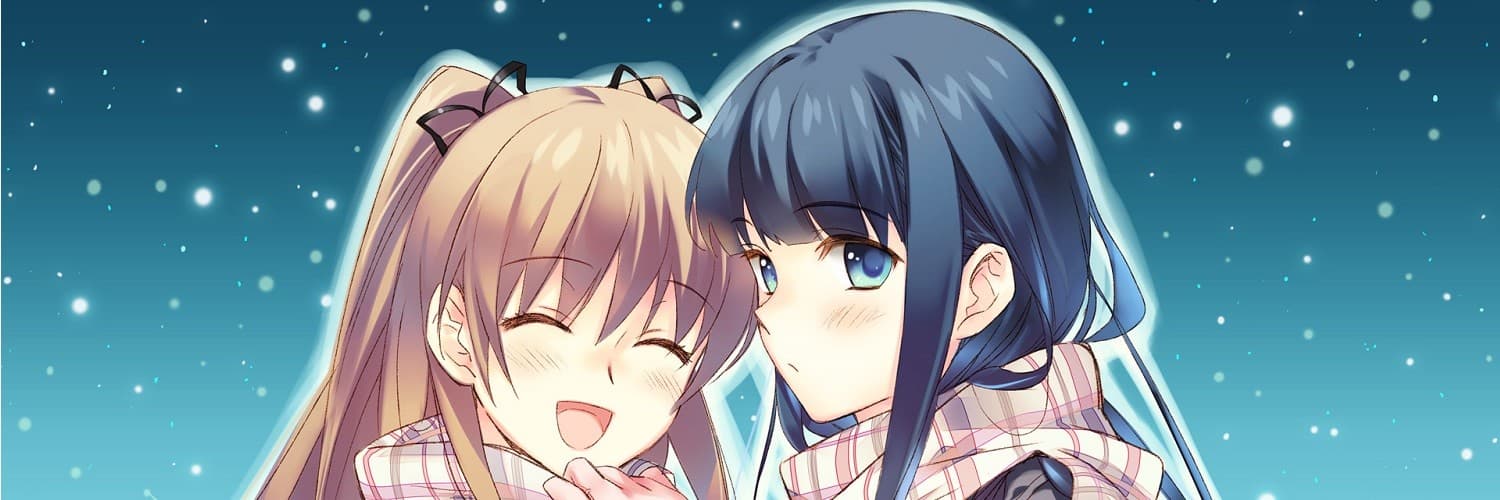
White Album 2
a review by AkaiShitoHat
a review by AkaiShitoHat
A White Album 2 Review: What's a tragedy?
Ah, this moment has finally arrived. Without hesitation, I saw White Album 2 for the first time in December 2022, and since then I have been particularly fascinated by it. I therefore decided that I would watch it again every winter, when the winter season arrives, in a dutiful tribute to it. And a promise that, in fact, I have kept, having seen it again both last and this winter - at the beginning of December -. But it was only with the last rewatch that my conception towards this work has definitively changed, towards something that is much more and goes beyond a simple appreciation: I felt a spark go off in me with WA (if necessary, from now on I will refer to it with this contraction); I can say with relative certainty that it has risen among my favorite works ever, because, like few others, it manages to move something deep within me; every time I see it. And it is always with the third viewing that I finally managed to enter the gears that represent its mechanisms, thus managing to come to a better understanding of the work, proving how although apparently simple, it is not at all. In this last month I have practically been obsessed with this work; let's add that other users, among those I follow, have also seen it as a series, in the end I finally decided to write this review. And then to us. The first necessary premise is that WA2 opens countless doors, therefore talking about everything would be impossible for me. So i’ll try to extrapolate its most significant parts or themes and we will focus only on those, aware that however there would also be just as much to say
A look at the work
Before starting with the actual analysis of this review, there are a series of preliminary discussions that must be made, and that need to be clearly focused, by virtue of their importance. First of all, WA2 is configured and takes on the characteristics of a real tragedy: an almost Greek tragedy I would dare say, at the end of which, consequently, we can only expect catharsis; de facto it is configured as such since happiness, in this series, essentially does not exist. Even more so in the first portion of the story (the one that the anime adapts, I remember that the source of origin is a VN) - that is, Introductory Chapter (IC) - in which the events end in the most disastrous way possible and imaginable, in which everything that could go wrong actually goes wrong and with the three main protagonists who will come out of it with broken bones and traumatized by what they have just experienced. It is a work that highlights and accentuates the great fragility of the human being, in which the characters will continually find themselves in a series of circumstances such that they cannot help but be mere shadows of themselves; a story full of mistakes, betrayals, feelings of guilt, insincerity and lack of honesty towards themselves (no one can say they are honest with themselves in the story) and so much, too much selfishness. All these words are well suited to describe the story that we will find ourselves facing and with which we will have to deal. But, also, we could also describe it as what happens when cruel fate (alas, truly cruel in this story and secretly the great protagonist of the same) brings extremely insecure, wounded, some even traumatized people together, in what is the most delicate period of their lives: adolescence, or the crossroads of people's lives; so much so that IC is still set in high school, precisely, specifically in the last year of school, on the threshold of graduation. Three more important speeches: according to one of the main minds behind this work – Fumiaki Maruto, who wrote the original scripts of the VN (perhaps best known for being the author of Saekano) – he wanted to impress in the viewer a sense of "impotence and of futility" such as to suffocate him, through a story, as he described, "apparently innocuous" but in reality much sharper and more cutting as he dug deeper and deeper. And, damn it, I would say that he succeeded very well, especially with regard to certain scenes. And precisely this description of the work - apparently harmless but in reality much deeper than you might think - brings me to the next point: the plot of WA2 is rather simple, banal but in reality the story is much more complex than you might think; many dialogues or certain passages are not immediately comprehensible and need to be understood by the viewer, otherwise there is the risk of losing essential elements; I also believe that the non dictum of this series is something extremely powerful, in support of what has just been said.
And finally, the music: to say that it plays an essential role in the story is right but perhaps reductive for the importance it actually has. The songs in the story – and there are many – perfectly accompany the latter and, indeed, perfectly reflect certain contexts or narrative situations as if they were truly mirrors. Understanding the meaning of the aforementioned and their lyrics is therefore fundamental for a better understanding of the story. The music itself, more generally, even becomes a tool through which the characters can communicate with each other (just think of how they themselves meet, almost attracted to each other as if they were magnets by the legendary “White Album” or even Beethoven’s Sonata No. 26, which perfectly reflects the teacher/student relationship between Haruki and Kazusa). Even more specifically, it plays a crucial role with regard to the character of Kazusa, who, being unable to express herself efficiently with words (not being a skilled communicator), uses music – and it, vice versa, thus behaves towards her – almost as if they were her verb. White Album - the debut song sang by Morikawa Yuki - and who took the main characters together in WA2
The first part of the story and its main characters
As mentioned, the story, from a narrative point of view, is quite simple: the music club is close to collapse and only the male protagonist - Kitahara Haruki - and his best friend ever - Takeya - remain members. The boy, however, has a dream and would really like to perform at the upcoming school festival (we are in Autumn, around October, the festival will be shortly in November). The boy plays the guitar - in a dignified manner - and in the classroom adjacent to the one in which he practices daily, a prodigy pianist plays the piano, about whose identity nothing was known at the beginning. We could say that this is the comfort of the young man, who despite his "bad" solos is often accompanied by the mysterious pianist, who adapts to his rhythms (like all great geniuses). Late one afternoon the boy hears a nightingale voice coming from the roof of the school: he rushes to it and finds himself in front of none other than the school “idol”, Ogiso Setsuna, whom he had already met previously for other business. This was the sign of destiny he needed (which will always return in some way, as mentioned): hence the boy’s “unhealthy” idea of reconstituting the band by enlisting Setsuna himself – and subsequently the piano prodigy, who will hide the figure of Kazusa Touma, the other main female heroine and the boy’s classmate –, in what will become a race against time to arrive prepared for the school festival. Very simple so far, right? Let’s now look a little closer at the characters, who from a psychological point of view conceal much more complexity than one might imagine.
__Kitahara Haruki
__
And here he is, our male MC, hated by many for the “deplorable” actions he will carry out in the second part of the story, but who I consider a good male protagonist. On the surface, Haruki appears to be a boy with his feet firmly on the ground, solid, authoritative and composed. His great professionalism – being very serious – and his perseverance will be what will make Kazusa fall in love; his great courtesy and kindness Setsuna. But, like much of this work, it is only a facade: Haruki is a fragile person, much more than he seems and not free from insecurities of any kind; certainly marked by a not exactly rosy family situation – he is totally independent from his parents with whom he has practically no relationship –. And it is precisely to these insecurities that he will fall prey in the second part of the story: after ep.7 forget about the thoughtful, authoritative and composed Haruki that we see in the first part; to use a rather fitting metaphor – and in keeping with winter – will melt like a snowflake in the sun, leaving room for a Haruki who will be a mere stand-in for what he was in the past. A Haruki who is highly unsure of himself and his own choices, distracted and no longer capable of acting lucidly. He then has three sets of problems that are certainly not indifferent: the first is that he always thinks of the good of others before his own, thus sacrificing – even involuntarily – his own happiness to please others (a rather recurring theme in the story and indeed the last question that is posed to the player at the end of the original VN, in its ending); the second is that he tends to follow the “flow” too much, failing to go against it (see for example continuing to help the members of the student council even though he is no longer a member of it, because he is unable to refuse the requests for help continually directed to him, or even his relationship with Setsuna itself later in the story etc.); and the third: guilt, which is most likely his weakest point. No matter what the circumstances are, no matter how serious the fact or situation is, or whether he is actually responsible, Haruki will always tend to take responsibility, blaming himself for everything that happens. And Setsuna, about this weak in particular, is fully aware.

Ogiso Setsuna
And this brings me to talk about the good Setsuna, who is probably the most complex character of all, and in some ways paradoxical. This is demonstrated by the fact that even though she lives in her own world, made of stuffed animals, she is a girl who is anything but ditzy but on the contrary very shrewd and perceptive. Much of what the other two main characters cannot "read", Setsuna manages, instead, to read everything between the lines. Indeed, returning to Haruki, she will demonstrate that she has understood him quite well, perhaps even better than he has understood himself. Setsuna is considered by everyone as the school idol, having acquired innumerable popularity during the years of high school (popularity that she does not look favorably on at all); but this, who appears to the public, is not the real Setsuna, because it is only a mask. The real Setsuna, the one she keeps segregated and hidden from others, is the free spirit with the sweet singing who enjoys getting herself smashed every day – or almost – in karaoke sessions and who, in her humility and modesty, enjoys doing a part-time job to scrape together a few extra pennies, like many young Japanese; the real herself that she shows exclusively to the circle of people she trusts, for example her family and what the good Haruki will become shortly after they meet. The girl, unlike the other two, does not have a troubled family situation, indeed from this point of view the affection of her loved ones has never been lacking; however, she is probably the most hurt of the three. The girl is traumatized by an event that happened to her some time ago, in middle school, when following certain vicissitudes she was isolated and alienated from her friends, experiencing abandonment syndrome and the consequent fear of loneliness. It is a trauma that has marked her deeply – we understand this several times in the story – and this terrible fear of being abandoned and “put aside” again in reality, as often happens, has never gone away, it has always been there with her. So here is the truth: Setsuna, despite the love of her family and her popularity, still feels deeply alone, she is the victim of the thousand insecurities that oppress her and, just like Haruki, it is all a facade, behind which the house of cards is just waiting to fall.
 Despite this, her being extroverted and extremely direct and frank (even with her own feelings towards Haruki, which she will understand very soon that she has developed) puts her in a position of advantage compared to the one who will become her rival in love, Touma. So much so that it will be her “crazy” idealism that will act as a catalyst for events in the second part of the story: after confessing to Haruki, Setsuna will be so selfish and idealistic that she will want to claim both things (keep the man she loves for herself and at the same time safeguard the stability of the trio), in an union that has been unable to coexist since the beginning (and hence its inevitable disintegration, which will happen at the end). On the other hand, Kierkegaard would have said “Aut-Aut” (either this or that). And, without beating around the bush, she is also the most manipulative of the three: from this point of view, if you like, she is rather Machiavellian, willing to do anything, even to sacrifice people dear to her, in order to pursue the object of her love and stay by his side, becoming his “panacea”.
Touma Kazusa
“She can’t just be my friend. Because she will be destined to become either my best friend or my sworn enemy" says Touma Kazusa referring to Setsuna.
Kazusa is the daughter of a world-famous pianist and since she was a child she has tried to follow in her footsteps, practicing the piano incessantly and proving to be quite talented with it (in reality Kazusa is a jack of all trades, she can play almost all instruments even though her main one is the piano). She is, in fact, the much-talked-about piano prodigy of Music Room 2 and the one who accompanied Haruki's solos on the guitar for almost the entire time. In reality, but this is well understood in the story, she and the boy have known each other since before the events of IC began, almost since the beginning of the school year when Haruki approached her for the first time in an attempt to get her to sign some paperwork (as will be seen in her long flashback at the end of the series). Having fallen in love with the boy at first sight, she will silently hide her deep feelings for him and, like the other two, she too will be a victim - for practically the entire story - of her own insecurities and fears. Kazusa is in fact a wounded girl: when her mother moved to Paris years before, she felt betrayed in her pride for her decision not to take her with her, since she was still considered unripe and immature, and, subsequently, abandoned by her in Japan as a consequence of her transfer.
 These facts led her to develop a deep hatred towards the latter, which she will keep for a long time, tearing apart and alternating the relationship between parent and daughter, as well as a deep loss of trust towards others, leading her to close in herself like a turtle does with its shell. As a result of this, the girl found herself in a deep condition of social isolation, which led her to loneliness, to reject any type of human relationship and, therefore, to the total lack of friends. Add to this the fact that she is a rather lazy girl who has no interest in studying (she always takes naps during class), which has led her to gain a bad reputation among her peers and teachers, who see her only as a troublemaker who must be treated with kindness, being the daughter of a famous and rich pianist, and her rather surly, rude and cutting character, and the picture becomes complete. A girl who apparently hates music (because of what happened with her mother) but in reality it is the only thing she really has – and loves with all her heart, despite thinking otherwise – and in which she is extremely capable (so much so that as mentioned it becomes her verb with which she communicates with others), absolutely incapable of taking care of herself, with zero self-esteem and with enormous “communication” problems, meaning that she is unable to convey her feelings and emotions into external reality (as she herself will say in ep.12).

 A sleepy Kazusa
From these introductions I would say that all three lend themselves rather well as characters for the creation of a nice love triangle. And, to close this section, I would like to clarify and explain even better how Kazusa and Setsuna are literally poles apart, almost as if they were two sides, however, of the same coin: Setsuna –> extroverted, popular, direct and surrounded by affection of family members/Kazusa –> introverted, marginalized, has a controversial relationship with her mother (which however will resolve positively towards the end of the events), and incapable of expressing her feelings clearly and punctual. There are certainly some common denominators: both feel alone, are deeply insecure and hurt, and ultimately hate themselves. But there are many more differences than similarities. And do you know when their contrast reaches its maximum expression? At the time of the festival performance: notice how their costumes are completely opposites in terms of the colors used. Setsuna wears a candid, immaculate, white dress, becoming a “White Angel”; Kazusa, instead, wears a dark dress, based on black/dark blue. And as we will see during the performance, also on a choreographic level, the two will almost be in a full-blown battle, in which they will not even implicitly challenge each other on stage. In short - and the choice of colors is obviously not random - almost as if they were the White Queen and the Black Queen: two queens at war ready to move their main pawn - Haruki - before the other’s one, thus emphasizing the love contest between the two for the boy and who will be the protagonist in the second part of the story.

Episode 7 (and 8)
If you want to make a satisfying analysis of WA2 IC you can't help but talk about this episode (with regards to the anime): in episode 7 we finally see the trio perform on the school stage in view of the long-awaited school festival. Let's start by saying that on a narrative level, from my point of view, you are not disappointed at all: getting the band back together, practicing until exhaustion and then finally being able to perform were the main narrative objective of the first part; and when this event finally happens, you cannot be disappointed, whether for the atmosphere or for the sublime music that permeates it (i.e. the songs they perform). But above all, episode 7 is an absolutely crucial episode (beyond some of its dialogue scenes, in which the love dispute between Kazusa and Setsuna is made definitively explicit, with the latter in particular revealing her feelings explicitly to her friend – in reality they are flashbacks of ep. 3 when the two meet in the cafeteria –) for the position it takes: I would define it as a watershed, which acts as an interlude between the first and second part of the story (and is it a coincidence that the total episodes are odd? –> ergo the seventh is placed exactly in the center of the same | First six episodes | Ep. 7 | Last six episodes). This proves how this is a fundamental episode, after which nothing will be the same again: yes, because that very evening, shortly after the performance at the festival, Setsuna will make her move and declare her love to the boy. If previously one could say that there were dynamics/or a balanced relationship between the three boys in their relationships (a real status quo), now this delicate balance that previously existed inevitably disappears. In this regard, a rather interesting reflection could be made regarding who first broke “these rules”, that is, breaking the aforementioned balance: Setsuna? since she confesses at the end of the festival; or Kazusa?, because as we will see in her long flashback at the end of the series, the girl in a fit of amorous fury had given in to her feelings by kissing Haruki (shortly before Setsuna's subsequent confession; so it could be that the latter was pushed to act also following this fact, which we know she saw, because Setsuna was present at the time of the kiss – again as we will see in the finale -). But I'm just throwing it out there: what if it had been Haruki? What would you say? This is a preview which I will however talk about later in a specifically dedicated section.

 Already from ep.7 – if you pay attention – you can glimpse something...
 Then in ep.12 (dialogue between Setsuna and Io)
But the objective fact par excellence is what was mentioned above with regard to Setsuna's confession (because, after all, it will be she who will determine a permanent alteration of the group dynamics): their engagement is in all respects the so-called point of no return, that moment from which things begin to take a very bad turn and the trio begins, inevitably, to fall apart.
 Alea Iacta Est, good Caesar would have said
But not right away. We have a last calm before the storm and it is represented by episode 8, another equally important episode. It is technically the first episode that opens the second part of the story, post festival, but it still has some happy traits: the main event, which unfolds in its second part, consists of the trio that to celebrate Christmas goes to an onsen located in the mountains, where they will spend moments of happiness and lightheartedness as well as of union and sharing. But they will also be the last ones who will ever feel (from now on to the years to come, following the conclusion of IC): by now something has cracked and the sudden destruction of their bonds and their group is about to happen. The stage is now set: its main actors are about to climb onto it; the tragedy is moving towards its final climax.

There is also another reason why ep.8 is so important, the same reason why I decided to deal with them together: these two episodes share a big common denominator, that is, they represent the two greatest moments of happiness par excellence in the lives of the three. They are the pinnacle of their joy (the festival in particular is almost the realization of each: Haruki realizes his dream - which we will see later -; Kazusa returns to play on a stage after years, savoring the fun of playing and rediscovering, therefore, her love for music; and Setsuna as a vocalist sings, in front of an entire audience). And as the maximum representation of happiness and joy, when everything inevitably goes to pieces, they will be precisely those events to which the three will most nostalgically cling (in the most negative sense of the term); a happy point in their lives to which they want to return, almost as if, by miracle, time could rewind. In particular, I find the scene in the tub at the end of ep.8 to be the greatest representation of the ephemeral, of what is fleeting and destined to vanish as time goes by. Please note: that the winter season plays a fundamental role in this work is clear – because essentially it is in Winter that the events of IC will end in tragedy, with the total disintegration of the group, and therefore the season that holds the most painful memories for them –; in compliance with this, the passage/or transition from one season to another (and between seasons in general) is a rather recurring theme in the series – also traceable in countless songs –: from Summer, at the end of which Kazusa taught Haruki to play the guitar, yes indeed – therefore corresponding to his happiest memories ever –; to the lively Autumn, in which the events of the story begin and then converge at the school festival; to the ominous Winter, theater of tragedies and season of separation, in which everything is destined to fall apart. Do you want a final proof? Do you know how ep.8 is titled? “And Winter finally begins”. Curiously, Spring is almost never mentioned, perhaps the season associated par excellence with happiness but above all with rebirth, if not… in the name of Haruki! (his name is written with 春, the kanji for spring… the authors are very nice, don’t you think?). And, lastly, I wanted to take this space to do another analysis: do you remember when I was talking to you about the sad and cruel fate? Mh. In the series there is actually a song dedicated to him: Sound of Destiny, a single actually coming from the first WA and sung by the famous idol Ogata Rina (one of the old protagonists of the first series; C.V. Mizuki Nana); during the performance at the festival he is performed second. Leaving aside the fact that it is precisely during this song that Kazusa and Setsuna finally declare battle (and the missing dialogues from ep.3 are revealed to us), in my view of things this song acts as a real preview for what will happen in the second part of the story: having understood that fate brought them together, and as such plays a very important role, in episode 7, which we said was the crossroads of the entire IC as well as an interlude between the two parts, this solemn song plays – in which he himself is the implicit protagonist - almost acting as a sad announcer about the nefarious turn that events would take shortly thereafter. > “And once again our destiny was in motion” > “Lala a single star falls, and the wheel of destiny begins to turn” (first verse of the last chorus of the song).
To fully understand the song and its lyrics, you should immerse yourself in the POV of its original singer, Ogata Rina – she too had her fair share of troubles –, which however we won't have time to do; therefore, a quick mention will be enough. In this song, the feelings that the girl felt when she fell in love for the first time are condensed: “I'm being captivated by a shapless thing called 'love' ” she says in the first verse; the Japanese verb used, however, can also have a stronger meaning, that of “being literally prisoners” of something, almost as if one were in jail. In essence, Rina felt like a prisoner of love, to the point of almost not being able to breathe, and she was overwhelmed by these feelings, almost as if they were a river in full flood ready to overflow. And she was clearly scared of these feelings: what happens when you are madly in love with someone? You no longer act or think rationally, because love by definition, especially when it is very intense, is something absolutely irrational, that goes beyond. She is therefore no longer able to control herself, she has lost her powers of self-control by virtue of the loss of her own reason; that is why she feels scared. She has gone mad because of love itself. What does all this have to do with it, you ask? Remember when we previously described the moment of the kiss after the festival between Kazusa and Haruki, stating that the girl in the grip of her amorous fury succumbs to her own feelings? Well, isn't it perhaps a situation rather similar to the one experienced by Rina? Kazusa knows perfectly well that if she kissed Haruki she would break that delicate balance mentioned above; yet her feelings are so powerful and overflowing that, in the end, she is overwhelmed by them anyway – exactly like Rina –. And, so, in the grip of an impulse, she does something that – rationally – she would not have wanted to do. But this fury – blind love towards Haruki – pushes her to act irrationally. This is the version sang by Ogata Rina in WA1's adaptation.
Todokanai Koi

Having reached this point the waters are now ripe to be able to talk about this song and its related theme. If you were wondering how to describe the whole of IC in two words, here they are: Todokanai Koi (“Unreachable Love” – the literal translation –/ but it can also be translated as “A love that cannot reach/or be reached”). This song and its homonymous theme are essential to understanding the true essence of the first part of the story, and will be equally cyclical, that is, it will return countless times in the continuation of the same. Given that all three will experience the “Todokanai Koi” in the finale (Setsuna does not reach Haruki because he loves Kazusa, but the love between the others two is also a Todokanai, since they are destined to separate anyway – and presumably to say goodbye; he does not have the slightest idea when and especially if Kazusa will return to her homeland one day); where does this song come from? (and understanding its creative process is fundamental). Let's start with a certainty: those who have seen it will know that this is the third song that the trio performs on stage at the school festival - even if it won't be shown to us right away - as well as that it is an absolutely original song, right in the same narrative universe as WA2, whose paternity is to be attributed to the trio of protagonists, who will each have a very specific role in its formation. That said: can we say that Todokanai Koi is a song created specifically for the school festival? No, this is technically a mistake and now we’ll see why.
The truth behind TK: the one who wrote the lyrics of the song is Haruki. And be careful, this is a crucial detail, the lyrics of the song written by him are PRIOR to the festival performance. Why? And here we finally come to his dream: we discover that the boy would like to perform on stage a song entirely written by him. So Haruki, precisely in compliance with this dream of his - of a tomorrow, and which he will then realize with the festival - had already written the lyrics of the song in times prior to the beginning of the events of IC, simply on his own giving vent to his creativity and his feelings. Where? On his notebook – an object that we will see often in IC, in fact it is one of the most important and representative – and on which NOT by chance the direction settles exactly at the end – it is the last frame that is seen in sequence – of the opening of the anime, in particular (but even before that it is the opening of the same IC VN version), which you look at, is always and precisely Todokanai Koi, yes indeed.

And, the icing on the cake, since at the time, albeit unknowingly, he was already infatuated with Kazusa, it is, obviously, a song that he wrote thinking of her and in which he channeled his feelings towards her (and this is clear for many reasons, first of all the lyrics of the song –> “Are you pretending to be lonely? Why?” – this is literally the first verse of the song; and who in the series did we say was in a state of deep loneliness, marginalized by everything and everyone?). The title, therefore, since Haruki wrote it himself should already make you understand what he thought of his love for Kazusa… but we'll come back to that later, don't worry. Now, what tour has this notebook taken? Because it has been touched by many hands – and here we come to the actual formative process of the song –. At the end of ep.4 we find the answer to this question: Takeya, Haruki's friend, presumably of his own free will, takes this notebook and physically delivers it to Kazusa. The reason is obvious and he says it himself: to fulfill Haruki's dream. Takeya obviously knows about his secret dream - mentioned above - and as a great friend he is, he helps him make it come true: and he specifically delivers the notebook to Kazusa because he believes she is the only one capable of making it come true once and for all (and it will be no coincidence that then Haruki in ep.8 - the one at the hot springs - will say to Kazusa "It's thanks to you that I became a man").
N.B. Before continuing with the thread of the speech, what has just been said could open a real Pandora's box: in the anime - at least - nothing is said (and in Takeya himself, for purely timing reasons, he does not particularly stand out as a character, remaining relegated to a mere secondary character but in the VN his role is much more important and accentuated and what will follow is proof of this) but since he physically had his friend's notebook, it is reasonable to assume that he at least opened it a few times and therefore leafed through it. It is also, therefore, reasonable to think that he read TK's texts... Therefore it should not sound so strange that he could have understood the feelings that his best friend hid for Kazusa, also because he is not an idiot either. And, in fact, he knows. The conclusions are yours to draw.

At this point the game is done: Kazusa, who is a genius in music, as soon as she has the boy's notebook in hand begins to compose the melody of the song. And once she has finished writing it, who is assigned the task of singing it? But obviously Setsuna, since she is the vocalist of the group. Does that make sense to you? Here is a first answer to the initial question: to say that TK was made specifically for the festival is inaccurate. If we want the melody and therefore the song were made specifically by Kazusa; but the lyrics - written by Haruki - date back to a time before and the song itself, another very important point, is simply inserted - at the last moment - as a song to be performed at the festival. That is: the impending school festival comes at the right time to make Haruki's dream come true; that's why Takeya gives the notebook to Kazusa in the first place, also because he knows that the festival is the perfect occasion. So rather than saying that the song was created on purpose, it would be more correct to say that it is the festival that at first glance seems like the perfect opportunity and stage on which to make the boy's dream come true. Having said this, we come to another fundamental point: TK, as a song to be played at the festival, was not even minimally foreseen in the original plans. What does this mean? It means that in their original programs only White Album and Sound of Destiny were supposed to be performed - songs, these, both chosen by Setsuna, because she is the one who chooses both and decides the order - but only at the last moment, Kazusa was presented with this opportunity and decided - in agreement with Haruki but NOT with Setsuna - to include it as the last closing song to be performed at the festival. Therefore, Setsuna's reaction of great amazement and surprise towards the end of ep.6 is absolutely justified, when she finds herself with the lyrics of the song in her hands - given to her by the other two - precisely because it is an improvised song and inserted as such at the last moment, not appearing at all in the original plans.

But after the initial reaction of surprise from the latter, something else follows (always at the end of ep.6). This something else can be summed up with the following question: Is Setsuna happy and excited to be able to sing this new original song? Not at all. Why? Because a quick read of the lyrics and especially the title is enough for her to connect all the dots and understand everything –> she knows that Haruki wrote the lyrics, the title is Todokanai Koi and the vocabulary is quite specific, so she does 2+2 and understands that it is a song written and dedicated to Kazusa, which contains in her the feelings that the boy feels – or certainly felt at a specific moment in the relatively recent past – towards the latter.
And here is the explanation of the following cut – huge in importance.

She would like to refuse to sing it, she would like to say something else but, simply, she can't. Because the circumstances don't allow her to do so: it was written by her two best friends, it's Haruki's dream, it's something the other two have invested time and effort into and it's about their own performance (only 24 hours away, basically a day before) at the school festival, the one they've practiced so much for, in a week full of sweat. How could she refuse?

She can't. And so - even though it is made clear and obvious by this sublime close-up - she decides to keep it all inside, wearing a beautiful mask with which she gives her assent and pretends that everything is fine. When in reality inside she is dying suffocated by the frustration of having to sing a song that almost sounds like a declaration of love towards her direct rival. [N.B. these, which I will talk about, are dialogues that were cut from the anime but present in the original VN: always in this same context, that is 24 hours before the festival when they are rehearsing the song, Setsuna to tell the truth does not keep it all inside. She will in fact confess to Kazusa, of how she cannot perfectly master the song, in a presumed "incompatibility" between her and the same, almost as if there were some "disturbing element" that prevents her from fully mastering it. Who knows what it could be at this point.]
Another piece can always be added to the puzzle: remember when I asked the question of who had first “broken” the rules of the game? Given everything we have just said, it could be understood why the first one was Haruki. Of course, unknowingly, but wasn’t it his Todokanai Koi that messed up the plans – even in Setsuna’s head –? At this crack will be given the final blow with Setsuna’s decision to confess at the end of the festival, for the reasons already seen above.
Another reason why it is a fundamental theme – and with it the song of the same name – is that it is de facto, literally, the entire fulcrum for understanding IC. Here the supreme question, already previously asked, triumphantly returns: why does Haruki, even though he loves Kazusa, accept Setsuna's feelings? Just connect the dots: the answer, quite banal and simple but definitely impactful and effective, is that the boy believed for x reasons, including his low self-esteem, that Kazusa could never fall in love with a person like him. So, put another way: he presumed that the feelings he had for her were a Todokanai Koi, an unreachable love. He simply thought that Kazusa could never reciprocate his feelings.
 This is the great mistake – and if you like, the great sin – committed by Haruki during the entire IC and, as mentioned, its essential core: having reached the hasty and erroneous conclusion according to which his feelings towards Kazusa were a todokanai koi, without thinking excessively about all the circumstances of the case. Therefore, if you like, a mistake of haste in judgment in the strict sense. A mistake that is highlighted by Kazusa herself during their face-to-face confrontation in ep.10:
 Ah..., an excellent example of the incommunicability between human beings.
But this haste can also be deduced in another way: precisely from the song Todokanai Koi. At the end of the chorus, in the last verse the “singer” (to be imagined as an entity in a generic sense) proclaims: “My heart cannot come alive” (ima mo kono koi wa ugokidasenai). And if you notice, throughout its duration the feelings that the singer harbours towards the person he/she is in love with are never clearly and explicitly expressed. In essence, at the end of the chorus, he limits himself to stating in a rather mechanical and authoritarian way how his feelings can never be reciprocated (and as such are not capable of coming into existence). Isn’t this perhaps the same presumptuous mechanism that the protagonist puts into action?
And to conclude this fundamental section, Todokanai Koi is a “very powerful” song: because, as already anticipated, it is a “formula” that will be applied to all three main protagonists of the story, because all three of them at the end of the events of IC will experience a form of Todokanai Koi. This is where the extraordinary nature of this song lies: it is versatile because it can be said to be true for all three; because as such it allows you to identify, at the end of the story, with each of them; it allows you to continuously vary the POVs, interchanging between the characters; it allows you to be able to say that it was born as a song intended for Kazusa but then becomes true for Setsuna too, with her ending up becoming the additional receiver of the same, and so, in this way, it allows you to encapsulate in just two words the most innate meaning of IC.
Ah..., an excellent example of the incommunicability between human beings.
But this haste can also be deduced in another way: precisely from the song Todokanai Koi. At the end of the chorus, in the last verse the “singer” (to be imagined as an entity in a generic sense) proclaims: “My heart cannot come alive” (ima mo kono koi wa ugokidasenai). And if you notice, throughout its duration the feelings that the singer harbours towards the person he/she is in love with are never clearly and explicitly expressed. In essence, at the end of the chorus, he limits himself to stating in a rather mechanical and authoritarian way how his feelings can never be reciprocated (and as such are not capable of coming into existence). Isn’t this perhaps the same presumptuous mechanism that the protagonist puts into action?
And to conclude this fundamental section, Todokanai Koi is a “very powerful” song: because, as already anticipated, it is a “formula” that will be applied to all three main protagonists of the story, because all three of them at the end of the events of IC will experience a form of Todokanai Koi. This is where the extraordinary nature of this song lies: it is versatile because it can be said to be true for all three; because as such it allows you to identify, at the end of the story, with each of them; it allows you to continuously vary the POVs, interchanging between the characters; it allows you to be able to say that it was born as a song intended for Kazusa but then becomes true for Setsuna too, with her ending up becoming the additional receiver of the same, and so, in this way, it allows you to encapsulate in just two words the most innate meaning of IC.
This is proof of how music plays a major role in the story; many others would be worth analyzing but I will limit myself to just mentioning them: Powder Snow; After All – Tsuzuru Omoi and Twinkle Snow. Each perfectly reflects the narrative context in which they are played and they are all very beautiful and poignant songs, which I recommend listening to at least once.
The Narita Airport sequence and the finale
Numerous things mentioned above, whether thematics or feelings, find their maximum resplendence in the famous sequence of Narita airport: it is at the same time the maximum manifestation of the todokanai koi of the three protagonists, metaphorically speaking their tomb, the place near which the tragedy takes place and which will remain imprinted on them for years to come. The most tragic connotations but above all that profound sense of oppression, impotence and smallness explode on the screen: all these elements mixed together determine the creation of what I would almost define as a lethal mix. This is why this sequence is also a very powerful sequence, with a shocking force capable of creating a hole in your stomach equal to that of a chasm. Do we want to just delve into it a little more? Let's start, first of all, by observing this: Haruki does not have the slightest desire to go to the airport, for more than obvious reasons. It is Setsuna, in fact, who insists on going there at all costs to say a last goodbye to Kazusa. In practice, Haruki is dragged along against his will (ah, if he still has one: he is literally a derelictum, a destroyed and vagabond man), also because the girl imposes a rather particular condition on him: either she follows him or nada. She won't listen when he has something to say to her. And that he has no will, I emphasize, is also seen later, just when the two enter the airport: once again Haruki rejects Setsuna, almost as if he were refusing to follow her further. But by then it's too late.
 We have repeated countless times that Setsuna is anything but a silly girl: so, do you really think that she hasn't understood the reasons why Haruki absolutely doesn't want to go to the airport? They are quite understandable and obvious (also because from the moment she sets foot in his apartment, once again, a simple look around is enough for her to understand everything that happened -> basically she has already understood that he cheated on her). Therefore, if she was perfectly able to imagine the reasons why Haruki didn't want a single one (and as said it doesn't take much to understand them), the question automatically becomes: but why then does Setsuna insist on wanting to take him to the airport, almost as if she wanted him and Kazusa to meet, also, for one last time...? Well, because de facto that's exactly what she wants: Setsuna wants the two to meet; more precisely, she wants to witness the kiss that she knows the two will exchange, when they meet. Which obviously will happen: it is in the sign of fate that this happens. From the moment they set foot in that damned airport they are already doomed. And Haruki knows that Kazusa, for sure, despite the chaos and chaos that normally characterize such a place, will certainly find them.
 And here comes the last sequence that we can imagine... For those who were to question Haruki's choice to rush to Kazusa and kiss her right in front of "poor" Setsuna, these are, alas, senseless criticisms: first of all because she was the one who once again acted as a catalyst for their meeting (indeed, she wanted to witness it); secondly, this was the real last time before the definitive farewell between the two boys. What could you have expected from Haruki? Would you have expected, honestly, that the boy would pretend nothing had happened and stay where he was? (which was useless anyway, because he had nothing left to hide from her, she knew everything). But also for another reason it was unreasonable to expect that the protagonist would not have acted as he did: and here, my dears, we return to the basic concepts of Hon'ne (本音) and Tatemae (建前); what you really want to be and what you should be in the eyes of others, just as others – and society – want/impose you to be. For both Haruki and Kazusa, for her, definitively, the Tatemae or “the facade” falls: Haruki knows that something horrible is about to happen but he can no longer lie to himself – about his feelings – any more than he has already done throughout the series. His facade collapses, shatters into a thousand pieces. The same goes for Kazusa: this is how the apologies she offers to her friend should also be read just before exchanging that last passionate kiss with Haruki. She would like to keep her “Tatemae”, that is, keep the mask of the dutiful best friend, what until the end of this scene she should have “been” in Setsuna’s eyes, but she too can no longer lie to her feelings. She can't help but kiss him one last sappy time, even if it means doing it in front of Setsuna, because her feelings for Haruki are so overwhelming that she can't help herself. Here too, the facade/mask breaks.
 And so the tragedy unfolds:

Believe me when I tell you that this has become almost a “cult” scene, the subject of endless memes. Now you know where the original comes from (and its context). However, there is still one issue to be resolved (and I imagine it is something that is buzzing around in people’s heads): why on earth would Setsuna have “planned” their meeting and final kiss? Why on earth would she have witnessed it, since it is practically a suicidal, self-harming act? For a series of reasons, which I have reason to believe: victimism - that is, feeling the most victim of all and being able to feel like that until the final end of events -, and self-satisfaction/self-gratification.

She wants, as mentioned, to witness that kiss, which she knows would have traumatized her, for the reasons just stated. Really (you might ask)? Did she do it for pure revenge? To get revenge for the betrayal she just suffered from Haruki? Or did she do it simply to pass the buck, to act like good Pontius Pilate and wash her hands of the guilt and responsibilities she knows she has? But what a disappointment (you could always say)! And instead no; she didn't do it for either of these two banal and stupid reasons. If you think otherwise, I'm sorry to tell you, but you haven't understood Setsuna's character (but I don't blame you, he is objectively an extremely sophisticated character). Everything he has done - including what we see in this scene - he does for a single purpose: to pursue the object of his love, namely Haruki. Setsuna, more than anyone else, wants to be at the side of the only man she will ever love; she wants to be able to share her happiness with him; she wants to be able to become his “panacea”, capable of “curing” his soul from any illness. That is, she wants to be his “North Star”, to become an “irreplaceable” person for him, and therefore “the source of his main needs”, and therefore make him need her, and therefore make him codependent on her. She wants to be the only person able to comfort him with the warmth of her body, from whom Haruki will no longer be able to separate himself in any way or reject her in any way, precisely because he will feel needed and strictly dependent on her. This is her ultimate goal, for which she is willing to do anything to pursue it (be it playing dirty or exploiting Haruki’s weaknesses to her advantage). And this is exactly the direction in which the story section following IC will go. At the beginning of the latter, Haruki has in fact fallen into the trap that she has set for him; a trap for which, however, she had already laid the basis three years earlier, more precisely from this very scene at the airport.
In essence, she wants Haruki to perceive her as the only one who can be by his side, as the only one capable of healing his grieving soul and, therefore, giving him all her comfort.

N.B. The ending of IC is already – unknowingly – spoiled for us… in ep.2! During the scenes in which we see Setsuna singing happily at karaoke, on the television in the background you can notice this image:
 Um, does this remind you of anything? An airplane… Two people who seem to want to reach it…
To be honest, the song Setsuna covers (悪女 “Akujo”, sung by Nakajima Miyuki; song released in October 1981) is quite revealing and anticipates the ending… Read the lyrics to believe it.
In the presence of inevitability, nothing is possible
And so what is left for the viewer after having witnessed the climax of ep.13 and therefore after having seen the ending of the anime (IC)? Catharsis. Which will reach its maximum manifestation, obviously, with the song [Todokanai Koi], which here for the first time is made to be heard and played, also extending it as the ending to close the entire part of the story. Only now, after the viewer has seen and contemplated the “Todokanai Koi”s seen on the screen, is he ready to listen to its namesake song, in the greatest possible catharsis.
What is also left (for us)? That deep sense of impotence and futility that we mentioned at the beginning; precisely those feelings that Maruto Fumiaki intended to impress on the viewer. And that here and now, in these solemn final scenes, proclaim themselves rulers of the same and whose majestic sound echoes in the surroundings of the vast surrounding world, losing itself in the eternal cold that only Winter is capable of offering you.

 One of the most beautiful, poetic and majestic scenes of all IC. When I watch these scenes I always feel my infinite smallness.
And why all this sense of impotence and futility, ultimately? Because the sequence of events that we see in IC evidently, always by a cruel whim of fate, had to go that way. Because, evidently, it was the only direction in which the latter could go. In short, it was an inevitable succession of events. And it will not be a coincidence, I underline, how in the VN IC – rising to an atypical VN – does not offer ANY possibility of choice to the player. That is: during the course of the events of IC in the VN there will be no choice that the player can/must make; better yet, he is not allowed any, because the course of events is predetermined and therefore as such immutable; by virtue of this, he will not be able to interfere in any way, thus being relegated to a mere reader of what happens on the screen and a mere third-party observer of the unfolding of events. This is why once the anime is over, the viewer will almost feel like he is faced with a real headache: not even by trying hard and racking his brains will he be able to say when exactly things started to go wrong, nor how he could have tried to fix things. Because the story, being structured as seen above - an inevitable course of events that had to unfold in an almost obligatory manner -, as such does not admit or offer any solutions whatsoever. It is a dilemma to which there are no - apparent - solutions; which it knows none. And as proof of all this, the fact that the VN does not allow you to make any choice, with which, instead, you could be able to change the order of things. Which is, on the contrary, immutable and is obligatory. This, in my opinion, is the ultimate tragedy called Introductory Chapter.
And if all this were not enough to consider it a masterpiece for ¾ (because, alas, the anime is incomplete), here is its last characteristic: like all tragedies, it is a brutally human story, in which you are able to identify (even if only a little) and that once concluded will hurt you (or badly, depending on the sensitivity of the soul; very badly for me). And this extreme humanity is expressed first and foremost by the characters: boys who, like many others, are not exempt from their own weaknesses and insecurities; wounded and emotionally unstable - in the most unstable period of your life - adolescence -; and fragile. Fragility that is almost always reproduced on screen, and that will lead them, in conjunction with their fears and weaknesses, to a whole series of errors. Can Haruki be reproached – first of all – for having committed a mistake of haste that led him to a hasty and superficial judgment regarding the belief that his feelings towards Kazusa could be considered as a Todokanai Koi? Certainly; indeed it was a huge mistake, his greatest mistake at the heart of all the events of IC. But do we want to crucify him for this? Remember: errare humanum est. And the human being, undoubtedly, in the course of his life makes mistakes (he made mistakes in the past and will continue to make mistakes in the future, because it is part of his nature); the important thing is to be able to understand your own mistake so that you don't make it again in the future (and Haruki in the VN will continue to make mistakes even multiple times; but in the end he will have - also depending on the various narrative routes that will be taken - the possibility and the determination to remedy his past mistakes and fix things. Only that someone who has only seen the anime, I realize, might have a hard time understanding this. On the other hand, these are all things - the protagonist's growth path - that will also and above all happen in the continuation of the story [always remember in this regard that what we have talked about up to now is the Introductory Chapter, that is, the mere introduction of the story]).
Similarly, do we want to blame Kazusa if for the whole time she was unable to find the courage and confidence, the determination to be able to confess her - deep - feelings to the man she loved? But obviously not. Indeed, it is perfectly normal – even more so in the field of love where your own happiness is at stake – to be fearful to the point of not being able to take the initiative.

 (For enlarge open the images)

The same goes for Setsuna: do we want to blame her for being selfish to the point of wanting to keep the person she loved only for herself? Or for having acted first, beating her rival in love to the punch – even though she was prey to all the insecurities we have already spoken about –? Obviously not. Can we, truly and sincerely, reproach her for the excessive selfishness shown in these moments? Perhaps a little; but condemning it entirely would be quite hypocritical in my opinion, since, as mentioned above, in love it is mainly our happiness that is at stake – and not that of others –; in the end, those who will feel bad – if you lose the person you are seriously in love with – will not be others. But us. Or again, can we blame her for having interfered from the beginning between Kazusa and Haruki, despite knowing of the mutual feelings between the two? Yes but no, in the sense that the same argument made a line above applies.


Well, if anything, we could reproach Setsuna for having taken advantage of Haruki's weaknesses, because at the end of the festival, when she confessed, she knew very well that the boy was not at all in a position to not be able to reject her that evening.

Or again, of having been too idealistic in wanting to pursue the stability of the trio while at the same time wanting to keep the man she loved for herself. Aut-aut as seen earlier. And that's fine. But this doesn't make her more guilty than the other two, because they too are not free from guilt - or sin -. In particular, Haruki, who however justified it was, still committed a blatant betrayal to Setsuna. And that's exactly what I wanted to return to, at the end of this last section of the review. If what was listed above can - perhaps - find many in agreement, what follows could be a source of discord and differences of opinion (that's why I purposely kept it for last). Why did I define the betrayal, however much it remains such - and there's no arguing about that -, as "justified"? The point is, and I'll get straight to it: what would you do if you realized that towards the woman you're engaged to you don't feel the same feelings that you feel, instead, for another girl? How would you behave if you were aware that you do not love her to that extent and with that verve, which instead exists towards another person for whom you have infinitely stronger feelings? Would you follow your heart, willing to leave everything behind but knowing that, in doing so, you will listen to yourself - and that no matter what happens you will have no regrets - and you will follow what is your happiness? Or would you prefer not to take this risk, preferring therefore to remain in the comfort zone that [you] have built over the past time, thus putting your "heart at peace" by accepting "a love of compromises" with yourself and for the good of others around you? This, just posed, is the final question that the player - and therefore Haruki - will find themselves facing in the ending of the original game; we could define it as the mother of all questions. This is why I feel like justifying it despite the act of infidelity: would we all be capable of living with a mask forever, continually lying to ourselves and acting blind to our true feelings, almost pretending they don't exist? And, mind you, there is no univocal answer to the question just posed; on the other hand, the various endings that the last part of the story has - always depending on the choices made by the player - could not be explained otherwise. There could be, at most, an ethically more correct answer than the other, but it will never be the one and only possible answer. Here it is up to you, readers, to make the decision that you think is most correct. And without any fear of being wrong: both are equally justified and understandable choices, which do not need or require any further justification whatsoever.
Graphics
Just a few words about the graphics: the animation studio is Satelight (they animated the various Macross; in general I really like their drawings/chara design, maybe a little particular but I like them). Overall, with some peaks in some sequences or cuts; however the level is good and always remains constant. I would give 8/10


Conclusions
As I like to define it, IC is nothing more than the "business card" of WA2, a single part of it (and it alone is worth the price of admission, in my humble opinion; on the other hand we have sung its praises up to now). And it is simply extraordinary, always in my opinion, to think that it is nothing more than the mere introduction (and, fully, only his first part) of the story. But I assure you that the rest of the original VN is no less. Even its subsequent sections maintain the same spirit of the introductory part and as such are no less. A whole and long story still awaits you, there somewhere, ready to be played. Up to its final resolution, its last segment – the true finale – in which, probably, the peak of poetics is reached.
22.5 out of 23 users liked this review
