The Horizon
a review by NapoJ
a review by NapoJ
The following analysis is the translation to English of my interpretation of the work from the Christian approach used by the author, demonstrated through the inclusion of religious symbols throughout the work, it does not reflect my beliefs nor (in the absence of interviews, introspective or similar) is it the “correct or objective” interpretation.
The original text is in spanish, posted in my blog a few years ago, the title was "The Horizon: In God's Palms".
Spoiler alert! I make a full anaylisis about the story, refrain to read if you hadn't read it!
Ji-Hoon Jeong is the author of 3 manwhas: The Horizon (2016), Mosquito War (2017) and The Boxer (2019), being his first work the most famous and shortest; The Horizon only has 21 chapters divided into 5 parts: The Boy and the Girl, the strange man, the man in a suit, the Girl and the epilogue. It takes place in a post-apocalyptic world following an unknown pandemic disease and a bloody war without defined sides, i.e. chaos. The protagonist is “The Boy”, he has no name or age, he is just a Boy who survives because it is what he should do, at the beginning of his journey he meets the Girl, a girl of similar age, also nameless, both holding hands walk forward because it is what they should do.
Comments about The Horizon tend to focus on 2 points, being only message and how painful the story can be in several of its segments, both observations equally accurate. The story finds its justification is through the epilogue, where Jeong uses the elements raised to give a solidity to the message that he wants to provide so much. Not at all, there is no universal rule that indicates the contrary, to talk about lack of depth in the characters ignoring the objective of the story is counterproductive, of course, as long as the characters do correspond to that planning.
The story of "The Boy" is similar to the book of Job, the righteous man of the Old Testament, whose faith is tested by suffering consecutive misfortunes. It has been discovered that the book of Job has roots from ancient Sumer (I will praise the Lord of Wisdom) which shows how ancient that question is for mankind “Why do misfortunes befall the righteous?”. Neither the Sumerian account or Job provide an answer, the well-known ending of the Old Testament book is God's words “Whatsoever is under heaven is mine”, which is a hint of his greatness, of how his plans cannot be understood by man.

The Boy is simply an infant caught in the middle of misfortune, he has no sins, that is to say and highlighting the obvious, he is just a child, that is our Job, a righteous being suffering misfortunes. The story will use him as the vehicle to provide an answer to that age-old question, however, from the very beginning and through various reflections in its different parts, Jin-Hoon extends it, it is not only the reason why misfortunes happen to those who are righteous, it is the mere fact of having misfortunes, the mere fact of existing among the unknown, the mere fact of “Why should we go on living if there are only misfortunes in the future?”
The strange man is the first part of the story, the theme could be encompassed as the loss of innocence or similar connotations, but I consider that the important thing is to settle the relationship between the Boy and the Girl, because just as the Boy is a vehicle of the narrative, the Girl exists to have reached that conclusion, without implying that it is only for decoration. In the final stretch the destiny of each could have been exchanged, and we would have obtained exactly the same conclusion, that is to say, whoever it was, each one was the support the other needed.
Beyond the usefulness of the first part, it has key elements to define the visual identity of the plot, such as the contrast between the first panels of the first chapter strongly loaded with visceral chaos for chapters later to be surrounded mostly by countryside as far as the eye can see, that beauty that nature has almost intact; as well as determining aspects in the narrative such as the inclusion of an attitude that will be crucial for the life of "The Boy", the protection of what is dear to him.

The strange man leaves, the man in the suit arrives. The second part is less subtle in its intentions, about whether life has value. It will end and presents no lesson, it is only a dichotomy of the state humanity has been brought to, the very scenery has changed, nature is enveloped buildings and squares, completely empty, except for a few squads of soldiers who long ago lost their conviction, now they only fight for survival. The suit is the hero who rescued them, he is a doctor and the killer of the soldiers scattered in the city. He knows he is doing things that are wrong and contrary to the beliefs to which he has dedicated his life's effort, but in his justification he has to do them, because he should.
At this point it is already noticeable a characteristic that will be emphasized in the end precisely because of its absence, and that is the lack of punishment or retribution for the events that occurred. The bloody situations that seem to have no karma against those who have done wrong. It might seem that "The Medic" is the exception, it is not so, he killed from what he believed was the right thing to do, not from what was objectively just.
Forgiveness and turning the other cheek, two fundamental concepts in Christian morality (but not only) that have permeated most narratives ever since. The perpetrators of the horrors are not exposed, because it is also impossible, the leaders of the battle are not even hinted at and a virus cannot be physically defeated. At the only time when the Boy has the opportunity to retaliate against the one who harmed them, he refrains, maybe, out of forgiveness, love for the enemies or love for his own humanity, or a combination of all three, he still believes that life has value.

"The Girl" is a flashback about her existence until she meets the Boy, it is the direct approach we will have about the ravages of the pandemic disease. In a small bus lives a diverse group that is gradually reduced because they are losing to a lethal and invisible enemy. As in the first part, there are lessons to be learned about how each of the passengers could represent some aspect of humanity, but considering, that appreciation is perfectly valid for any bus anyone has ever been on. Whether intentional or not, the monologues about how loneliness and fear of impending death can get to someone regardless of gender, age or occupation are another support for Jin-Hoon's question. To come up with the approach to his answer, only one more push is needed.
By definition, the epilogue begins where the story ends, the bloody tale takes a final twist in the reader's sensibilities, the Boy reaches the sea alone and lost. After a temporal ellipsis he remains in the same state, at sea, alone and lost. Depressing thoughts occupy the panels, life seems to have no meaning, misfortune comes no matter where we are or how we have behaved, there simply seems to be no escape from the void, and then he meets what will be a future family.

The next parents are eternally marked in their physique with the wounds of war and yet they are seen happy, waiting for their baby, they speak a different language than The Boy, they can only understand each other through sharing as they can. Certainly the family is a universal symbol, only that in need of aligning them to the theme of the text, I will take it from the fundamental role they represent in Christianity, because it is significant how the beginning of the revelation for the Boy is from the contact with the fundamental unit of Christianity, the family.
Prior to the climax, little by little the barriers between the two are broken, the Boy is closer and closer to the family because they do not avoid him, on the contrary, they invite him to be part of the sharing, he becomes close to that forgotten warmth of contact. It is a predictable human behavior and in line with the same message, the love of a family nucleus softens a heart that has only seen misfortunes, unfortunately it is not strong enough to clear all his doubts, even in a corner of his feelings there is still that uncertainty of whether everything will really be all right or if he would like to be.
Those thoughts freeze him for a few seconds when he sees the misfortune passing in front of his eyes, the anchor that prevents him from reaching the surface and rescue that point of life he has known, the avid reader will quickly recognize what are the next events to happen, not in vain are not strange or unique, the fundamental difference is the sense given by Jeong. While he is under the waters, a light rests on top of him.

The panel is among the 3 most representative of the whole work (which, precisely, are all in the last couple of chapters) a light above the waters, in a dark background, as the scriptures say “In the beginning, when God created the heavens and the earth, there was chaos and there was nothing in them. The deep was in darkness, and the Spirit of God was hovering over the waters” (Genesis 1:1-2). Not only that symbol accompanies him, in the lower left corner there is a crown of thorns, it is evident the intention of the author, it is not the symbolic load of the moment itself, it is the implication of the next.
The boy comes out of the sea, he has rescued his friend, the panel is in color, the light is seen, the light of life, the light of love, the light of God.

The big difference between The Horizon and Job or I will praise the Lord of wisdom, is that it does have an answer, because let's remember how unresponsiveness in the face of fervor is another characteristic of the Old Testament, where God is more justice than love, contrary to his son in the New Testament. Christ who came to love mankind, who said “Thou shalt love the Lord thy God with all thy heart, and with all thy soul, and with all thy mind. This is the first and great commandment. And the second is like unto it, Thou shalt love thy neighbor as thyself” (Matthew 22:37-40), the answer to why we should go on living if there is misfortune, is because of love, the love of life.
It is nothing unique or innovative, the difference is the effort of the writer to have achieved it satisfactorily in line with his intentions, whose universal scope surpasses the Christian symbols he has used. The emotional strength of having achieved that the Boy, who has seen misfortunes, crushed his hopes and drowned in the absorbing loneliness, can see a world in color, because life goes on and he loves it to be so.
The last episode is the climax of the story, the Boy shares with the Girl and her parents, she grows vigorously. They are together day by day on the beach, he has finally reached the peace he longed for, and is still there in the same sea but not in the same solitude, he is part of a family, that is enough for him. He even has a reconciliation with death, seeing it as something that simply has to pass, he taught that lesson to the little girl. He sets out to sea and sees in the waters the Boy he once was, afraid of not understanding what is happening or why it was happening. He never found those answers but what he should do, keep living for the love of living. He shakes hands with that Boy, he receives him who in his greatest act of love gave his life for the world, the one who has nail marks on his palms, he will give him the rest he deserves, he leaves with a smile on his face.

Certainly The Horizon is entirely just a message, but not a gratuitous reflection but a genuine effort in a theme worked in its narrative and symbology. It doesn't matter if you are of the author's religion or not, his message is universal.
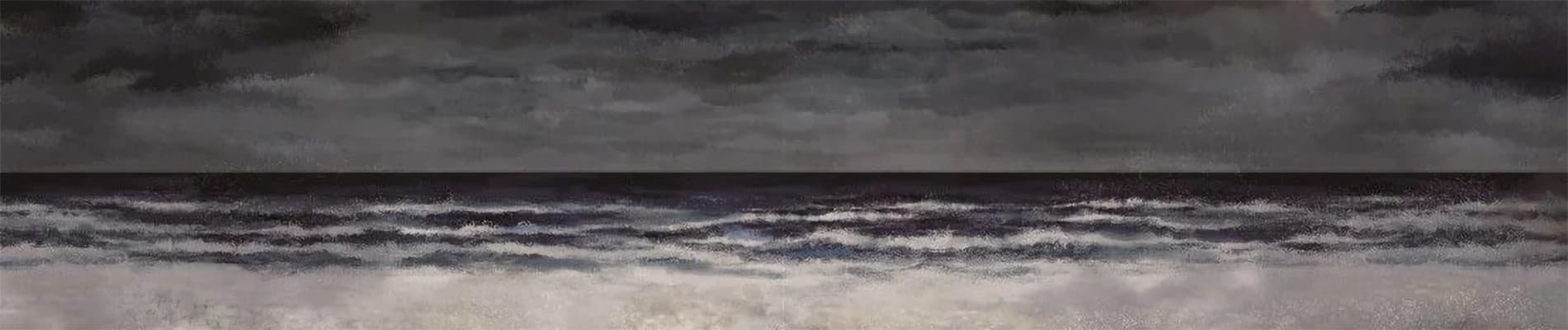
The unreachable horizon, abstract and at the same time present, whose very existence is enough to walk towards it; and which is then the eternal representation of the greatness of the sky, sea and world. That directly in relation to this title: “It appears associated to the sea... with it it is united in the horizon... full of the secret of God; and with it it closes, in a complementary image to the previous one, as one of the palms of God” (Paulino Ayuso José, Miguel de Unamuno - Studies about his work IV, page 30, Edition University of Salamanca.).

19.5 out of 20 users liked this review
