Katanagatari
a review by JaguarJack
a review by JaguarJack
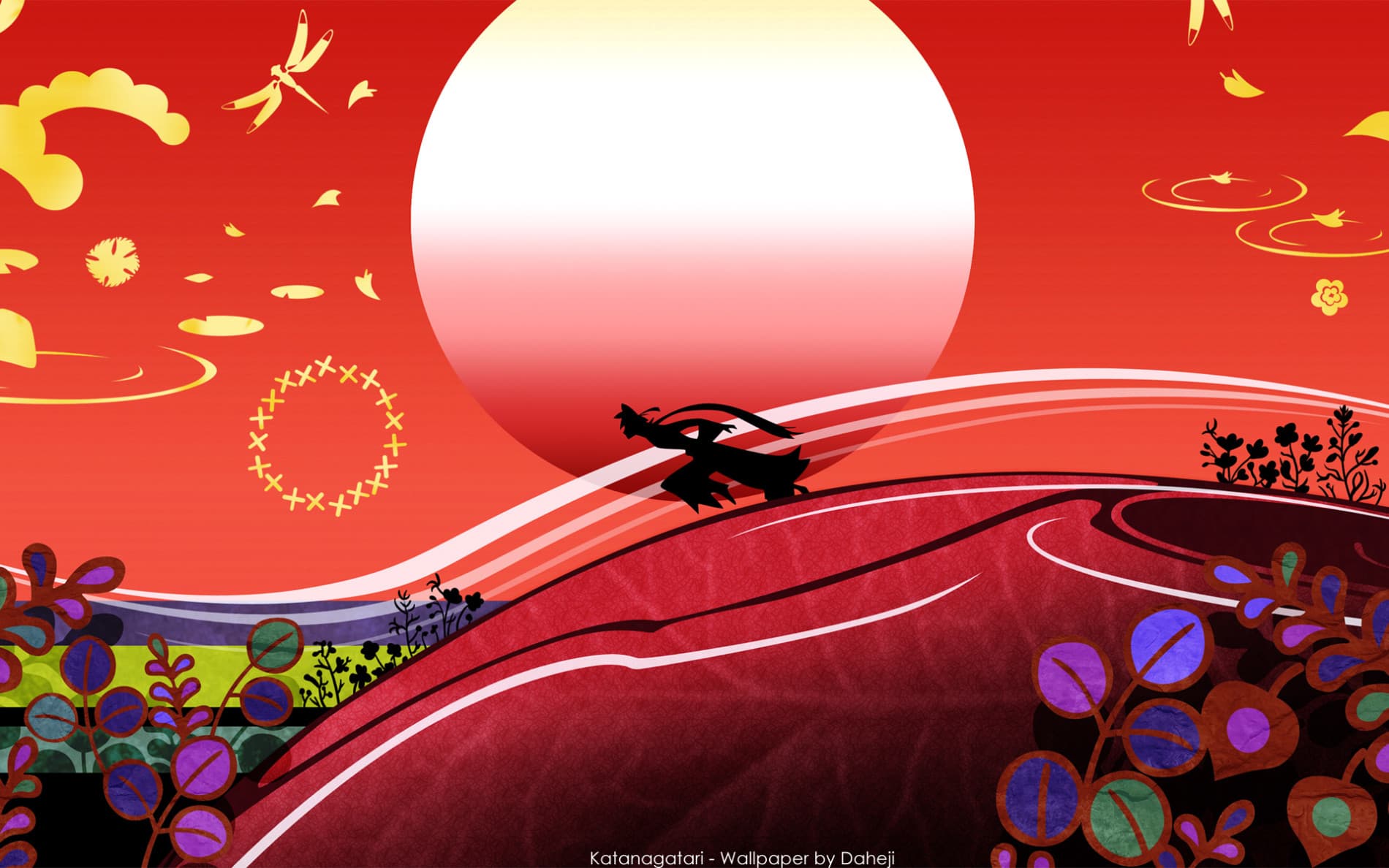
Katanagatari stands out with its art style and the colorful, almost daring character designs as well as bold soundtrack - contrasting the historic setting. The premise is simple enough to follow, setting the stage of an engaging adventure.
Togame is more complex. Initially, she’s annoying and intrusive - and clearly unable to think out of the box which is in stark contrast to the persona she upholds. This gives her lots of room to grow, which she does.
Togame forces Shichika to “fall for her”, as a way to give him a reason to join her. This clearly isn’t how love or devotion works. Togame’s father was killed by Shichika’s father, so her motivations are more than questionable.
Despite the dubious circumstances, the two develop a convincing bond. Togame is shown to be jealous whenever Shichika interacts with other women, and overreacts with mild physical violence. She has tsundere traits, but her feelings for him are more complex than that, which makes her a subversion of this archetype. Usually, the violent overreaction is a trope I cannot stand. However, here it doesn’t create cheap drama but helps to bind them closer together. Shichika too finds himself drawn to Togame, and him claiming he “fell for her” rings truer every episode. It’s a self-fulfilling prophecy in a way.
The two also get physically closer in a believable way. Shichika becomes fond of Togame’s hair for instance. They also lack reservations being naked around, or sleeping next to each other - these small moments of intimacy help to sell their bond.
It still can’t really be defined as romantic love. Shichika displays no apparent attraction, and despite his mature age of 24 (which the character design doesn’t quite sell) he’s unfazed by sexual stimuli. The relationship between the main characters therefore stays on a platonic level. Maybe it feels even more genuine precisely because it doesn’t rely on physical attraction.
Shichika gets depth when it’s revealed he had killed his own father. This would be the perfect setup for some deep-rooted conflict that might have explained his actions in the finale, but the reason behind it is never explained. His story thus feels incomplete. Shichika seems to be a blank slate and doesn’t change much - which is acknowledged at one point by the sage they encounter.
Shichika’s decision to leave his sister alone on their island is recontextualized when we learn Nanami is extremely gifted. Because of her weak body, she always wanted to die, but simply couldn’t. This leads to a tragic confrontation between the siblings, where Shichika is forced to kill his own sister.
You would think having to kill his only remaining family puts quite a huge emotional toll on Shichika, but apart from some reflection later on, he doesn’t seem to grieve her death.
Katanagatari’s plot consists of 12 episodes for 12 months and 12 deviant blades to be collected, but despite this formulaic approach, the pacing surprisingly works out great - except maybe that the fights usually get cut short. This is partially because Shichika is displayed as near invincible - he can’t really be beaten physically which lowers the stakes, but the battles are usually only won through wits. Togame's “schemes” start to pay off, despite her initial apparent lack of critical thinking.
Each episode tells a complete story of its own, featuring a blade wielder with their own stakes. While they oppose the main characters, they aren’t evil - though maybe misguided. The resulting philosophical conflicts are what make this series great.
The plot occasionally suffers from leaps in logic, like why the sword wielders are ready to bet their blade in a duel or why Togame’s schemes work out. Sometimes the duel ends with the death of the deviant blade wielder, sometimes not - this arbitrariness makes some deaths feel pointless.
The Maniwa ninjas are inconsequential antagonists. It’s rare they oppose the main duo directly, but are usually dealt with quite easily - especially when compared to Shichika’s power. They do enrich the series with some colourful character designs, abilities and personalities, but ultimately don’t serve the narrative. It seems the Maniwa sapped most of the storytelling efforts though, as many get a decent character conflict and motivations - so much wasted potential.
On a meta level, the fact Shichika had to kill his own sister was actually spoiled by the narrator in the previous episode, which is somewhat absurd to me. Generally, there is meta-storytelling going on in Katanagatari. There also are a few anachronisms, like a pack of cigarettes which has no business in feudal Japan.
One episode really sticks out in that the art style suddenly changed dramatically without apparent reason. This happens in conjunction with the death of Nanami, so it seemed to have a symbolic meaning. The lack of shift in tone however created a dissonance with this creative choice in my experience.
Katanagatari also features lots of dialogue which can get meandering at times, but it’s way more grounded compared to other works by Nisio Isin, appropriate for this series.
There is the theme of a sword style without a sword. It’s shown that the Yasuri family can’t physically use swords. The Kyotouryuu - Shichika - is even equated to a sword. The fact a sword can’t use a sword is given as the reason why Shichika can’t do so. This theme goes further in that Shichika is Togame’s blade. The Kyoutouryuu being the 13th deviant blade further enforcing this theme and Shichika’s role as a mere weapon, entirely dependent on his master.
Why is it then Shichika successfully learns a sword style anyways? I’m not sure what the point of it was, when he doesn’t use anything other than his Kyoutoryuu style afterwards.
My biggest issue with Katanagatari is the ending. Togame’s death is a big gut punch after she developed into quite the complex character and Shichika’s purpose hinges on her. Togame’s claims she always planned to kill Shichika and she only ever acted out of revenge completely contradict her journey up to that point. Maybe you could argue that even in death, she wants to uphold her persona and denies her feelings which seem so undeniable, but her inability to make that final leap and acknowledge this side of her makes for an unsatisfying end for her character. It may be tragic, but for the wrong reasons. From a storytelling perspective, her development had been forcibly denied.
It gets worse. Shichika’s character shifts completely as he now shows grief and claims he wants to die - though his actions contradict his claim. I can see some irony in him destroying the 12 deviant blades he spent a year collecting, but seeing the accomplishment of the whole adventure being undone still leaves a bitter aftertaste.
Maybe Shichika needs to die as well so all the blades are truly destroyed? I actually feared he might, but his ferocity has him survive. Maybe you could argue the Kyoutoryuu style ends with Shichika, and with him the 13th deviant blade. He’s not shown to continue his family legacy, but I fear that’s beyond the considerations of Nisio Isin.
I can get behind that Shichika doesn't want revenge and lets Hitei live, but wouldn’t he have any complex feelings about her involvement in Togame’s death? Why his journey ends in joining her is beyond me.
The finale was a tragic and ironic end to the story, but ultimately it feels meaningless. How did Shichika grow? What was gained? I can’t see it. Maybe that was on purpose: Shichika being a blade - a tool - denies him humanity.
There are many open questions left: Why did Togame want to kill Shichika? Why did Schichika kill his own father? Why did he claim to want to die in the end? Why did he end up travelling with Hitei? I’m aware not every question needs to be answered for a story to be complete, and leaving some points open invites the audience to engage with the series beyond its ending - in that regard Katanagatari clearly succeeded for me. But the open questions include some pretty basic character motivations we shouldn’t have to guess.
And it’s not like Katanagatari didn’t try. The finale was overloaded with plot twists. These seem like a last ditch effort to insert meaning into a story but only served to overcomplicate it. These details aren’t what stick - the characters do.
Katanagatari managed to engage me to a degree few anime have, but not for the right reasons. It feels like this story has a hidden meaning I’m too dumb to see. It’s not like Katanagatari is revolutionary in its storytelling - it destroys its story by subverting expectations. There’s no dramatic irony, no negative character arc - it simply undoes itself in the finale. It feels like a betrayal to a story I’ve dared to get so invested in.
So what’s the verdict? Despite having tons to say about this anime, it’s hard for me to decide on a score. Disregarding the finale, Katanagatari could have easily been an 8 or 9 out of 10. But the finale alone might put it at a 4 or 5. These mixed feelings are hard to translate into a score for this AniList review.
22.5 out of 38 users liked this review
