
(ENG Review)
Prawa w zamian za daniny,
Zapłata za pracę.
Co zatem musimy zaoferować, aby poznać Prawdę o świecie?"

Doubting, even of imposed axioms, often serves to start studies over from the beginning to recalculate a principle and establish a new truth, which, especially when it contradicts religious dogmas, before being accepted in its irrefutability, passes through sacrifices, abjurations and denials, because "it is in bewilderment that ethics resides" and "secrets are much more frightening when they are discovered".
It is no coincidence that often, the minority positions considered subversive, have become the reference ones over time.
It took minds of the caliber of Copernicus, Galileo, Newton to open new cognitive gaps, introducing concepts such as Heliocentrism, the Theory of Relativity and the Force of Gravity.
Minds capable of detaching themselves from collective hypnosis, bringing to light truths initially seen as taboos to be disavowed, only to later become the basis for every possible cosmic formula and calculation. The introduction of these discoveries led man to formulate new thoughts that expanded his mindset, to the point of understanding concepts that were very difficult to accept, precisely because they contradicted human perceptibility.
And what if it were precisely the decoding of reality through our senses that hid the truth that we have before our eyes?


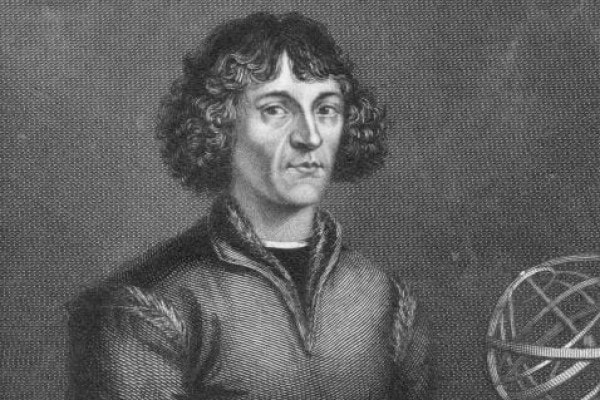
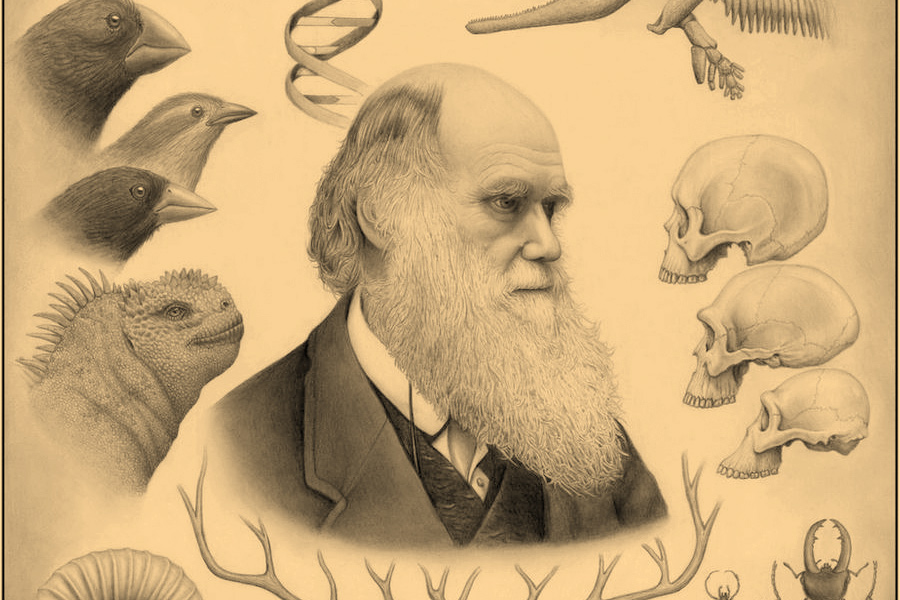
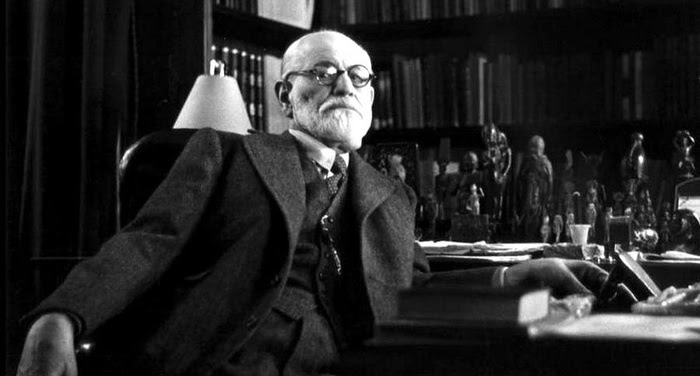
>TRIVIA: Sigmund Freud, the father of Psychoanalysis, identified the 3 narcissistic wounds towards the human race, or rather the three humiliations that Science has inflicted on our species throughout History.
>>-The first is the Copernican Revolution (here we are xD): knowing that we are not at the center of the Universe and that we orbit around the Sun like a simple planet was a real blow for the people of the time.
Spoiler, click to viewclick to hide
If we are aware of this, we can empathize more with characters like Oczy.-The third, according to Freud, was inflicted by himself (he certainly did not lack self-esteem xD), with the Theory of the Unconscious and that therefore we do not have full control of our actions.
----
Well, telling a story is hard enough in anime (and manga), let alone when you decide to tell several in the same series ...
And in this case, Geocentrism vs. Heliocentrism is the backdrop to several extremely well-told ones.
Orb: On The Movements of the Earth (in Japanese チ。―地球の運動について―/Chi: Chikyuu no Undou ni Tsuite) is a TV series based on the award-winning Japanese manga written and illustrated by Uoto, serialized in Shogakukan's seinen manga magazine Weekly Big Comic Spirits from September 2020 to April 2022, with its chapters collected in eight tankōbon volumes.



###
.
.
.
>TRIVIA: _Since the (KATAKANA, not Kanji) Japanese title of this anime, チ (Chi), has a flexible meaning, the author wanted to exploit it to make it adhere to the various themes of the main story.
Besides the "Earth", that is a "sphere", in the title, the word “チ” in Japanese is also a play on the word "blood", due to the fact this is a tale of the clash between intelligence and violence, leading inevitably to the spill of it.
But “チ” also stands for the word “knowledge” and so "Truth", or again "terror",
Spoiler, click to viewclick to hide
the last one is another key-word quoted by Nowak in ep. 11.


>_So therefore, this anime’s themes revolved around “The Earth/Orb, the Terror/Blood, and the Knowledge/Truth”.
There is action, constantly followed by a mysterious Orb necklace, there is terror accompanied by bloodshed and there is certainly knowledge to be shared in order to reach the Truth on the world._
-----
-----
#SYNOPSIS


~~Poland Saga~~ is about Rafał, a young Polish boy with a brilliant mind to say the least but above all with a marked curiosity.
In 15th century Europe, there is a cultural servility that imposes theories as undeniable dogmas, by virtue of a dominance of knowledge for which every alternative idea must be condemned: we are dealing here with the Heliocentric Theory versus the Geocentric Theory, two hot topics that had long been disputed between them.
----
#『 At this point, it's necessary to digress a little and provide a quite brief explanation.
The Geocentric system is an Astronomical theory that places the Earth at the center of the Solar System, with all other celestial bodies revolving around it. This embryo-theory was enunciated by a Greek astronomer, Eudoxus of Cnidus, following the ideas of his teacher Plato, and it quickly replaced archaic Cosmography. The system was later perfected by other astronomers of the past, including Ptolemy, whose definitive version was then known as the "Ptolemaic system".
Geocentrism was widespread in ancientness and so on during the Middle Ages, because it was considered satisfactory in astronomical terms and consistent with the philosophical and religious views of the time.
#This means that, for the Catholic Church of the time, the Ptolemaic System with the Earth at the center of the Universe was considered proof of the existence of God.
On the other hand we deal with Heliocentrism, another theory developed later that basically hypothesizes that the Sun is positioned at the center of the Solar System and the Universe, a pole contrary to what Geocentrism claims. 』
>#『 During the Medieval era, the Geocentric one was still considered the correct one of the two, while the Heliocentric was considered so unfamiliar and in a special way so inconsistent with the Holy Scriptures that it was considered heretical. 』


----
So, in 15th century Europe, heretics are being openly tortured and burned at the stake.
And it is a perfect stage for the silent rebellion of Rafał, who is forced to attend the era’s most important field, the faculty of Theology, instead of the nascent and way more humble faculty of Astronomy. But he has always valued Reason above all else, which leads him to the shocking conclusion that the Earth orbits the Sun.
He would like to remain silent about the motions of the Earth to save his life from the hands of the Inquisition, and instead in the end he falls victim to an "incurable disease":
>#FREEDOM.

Knowledge makes you free, it allows you to decide for yourself what life to live and what death to die.
Of course, man is not infallible at all, he can give himself too much to freedom, lose sight of the healthy ways to use it and become almost a slave to it, in an endless search that wears out any external relationship.
#But can you really be alive WITHOUT? Can you come to appreciate Creation WITHOUT the prospect of enjoying it?
Rafał and the people who will follow him on this tortuous journey will therefore have to fight first of all against themselves to understand how it is right to lead their existence, especially in difficult, uncertain and tormented times like the ones they find themselves in.


In search of the Holy Grail of Truth, even if they are willing to pay too high a price: this is a race against time of all those Icarus who have given mind, soul and body to pursue the Heliocentric Theory, once considered not only incorrect but also blasphemous and dangerous for the future world order by the dominant social class.
...And with a VERY PIVOTAL finale that not only shatters our few and only certainties, but opens the space to an endless debate on the "historical" truth and of how "lucky" we were to have been able to witness it all with our own eyes as spectators, detached from that context, because if we had been people within that story we would have easily doomed to forget due to bigger external circumstances that created the concept of Oblivion and of *damnatio memoriae*, which is very often utterly unjust but which is inherent according to the gigantic narration of the facts made by History itself.

>AN IDEA.
-----
-----
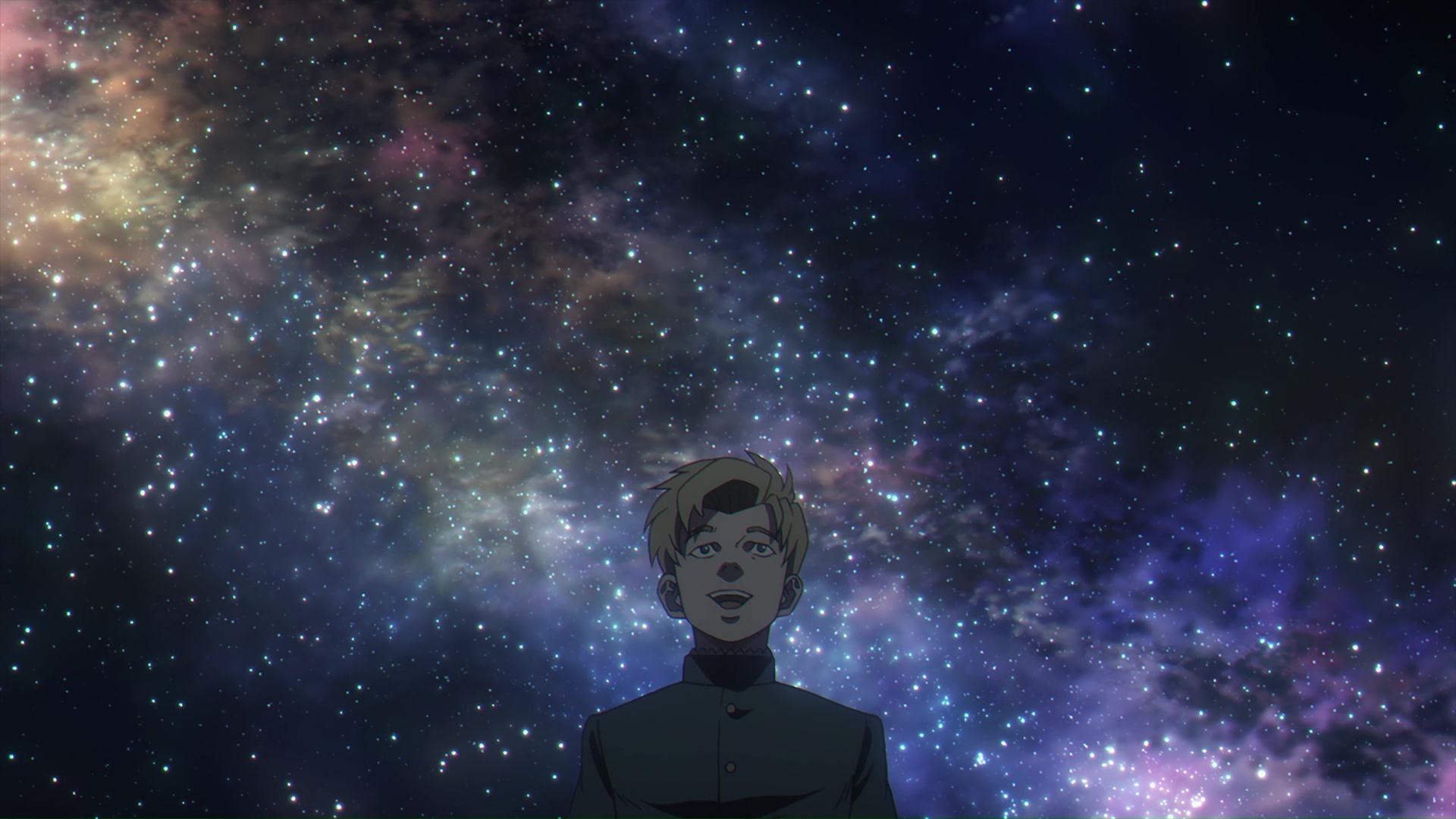
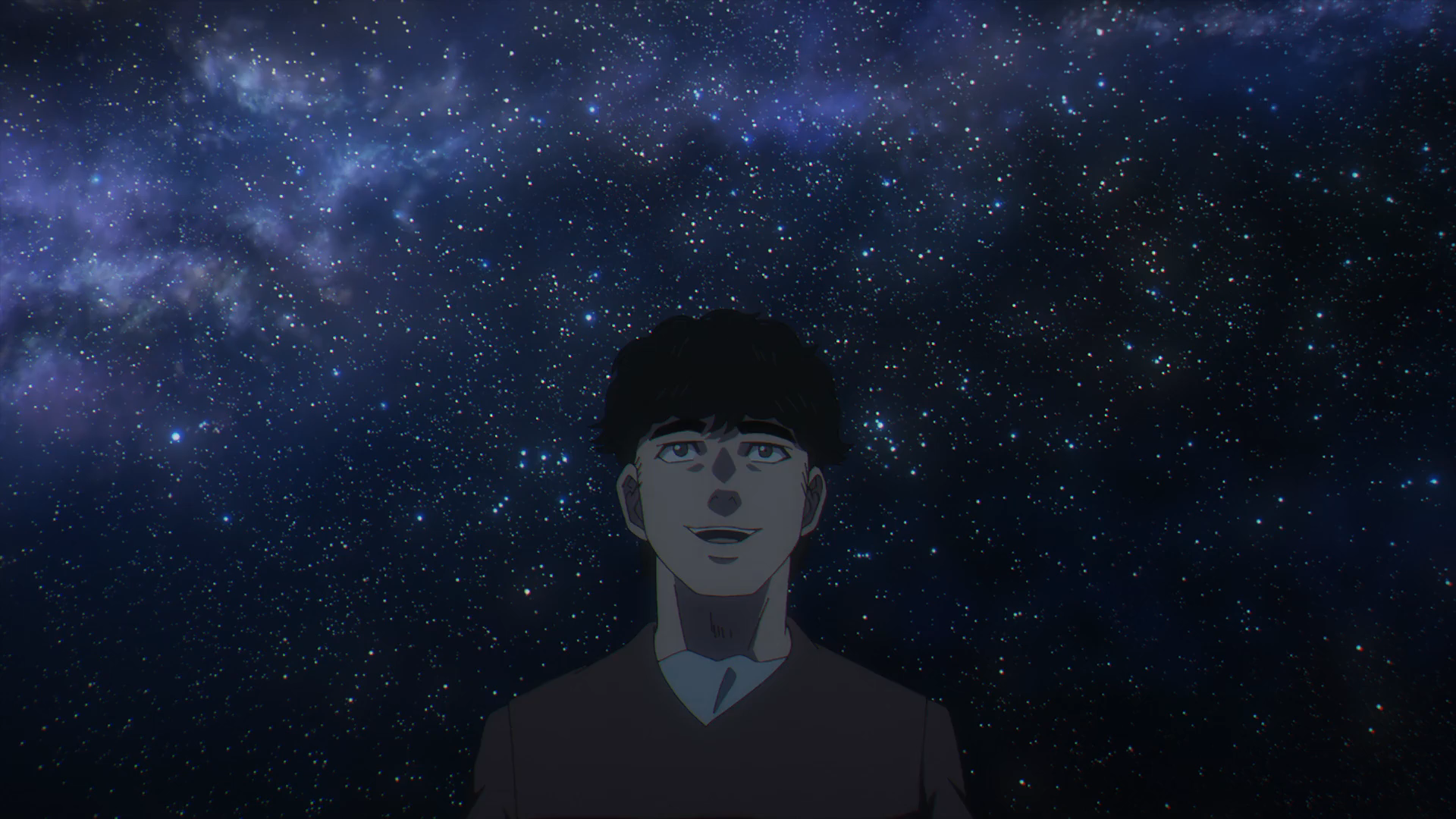
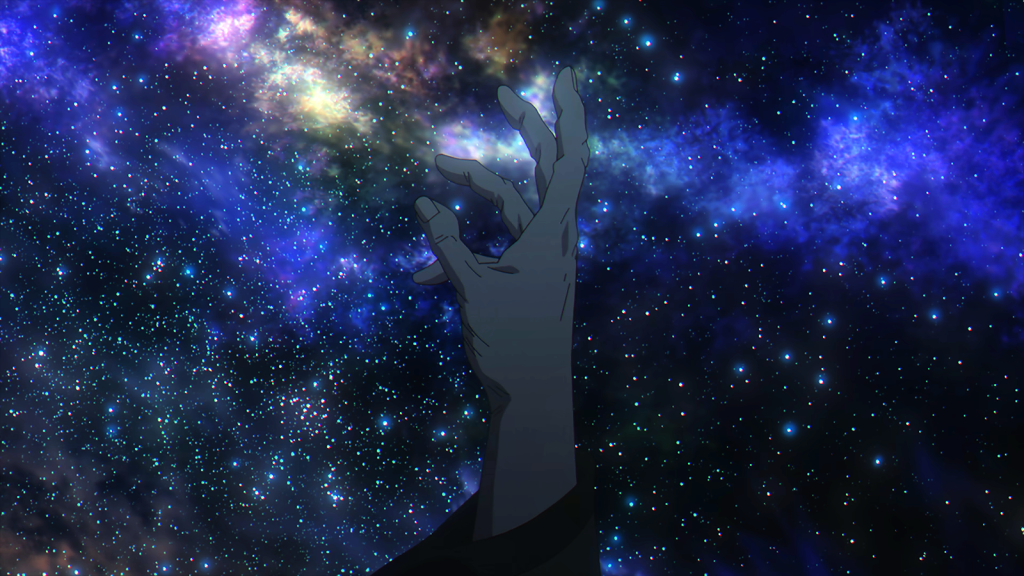
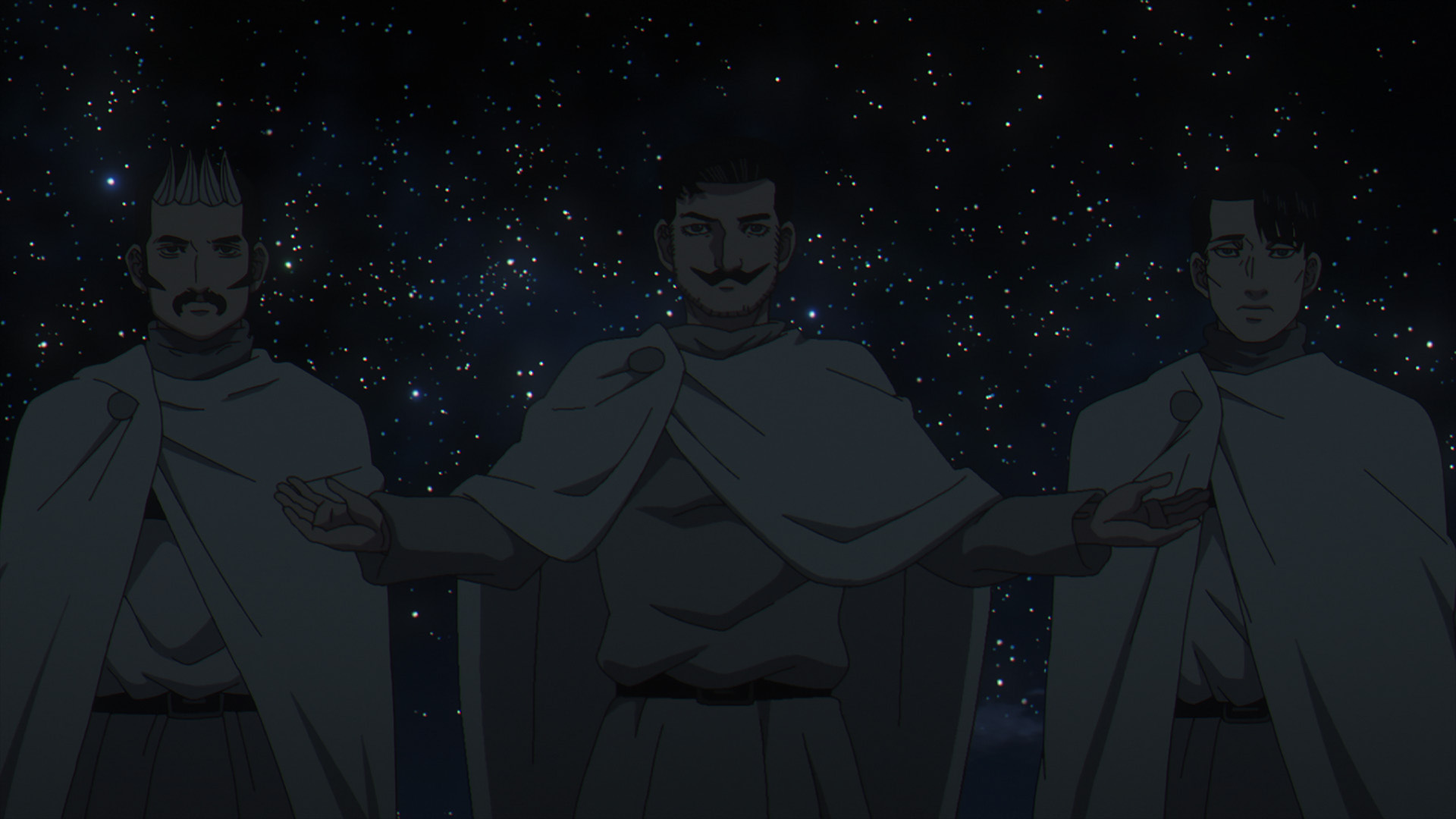
#...What are we willing to do for our idea(l)s?
----





-------
------
#INFO, ANALYSIS/PERSONAL IMPRESSIONS
There is very little of the mistreated predictable clichés or other narrative conventions and, especially starting from a certain episode (I will not say which one...) you will have the sensation of suddenly watching something different from everything that came before, which in a certain sense is true, but it remains really complex to explain by words why works of this kind transcend wonder.
And having finally finished watching the entire content, which in my opinion has been faithfully adapted and well-paced, I can say that I feel entertained but at the same time excited and seriously questioned.
>You know when people complain (and I join in the discussion) that "There's never anything different!", that "Now there are only isekai around!" and therefore nothing stimulates us? Well, maybe this show is for you. xD
------
#THE WEIGHT OF KNOWLEDGE, THE FALL OF THINKERS & RIPPING THE FUTURE APART
The relay of the protagonists, all indispensable to bring the truth to light, serves to underline how every step forward of humanity occurs thanks to collective effort, and not to the intuition of a single person.
The common thread that makes the apparently episodic narrative structure cohesive is precisely the progressive sense of discovery given by the knowledge that the characters inherit from the previous protagonists. Uoto makes us reflect on the importance of culture passed down through transcription, an element that today we tend to underestimate.
>Today, the Internet is a database of frozen information, but we must not forget that before, knowledge was on sheets of paper, and risked being lost forever with every crackle of fire.
How many times has a fire erased everything? How many times have we had to start calculations from the beginning to get answers that someone before us had already obtained?


In this series there is no banal character, and their goals are personal and different from each other.
The common thread is Heliocentrism and the struggle to uphold one's beliefs, the refusal to surrender to injustice, and the sacrifices one is willing to make for it: this connection is represented by a pendant (plus other implicit elements) that passes from one's hands to those of the subsequent protagonists as the story unfolds, and it is also the object that Nowak, one of the leading figures of the story, desperately seeks to interrupt this legacy of ideals.
----
#NOWAK & THE CHAINS OF DOGMA


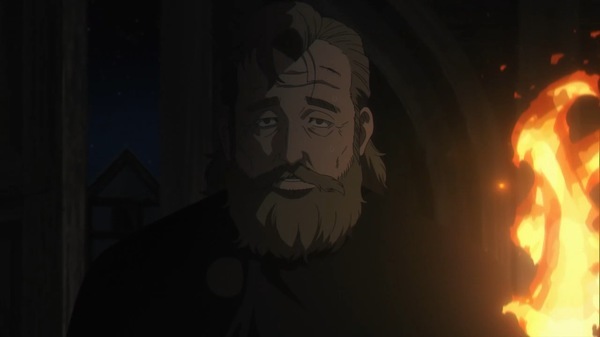
Opening a due separate parenthesis, the ruthless Nowak is the leader of the inquisitors in charge of suppressing Heliocentrism. He brutalizes the unfortunate defendants in his interrogations with terrifying instruments of torture, boasting heresies aimed at hiding the atrocity of his actions under the word of God.
His characterization in particular is excellent, with different facets that make him a complex character, far from monotony: his motivations are clear and constitute his strength. He's also deeply distorted, since his mind has entered a loop such that even the worst atrocities have become normal for him.
When he finds himself having to torture children, he simply states that he does not like doing it, but this does not stop him from carrying out such actions, making everything grotesque and horrible.
In his mind, his beliefs are so rooted and solemn that he justifies any means to achieve them.
Generally, it's natural to side with the "good guys" against the "bad guys", considering the actions they take, but in the case of Orb all the characters are deeply convinced of their opinions and act accordingly, convinced that they are right. This, however, will not exempt them from committing mistakes or acts of a certain gravity.
>"Thinking of us, people from another era will simply consider us men of the 15th century. More than to those who have a philosophy similar to mine, I feel closer to those born in my same era.
Even if we hate each other to the point of killing each other, we are comrades who have built a given historical moment together."
>>


The purpose of Nowak's character is to convey one of the central points of the story, i.e. the torture perpetrated by the Inquisition. Many episodes focus on this theme and it's the terror of those who risk being investigated. Despite the horror, however, this won't stop the protagonists.
>
Spoiler, click to viewclick to hide
TRIVIA: Symbolically speaking, each character represents a characteristic needed for Astronomy (or Science, in general): Rafał can be associated to mind, since he's born as a genius prodigy, but also he's the inspiration (a mixture between curiosity and wonder, an ep. 3 reference). Oczy is the eye (an hawk-like one xD) and the gradual learning from literally scratch, Draka has the picture perfect memory and an iron logic skill, Badeni can be the wisdom (albeit in a rather stingy form xD) and the overwhelming will to rise up and push oneself beyond one's limits but also to realize when it's time to rectify oneself (and I'd associate the latter to Count Piast, too), Jolenta can be the literacy but also the emancipation from imposed roles and dogmas (ex. relegated to the women of those times), while Albert's father and teacher are respectively the doubting and the believing concept (in a separate and in a blindly way...), and so on...


-----
#UNVEIL THE WORLD'S TRUTH by LETTING ONESELF GO
to bring Heliocentrism to the fore at the expense of the "C-Religion" Geocentric system.
This aforementioned historical reconstruction, which is undoubtedly imaginative on many points, however gives space to reflections on how the fire that burns in the human soul is functional to the growth of the species, on how curiosity is a source of discoveries and at the same time of risks, on why we continue to fight even when the war is over.
And in this sense Orb is a work of great caliber, full of lofty dialogues, pathos and illuminating philosophical digressions that lead to "lateral" reflections.
The series manages to provide us with different perspectives, proving itself mature in oscillating in constant balance between Faith and Science, teaching us as the very first notion to keep in mind that
#The wonder (or in philosophical language the Thaumazein) of discovery is the only true principle of knowledge.


>"The rest is up to you...Because History needs us."
However, as I said above, I don't want to spend too much because it is one of those works so richly complex in content that should not be defined by words but by the visual experience (and even before that by a basic smattering of some themes/topics that have their roots in our History).
>In this brainy series, however, there is no shortage of action scenes, which is one of my favorite parts because all the fights in it in my opinion are well choreographed and apparently accurate.
Spoiler, click to viewclick to hide


In fact, after watching each ep. I used to do some research on details related to Astronomy or Late Medieval History and gaining not only knowledge but also a different perspective on the changes in the flow of centuries, all requirements that make you better understand what you just watched.


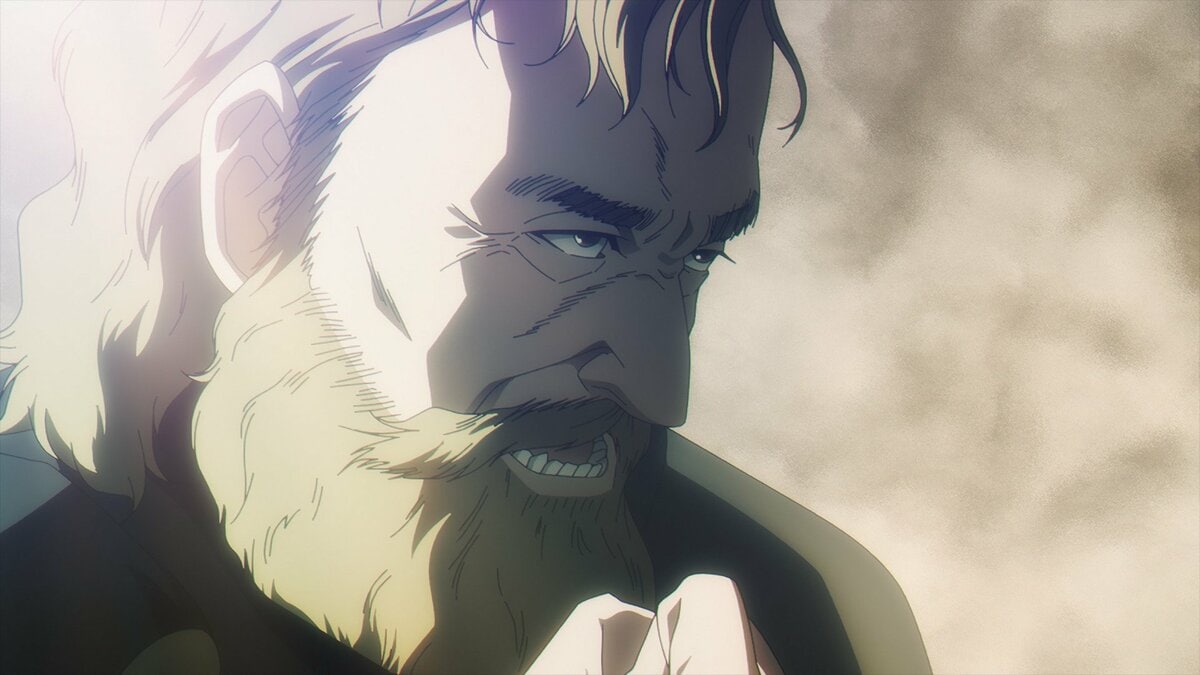


>“Rather than moving adequately in it, I would like to try to move the world itself”
Also, honorable mention must be made of the incredible soundtrack, including the now memorable opening and the two-parts endings produced by artists of great skill (Sakanaction and Yorushika) and of a cast of high-level voice actors (Kenjiro Tsuuda, Maaya Sakamoto...).
---


###Some posters for *Orb: On the Movements of the Earth*
-----
>#NOW, IS ORB A WORTH-WATCHING ANIME SERIES?
And Orb is slow, it has to be to give space to all the information it collects, but the entertainment instead of a joke or in photonic blows lies in the infinite food for thought that it throws at you.

Through a narrative divided into arcs that changes protagonists and year, the story ties together various existences around the taboo of Heliocentrism, obvious in 2025, sacrilege in the times when the opposite Geocentrism was imposed.
The setting therefore determines for those who are searching for the Truth a sort of "daily clash with the world" that is consumed between the fear of being discovered and the desire to know more, until going beyond the limits from which there is no return.
Spoiler, click to viewclick to hide
Rafal, the first protagonist, for example, is shocked by the fact that his calculations confirm the validity of Heliocentrism and convinces himself that he can keep the Truth hidden for his whole life, only to realize that it is now too late.▶ Video
As when for Schopenhauer the man tears the "veil of Maya", reaching the Truth is a source of pain and desperation: there is no going back and certainly it also seems difficult to move forward.
So the only push is the awareness of the obstacle, the realization of inevitability, the choice to accept the cyclical nature of suffering as part of a path that leads to a moment of happiness.
▶ Video
In Orb a community appeal is made to recognize pain as part of the material that serves to build joy, letting dozens and dozens of years pass to show how suffering binds people in an almost casual and therefore indissoluble way.
Many of us see our lives end in the brutality of violence and it is not at all what one would want for the future, but between fear and doubt there is the possibility of meeting people who then become important, the beauty of love (not only the romantic one), the opportunity to create moments that no one will be able to erase, not even by stopping to pass them on.
Pain is a circular table to sit around to help or not to make things easier or more difficult for whoever takes that place in the future, like in an endless soap opera where the writers must continually invent new tragedies.
>#I'd say YES.
Do yourself a favor, and start it as soon as possible if you haven't already.
Orb: On the Movements of the Earth wants to be a tribute to all those who fought for their beliefs, defending freedom of research and expression to the point of giving up their own most important good.
"The thirst for knowledge that calls you when you turn your back; the Universe that appears and manifests itself, in a ray of sunshine that wakes you in the morning, or in the moonlight that filters through the window of a dark cell. The path of enlightenment that descends, from the black perimeter of the sky, when the eyes of the mind open, blinding the sight."
----
#An anime that finally speaks to all of us and for all of us, ergo a love letter towards the limits but also the incessant work made by mankind.

>>*BEWARE: if you want to get seriously into this series, YOU MUST BEHAVE AND THINK LIKE A SCIENTIST WOULD, therefore approaching the proposed events with infinite curiosity but questioning each time what you have just seen. I said this because otherwise, you will not be able to understand the numerous underlying messages that the work disseminates in the episodes.
-----
-----
-----
.
.
.
.
~ ~ ~Chi. / チ。~ ~ ~

#
#####*I want to apologize for any errors or repetitions (I'm not a native EN speaker) or if I put too many images in it. xD