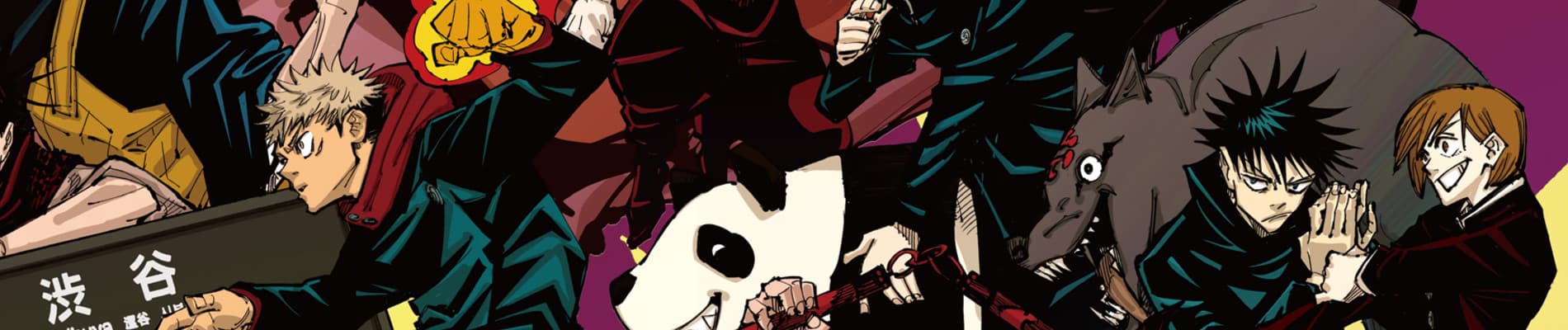
Jujutsu Kaisen
a review by Shad0wq
a review by Shad0wq
Jujutsu Kaisen started off as a highly engaging and well-paced story. The early chapters were structured clearly, with a strong sense of direction—every event had a clear purpose, making it easy to follow the narrative. The smaller cast at the beginning allowed for stronger character focus, and the balance between action, humor, and horror was excellent. Akutami’s art was also at its peak here, with crisp, dynamic panels that made the fights easy to follow. The comedic moments blended seamlessly with the darker themes, though toward the end, the humor started to feel a bit forced or out of place.
One of the most striking aspects of Jujutsu Kaisen is its cast. Every major character feels somewhat unhinged in their own way, which makes interactions unpredictable and fun to watch. Todo, for example, is like the embodiment of chaotic energy—his obsession with a person’s taste in women and his extreme social cluelessness make him feel almost like a walking meme, but he’s also undeniably competent. Then there’s Nobara, who had one of the most chilling moments in the series during her fight against the Cursed Wombs. She wasn’t terrifying in the traditional sense, but the way she spoke about killing them with a smile on her face was undeniably eerie. That scene was a perfect example of how Akutami plays with expectations—Nobara had always been fiery, but that moment showed a much darker and more ruthless side of her.
As the story progressed, cursed techniques became increasingly complex. While this added depth to battles, it also made them harder to follow. The Sukuna vs. everyone fight is a prime example of this issue. The first half of the chapters felt like pure exposition, explaining every little detail before we even got to the actual action. And even once the fight started, we still kept getting interruptions filled with explanations. In comparison, Gojo vs. Sukuna also had a lot of technical details, but the pacing was handled much better, making it feel more natural.
Another issue with the final arc was how many old characters suddenly reappeared. Some characters who had barely been relevant for dozens of chapters were suddenly brought back as if they were meant to play an important role. It felt like Gege Akutami wasn’t entirely sure how to handle Sukuna’s overwhelming power, so instead of a natural progression toward his downfall, we got last-minute twists. One of the strangest moments was the reveal that Sukuna’s last finger hadn’t been consumed, allowing Nobara—who hadn’t appeared in over 100 chapters—to use her Cursed Technique to injure him. While it was nice to see her again, the execution felt rushed, like a desperate attempt to find a way to weaken Sukuna.
The final stretch of the manga also suffered from declining artwork. In the beginning, fights had a great sense of flow, with each panel naturally leading into the next. But in later chapters, action sequences became chaotic, making it difficult to tell what was happening. Some panels were so cluttered that the movement between them felt disjointed, which hurt the readability of the fights.
Overall, Jujutsu Kaisen is still a great manga with a lot of memorable moments. The earlier arcs were especially strong, with well-defined pacing, great humor, and impactful character moments. However, the final chapters struggled with pacing issues, overly complex fight mechanics, and an unsatisfying resolution. With better world-building and character development throughout the story, the ending could have had a much stronger impact. Despite its flaws, though, it remains one of the most unique and thrilling battle shounen series in recent years.
6.5 out of 7 users liked this review
