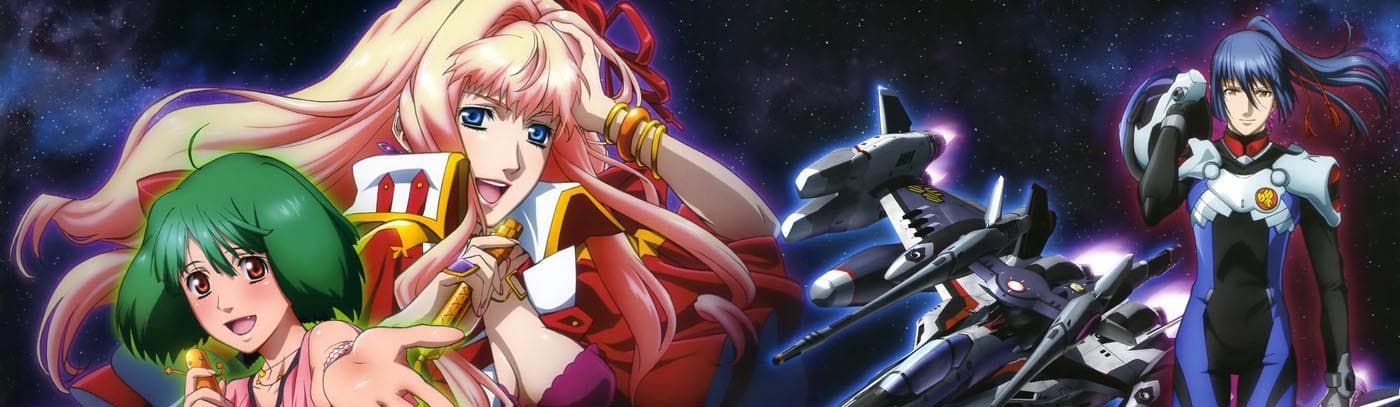

A Review of Macross F – Beyond Every Frontier
After the Macross 7 series, which aired in 1994 and concluded the following year, Macross Zero was released in 2002, consisting of a total of 5 episodes, which I have already thoroughly discussed in a previous review. So, continuing the discussion from where we left off and moving forward, we encounter the next series in the franchise – and one of my all-time favorites – Macross F [Frontier]. After a long fourteen years since the last full animated series (seven years after the groundbreaking 49-episode Macross 7, still a record for the franchise), Frontier (in its television version) finally emerged, with its twenty-five episodes. I believe I’ve already mentioned how I fell in love with this franchise, with its wonderful love triangles and sublime, timeless songs, and how, over time, it has become an integral part of me: to the point that, to this day, I consider it one of the works, in a broad sense, that has moved me the most and always manages to bring a tear to my eye at the right moments. And, for me, Macross Frontier is one of the highest peaks of the franchise, turning out to be one of the series I’ve become most attached to (and also the most moved by): gone is the seriousness, maturity, and rawness of Macross Zero (which is still quite welcome and does not fall short in its five episodes), and in comes a greater sense of lightness, which, in certain ways, also characterized the first Macross: Frontier returns to being a space comedy, set in the namesake fleet, where we also see the daily life that defines it (in glimpses of the cities and various environments it contains) and with it, the daily lives of the characters who inhabit it, and where the events of the series take place, with a nice old-fashioned love triangle. However, from my point of view, Frontier can be considered the culmination of everything that came before it: from a substantial perspective, it continues the narrative paths established by Macross Zero, picking up and expanding on the concept of Fold Waves and introducing the mysterious Fold Crystals (but not only that, F in some respects directly follows Zero, continuing the story of certain characters; thus, to conclude the point, it’s no surprise that there are numerous references to the latter in F, with the most prominent being in episode 10, where there is literally a faithful retelling of the events from Zero, shot as a documentary-style film titled Tori no Hito). At the same time, the "spirit" of the first Macross is recovered: the lighter tones typical of a comedy, the old-fashioned triangle; on the character side, the tropes and features typical of Minmay’s character, which will be revived through Ranka Lee, one of the two female protagonists and love contenders (along with her sweet voice and the status she will acquire, from the "roots" of her Chinese descent, and just like Minmay, working part-time at a Chinese restaurant). And even the return – albeit nominally – of the Skull Squadron, which was absent in the previous series (the pilots serving the SMS – the private paramilitary company with which the protagonist will become involved, cooperating with the Frontier government – have decided to rename themselves in this way, using the name of that legendary squadron which flew through the skies in the first Macross). So, a series capable of innovating but at the same time maintaining that classic, self-referential, and nostalgic spirit that has always characterized the franchise, without losing its essence. A perfect summary, with all the right elements to amaze the viewer and make the franchise's reputation shine once again. And, spoiler alert, I think it succeeded quite well, considering it is one of the most appreciated series even in its home country (thanks in part to the other female protagonist – to whom I will dedicate a small section later in this review – and some memorable songs, some perhaps among the most beautiful in the entire franchise). With the series framed, then, in what I consider to be its main characteristics, I would say it's time to start this discussion, which can only begin with what are considered the "foundational pillars" of Macross (or its three main tropes), as defined by the creator of the series himself, Kawamori Shōji: in particular, I will focus on two of these: a) the love triangle and b) the songs. A small clarification: regarding the numerous songs introduced in Frontier – limited to those I consider most worthy of discussion – I will space them out throughout the review, as many, due to their themes, are best treated alongside the related points in their respective sections (and also because otherwise I would end up with a mere list, a useless and boring shopping list; this way, I should be able to cover them all, spreading them out across the review and at the same time avoid the long, tedious list). Final warning: there will inevitably be spoilers along the way.
The Love Triangle
To clarify what I think about this triangle, it’s a triangle that works. And it works quite well, taking all the time it needs to blossom in the early episodes and gradually evolving throughout the story, reaching its peaks in certain specific episodes (which I will mention later) and at the story's conclusion. And, arguably, the triangle in Frontier – Alto, Ranka, and Sheryl – is one of the best in the entire franchise, alongside the original one, considering that in Macross Zero, the triangle had little time to develop due to the brevity of the series, and in 7 it cannot be considered a triangle (apart from the fact that it remains unresolved until the end of the series, even though Mylene seems to lean toward Basara, but as for the legendary Basara... let’s just say he loves his guitar and music more than anything else). A special mention goes to the triangle in Macross Plus, a unique case, which is treated in a completely different and much darker and more brutal light compared to the norm (maybe in a future review of Plus).
From my perspective, four are the main strengths of this triangle: i) Its female protagonists; among the best, most well-written, and well-characterized characters in the entire series, who could be said to literally drive the dynamics of the triangle, as most of the impulse to continue it comes from them (I will discuss Sheryl's character later). ii) and iii) – I will treat these together – The great chemistry between the three characters, which keeps the viewer’s attention alive and constant until the very end (and their desire to see how it concludes) and, on the other hand, both prove a deep devotion to the person they love. The love triangle in Frontier is alive: it encompasses a true, genuine, and deep love from the girls toward Alto; a love in its purest and most innocent form, the kind of love that strengthens you and keeps you going despite difficulties or despair, and one of mutual benefit, in the most classic do ut des sense. This, at least, is how I interpreted the excitement I saw on screen in Sheryl and Ranka. And this genuineness not only characterizes the love dynamics between the three but also the interpersonal relationships between Sheryl and Ranka: rivals, yes, but at the same time bound by a deep bond of friendship, almost a sisterhood in some ways (Ranka sees Sheryl as her senpai, the more experienced and older colleague, and also as a source of inspiration). From this deep friendship, characterized by sincerity, comes the mutual and profound respect: a competition [for the man they love] yes, but one that always takes place in the respect of honesty and in the style of "we both give our best and may the best one win!" And there is nothing more beautiful, to me, than mutual respect born out of a healthy rivalry (both in love but also on stage, as professional singers).
iv) But what I think is the greatest strength of this triangle is the following: the series is, in my view, extremely skilled at portraying the two female protagonists in their respective advantageous situations – one over the other – and alternating them repeatedly throughout the entire series. That is: at first, Sheryl starts in a clearly advantageous position – because of her status, reputation, physical beauty (as she is much more mature physically compared to Ranka), her resourcefulness, and confidence in her abilities, thus making it seem to the viewer that she is probably the favorite to win in the end, or at least, starting from an advantageous position, will ultimately surpass Ranka. Then, gradually, Ranka comes into her own, gaining more confidence in her abilities, and she begins to balance the scales; in the second half of the series, this perception is completely reversed in favor of Ranka, who seems to soar on the wings of enthusiasm after her explosive and impactful debut, with Sheryl seemingly being pushed out of the game, also due to the downward trajectory she will take (both professionally and in her private life). In this way, Ranka gains a position of prominence; yet, Sheryl’s determination will push her not to give up and to restore the dynamics of the triangle once more toward the finale. This continual alternation ensures that neither of them ever prevails at the expense of the other, leading to a contradiction and a balance between them, which adds extra flair to the development of the triangle, and prevents predictable or clichéd outcomes. The best depiction of all this is found in episode 15 [Lost Peace] during the famous sequence in which Sheryl and Ranka duet, practically back to back, in front of Alto, expressing their overflowing feelings for him.
Ranka and Alto went to the hospital to visit Sheryl, who was admitted there, and during their conversation, on the large screen behind them, the song What 'bout my star? begins to play – a song originally sung by Sheryl, but later also performed by Ranka [the first song she sang in public before even being scouted]. As Sheryl reflects on her feelings for Alto, she clings to the song, beginning to sing it. With her sensual demeanor, it seems as if she holds the upper hand in this situation, but Ranka, upon seeing this, doesn't get discouraged and, with determination, begins singing as well. The impromptu performance – started by Sheryl – ends up transforming into a beautiful duet, during which the two girls express their feelings for the man they love. The chorus of the song at this point is more than explicit, especially since the pre-chorus is a literal count, a countdown that precedes the emotional outpouring of the two girls’ feelings.
In essence, from this moment onwards, Alto undergoes a true discovery of Sheryl's and Ranka's feelings, coming to know them with certainty – in fact, these feelings were never really hidden, especially in Sheryl’s case – as they are expressed openly and unequivocally, being literally sung to his face. Moreover, from a choreographic point of view, the scenes during the chorus of the song are stunning, with Sheryl and Ranka first duetting back to back, leaning on each other, before pulling away and reaching out toward the protagonist, extending their arms to him. This scene, at this point, is not only visually beautiful, but also turns into something amusing, with Alto being practically cornered by the two, with no escape, forced to succumb to their feelings. (And if it wasn’t clear enough that the two girls are madly in love with him, the series, once again, makes sure we get the point through visual cues: their positioning, in the shape of a triangle, and even one of them forming a triangle with her fingers – this emphasizes the meticulous attention to detail in many of the scenes, as Frontier is extremely well-crafted).▶ Video
In essence, from this moment onwards, Alto undergoes a true discovery of Sheryl's and Ranka's feelings, coming to know them with certainty – in fact, these feelings were never really hidden, especially in Sheryl’s case – as they are expressed openly and unequivocally, being literally sung to his face. Moreover, from a choreographic point of view, the scenes during the chorus of the song are stunning, with Sheryl and Ranka first duetting back to back, leaning on each other, before pulling away and reaching out toward the protagonist, extending their arms to him. This scene, at this point, is not only visually beautiful, but also turns into something amusing, with Alto being practically cornered by the two, with no escape, forced to succumb to their feelings. (And if it wasn’t clear enough that the two girls are madly in love with him, the series, once again, makes sure we get the point through visual cues: their positioning, in the shape of a triangle, and even one of them forming a triangle with her fingers – this emphasizes the meticulous attention to detail in many of the scenes, as Frontier is extremely well-crafted).
But the true marvel lies in the scenery: remember what I mentioned earlier about the alternating positions of advantage between the girls? Well, this constant back-and-forth is actually put into black and white in these sequences: the person singing – and thus the one who holds the prevailing position in reference to Alto – is illuminated by the spotlights, bringing them into focus, as if they were performing on a real stage where the lights shine on whoever is at the center of the scene. This creates the very alternation I referred to earlier, amplifying the back-and-forth between the two rivals in love – both of whom want to have their say. And in light of all this, I believe it is from here that we can understand the depth of Sheryl’s and Ranka’s relationship – both as friends and as rivals – with their mutual respect and the sincerity of their feelings. It’s a sublime duet in which both are highlighted, shining like true... stars (which they truly are). A scene that lasts not long – about two minutes – but in those brief moments, so much is communicated to us. It’s no wonder that I consider this one of the most beautiful, meaningful, and electrifying scenes of the entire Frontier TV series.
 What ‘bout my star Full Version – Listen to it with earphones; this way, you should notice something...
On a purely thematic level, however, I can’t help but mention another song: Triangler, the first opening of the series (with a title that is quite fitting), sung by Sakamoto Maaya. The beginning of the song is quite exemplary: > Who will you kiss? Me, or that girl? Who will you kiss? Orbit the stars, my pure feelings.
The same title, Triangler, will also be assigned to a specific episode of the series, specifically episode 19, which, like episode 15, can be considered one of the most significant in the series. At its conclusion, particularly intense due to the multitude of events happening simultaneously on screen, both Sheryl and Ranka come to a firm decision and choose to confess their feelings to Alto in a clear and informal manner. The first to arrive at the school bed where Alto is with his friend Michel is, however, Sheryl. Soon after, Ranka, having finished her performance, rushes to the bed to confess her feelings as well, overwhelmed by euphoria and excitement. But here comes the bitter disappointment: Alto and Sheryl are embracing each other, and perhaps even close to a kiss (although Ranka interrupts them at the most intense possible moment). Just before the final moments of the story, the three of them come together on the rooftop, in all the beauty and at the same time the rawness typical of a classic love triangle: an emotional roller coaster filled with ups and downs, hopes, joys, and disappointments.
 Triangler
Finally, as already mentioned earlier, F is particularly attentive to detail, and since the love triangle is one of the three main narrative pillars of Macross, it is only fitting that it be – subliminally – constantly reminded to us through any type of graphic or visual device:


To conclude this first section, I want to touch on two additional points: the first is related to a critical aspect, since up until now I've only discussed the strengths and what works in the dynamics of the love triangle. This aspect refers to the somewhat absent-minded nature of the protagonist: as mentioned earlier, the primary driving force behind the trio’s dynamics comes from Sheryl and Ranka, since Alto is the kind of guy who, let’s say, isn’t particularly sharp. Does this detract from the beauty of the triangle I just described? Obviously not. However, I believe it’s worth mentioning; in fact, in the “ugly, there’s beauty” sense: the fact that the story is carried by the girls and remains equally interesting and engaging implies, on the other hand, and as I mentioned at the beginning, that the two female characters are truly extraordinary, and are among the best and most positive aspects of the entire anime. Sheryl and Ranka are indeed two remarkable women, in different ways, and I can only feel admiration for them – especially for Sheryl. The other point, however, is a bit more interesting: some of you might be wondering: how do these romantic dynamics end? Who ends up winning in the end between the two? [Spoiler] : Neither of them. The series concludes with an open ending, from which it becomes clear that Alto has not yet made a decision about which woman he loves, and the two girls are left in a position of perfect equality, ready to once again compete – full force – to win the man they love. The games are thus still open, and the triangle does not reach a definitive resolution. This unresolved ending – and with it, Alto’s indecisiveness – however, I don’t believe should be viewed as entirely negative: a) because it reinforces the concept I spoke of earlier, this position of equality that persists even until the end, with neither of the two technically prevailing over the other; b) because the justification for this narrative choice – which is more than acceptable, as not everything needs to necessarily come to a conclusion – is quite poetic, thus compensating for this aspect. Essentially, as the protagonist himself states in the final episode, both Sheryl and Ranka are his wings, and considering that Alto, like all Macross protagonists, has a strong passion for flying (here more than ever associated with freedom and naturalness), it means affirming something with a very strong significance. The girls, in short, are his wings both materially but also spiritually: they are the ones who will always support him, through their immense love, and will always push him further toward new achievements, new heights, and ever-higher skies: beyond every frontier.
Some of the songs...
If it's true that songs are one of the foundational narrative themes and most important elements in Macross, and if it's also true that they represent the soul of the series, then Frontier does not disappoint in the slightest and, in fact, is an absolute excellence in this regard. This time, both girls are singers, and the range of songs Macross F has to offer is quite broad and definitely of refined taste. As mentioned, discussing all these songs is somewhat impractical, so I decided to take the following approach: some songs are perfect to be discussed in other parts as they fit and complement the themes within (such as Triangler and What 'bout my star); the most significant ones, however, precisely because of their importance, I decided to treat them separately in another space, as I want to explore them more thoroughly, dedicating all the necessary lines to them. Therefore, I will mention the remaining songs by exclusion, which I believe deserve more attention for discussion.
i) Infinity This song is first performed by Sheryl in episode 7 during her farewell concert from Frontier. It earns its special place thanks to the moving introduction Sheryl gives it: a song dedicated to both the man she loves – that special person in her life – but also to all those who, just like him, are fighting out there somewhere, risking their lives with the possibility of never seeing their loved ones again. Infinity thus becomes a tribute to all those soldiers at war, as well as to her beloved who has gone to the "front," with the hope and prayer that, once the battle is over, he will return safe and sound. As for the song itself, needless to say, it's another absolute masterpiece.
youtube(https://youtu.be/yDl_qY8AQKw?si=W7_zZSrKBC7xrjXa )
ii) Seikan Hikō
‘Minna Dakishimete Ginga no Hate Made!’
Translatable as Interstellar Flight, this song is performed by Ranka Lee (V.A. Nakajima Megumi) in episode 12, where it appears as an insert song when the girl comes to the aid of Alto and his companions on Galia 4. Again, this is a song that had to be mentioned due to its undeniable importance in the episode. Seikan Hikō is sung by Ranka at a particularly significant moment – in the midst of an uprising involving a group of Zentradi soldiers, who, after experiencing the sweet sound of the new diva’s voice, are immediately overwhelmed and fall in love with her, utterly entranced. This song brings back the cultural shock element from the first Macross series, where Minmay was the representative, in a very welcome nod to the past, and likely a unique moment in Frontier's history (although Ranka’s singing can influence the enemies, it cannot be compared to the cultural shock experienced with Minmay’s songs). It should not be surprising that this theme returns in relation to Ranka, as she is, after all, a kind of successor to the legendary singer Minmay. As for the sequences during Ranka’s performance, they are absolutely well-done: very fluid and particularly charming, with the classic kawaii idol-like movements. For all these reasons, I believe this is probably the most iconic song overall and perhaps the best representation of Ranka's character, as well as objectively her best track in her repertoire (at least, in my opinion). ▶ Video
The Vajra
After delving into some of the most significant themes of Macross (in a broad sense, as intrinsic narrative pillars of the work), it’s time to shift focus and look at the antagonists of the series. In Frontier, these are represented by the Vajra, an insectoid alien species that, before even coming into contact with the Frontier fleet, had attacked the 117th Research Fleet—of which Ranka's mother, Ranshe, was a part—causing what appeared to be its complete destruction, condemning Ranka to live as an orphan (or near-orphan) for the rest of her life, deeply marking her. Following the events that led to her losing her family, the girl developed dissociative amnesia and PTSD.
It should be noted that the life cycle of these beings develops through various stages: from larvae, they move through a slender, less threatening form to the final stage—where they appear as immense armored insects with crimson-red exoskeletons and giant cannons mounted on their backs (which makes me wonder if the design of the red Genesect Pokémon was inspired by the Vajra, given the striking similarity in appearance and the cannon on their back).
An examination of this species is necessary because the Vajra play an absolutely crucial role in the story, in many diverse ways. Everything or almost everything literally passes through the Vajra's hands: from the mysterious phenomenon of the fold waves, to the mysterious fold quartz, to the type-V infection, to the ultimate goal of the true antagonists of the story—who intend to use the Vajra for their purposes—and they are even the key to resolving the entire conflict that seems to have been initiated with humanity. Gradually, I will try to break down all these points, and I would say we can start with an objective fact: the Vajra represent a completely new element within the Macross franchise due to their intrinsic characteristics. For now, it is enough to say that this alien species is completely different from humans, or rather, they are the exact opposites, and they share no common points with humans (first of all, the fact that their soul is not in the brain, but elsewhere – I will return to this later). Due to this profound difference with humans – starting from a different location for the brain – they are unable to communicate with humans, unable to understand them at all. So, in Frontier, there is a complete wall between the two parties involved, something that had never occurred in any of the previous series. In fact, in the first historic series, we had the Zentradi, who, however, shared the same genetic material as humans – both having descended from the Protoculture –; in Macross 7, the Protodeviln were a different race but were still able to communicate with humans – even though they did not descend from the Protoculture – through possession (which allowed them to take control of human bodies and use them as a bridge to communicate with their kind); in Macross Zero, we have a war between humans; in Macross Plus, we have a conflict against an AI, which, however, is still modeled in the image and likeness of a human. And even in Macross Delta, the most recent series in chronological order, the antagonistic race – the Windermereans – still have human-like appearances and are also one of the many species descended from the ancient ancestral race (the cradle of numerous species, including humans in the strictest sense). Therefore, as we can see, Macross F is the only exception, where there is a total difference between the two species involved. This represents a groundbreaking innovation for Macross, elevating F to a true one-of-a-kind within the franchise, as no such precedent exists. Now, let’s delve deeper and examine the concept of Fold Waves: First of all, fold waves are a phenomenon, I quote verbatim, "that interferes with the physical three-dimensional dimension (space/time)[…]", particularly affecting the passage of time, causing a significant dilation of time during fold travel. The Vajra themselves emit fold waves through their intestinal bacteria, but they are also attracted to them. Even the two heroines of the story – Ranka and Sheryl – each for different reasons, emit fold waves: Ranka emits them by default from her body, as she has the same bacteria in her intestines – specifically in her small intestine. This is because the girl genetically inherited the Type-V infection from her mother – a peculiar type of infection caused by the bacteria originating from these creatures [to be more scientifically precise, from an etiological agent derived from their bodily fluids]. This infection, obviously, came from their natural incompatibility with the human organism – with her mother having contracted it while aboard the 177th Fleet (do you remember? Her mother Ranshe worked there). Why did she contract it there? Well, because the focus of the 177th Fleet’s studies was precisely the Vajra race, and Ranshe was part of the scientific team working on this project. The dots are starting to connect, aren’t they? Returning to the matter at hand, Ranka’s particularity, however, is that she contracted the disease while still in gestation in her mother’s womb, with the incredible and fortunate consequence that she acquired innate immunity. In return, she gained a powerful new ability: the ability to emit fold waves with which she can also communicate with the Vajra – thus becoming similar to them in this respect – and, indeed, throughout the series, she will earn the title of Little Queen (this is a crucial aspect in the story, and I will return to it later). From this additional information, we can begin to draw an important first conclusion: here’s why – most of the time – the Vajra head toward Frontier; because Ranka is – unbeknownst to her – their attraction point, and they are inevitably drawn to her (the same reasoning applies to the 117th Fleet: it was Ranka, unknowingly, who attracted them to the planet where it was stationed, which ultimately led to the attack by the Vajra and the extermination of her family). But, surprise! Sheryl is also able to emit fold waves: this time not for genetic reasons, because the waves that Sheryl emits through her singing – which we already know has particular properties, as seen in Macross Zero where it takes on an almost supernatural connotation – are quite weak. But, here’s the point: these weak fold waves are significantly amplified by the earrings she wears, which contain a mineral with peculiar properties: these are the aforementioned fold quartz.

Fold quartz is an extremely rare mineral with limited availability, having "miraculous properties" that make it usable as an energy source and that, in the future, could represent the key to the new generational technologies for communication and fold navigation. In short, we are faced with an extremely rare and valuable material which, in the lore of the Macross Saga, could acquire a crucial importance due to its undeniable potential to be used by humans as a source of energy for their future technologies. In the TV series, the creation of fold quartz is always attributed to the Vajra, with it being stated that they themselves create this mineral by using various materials and scraps they gather from space for the formation process, possibly adding some of their bodily fluids (though the origins of fold quartz were likely retconned later; but since we are dealing with the TV series, we will accept what is told to us here initially). Obviously, what results from this process is not the final product: it’s the quartz in its raw form, which, like all minerals, needs to undergo a refining process to remove impurities. Having made this introduction, it becomes clear how fold waves react to the presence of quartz, amplifying their power and range. But there’s another question that remains to be answered: why do the Vajra create fold quartz? What other use could they have for it if this species constantly creates it and reuses it every time? What is the purpose of the "enormous" amount of fold quartz produced by the Vajra through their labor – given that they do not create it by chance or for mere pleasure, because there must be a reason behind their actions? And here we come to investigate the true nature of these beings: starting from the assumption, as mentioned before, that they are conceptually different – and opposite – to humans, it will later be revealed throughout the series that the Vajra do not act individually but instead always act collectively. These insects are all interconnected through fold waves, in what can be described as a true network. Therefore, the true nature of the Vajra is that of a living network, sustained by fold waves, through which they are always interconnected, permanently linked to one another. And what do the quartz do, as we’ve seen earlier? They amplify these waves: so now we have the answer. The Vajra form a living network supported by fold waves, with the primary energy source being the quartz. This is why these beings have developed the need for their own labor, because these minerals are used to power and amplify their network of waves, acting as energy cores. But it’s not just that, there’s more: the assumption we must start with is that the Vajra’s network was already functioning and fully operational before they began using the fold quartz to amplify it. So there must be another beneficial effect behind the use of these quartz. Essentially, and I think this is absolutely cool, the Vajra network, before the use of quartz, was indeed perfectly operational but defective: we mentioned earlier how fold waves are a phenomenon that causes temporal dislocations, affecting the three dimensions; let’s apply this concept of dislocation to computing, and we arrive at the conclusion that the defect in question was the existence of time lags. In other words, the network was fully functional – and thus the entire Vajra colony was interconnected with each other – but due to the side effects of the waves, there were time lags that prevented immediate communication (imagine it like a time lag of a few seconds, similar to when a connection is poor and delays occur; it’s exactly the same concept). But, attention, the quartz, which have the power to amplify fold waves enormously, are the exact solution to this problem: the quartz, therefore, are simply a way, found by the Vajra, to solve a practical problem that was afflicting them –> I’d say this is a perfect demonstration of problem-solving by an alien insect species. By using the power of the quartz, this species was able to eliminate the time lag inconvenience, greatly improving the efficiency of their network and effectively perfecting it to its maximum potential: once again, the quartz were the instrument through which the Vajra finally perfected their network by removing the time lag. This explains why, as stated in the series, this race was so coveted and feared – even by the ancient Protoculture, who would have liked to get their hands on it and seize their advanced fold navigation and communication technology. And it also explains why the Vajra are such a coveted prize for the true antagonists of the story: entities [actually digitized, as they lack a physical body] belonging to Macross Galaxy, the twin fleet of Frontier, launched in the same year, and now, just like it, on a journey to colonize new planets. This group of tech gurus is orchestrating a huge conspiracy to seize and conquer the entire galaxy, and for that purpose, they intend to use the Vajra, exploiting their abilities and characteristics. In fact, by using the technology of implants – which has become the norm in Galaxy – they intend to take control of the Queen of the Vajra, so that they can dominate the entire colony and use their network to create one of intergalactic proportions with no time lag (thanks to the quartz). If this crazy – but not impossible – plan were to succeed, in essence, the entire population of the galaxy would find itself interconnected and connected simultaneously: everyone would lose – in fact – their physical bodies (the concept of materiality would no longer exist) and would become a massive thinking network in which all the inhabitants of the galaxy would merge into a single being, omniscient and omnipresent – as it would extend across the entire known Galaxy [the Milky Way]. In short, a significant step towards the evolution of the human race that would transcend into a new stage of existence. Does this remind you of anything? Perhaps a nice project for perfection in Shin Seiki Evangelion?

And to any other such plans I might think of (Charles with Akasha in Code Geass, Durandal in Gundam SEED Destiny), they have always miserably failed – or almost – and I have never managed to like them: why should I give up my individuality and my physical body [my physical barriers, what defines me and separates me from others] for some transcendence that, in its nature, I wouldn’t even be able to grasp? On the other hand, I am a human being, not a god: transcending, going beyond, is something that escapes the logical comprehension of a human, and, on the contrary, requires already an extra effort. How can a human, who is by definition finite, understand a metaphysical concept like transcendence [to a higher stage of human evolution] which, by its very nature, is beyond the finite? And I should give up my individuality and my body in the name of something I don’t even understand? Should I do it in the name of a higher good [such as human evolution and/or for the sake of science]? Come on, let’s not joke; thank you and goodbye. In fact, if one of these plans were to be realized, we humans would become gods – which we are not and should not become. And indeed, all the characters I mentioned earlier believe themselves to be gods and pursue their goal in the name of a higher good [Gendō and Charles are actually motivated by a reunion with their respective deceased wives – Yui and Marianne –; Durandal aimed at creating a world where people’s lives would be predetermined from birth, a predetermination on all fronts which, on the one hand, would deprive humans of their free will and humanity, turning them into mere pre-established automatons, but on the other hand, it would create an entirely idealistic world where conflicts, hatred, and racism would be eradicated]. I apologize for this digression, but I found it to be an extremely interesting discussion, overflowing with ideas I’ve had since the time I reflected on the Jinrui Hokan Keikaku of Evangelion.
Having tackled all these points, the waters are ripe for the heart of the discussion: we’ve said that the Vajra are a species profoundly different from humans, to the point of being their exact opposites. The main areas of difference are essentially two: the first is, and I can now conclude this discussion, the soul of the Vajra is not located, as previously mentioned, in the brain – which they don’t even have – but in another organ/system, the small intestine – where, as we said, the V-type agents causing the infection in humans are present. Therefore, the sentient organ is not the brain, but the intestine: this doesn’t mean that they are not intelligent beings or that they cannot have emotions – otherwise, we would be making the same errors of assumptions and false deductions we see in the animated series. They are both intelligent beings and perfectly capable of having emotions; they are just deeply different from us, and we must acknowledge this difference. The other massive difference – if you think about it – that makes them completely opposite to us is a direct consequence of their digital network: because they are always interconnected, the Vajra never act individually but always collectively, just like a perfectly coordinated swarm – as if they were a single large being – which, in fact, they are. Hence, it follows that the concept of individuality and/or individualism in general has never even occurred to them, and indeed it is absolutely nonexistent. And from these vast differences come all the misunderstandings that occur in the series and fuel the conflict between the two species: a species that thinks and acts collectively in unison, without distinguishing anything else, and on the other hand, humans, who are all different from each other, varied, multifaceted, and thus behave differently from one another. This is the main profile behind the profound miscommunication between the two sides involved, which becomes an immense and seemingly insurmountable wall, with the increasing hatred that humans feel toward the Vajra, labeled as a bloodthirsty and cruel race – who, from their perspective, attacked them first and are slowly exterminating them.
And guess what will be revealed in the last episodes of the series? That, in reality, the Vajra are not at all driven by hostile intentions – if anything, they only reacted to others’ attacks – and, on the contrary, were simply driven by the desire to understand humans – whom they couldn’t comprehend precisely because of their difference, as they think different things and act differently from one another – and they wanted to save Ranka Lee, whom they perceived as similar to them because of the intestinal bacteria in her body, and thus in danger among the “strange” humans.


So yes, I think it can be said that, in reality, the war was the result of a huge misunderstanding between two species that were deeply different from one another. And war, as it usually does, fueled everything that followed – hatred first and foremost. And thus, an unnecessary war. Of course, not without purpose, in the sense that, as the war neared its end, the differences were understood, and mutual understanding was finally achieved.

And so, we arrive again at the theme of interspecies communication, which in turn opens the door to dialogue: only by establishing a dialogue we can hope for a better and more effective mutual understanding; only by extending a hand to the other side can we hope to make any progress; by trying to love one another... And from my point of view, communication and love are two sides of the same coin: love that the Vajra are capable of feeling, as demonstrated by the song Aimo – Ranka’s only childhood memory, passed down to her by her deceased mother – which is actually a word from the Vajra language, meaning “My Dear” (so the refrain ‘Aimo Aimo[…]’ = ‘My Dear, My Dear’). youtube(https://youtu.be/WHpt2qikj1I?si=UEOnQX0SF3dhfWVz ) Aimo
And as demonstrated by Ai-kun, the Vajra larva that Ranka found by chance and which, over the course of the story, becomes friends with her, to which, ironically, Ranka gives the name "愛" (Ai), meaning love. Both Ai-kun and Ranka, within the conflict-ridden chaos of Frontier, represent the highest expression of the aforementioned communicability, embodied as that strong and particular desire to understand each other, driven and supported by a genuine feeling of mutual love. Perhaps they are the only characters in all of Frontier (at least in the beginning) – and definitely the first ones – who understand this need, taking the path we mentioned earlier and striving, together, to take the first step toward it.
The Galactic Fairy
__"Atashi no uta o kike!" __
The last and significant paragraph, as already widely anticipated, I want to dedicate to the character of Sheryl Nome, the other female co-protagonist of the story and, probably, one of my all-time favorite characters. Sheryl is introduced to us as the new Diva of the Macross narrative universe [chronologically succeeding the Fire Bomber of 7 – we are in 2059]; having earned the title of Fairy Galaxy, she is a confident woman, proud, energetic, and with music in her blood: in fact, it might be more accurate to say that she herself embodies the music itself (but I'll get back to this point later). So, at the start of the series, we have a perfect portrait of her: a beautiful girl, with an extraordinary voice at the peak of her singing career, and definitely very, very ambitious; her humanity and her past, however, will gradually unfold throughout the anime, as her character is gently explored. But I would say let's break the rule a bit and provide, right from the start, a broader introduction to her character, so we can already get a good grasp of who she is: Sheryl was born on Macross Galaxy, the twin fleet of Frontier (and the true antagonists of the story), daughter of Sally Nome and Abel Coureaux [from the manga dedicated to her, Sheryl Nome ~ Kiss in the Galaxy]. If we look at her surname, we will realize that the future diva is none other than the granddaughter of Mao Nome – that Mao Nome – the younger sister of Sara in Macross Zero (who would later become the research director of the 117th Fleet, whose object of study, as we said, were the Vajra); thus, a dynasty from a previous series is continued, and an important one at that, considering that Sara was a descendant of the Wind Clan (I would dare say: great dynasties, great destinies). Sheryl’s life was initially carefree, as it should be for children: happy days spent with her parents. But that fateful day, everything changed: the Galaxy government had begun a dictatorial campaign aimed at cybernetizing all its citizens with the so-called implants, in order to turn them into superhumans enhanced by infinite resources; however, a significant portion of these citizens decided to oppose these government impositions, unwilling to give up their humanity in favor of the supremacy of the machine. And as in any good dictatorship, sooner or later, the opposition must be eradicated: among these unfortunate ones were Sheryl’s own parents, who were brutally assassinated by government’s hitmen on the very day of her eighth birthday. Before accepting the consequences of their actions, however, the two managed to escape with Sheryl, thus saving her [source – also from the manga].


To conclude this first introductory section, I’d like to also mention the earrings, because we’ve talked about the quartz but not about the earrings in a more specific sense: these earrings are a precious family heirloom, passed down from generation to generation, as Sheryl’s mother Sally will explain in the manga. Only in the second-to-last episode of the anime will we discover that these earrings were given to Sheryl by her mother at the explicit request and will of her grandmother, accompanied by a letter that contained a photo showing Mao wearing the earrings, with a newborn Sheryl held in her warm arms.

The manga completes the picture, confirming how these objects are passed down from mother to daughter and showing us the exact moment when this passing of the torch occurs: Sally decided to give and pass down their precious family earrings – which had been inherited from Mao – on the very day of Sheryl’s eighth birthday [the same day she would later be killed along with her husband], and specifically as a gift to celebrate this milestone (because she believed her daughter was finally mature enough to receive them, or perhaps, who knows, because she had sensed that there wouldn’t be much time left for her; this we can never know). These earrings are described by Sheryl’s mother as a family good luck charm capable of "transferring memories and feelings." These earrings will play a particularly important role in the series, especially from a symbolic perspective: the earrings represent and embody the unbreakable bond that forms between Alto and Sheryl, as well as the overflowing feelings that the latter has for the former. It would not be incorrect to define them as a true channel through which the girl’s emotions flow, granting Alto the strength and determination that will always push him toward victory (see ep. 25).
Sheryl's debut in the first episode is absolutely fitting for her character: thanks to Iteza Don’t Be Late, her impact on screen is objectively extraordinary, elevating her right from the start to one of the greatest divas in the entire Macross saga (if not the greatest of all time). And the live performance of her first song [with the voice of May’n] is the perfect reflection of what Sheryl herself is: she is music incarnate; a nymph with a captivating voice, a true Utahime (歌姫) in the most literal sense of the term. But Sheryl doesn't embody "the song" just in a strict sense but also in a broader sense: she encompasses everything, from melody to arrangement to rhythm […] (to quote Nyan Kuri verbatim). This is Sheryl Nome's musical creed: a true and unique combination of components that, as a result, enchant us gently. And in accordance with this, how does she experience the stage, and how does she experience the more specific moment of performing on it? We can answer this question as well; the answer can be found in episode 19: she experiences it as that unique moment of pure excitement and ecstasy through which she can break into the “hearts” of others [the audience], channeling her emotions and/or messages toward them [being on stage and performing in front of the crowd is described, also in the same episode, as ‘a sweet…, a poison with a sweet taste’ by Alto’s older brother]. These are truly magical moments, perhaps characterized by a bit of eccentricity and a hint of madness, in which you almost have the impression that you can control the mass before you [‘the omnipotent feeling of being able to control everything […]’]. ‘To gather, provoke, and attempt to capture the attention of the audience […]’: in this single and unique phrase, Alto’s older brother, addressing Sheryl, encompasses everything the stage has to offer and is capable of giving us, certifying, moreover, how much more similar singing on stage and acting on stage in the role of a Kabuki actor might be than one might think (after all, in both cases, one performs on stage).

This is why Sheryl is constantly in search of that trick, that device that can enchant, tempt, surprise, and astonish the audience attending her concerts: indeed, if you simply watch some of her live performances, both in the series and the movies, they all have a common denominator: spectacle. Sheryl’s performances are always spectacular, brilliant in many aspects; there is a constant search for wonder. Some of the music videos even contain inherently cryptic components, which, by their nature, provoke and excite the curiosity and senses of the viewer. Sheryl wants her audience to have fun, feel that shiver down their spine during her performance, and, in a way, experience the joy and excitement she herself feels when stepping onto the stage, as explained earlier. Having clarified this point, I can’t help but emphasize once again her nature as an incredible talent: not only can she sing, but she can also write lyrics and compose songs (as often happens in real life with singers who also compose the music they perform or write the lyrics) and she can also play a couple of instruments, including the piano (as seen in her performance of Diamond Crevasse – in Nyan Kuri, not in the anime), but also the guitar (this one in the manga). In short, a well-rounded training that makes her incredibly versatile: at this point, I think the term "diva" fits her quite well, in fact, she is the perfect representation of it.
As mentioned, Sheryl is introduced with great fanfare and is placed right from the beginning on a pedestal: she appears as a strong, authoritative, proud, and in some ways arrogant woman, who looks down on others from the height of her glory, at the peak of her career as a super-famous idol, in an advance that seems unstoppable. Thanks to all these characteristics, we end up forming a particular impression of Sheryl. Well, this impression will be relatively overturned throughout the story. This is one of the main aspects – but not the only one – for which Sheryl works so well as a character, perhaps even more than expected: the deconstruction of her character, which happens gradually as the episodes progress, is simply masterful (and at the same time, not at all predictable; this is also thanks to the character herself, who has a depth and gravitas undoubtedly different from the average). A first – relative – twist that contributes to this deconstruction is related to her past (and this also concludes the discussion about it): after the death of both her parents, the tender child is left orphaned, with no place to return to, and ends up wandering the alleys of Galaxy as a homeless person. Dressed in rags, malnourished and starving, deeply lonely and in undoubtedly vulnerable conditions, the little girl continued to wander, doing her best to survive and never losing hope: she couldn’t give up, after all, it would have meant failing to fulfill her mother’s last wish, to live for both of them. This sad situation lasted for several months and ended when the little girl accidentally crossed paths with Grace O’Connor, who took her in, thus saving her from the streets (the same Grace who would later become her manager).

And this inevitably affects, from an objective standpoint, the impression that you initially have of her character – not completely, but to a significant degree – thus shuffling the cards on the table. Already earlier, Sheryl’s figure was normalized in the sense that, from her first interactions and outings with Alto, we see her behave quite normally, like any other girl: behind the Diva, as one might naturally expect, is a completely ordinary girl, like many others, who, outside her work context and her celebrity image, enjoys her daily life, likes to be in the company of the person she loves, enjoys chasing butterflies, and is fascinated by the lush nature on Frontier (which is completely absent on Galaxy – which I imagine as a dark, gloomy environment with deeply cyberpunk shades; at least, that’s how I picture it). But from a certain point onward, something begins to crack: a new star rises – or perhaps it would be more accurate to call it a meteor, since it will burn through some stages – and Ranka Lee begins to gain more and more popularity and support until her career fully explodes, allowing her to seize the absolute center of the stage. Ranka’s rapid rise, inevitably, comes at the expense of Sheryl’s career, who will slowly and inexorably be overshadowed and sidelined, more and more, until she eventually falls into complete oblivion. And on this matter, I would like to highlight something: Ranka achieves her dream of becoming a singer certainly thanks to her determination and tenacity, as well as the encouragements from Alto, but also from Sheryl, who, recognizing something promising in her from the very beginning, urges and pushes her not to give up and to persevere, so that one day she could reach her level (Sheryl is also Ranka’s idol, in the strictest sense). And, another interesting thing, Sheryl sees immense potential in Ranka not only from the start but also knows, with relative certainty, that if Ranka lives up to those expectations, she could even surpass her in the future – and that future, it turns out, is not as distant as one might think. So, to put it simply, Sheryl decides to help and encourage Ranka to give her best even against her own interests, knowing that one day Ranka would become her rival and could, as such, steal the spotlight or at least create valid – but always healthy – competition.

Spoiler, click to viewclick to hide
Due to her illnessSheryl will find herself increasingly weakened and debilitated to the point of requiring hospitalization. As her clinical condition worsens, the descent of her career begins, losing more and more popularity in favor of Ranka, who finds fertile ground for her rapid rise. Sheryl faces the despair of her existential status gradually: she is forced to deal with the physical limitations of her body, a problem that, despite her best efforts to ignore it, unfortunately persists, and its absence can no longer be pretended. Accepting her slow and inevitable departure in the face of Ranka's ever-growing career, she finds herself overshadowed professionally but, more importantly, losing her ability to stand on stage – her natural habitat – as she once did. This is the true debilitating aspect: to prevent her from doing what, more than anything else, she loves, what she was born to do, as singing is her calling; her raison d’être. Overpowered by Ranka and with her career in rapid decline, one might almost say, using a slightly poetic metaphor fitting her nickname, that at this point in the story, she is a fairy who has lost her wings, losing the magic that once set her apart. Already as a sick and highly limited person, Sheryl elicits deep sympathy, which reaches its peak in episode 18 when the truth finally comes to light: it turns out that Grace, her manager, has never had benevolent intentions towards her and has only ever used her for her own purposes; furthermore, she has recently started managing Ranka, literally abandoning the person who should have been her primary client. This will be the moment of deepest despair for Sheryl: terminally ill, aware that she is close to death, deprived of her true essence – singing – with the further realization that she will probably lose the man she loves to her rival, and now she is also betrayed by her manager, probably the person she trusted and relied on the most, the one who has “supported” her all this time. A betrayal as painful as a sharp knife to the chest, especially considering that, after this, Sheryl is left with literally nothing – except to cling to the deepest despair – and finds herself completely abandoned to her fate.


And this brings me directly to my final point, which is why I love this character so much: a first reason why Sheryl is certainly admirable is her devoted and genuine love for Alto, whom she truly loves from the bottom of her heart; a second reason why she is equally admirable is her great professionalism, as well as her honesty and loyalty towards Ranka (after all, her rival both in love and in the professional world). As I said, despite this, she will never fail to support or comfort her, playing the role of the classic older sister during Ranka’s moments of difficulty, the one who has to get her back on the right path; and the relationship between the two singers is one of the most beautiful things there can be, and it truly deserves praise – between them, a profound bond of sincere sisterhood will develop, rooted in mutual respect. But the defining trait – and here I’ll close my argument – that elevates her to a position above all other characters, giving her that extra edge, is how she faces her illness and her reaction to it: Sheryl may have seemed lost, already resigned, but resignation is not made for her. Like anyone in that situation, she succumbs to despair for a few moments, but despite the existential condition marked by no escape, she doesn’t surrender to it. The Galactic Fairy is a tough and resilient woman who stoically and maturely accepts her ominous fate and, with it, her imminent death. But, attention, her death will certainly not be an ordinary one, because that wouldn’t suit her: if death comes, Sheryl intends to take her last breath there, in her natural habitat, on her beloved stage in the middle of a performance. It will be a magnificent performance, just like all the others – just like all the ones she has done up until now. And in this way, Sheryl is able to remain true to herself [to her essence] until the very end, never renouncing what she loves and her singing vocation. As often happens, illness brings out our most warrior-like and combative side, and this is exactly where Sheryl stands out, shining brightly with her own light: a fierce fight, in which Sheryl opposes and confronts it with her nails and teeth… exactly like a lion. And it’s no coincidence that this regal animal has been constantly referenced before (I’d say the metaphor is now more than clear): indeed, there is a song in the series with the same name, Lion, sung by May’n and Nakajima Megumi in a duet, which is also used as the third opening theme [episodes 18-24 – thus the final block of episodes]. Well, it is a song, not only beautiful but crucial to the themes at hand – and decidedly fitting with them – offering numerous and additional reflections about the relationship between Sheryl and her illness.
*I want to survive I want to survive I still can't stop wanting to live Guided by the constellations, our eyes met[...] I want to survive I still want to live I'm in love with you! Until I show off my serious heart, I will not sleep*
I would say that the chorus is clear: 'Lion' is the song that sublimely embodies everything we've talked about so far: it's the song in which Sheryl reaffirms her existence; in which she accounts for her immense determination to live; in which she exclaims and shouts loud and clear: 'I want to live,' like a message carried by a melodious bell that rings with enough echo, in a true anthem and ode to life. What is truly extraordinary about this character, in my opinion, is precisely her vigorous determination and her strong will, through which she stands tall until the end, fighting and singing, and in honor of which she does not retreat even an inch: and both of these wonderful components are absorbed and materialized in 'Lion,' creating a whirlwind of emotions that cannot be explained with mere words. Here, then, revealed is the true nature of this song: it represents a reflected mirror of Sheryl – of a Sheryl who is wounded and devastated, but who has not at all lost that will to live that has always distinguished her – and her roar of life, shouted at the top of her lungs to the rest of the world.
 Lion Full Version
So, in conclusion, thank you, Frontier!
