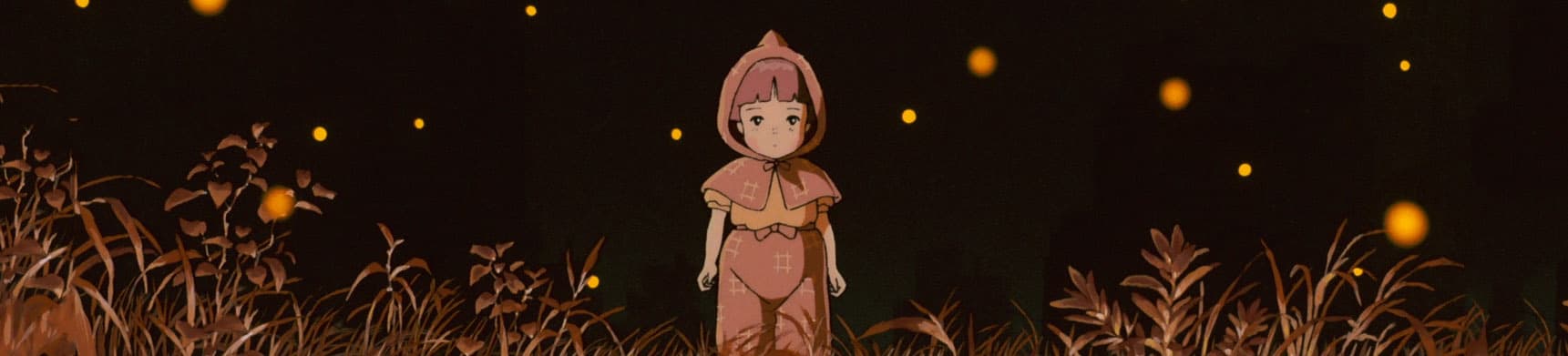
It seems that i have a bit of a different take than the majority of viewers. I've seen Grave of the Fireflies being described as anti-war, and while i don't think that's inaccurate, i also don't believe that's what the film is trying to accomplish. Rather, the war serves as bleak backdrop to the siblings' relationship, which is the real emotional crux of the movie. Seita and Setsuko's relationship might be simple, but it's fierce in its sincerity, loyalty and protectiveness.
This is tragedy in the purest sense, and a masterfully crafted one at that. Right from the start, we learn that the characters are doomed. This casts a mournful shadow over everything they do, even in the scenes that depict pure childlike joy (and there are many scenes like this - they help deepen the siblings' bond, make our connection to them stronger, while also making their demise hurt more). The audience is forced into a kind of helplessness, as we watch the siblings play on the beach, sing together, catch fireflies, play pretend, bond, put up with their aunt, endure hunger, struggle to survive - we want to reach through the screen, warn them of the upcoming danger, save them. But there's no helping them. These feelings of grief and nervous anticipation are further reinforced by the characters themselves, as they go through their memories post-mortem. What does Seita feel? Is he regretful, reliving grief, or is he glad that he's reunited with Setsuko? Is there any reconciliation with his past self? One might view Seita's choice to withdraw from society as his cardinal mistake, but that can only be said in hindsight. There's nothing else he realistically could've done - he too is a child, left bereft by the adults that should've, but couldn't or wouldn't protect him. One of the scenes that shook me the most was the beginning of the film where people pass by Seita's emaciated body without sparing him another glance.
I also have to applaud the animation. There is some striking imagery, especially when the siblings observe fireflies. The characters have a brown outline, which makes everything feel a bit softer, more delicate and vulnerable. Setsuko's movement, in particular, is so reminiscent of real life toddlers. This is most evident in the way her small face scrunches up when she cries. The music also greatly contributes in creating both cheerful, but also sorrowful atmosphere.
(It's worth noting that this movie is based on a semi-autobiographical short story by Akiyuki Nosaka. Nosaka wasn't as noble as Seita - he stole food from his little sister and even hit her when she cried. One can view the fictional retelling as wishful thinking, something that should've been. Here Seita's death serves as redemption for the author.)
(accidentally rated this with a 10/100 instead of a 100 whoops)
34 out of 38 users liked this review