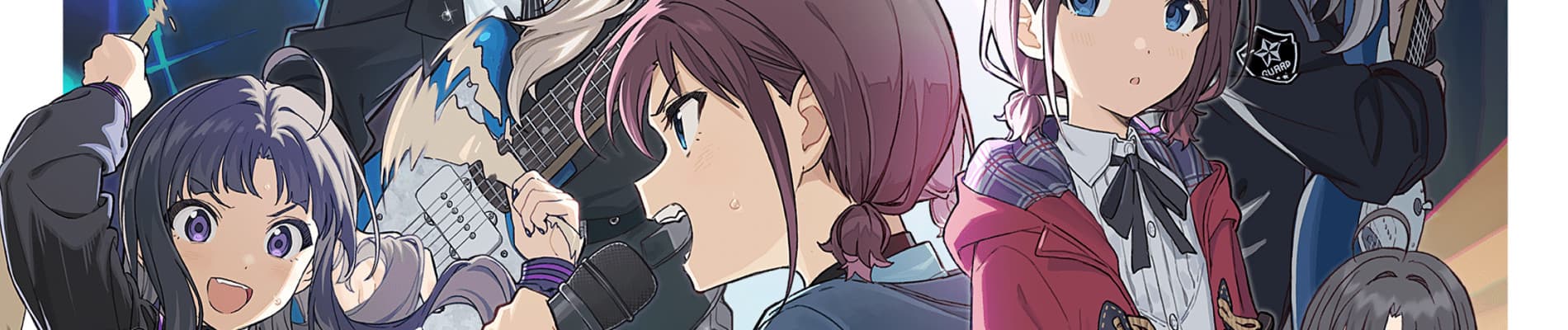
Girls Band Cry
a review by RiPHopscotch
a review by RiPHopscotch
There’s something almost delicious about the word “irony”, especially among people who grew up being immersed in internet humor. While comics have always been able to lean on a kind of wry, tongue-in-cheek twist to poke fun at the inherent absurdity of something, more modern “meme humor” is often steeped in post-irony, meta-irony, or whatever other kinds of irony you can concoct. But irony isn’t just something to make us laugh. Something like a chef hating food or a fire station burning down would be ironic situations where reality and expectations diverge, but not necessarily in a funny way. On its surface, nothing about Girls Band Cry is ironic. From the rooftops this show shouts—screams, even—the message that it wants to convey to the audience, showing off its themes with an almost refreshing sincerity. However, lurking beneath the surface is a bit of irony that seems so antithetical to those themes that their overall impact can’t help but be greatly dampened.
Girls Band Cry starts by introducing us to Nina Iseri, who quickly establishes herself as the driving force of the story. After her solo move to Tokyo starts… less than optimally, she’s found feeling sorry for herself in a coffee shop. As a result, she tries to cheer herself up by going to see her favorite musical artist, Momoka Kawaragi, who just so happens to be doing a solo street set nearby. After meeting, and the requisite Wacky Hijinks™ occuring, the two eventually end up back at Momoka’s apartment, where she reveals that she’s planning on hanging up the guitar and giving up music starting tomorrow.

This scene, and the entire back half of the first episode, is where one of the most extreme personality traits of Nina starts to shine through. For most of the initial episode she’s come across as rather timid, though there have been hints that she has a lot of resentment and hostility brewing beneath the surface. Now the audience sees her stubbornness, her absolute refusal to “lose”, and her desire to impart that feeling onto others like Momoka. She manages to convince Momoka to stick around and to keep playing music, and eventually Nina joins Momoka’s new band as the vocalist. Over the span of the next few episodes a new member, Subaru, joins the band, which is eventually rounded out by two more girls, Tomo and Rupa. Together they form “Togenashi Togeari”, and they all more-or-less work together to make it as an indie band.
It’s at this point I have to address the first of many issues I have with Girls Band Cry: Nina. Simply put, she is one of the most unlikeable characters I have come across in years, with a sense of self-righteousness so palpable it feels like she is the fiercest zealot on an unending moral crusade. She pushes and pushes and pushes, constantly sending those around her to their breaking points and starting fights, at which point she paints herself the victim. She is, to temporarily adopt internet parlance, an “S-tier ragebaiter”. This pattern happens several times over the course of the series, and eventually it feels like Nina’s personality overwhelms every character that remotely challenges her. I can’t see any clearer examples of this than in her relationships with Tomo and Momoka.

While Tomo briefly appears in the first episode, it’s not until episode six that she formally joins the band. Despite a dream of playing the Budokan and a passion for music, she’s had trouble in her previous bands, and it isn’t difficult to discern the reason: Tomo has a very strong personality, and has very high expectations from her bandmates. If she thinks someone is bad, she’ll say they’re bad and start a fight. If she thinks someone isn’t trying hard enough, she’ll say they’re doing nothing and start a fight. Most stories would treat this as a flaw to be worked on over the course of a character’s arc. By the end, Tomo might still have a sharper edge than most, but it would be dulled, and she would be capable of behaving like a functional person and getting along with those around her. She would have learned how to deliver feedback that was actually constructive as opposed to simply tearing people down and calling them bad, and the audience would be shown evidence of her growth. That’d be the traditional, safe option.
Girls Band Cry, however, takes a very different approach. Nina actively encourages Tomo to continue being that same brash, abrasive person who was unable to connect with people. “Encourage” actually isn’t even strong enough here, as this behavior is coaxed out of Tomo by Nina—she literally tries to bring out the toxicity in her. The reason? Nina believes that’s simply how Tomo truly is, that inherently Tomo is, well, an asshole. The concept of changing for others to any degree, of adapting to make others more comfortable, is anathema to Nina. Writing a character so fundamentally opposed to growth is certainly… unique, but more importantly it stifles the ability of the rest of the cast to have true character arcs and demonstrate development. And honestly? It’s just unfulfilling when a character like Tomo, who is in dire need of some kind of growth, has an arc that ends up encouraging her to stay the same, painting those who can't handle her brashness as the problem.

While the Nina/Tomo relationship dynamic is frustrating, it doesn’t even come close to the sense of disbelief I feel when I think about the Nina/Momoka relationship, which (unlike the former) happens over the span of the entire series. From the minute they meet in episode one it never feels like these two are on equal footing, as Nina clearly idolizes Momoka. Nina sees her as the person who created the music that saved her, and as a result Momoka’s desire to quit making music is something wholly unacceptable. I initially thought the two working through this dynamic and eventually reaching a healthier place could be interesting. However, that isn’t what happens.

Nina and Momoka’s relationship climaxes in episode eight, when the two travel to a show being performed by Momoka’s old band (who have replaced her with Nina’s old high school friend/now rival and yes, it really is as contrived as it sounds). Through a series of fights within the episode, two developments come to light. The first is that Momoka sees herself in Nina, and as a result is concerned about her future. Nina absolutely cannot abide this, and doesn’t want Momoka to use her fear of Nina turning out like her as a reason to quit music. This is probably the peak of Nina as a character. Momoka’s fear of her past is preventing her from pursuing her dream, and Nina helps her overcome that—it has so much potential to be great. On the flip side, it also becomes apparent that Nina is entirely incapable of realizing Momoka isn't her memory. Momoka isn't just someone who churns out life changing music, and when she was writing the music that changed Nina's life she had hopes, dreams, and aspirations Nina knew nothing about. Not only does Nina refuse to hear that, she projects her own feelings onto Momoka.
You started the band because you wanted to express your feelings, your joy, your anger, your sadness. That’s why you sang at your school and came to Tokyo! That’s why you went professional! Why are you scared?
Although that is being said by Nina to Momoka, that might as well have been Nina talking to herself. After all, it’s Nina who used Momoka’s music as an excuse to drop out of school, to move to Tokyo, to stop trying to get into university and instead become a musician. Her naked hypocrisy detracts so, so much from her very valid points about Momoka, and it becomes apparent that this entire relationship is two broken people using each other as a crutch. And while Nina does end up forcing Momoka to not use her as an excuse to run away, Momoka never even thinks to ask Nina not to use her as an excuse to avoid growing up. In the universe of Girls Band Cry, Nina is never wrong, and never in the wrong.
All of this does beg the question, “what is Girls Band Cry even about?” And honestly, that question brings a host of new issues and frustrations. It’s not really about music or being in a band, which are both just kind of the backdrop for the soap opera the rest of the show is. I’ve talked to people who claim that Girls Band Cry is about a group of girls who are in active rebellion against the concept of doing the "correct" thing with their lives, and while I don’t wholly disagree, it’s just a little bit off to me. I don’t think this is a show about not being “correct” so much as it is a show about not being “wrong”. Nina needs to know she wasn’t wrong to value Momoka’s music so highly, in the same way Momoka needs reassurance she wasn’t wrong to value her integrity as an artist so highly. Subaru needs to know she wasn’t wrong in rejecting her grandmother’s dream for her and pursuing music, and Tomo needs to know she wasn’t wrong when she pushed away anyone who couldn’t meet her standards. And while I know this unyielding desire to not be wrong is going to be appealing to a lot of people, I just can’t get behind it. It’s okay to be wrong—it’s good even. Looking back on something, realizing it was a mistake, and learning from it is one of the best avenues people have to grow and mature.

My frustration with the characters and their relationships inspired me to look at the individuals credited, and I was taken aback when I saw the script and series composition was done by Jukki Haneda. Haneda is fairly prolific, but there is one project I know him best for: A Place Further than the Universe, which is my favorite series of all time. There are a couple reasons I was floored, but first I just want to provide some snippets from both shows, where two characters (Shirase and Nina) are expressing similar feelings around loving a certain place towards the end of their series.
A place further than the universe… It’s a place that strips everything bare. Time, life, hearts… It’s a place with nothing to protect you and nowhere to hide. It’s an environment that exposes everything we’re embarrassed about, and everything we want to hide, and so naked and crying, we’re forced to come face-to-face with who we really are. We’ve overcome trial after trial together. And from that, I think I now understand… the reason my mother loved this place was not just this scenery, this sky, this wind, but also the time she spent here overcoming things with her team. She loved this atmosphere, where you have no choice but to overcome things with your team, with nothing else to get in the way. I love this place.
This is from the finale of A Place Further than the Universe, when the characters are reflecting on their time in Antarctica. Now, here’s a quote from episode twelve of Girls Band Cry, where Nina is reflecting on why she loves Tokyo.
I love this city. I love this city where I met lifelong friends I can laugh and cry with.
Obviously these two scenes have wildly different contexts and it’s more than a little intellectually dishonest of me to frame a comparison like this, but the underlying reason I was taken aback was that I couldn’t believe the same person wrote these shows. It’s not just the prose and dialogue of one against the other though. The characters of A Place Further than the Universe feel so much more connected with not only each other, but also with the setting of the series. The writing was seamless, and layered each of the four girls on top of each other in such a way that you felt it was the most natural thing in the world they became best friends. The audience understood how strong Shirase’s desire was to go to Antarctica, how her enthusiasm rubbed off on Kimari, how the two of them caught Hinata’s attention, and how Yuzuki really just wanted to be part of a group. Once you got over the idea of high school girls going to Antarctica, nothing felt out of place; the characters became so interwoven that, by the end of the series, Antarctica wasn’t needed to bind them together at all. These girls were clearly going to be lifelong friends, no matter what happened next.
In Girls Band Cry, there is nothing coming close to that. Momoka is on the verge of quitting music, and Nina is less interested in music as a general idea and more interested in Momoka’s music specifically. Subaru and Tomo have a desire to play music, but little connecting them to either Nina or Momoka, and Rupa only seems interested in Tomo. The characters of this show just feel so… fragmented, and disconnected from one another, that it’s really hard to see them becoming friends, or even being particularly good bandmates. Girls Band Cry tells the audience how close they become over the course of the series, quite often in fact, but aside from Momoka and Nina, we’re really not shown the girls becoming close. If anything, we’re shown dozens of instances where the various personalities clashing might have led to the dissolution of the band, yet inexplicably don't.


The writing, unfortunately, is not the only part of the production that could be improved upon. Visually, the most charitable I can be would be saying that Girls Band Cry is wildly inconsistent. The show is entirely 3D, and I’d be remiss if I didn’t give credit to the way having the entire production be 3D makes the transition from episode to stage performance much less jarring. The stage performances themselves are also visual spectacles, and while I do think occasionally there is simply too much going on for my brain to process, they’re flashy and fun. However, outside of the stage performances the visuals swing between “bland but alright” and “PS2 cutscene”. Efforts have clearly been made to mimic common 2D visual design cues, however the linework and compositing are often completely off, making the characters look totally unnatural within the space. Backgrounds and textures tend to be flat and feel totally devoid of depth, lighting is one-note, and the camerawork frequently feels uninspired. Ultimately, it feels like this show doesn't take full advantage of being entirely 3D and doesn't have a unique visual identity, and as a result ends up coming across as a knock-off of a traditional 2D production.
The production element that I can’t give any credit to though—and that might actually be a little ironic, given that this is a show with a focus on music—is the sound mixing. It is routinely horrendous, to the point where I initially thought it must have been an encoding error or something on the part of the streaming site I was using, only to discover it was just a part of the show upon downloading the series. Emotional climaxes regularly have solid voicework fighting against backing tracks, to the point where it becomes genuinely difficult to hear the characters speaking. I really do not think I’ve ever heard a backing piano track drown out dialogue before Girls Band Cry, and it is not something that I ever want to experience again.
A show ostensibly about a band having poor audio-mixing isn't actually the bit of “irony” I was initially alluding to though. Before I get to that, let me give a bit of background into the people behind this production. Girls Band Cry was made primarily by Toei Animation, a massive studio that has been around in some way, shape, or form since 1948, and in that time has been responsible for animating series like One Piece, Dragon Ball, Precure, Doremi, Slam Dunk, Digimon, Yu-Gi-Oh!… and so, so many more (but I’d be remiss if I didn’t also shout out Kyousougiga here). I say “made primarily by” because the show was a product in conjunction with Universal Music Japan—one of the largest record labels in Japan. With two industry titans behind a project that did not splurge on visuals, one might assume the budget would go towards getting industry stars to come on and do voice work… but strangely enough, this is the debut project for every voice actor with a leading role. The reason? They were actually all scouted/selected back in 2021, and a real-world Togenashi Togeari was formed alongside the show with those same voice actors as members of the now-touring band. And did I mention there’s a Girls Band Cry gacha game in the works?
To be clear, I don’t begrudge companies trying to make money. I will, however, begrudge a production for putting the concept, the idea, of being “indie” on a pedestal despite nothing about said production being indie. This show draws my ire for the opposite reason a show like Keep Your Hands off Eizouken! gets my adoration; it feels disingenuous. Girls Band Cry seems like it was designed by a committee of two industry giants to springboard not just a show, not just a band, but an intellectual property that will be a recurring source of revenue for years to come. Let me just ask this: if two massive companies using a show about indie musicians to launch a new IP—that from the moment its released consists of an anime, a band whose members were carefully selected and trained, and a planned gacha game—isn’t ironic, then what is? How am I supposed to take Nina’s staunch desire to have Momoka pursue her own sound and eschew chasing record sales seriously, knowing this entire production is, essentially, a cynical cash-grab?

If that feels like a particularly venomous opinion, I get it. This entire review is more than a little critical, because when it comes down to it not only do I think the show is a cynical cash-grab, I just don’t think it’s particularly good. When I say that though, what I mean is good holistically. There are definitely some strong elements of the show, and in particular I’m thinking of one episode.
Episode ten of Girls Band Cry, titled Wandervogel, was easily the best episode of the entire series, and an episode I’m more than comfortable saying I enjoyed immensely. It revolves around Nina taking a trip back home, which was precipitated by a letter she sent home in which she essentially excised herself from her family. She’s forced to confront her past, as well as her mom and dad, who she’s terrified see her as a problem-child and failure. Not only is the family drama well done, but it puts Nina in a position she hasn’t been in up to this point. Now that she’s home she can’t just escape into victimhood, and she’s beaten over the head with the fact she’s loved. Her conversations with her sister and dad are well-written and well-directed, and I especially love the shot compositions. Showing off her father chainsmoking in an isolated room, showing how many cigarettes he’s burned through in the ash tray, cutting back and forth from both sides of the wall between them, shows not only his self-imposed separation from his daughter as the head of the house, but also how much he’s agonizing over how to best handle her. It even ends with Nina giving something resembling an apology (the only time in the series she does), and acknowledging she loves her family and they love her. It’s an episode that demonstrates the desire for family members to understand one another, and while nothing about it is ground-breaking, it’s very well done; I truly wish more of the series was as heartfelt as this episode.
And I think how heartfelt something is has to count for a lot, doesn’t it? How sincere, or genuine, something is. When I consume art, be it anime, film, music, books, or whatever else, I want to feel like what I’m consuming is something the creator is proud of. I want to know they don’t just view their creation as something to be commoditized and sold, but also an expression of their creativity. And maybe it's presumptuous for me to say, but I just don’t get that feeling with Girls Band Cry… at all. This never feels like the work of a creative team, it feels like the work of a committee of people wearing suits. It’s sterile and artificial when it needs to be as messy and chaotic as the story and characters it depicts. I want it to feel natural and organic, as opposed to feeling like a multi-step plan on how to monetize this IP has been in place since 2020/2021. More than anything else, this feels like a product. And that’s just an ironic twist that I can’t get behind.
49.5 out of 83 users liked this review
