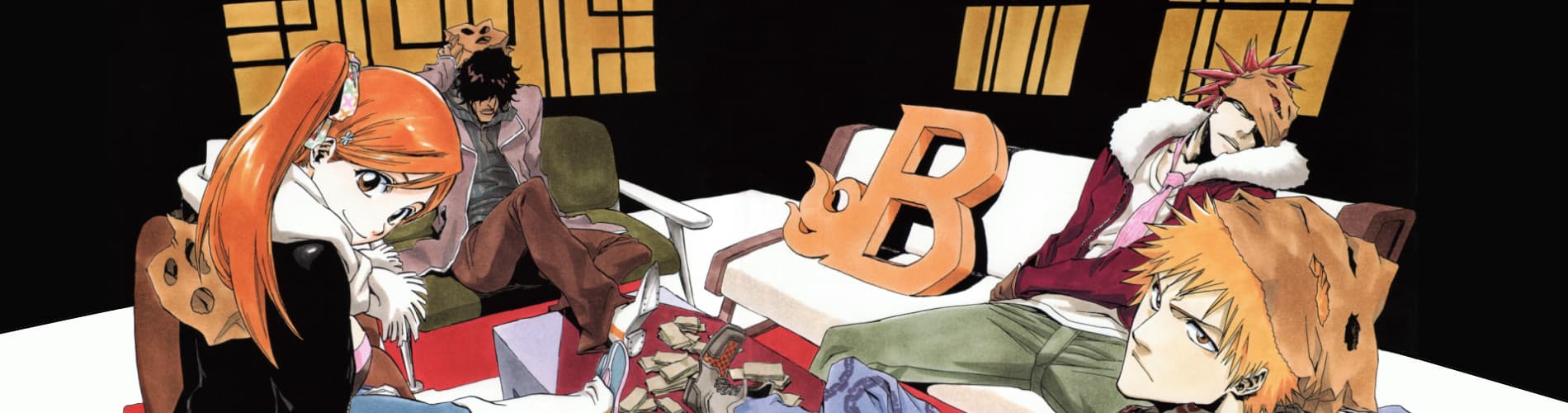
Revisiting Bleach all the way through is a curious and fulfilling experience. It’s a nostalgic trip down memory lane to one of the shonen classics that felt simultaneously light-hearted and heart-wrenching. Initially, it’s like a candy, with its flashy combat and vibrant characters. However, a second read reveals that Tite Kubo is actually weaving a multi-layered and self-examining narrative, beyond the spectacle of swords and shades.
One of the first things that strikes you on a reread is how much tighter the early arcs are compared to the later, sprawling ones. The Substitute Shinigami arc and the Soul Society arcs are the gems of Bleach, showcasing Kubo’s mastery of momentum, pacing, and buildup. He skillfully balances mystery, world-building, and character introduction without overwhelming the reader. Ichigo’s reasons are clear, and his development is natural. The presence and subsequent extraction of Rukia also serve as the emotional core of the story, highlighting the series’ tragic heart and the desperate desire to defend.
The Soul Society arc, in particular, reads even better now. The minor political and emotional subplots, such as Byakuya’s cold demeanor, Ukitake’s quiet rebellion, and Aizen’s deceptively serene nature, gain new depth upon a reread. The initial excitement surrounding a jailbreak storyline is revealed as the complexity of a more intricate society with its rigid structure and ambiguous moral compass.
When we enter the third and fourth arcs, Arrancar and Hueco Mundo, Bleach expands in scope but becomes highly inconsistent. However, upon reflection, the bloat that some critics complained about during this stage wasn’t a lack of ideas, but rather an abundance of them. Kubo introduces a plethora of new characters, including Espadas, Visoreds, and Privaron, all of whom are conceptually rich but underdeveloped. For instance, Ulquiorra becomes more intriguing upon a second reading, as his philosophical conflict with Ichigo delves into a central theme of the series: the impossibility of truly knowing anyone and the burden of emotions. Ichigo’s hollowification, whatever its plot contrivance was in Tite Kubo’s mind, can now be interpreted as an allegory for self-alienation and the consequences of fighting without self-awareness.

Next is the Final Arc, or the Thousand-Year Blood War, which suffers the most due to serialization but contains some of the most ambitious storytelling in Bleach. The introduction of the Quincy and the re-framing of Soul Society’s history re-contextualize the series’ moral compass. I read this second time to better understand that Yhwach is less a final boss and more a cosmic inevitability, a force of death and predestination that even godlike beings must confront the cumulative end of their creation. While the richer mythology of the Soul King, Squad Zero, and the broader scope of Kubo’s cosmology is admittedly sparse, it promises to be tantalizingly mythic in its scope.

Upon re-reading, Ichigo reveals himself to be a much more complex lead character than many people acknowledge. It’s not his strength or righteousness that define him, but rather his empathy. He fights not for victory, but for connection. His power-scaling is not linear; instead, he’s emotionally coming to terms with his dual nature, his loss of loved ones, and the meaning of his own will. He’s not the strongest to be the hero; he’s the hero who carries the weight of the broken pieces of everyone.
Reflectively, Bleach transcends the realm of shinigami and hollows. It delves into the profound weight of self-identity, purpose, and legacy, which envelop almost every main character, including Renji’s inferiority complex, Rukia’s guilt, Urahara’s exile, and, of course, Aizen’s god complex. Bleach is devoid of stagnation. Each character is perpetually in motion, striving to save something or find a sense of belonging in a world that appears indifferent to their existence.
As a reread, Bleach offers catharsis, depth, and resolution. While it may not be flawless, it is a testament to the nature of ambitious art. In its final pages, as Ichigo stands tall with his sword, transcending the boundaries of shinigami, hollow, Quincy, or human, he embodies something entirely his own. This natural conclusion to a journey that has always been about defining a sense of self amidst chaos feels fitting and complete.

31.5 out of 34 users liked this review
