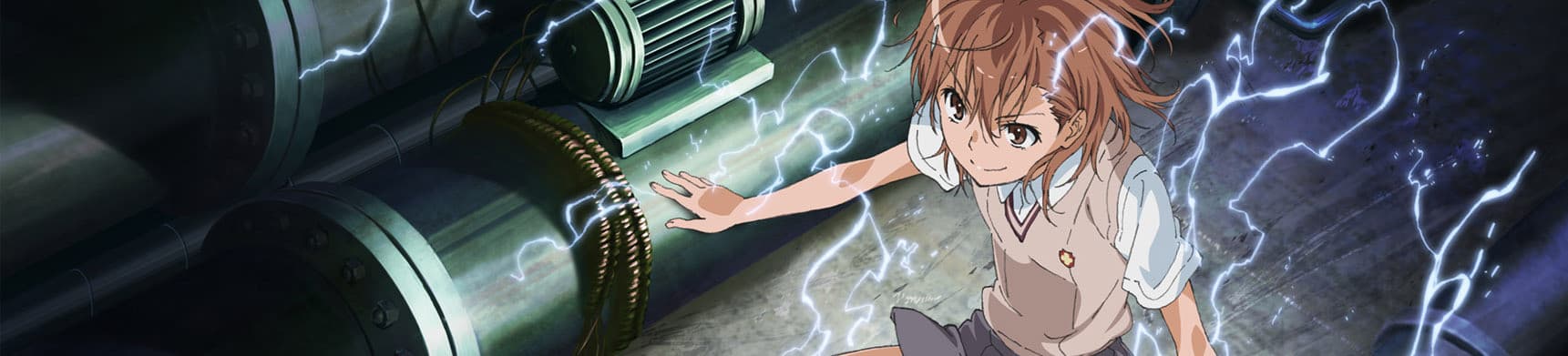
Let's try out this new format.
Synopsis (for both seasons, taken from MAL):
Season 1: The student-filled Academy City is at the forefront of scientific advancement and home to the esper development program. The seven "Level 5" espers are the most powerful in Academy City, and ranked third among them is middle schooler Mikoto Misaka, an electricity manipulator known as "The Railgun."
When strange incidents begin occurring throughout the city, she finds each crime to be connected to the elusive "Level Upper," a legendary device that allegedly increases the esper level of its user. As the situation escalates, it becomes apparent that there is more to the Level Upper than meets the eye, and that Academy City may be a far more twisted place than the glamorous utopia it appears to be.
Toaru Kagaku no Railgun focuses on Misaka and her friends—and the dangerous situations they find themselves in—as they get caught up in the matter of the Level Upper. As Misaka says, "There's never a dull moment in this city."
Season 2: Mikoto Misaka and her friends are back, investigating rumors across Academy City. Soon, Mikoto discovers something terrifying: horrific experiments are taking place throughout the city, involving the murder of thousands of espers. Moreover, these espers are far from just ordinary people: they are clones of Mikoto herself. Feeling responsible for their treatment, she sets off to put an end to the experiments; however, the forces opposing her are much more dangerous than she anticipated, and Mikoto finds herself up against some of the most powerful espers imaginable.
Toaru Kagaku no Railgun S continues the story of the Railgun as she desperately fights to put an end to the inhuman experiments that she believes she helped cause, her life dragged deep into despair in the process. There's never a dull moment in Academy City, but no one ever said all of them would be pleasant.
Story:
I'm done with plot summary. Let's just analyze the story. Each analysis takes both seasons into account.
Premise (1.5 out of 2 points): The premise of Railgun, as defined by the synopses, is definitely unique due to how supernatural the story of the show is. If you didn't read the synopsis, the show basically tells the story of Misaka Mikoto, a typical teenage girl with magnificent powers, and her adventures with her friends in this wide expanse of scientific innovation and contemporary life otherwise known as Academy City. The story integrates both normal and abnormal elements, so the story is easy for viewers who prefer a natural or supernatural premise. Additionally, the wide variety of "genre" (e.g., action, comedy, sci-fi) adds another dimension to the story while having something that any viewer can enjoy. However, such variety might push viewers away since genre preference is subjective.
Pace (.5 out of 2 points): Railgun's pace is all over the place; I genuinely felt as if some arcs were too slow while others put their foot on the gas. Seeing such inconsistency left me in a state of confusion for some of the show, and I felt as if some of the story lines would have been much better if they were not rushed/dragged down. Overall, the pace is one of the real weaknesses of the show.
Complexity (2 out of 2 points): Railgun is incredibly detailed. While some viewers might not appreciate shows with incredible amounts of description, background, etc., I loved the amount of lore and information that was provided regarding subjects like AIM dispersion and esper powers. The show as a whole was really interesting and complex in a way that grabs the viewer's attention instead of pushing it away. Overall, I was really immersed within the inner mechanisms of the story.
Plausibility (1.5 out of 2 points): Like with any supernatural show, there seems to be a lack of plausibility regarding the story. However, the contemporary setting and seemingly normal lives and stories told throughout the show are extremely applicable in a real-life setting. Yes, the show does feature the atypical in the form of futuristic technology and supernatural abilities, but these features do not infringe upon the very plausible environment, people, and atmosphere that are seen in the show.
Ending (1.5 out of 2 points): The ending is nice in that it builds upon the themes, events, and plot devices that developed as the show neared its ending. Overall, it seems as if the show wraps up nicely and leaves room for potential future seasons/side stories. The ending scene was a bit cliche, but that is more of a personal criticism rather than an actual detriment.
Overall rating: 8/10
Characters:
Presence (1 out of 2 points): The characters in Railgun seem to follow a pretty consistent formula. They are either present for most of the show and consistently contribute to the development of plot and themes, appear once or twice and contribute to one or two specific arcs, or appear once and do not contribute to the show whatsoever. The main characters (i.e. Misaka, Kuroko, Uiharu, Saten) and some side characters (e.g. Kongou, Mii) are fundamental to the show's plot progression and are omnipresent overall. I was particularly sad that some characters (e.g. Touma) did not see more time in the show; I really loved his character. Other characters, like Shinobu and Shokuhou, are almost irrelevant characters whose presence is incredibly brief and, to be blunt, incredibly idle and pointless.
Personality (2 out of 2 points): Regardless of presence, each character in Railgun is incredibly unique. No character is too generic or bland. In fact, most of the characters are very special in their own right. From the perverse nature of Kuroko, to the tsunderic (probably not a word but meh) tendencies of Misaka, each character separates themselves from the pack well, while also working well in conjunction with one another. The cast is very cohesive when one considers the interactions between these diverse personalities, which helps the viewer appreciate the cast even more as they watch.
Backdrop (2 out of 2 points): I'm not too keen on what backdrop is supposed to be. However, from what I can gather, its the interaction between each character and their environment. With this definition, it seems to me that Railgun's environment is very prominent for each character. In general, it seems as if Academy City plays a significant role when considering both the development and adventures of our cast of characters. Again, I don't really know how backdrop relates to characters, so that's all I'll analyze for now.
Development (1.25 out of 2 points) Most of the characters in Railgun develop quite well albeit very slowly (because of the length of the show). The first season was really spent developing the characters, so it makes sense to rate this segment high. However, some characters do take a backseat in the second season, which does hurt the show slightly, but it left room for Misaka's character to blossom during the clone arc. In addition, some characters do not develop at all, primarily due to both a lack of presence and an inadequate amount of time spent developing supporting characters in general. Don't get me wrong, some supporting cast members develop beautifully (like Kongou), yet the sheer number of characters alongside the more story-driven second season makes it more difficult for some characters to develop.
Keep in mind, I have not watched Index yet. Ratings would probably be a bit higher if I had watched the original before the spin-off.
Catharsis (1.5 out of 2 points): The expression of emotion primarily occurs within the second season. The first season isn't necessary devoid of any catharsis, but the emotional presence found within the last 24 episodes of the show completely dominate compared to the first 24. Most of the emotional purification happens through Misaka's experiences with her clones/Accelerator, but characters like Kuroko, Saten, Uiharu also experience feelings of doubt, fear, and other negative emotions that are eventually purged towards the end of the show. Once again, a lack of presence and development from some characters leaves them completely devoid of any emotional expression, so the catharsis in this show is not perfect.
Overall rating: 7.75/10
Aesthetics (artstyle):
General (2 out of 2 points): The art style in Railgun is very defined and detailed. The attack animations are fantastic to look at, the detail in each character and object is perfect, and the setting of the show is absolutely stunning. Excellent overall.
Characters (1.75 out of 2 points): The characters in Railgun are beautifully animated; the attention to detail from the art directors is extreme, for lack of a better term. The character design is slightly generic, as the characters are made to be middle school students, but the supernatural aspect shoves the simplicity right out the window; it really makes you question whether you're really looking at middle school students.
Backgrounds: (2 out of 2 points): The backgrounds are hyper-realistic; it's as if you're in a real city found somewhere in the world. There's not much else I can say.
Animation (2 out of 2 points): The animation is stellar. It is always good, especially during the battle sequences. Simple animations are executed to perfection while the more complex sequences are amazing to behold. The character movements are also very seamless and do not look choppy in any way. The environment is also animated excellently, as both nature-based forms as well as man-made forms move in a way that catch the viewer's eye.
Visual effects (2 out of 2 points): Very good. The super powers shown in the show are very beautiful and captivating. Other visual effects add to the overall atmosphere found during a particular context and are not intrusive in any way.
Overall rating: 9.75/10
Aesthetics (sound):
Voice acting (3 out of 3 points): The show uses high-profile voice actors who have been heard in plenty of anime. They fit each respective character profile well and are very pleasant to listen to. Nothing sounds exaggerated or fake as well; all of the voices are extremely realistic. Additionally, the performances of some voice actors were absolutely outstanding (Misaka S2 was so good). Excellent overall.
Music (3 out of 4 points): Most of the music in the show was absolutely breathtaking; the openings fit the futuristic and supernatural tone that the show exudes and the ending themes tie up each episode with a touching undertone, something seen on occasion within the show. However, I was not fond of all of the ending themes; I would've preferred something more epic instead of the soothing themes.
Sound effects (3 out of 3 points): Very good. Nothing excessive or ear-destroying. Very soothing when it needed to be and very epic when it needed to be.
Overall rating: 9/10
Enjoyment:
Art (1 out of 1 point): Loved everything about how the anime looked. No complaints.
Sound (1.5 out of 2 points): I love most of the music. As mentioned previously, some of the ending themes were a bit too lackluster; I wanted something more epic or something that I would actually listen to more than once.
Overall (4 out of 7 points): While I believe the story of Railgun to be exhilarating, hilarious, and emotional, the flaws seen within most of the show prevent me from fully appreciating the show. The first season was a bit too slice-of-lifey for my taste, since the plot progression was usually contingent on the development of each character instead of a specific plot. Whenever a specific plot (e.g. Level Upper) was actually established, the pace of the plot was too fast and really left me in a confused state for most of the show. I found the Level Upper and 2nd main arcs to be incredibly dull and lackluster overall. The second season mended some of the problems the first season had, but lacked in other departments that were either stellar or just as bad in the first season. While Misaka's character blossoms into one of the best animated heroines ever, some other characters see little development up until the last few episodes of the show. The Febri arc was mostly bad--save for Kongou's character development and the exaggerated cuteness--and I really felt as if the show should have ended/transitioned into another season after the end of the SISTERS arc. Even with these flaws, I wholeheartedly enjoyed the show's story, but it could have been so much better with some adjustments (or a 3rd season, which hopefully comes).
Overall rating: 6.5/10
Summary:
Railgun is a great show. It's nothing special, but I hold it in high esteem with most of the anime I have watched. I feel like I've done the show an injustice by watching it before checking out Index, but alas I did not have it on my list previous to watching Railgun. The flaws are not egregious, but they pile up and are impossible to ignore after a certain amount of time. Nonetheless, my casual-watcher half adored the show and my critical-watcher half thought it could have done some things better, but also thought it was a nice watch.
I would definitely recommend it.
Misaka is a fucking waifu by the way. She's fucking perfect.
Total rating: 8.25/10
Would I recommend?: Ya. Give it a watch, but don't expect anything perfect. Go into it casually.
14 out of 15 users liked this review