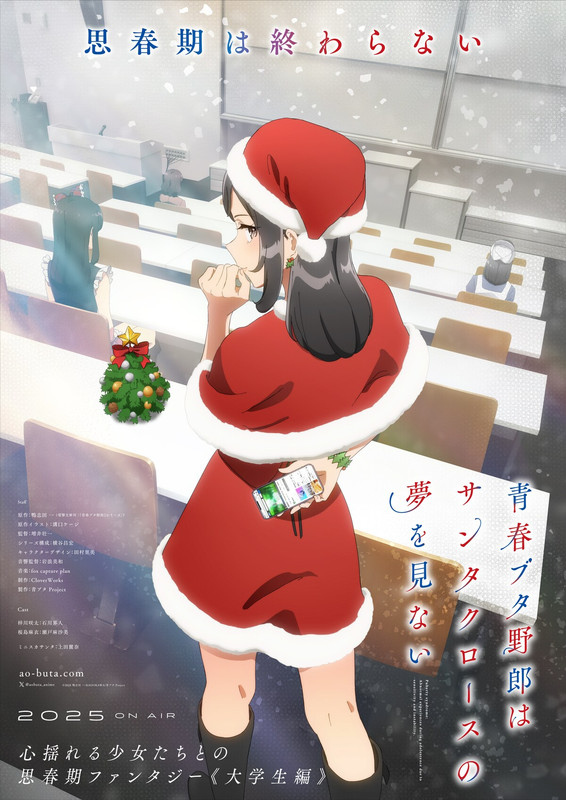
A preliminary note that I feel is necessary: I’m particularly fond of Aobuta as a work, for numerous reasons, and I believe it deserves far more recognition than it currently receives. In my view, it’s not easy to find a series capable of consistently delivering excellent interactions between its characters, with such a functional chemistry between the male and female leads, while also being able, often in subtle way, to offer insights, themes, and reflections that I personally find very compelling. As for Santa Claus — the second-to-last act of the anime adaptation — I’d like to talk about it in this short analysis/or review, if you prefer. (Needless to say, there will be spoilers.) ___
(The) Alleged flaws
Let’s start simple: the first aspect I want to consider is the introduction of new characters into the cast. Innovation can only be a good thing (after all, one couldn’t expect the story to keep moving forward with the same old characters forever, no matter how iconic they are; otherwise it would have become monotonous). I admit, though, that at first I was a bit concerned about how all these newcomers (and there were quite a few) would be handled. But in the end, I’d say the result was more than respectable. Sure, inevitably some characters get less screen time — Nodoka, Futaba herself, Kunimi (who, while never central, remains utterly peripheral), and so on— but, well, you can’t have everything in life. Rio definitely gets less space compared to previous arcs, but her role remains essentially unchanged: the steadfast friend and confidante to young Sakuta. Each of the new characters is handled well: from Uzuki (who had already appeared before) to Ikumi, Sara, and Nene. Putting aside the latter for a moment —the true trait d’union of the entire season, in the guise of Kirishima Tōko — none of the other three ever feels detached from the story once their respective arcs are over. This clearly shows that every character in this narrative matters, and none of them are left behind. Even the “enigmatic” Mitou Miori, whose role seems minor at first glance, manages to leave a strong impression during her brief appearances (indeed, proving crucial for understanding Nene’s particular case of the Puberty Syndrome).
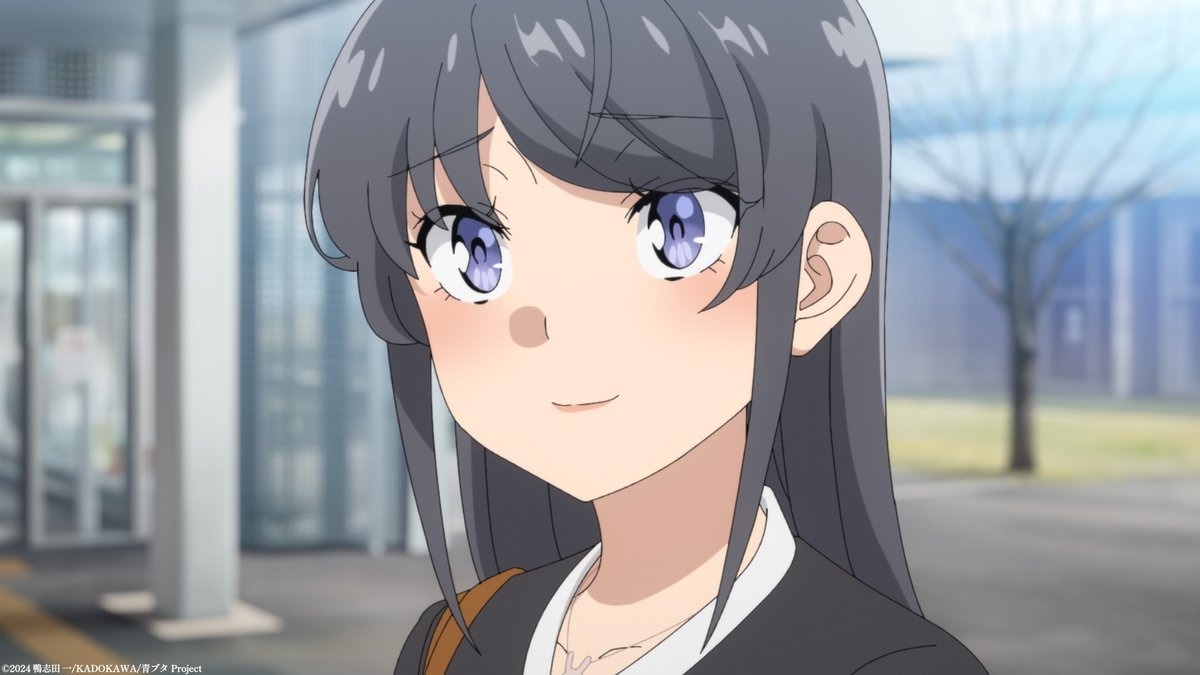
Another matter: the supposed “disappearance” of Mai. It’s true that in the first part, one might get the impression she’s given less attention than usual, but that’s not really the case. Mai is always there; she’s like an immense shadow looming over the entire story, the true driving force behind the events, even for Sakuta himself. In the end, it will once again be her who finds herself in danger and in need of being saved. Let’s also dispel another common misconception, which is the idea that Aobuta is a romance anime. It’s not, at least not primarily. The romantic element is there, of course, but it’s only one piece of the puzzle and it has never been the central focus of the work, which instead revolves around Sakuta’s journey as he faces and resolves the various “cases” that come his way. It’s no coincidence that my favorite episode is the tenth (the famous confrontation between Mai and Sara), where the actress explains why she loves Sakuta and why she “settled” for him. She tells us plainly, openly, and so explicitly that even Sara is left bewildered. From my point of view, Mai embodies the purest and most genuine form of love: one that doesn’t require external approval or validation. She loves Sakuta for who he is, or rather, for the person he has chosen to become in his life. It’s a love built on solid foundations, the fruit of a deep spiritual bond, and defined by a strong, reciprocal connection; a wonderful synallagma. A love driven by the desire to create and build something together, to be with him because they want to be happy together. Mai shines so brightly that she quite literally outclasses every other character in the show within mere moments. It’s an episode so impactful and meaningful that it practically redeems everything else.
Having just spoken of the Queen who radiates immense light upon all those around her, including us viewers, I want to take this opportunity to offer her my genuine praise. For also all the reasons mentioned above, I’ve come to truly admire Mai; from a human standpoint, she’s truly extraordinary. Find me someone kinder and more considerate than her; I doubt it’s even possible. Naturally, she’s one of my all-time favorite characters (and I’d say she’s more than earned it, based on what we’ve seen in the series). She is truly an invaluable treasure as well as an enviable girlfriend.
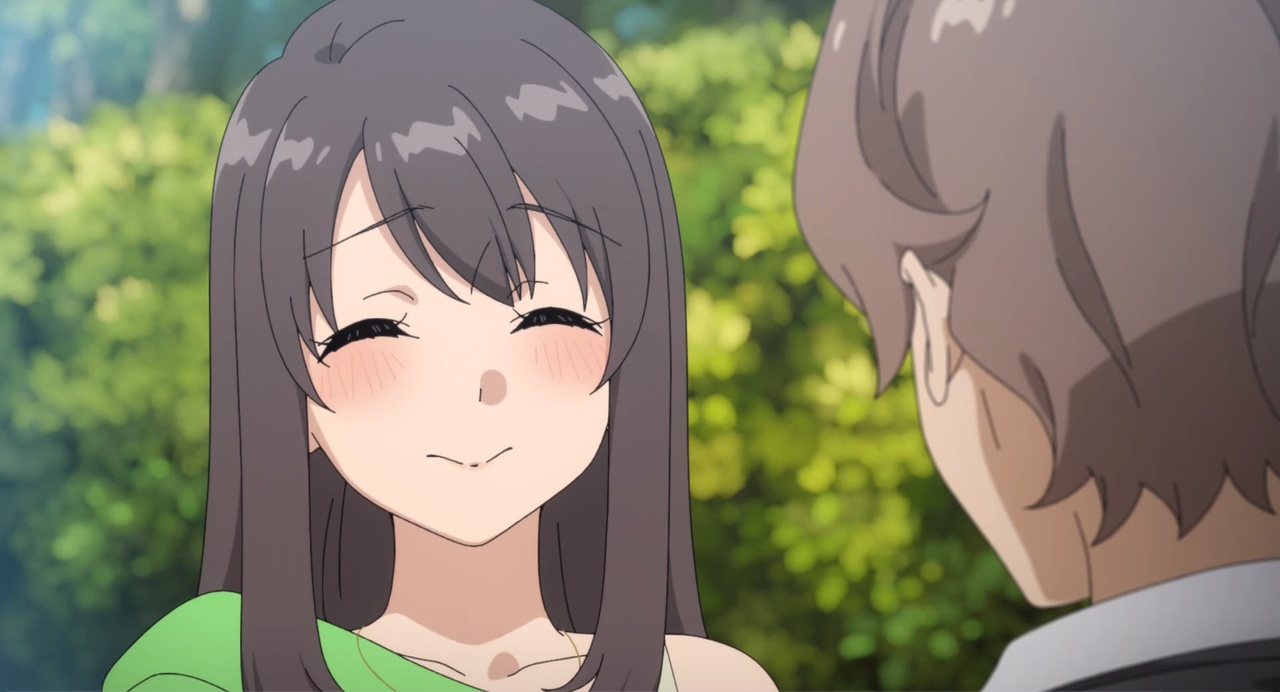
Now, let’s move on to the narrative proper. I found the university arc (that is, this second season as a whole) to be far more layered, intricate, and narratively complex than the first, classic season. In a word, more mature. And that, for me, was a major source of appreciation. It’s a solid narrative, one that progresses from arc to arc while maintaining a common thread; layered, yes, but never confusing or hard to follow. The new female leads themselves, through their respective arcs, bring real variety. With Uzuki, the story delves deeply into themes of society — from the fear of being different, to conformity, to the importance of “reading between the lines,” a vital skill in a society like Japan’s — but also the sense of loss ( as per title – A “Lost” Singer; naturally in an existential sense), as well as personal growth (from youthful illusions to the harsh reality of adulthood). All this is explored within just three episodes of Uzuki’s arc, which is why I consider it a small flower blooming in the desert —a tiny gem in its own right— because the number of themes it manages to address, all reflective and significant, makes for a bold attempt, and one that is, on the whole, well executed. Indeed, Uzuki’s existential malaise is really the result of a series of circumstances and situations accumulating over time.
Next comes Akagi’s arc, which, in truth, carries more weight than one might initially think. Akagi is, in a certain sense, the opposite of Sakuta (or rather, Sakuta succeeded where she failed). Unlike her, he managed to move beyond his past (not without hardship, of course, but he did it), rebuild his life, and move forward toward the future. Akagi’s dilemma is precisely this: she longs to make a clean break with her past, to overcome it, yet paradoxically she finds herself ever more mired in it. If Uzuki’s arc explores the “social world” (with clear reference to Japanese dynamics), then Akagi’s deals with another major topos of the Japanese society: the weight of failure [Akagi failed to help Sakuta when she had the chance] and the crushing pressure of not living up to the expectations others and society placed upon her [having not fulfilled her role as class representative properly]. Later, we learn that Akagi has also failed in life itself [whether in getting into university or becoming the adult she aspired to be] culminating in a powerful desire for escapism that ultimately leads to the “swap” between her two selves.
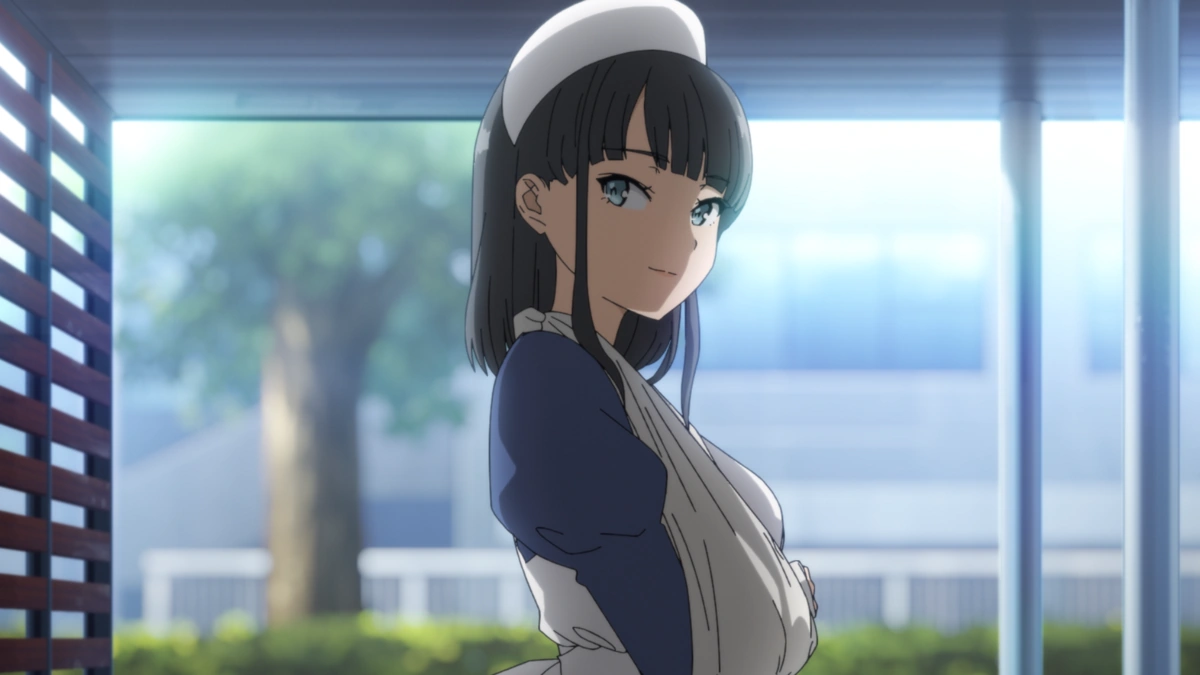
If Akagi is the opposite of Sakuta, then Sara is the nemesis of Mai. Whereas Mai represents a mature and genuine kind of love, Sara is the quintessential immature teenager, with a rather superficial understanding of what she believes love to be. For her, it’s more of a status symbol, something by which one can be judged, or even a source of pride in front of others. Her arc is quite interesting, though, because at its core, she’s simply searching for an answer to her questions: "What is love?" "What does it mean to love someone?" And how often, especially at that age (and even in real life), do we mistake one feeling for another? How often do we realize that what we thought was love was in truth affection, admiration, or perhaps a reflection of how others perceive us in something that we can’t truly control? And again, how often do we think we’re in love when, in reality, it’s lust driving us? What Sara believes to be love is, in fact, nothing of the sort, precisely because in all her relationships, she’s done nothing but impose her own will on her partners. What’s missing is the synallagma I mentioned earlier in reference to Mai; Sara, on the contrary, represents one-sidedness. Or perhaps more than that lust itself, since she seems to take delight in playing with others’ hearts only to discard them afterward (remember the teacher, for instance?).
And finally, Nene —the trait d’union of the entire series. Her suffering, too, is the result of an accumulation of circumstances: the unexpected return of Mai, which stripped her of attention and status, the envy of those around her (as Miori points out), and once again, failure — this time in her career. Fueled by dreams and convinced she had real potential, Nene finds herself stranded once job offers start to dry up. This is her true burden: perceiving herself as a loser, worthless (despite desperately wanting recognition), a foolish idealist who thought she had “everything it takes,” only to fail. This state of utter misery drives her to reject her own identity as “Iwamizawa Nene,” who now has nothing left, and to create a new one as “Kirishima Tōko.” In the finale, we’re struck by a major twist: it turns out Nene wasn’t the only one who wanted to become Tōko: she was merely one among many caught up in the phenomenon. The person we believed to be the mastermind behind it all is, in fact, just part of a much larger project.
If there’s one aspect of this work that absolutely drives me crazy (in the best way), it’s its meticulous attention to detail and, I’d add, its tendency to play a little with the viewer. I’ll give some practical examples to clarify what I mean. Let’s think back to the new cases of Puberty Syndrome affecting the female leads in this season. Two of them, in particular, bear strong similarities to cases we’ve already seen before: for instance, Akagi finds herself in a situation almost identical to Sakuta’s in Knapsack Kid, with two versions of herself switching places between worlds. And yet, while Sakuta’s exchange lasted only a few days (at most), Akagi’s persists for several months before reaching a resolution. A very similar case applies to Nene, whose condition closely resembles Mai’s at the beginning of the story (no one can perceive her presence anymore, she becomes invisible to others, memories of her gradually fade, and so on). The difference, however, lies in the progression: Mai’s situation lasted roughly a couple of weeks at most, whereas Nene’s extends for nearly an entire year. Her case, in fact, is presented from the start as far more severe. This ties directly back to the concept deeply embedded in the series’ iconic first ending theme, Fukashigi no Karte (不可思議のカルテ). The term karte, a loanword taken directly from German, has a very specific meaning in Japanese: it refers to medical charts (the patient records). Literally, the cases we’ve just considered could be seen as similar “charts”— that is, cases sharing a common root — but differing in other respects, such as the progression of the “illness.” Yet the genetic basis remains the same.
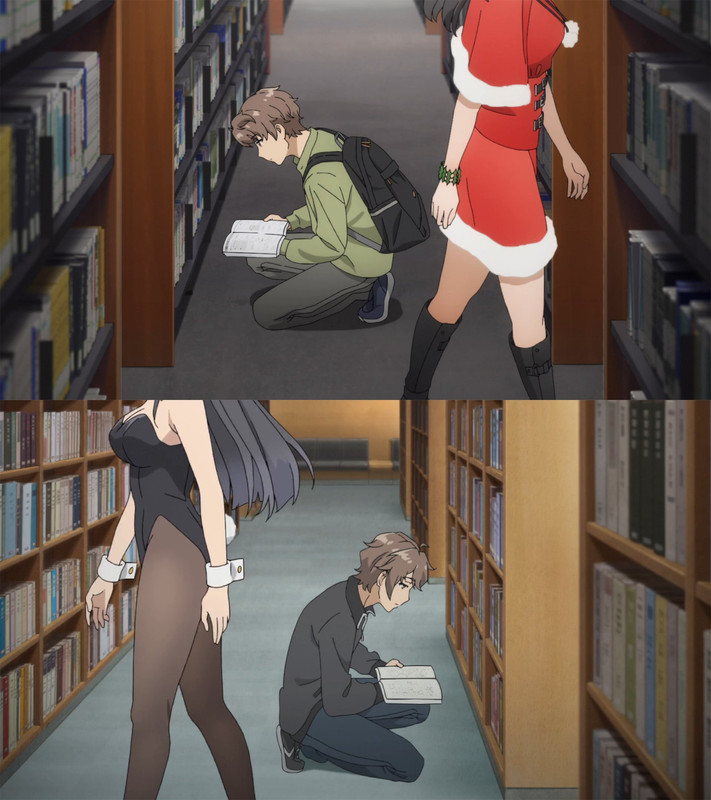
Or consider, for instance, Uzuki’s quip about rabbits on the Moon (a reference both to the Moon Rabbit of East Asian folklore but also to her own name). Another example: at the end of episode four, the object we see falling is a lantern (during her arc, Akagi is associated with the figure of Florence Nightingale, who was famously known as “The Lady with the Lamp”). This shows how truly nothing in this work is left to chance. It’s a story thought through from every possible angle. The series also loves to scatter clues here and there, inviting the viewer to piece things together. In this sense, even the revelation that Takumi was Nene’s boyfriend comes as a delightful surprise though, once again, the anime had already given us the means to figure it out. We already knew the boy was from Hokkaido; when Santa Claus’s true identity and origin are finally revealed, the pieces were all there to connect. Even the most seemingly insignificant detail can suddenly become crucial. ______
Kirishima Tōko: A Strangely Popular Singer… Even in Reality!
The decision to bring the singer Kirishima Tōko and her music into the real world was absolutely brilliant. It draws the viewer deeper into the story, almost as if we ourselves were part of it. I find this concept ingenious because it creates a sort of double narrative track, with the story unfolding on two parallel yet interconnected levels. Moreover, her songs carry strong narrative significance. In total, we’re presented with four tracks, one per arc. Each not only marks and punctuates its respective storyline but also reflects it thematically. In order: 「Social World」— obviously tied to Uzuki; 「Hilbert Space」— referring to the second parallel reality, thus Akagi; 「I Need You」— expressing Sara’s urgent need to always have someone by her side; and finally 「Someone」— representing Nene’s desire to find someone, anyone, who can acknowledge her worth (and, I would add, truly perceive her). From this thoughtful and consistent perspective, even the songs themselves appear deliberate and narratively meaningful, further enriching and beautifying the final result. _____
Quality and Visuals
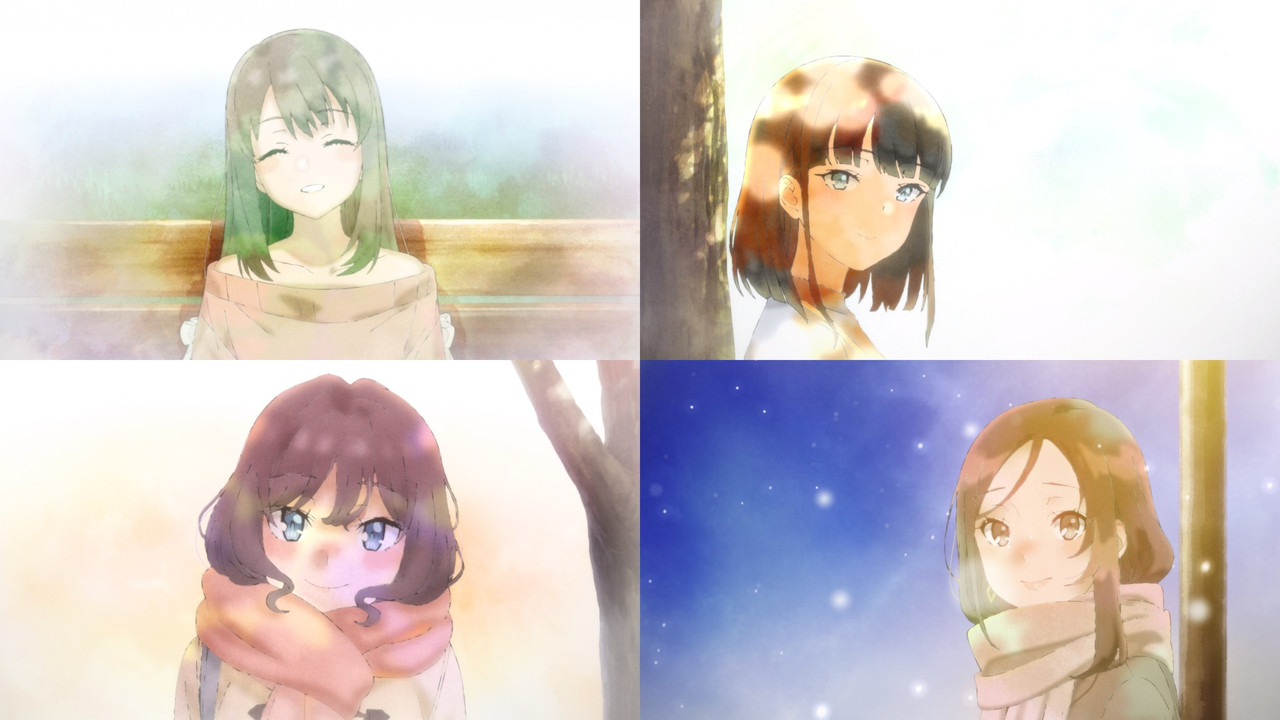
The last point I’d like to address concerns the overall quality of the adaptation and its visuals. The style of Aobuta remains fundamentally the same — strictly speaking — but when it comes to the graphics, that’s where I think Santa Claus falters the most. In my opinion, the visual quality is too uneven and inconsistent, alternating between episodes that look solid and others that feel noticeably weaker, with less attention to detail and nearly nonexistent animation. And that’s truly a shame, especially because other aspects – like the close-up shots, which are always clean and well-rendered – are handled with great care. This fluctuation in quality unfortunately affects even the final episode, which fails to deliver the impact I was hoping for (narratively as well, to be honest; there are a couple of things that I personally would have handled differently). Despite this small stumble at the end, however, nothing detracts from what the series has accomplished so far, nor from what was achieved previously. Still, it’s hard not to feel a sense of regret: it’s painfully clear that, compared to other productions the studio was working on during the same season, this one was treated like the last wheel of the wagon and deprived of even a minimal but much-needed improvement in visual quality. And that’s regrettable not only because the series deserves more on its own merits, but also considering today’s standards, where the overall quality of major anime productions tends to keep raising the bar. For me, the artistic peak is reached in the ending visuals, which feature excellent art direction and a softer, more diffuse linework that beautifully enhances the character designs. The series also continues Aobuta’s tradition in which, at the end of each arc, the ending song is performed by the voice actress of that arc’s heroine, with the exception of the final episode that features a combined version sung by all four female leads. Finally, in this last ending, titled 「Suiheisen wa Boku no Furukizu」, the various heroines appear to be watching a projection of their memories on a screen and in front of which they are sitting, as if it were a genuine psychoanalytic session, that could represent a symbolic staging of their own subconscious. Fukashigi no Karte remains undoubtedly iconic, but this one, too, performs its role admirably.
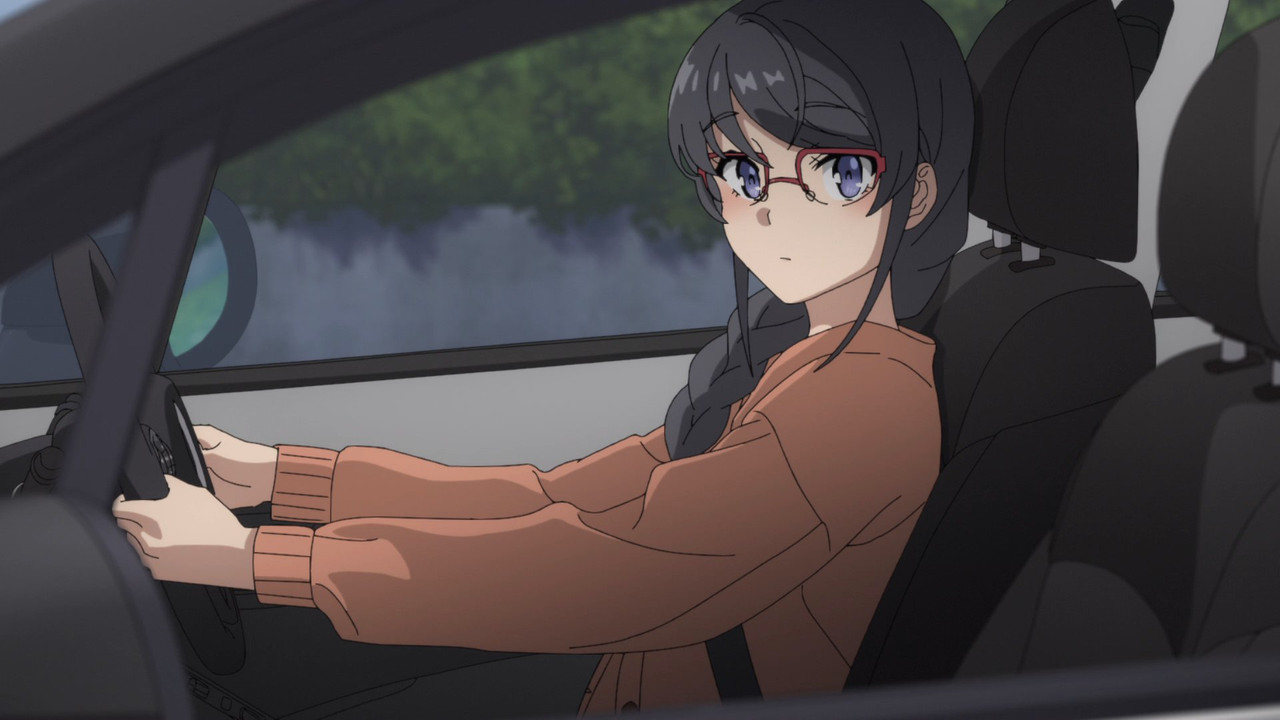
Let me, finally, include this image as well. I couldn’t possibly end this discussion without adding it. I honestly think it’s one of the best moments in the entire season — not only because of the delightful surprise it gives us, but also for how charming it is. Besides, Mai looks really good with glasses; they suit her well. And it’s this innocent Mai at the wheel who extends her greetings to the prospective reader.
24.5 out of 26 users liked this review
