Grave of the Fireflies
a review by oldschoolanimeworld

oldschoolanimeworld
8 months ago·Oct 30, 2025
50
/ 100
a review by oldschoolanimeworld
8 months ago·Oct 30, 2025
"Grave of the Fireflies" is not merely an anime film; it is a profound and heartbreaking masterpiece from Studio Ghibli that transcends the medium. Directed by Isao Takahata, it tells the devastating story of two siblings, Seita and Setsuko, struggling for survival in the final days of World War II. This film is a sobering and unforgettable anti-war narrative that portrays the true cost of conflict through the eyes of the innocent. Its raw emotional power and beautiful, tragic animation will leave a permanent mark on your soul. It's a essential viewing experience that is as important as it is difficult to watch.
To merely call Isao Takahata’s "Grave of the Fireflies" (Hotaru no Haka) a sad anime film is a profound understatement, akin to calling the ocean merely wet. Released in 1988 by Studio Ghibli, this film exists not as entertainment but as an experience—a meticulously crafted, emotionally shattering elegy for the innocent. It is a work that does not seek to tell a story of heroes and villains on a battlefield, but to document the quiet, systematic unraveling of two young lives caught in the gears of a war machine. Decades after its release, it retains its raw, unyielding power, not through graphic violence, but through an intimate and relentless focus on the human cost of conflict, establishing itself as perhaps the most important and devastating anti-war film ever created.
The film’s narrative is deceptively simple, framed by the ghost of a young boy named Seita. We meet his spirit in a train station, succumbing to starvation, his soul joining that of his younger sister, Setsuko. This opening tells us the end from the beginning; there is no suspense about the "what," only the agonizing journey of the "how." The story then flashes back to the firebombing of Kobe, where Seita and Setsuko lose their mother in a horrifically visceral sequence. What follows is their desperate struggle for survival, first under the reluctant and cruel care of a distant aunt, and then on their own in an abandoned hillside shelter. The plot is not driven by grand events, but by the slow, grinding descent from hope to despair, measured in handfuls of rice, stolen vegetables, and the fading light in a child’s eyes.
The film’s genius lies in its methodical deconstruction of dignity. Takahata masterfully illustrates how war erodes humanity long after the bombs have fallen. The initial tragedy of their mother's death is compounded by a thousand smaller, more intimate betrayals. Their aunt, herself a victim of scarcity, transforms from a figure of grudging shelter into a venomous symbol of societal breakdown, her passive-aggressive barbs and the prioritization of her own family’s rice over Seita and Setsuko’s serving as a microcosm of a nation’s collapsing social contract. She doesn't wield a gun, but her actions are a different kind of violence—a psychological warfare that proves just as lethal. This forces the children to flee, not to safety, but to a fragile, doomed independence, believing that their pride and self-reliance are preferable to the slow death of their spirits under her roof.
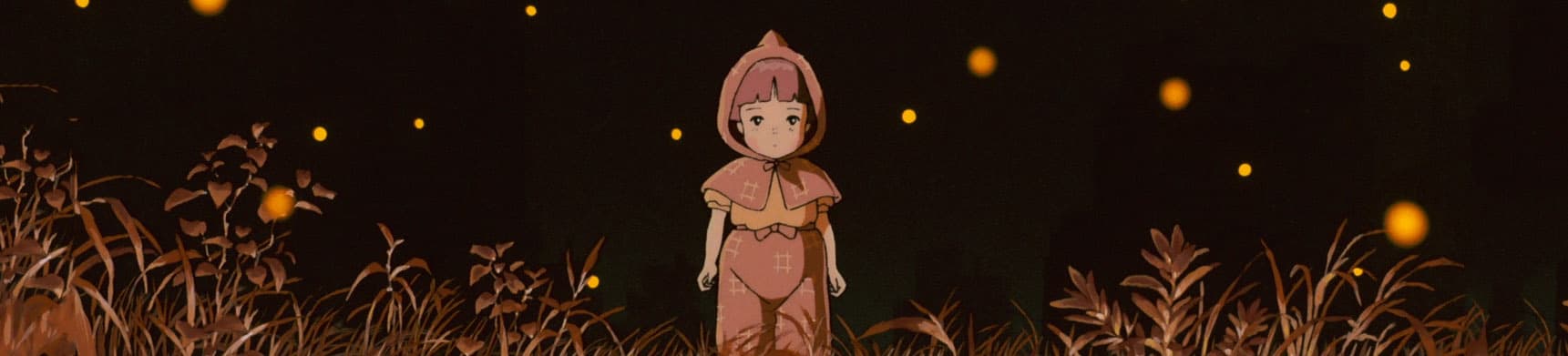
It is in the shelter where the film’s heart truly resides, and where it is most effectively broken. The relationship between Seita and Setsuko is rendered with an almost unbearable tenderness. Seita, a boy thrust into the role of a parent, embodies a tragic and flawed nobility. His determination to protect his sister is both his driving force and his fatal flaw. He is too proud to return to the aunt, too young to navigate the collapsing economy, and too desperate to see the grim reality staring back at him. Setsuko, meanwhile, is the soul of the film. Her innocence is not a cliché but a palpable presence. Her laughter while playing with the fireflies, her confusion at the world's cruelty, and her gradual, physical withering are depicted with a realism that is often difficult to watch. The scene where she desperately eats mud balls, believing them to be the rice cakes Seita promised, is a masterclass in showing, not telling, the depths of their deprivation.
Takahata’s directorial style further elevates the material from mere tragedy to high art. Unlike the more common, lush fantasy of Hayao Miyazaki's Ghibli works, Takahata employs a stark, realistic aesthetic. The animation is grounded, with a keen attention to the physical details of a war-torn landscape: the ashen skies, the charred ruins, the way a child's body begins to show the distinct signs of malnutrition. The sound design is equally masterful. The silence in their shelter is often punctuated only by the sounds of nature or Setsuko's cries, making the world feel vast, empty, and isolating. The absence of a traditional, sweeping score for much of the film forces the audience to sit with the uncomfortable quiet of their suffering, making the moments where music does swell—such as the tragically hopeful melody that accompanies their time at the beach—all the more poignant and ultimately, more devastating.
The film’s ultimate power, and the source of its enduring debate, is its refusal to offer catharsis or a moral lesson that can be easily digested. It does not point a finger solely at the Allied forces or the Japanese Empire. The enemy in "Grave of the Fireflies" is War itself—the abstract, insatiable entity that consumes resources, corrupts human decency, and abandons its most vulnerable. The final, haunting image is not of the two siblings finding peace, but of their ghosts, reunited, sitting on a bench overlooking the modern, brightly lit city of Kobe—a city that has moved on, rebuilt and forgotten. They are permanent ghosts, a silent testament to a pain that, for all its intensity, becomes a footnote in history.
19.5 out of 37 users liked this review