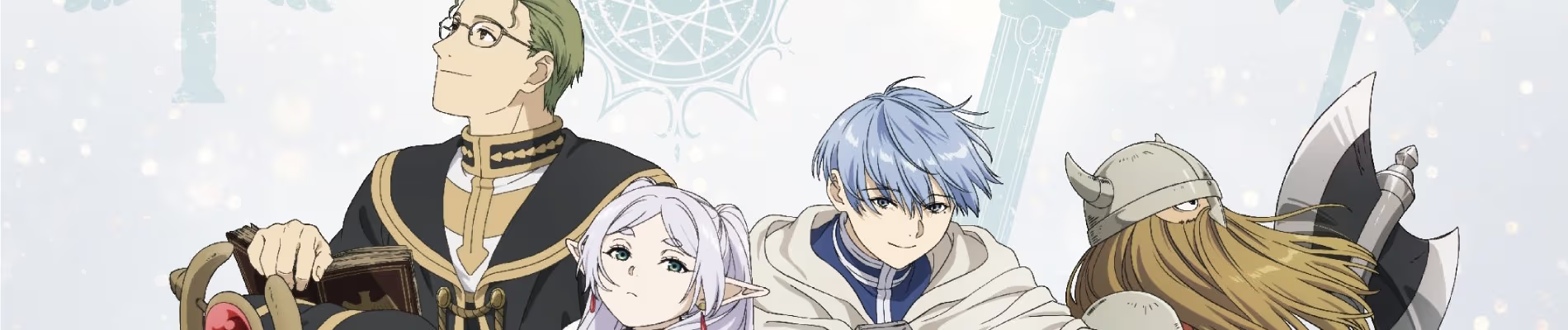
I find it difficult to think of Frieren: Beyond Journey's End as a single entity. If I am to hastily think of it, I'm struck by two images that could not be further from each other.
One is a poignant slice-of-life fantasy, the other is a loud and flashy shounen battle series. One is, I would say, fairly good, but the other, not at all.
The division is as abrupt as it is unwelcome, as the transition from one narrative style to the other seems to specifically upend crucial elements of the show around which its very identity had been formed up until that point. It's as though there is a deliberate effort to keep one half from informing the other. So, in a similar manner, I'm going to examine each half individually at first, before setting them against each other to illustrate how they defy consistency.
This review discusses several events across the entire span of the show, at varying degrees of detail. Whether or not any of the following constitutes spoilers is up to personal judgement, but on my part broad mentions of what a particular storyline is about (e.g, "these episodes are low-stakes exposition") will not be hidden, while references to specific plot points or actions taken by the characters (e.g, "these episodes have X do Y because Z") will be. I've endeavoured to keep the text roughly legible even when skipping the hidden sections.
The early days of Frieren are populated by self-contained storylines whose format allows for an everpresent view of the series' emotional core. Each new establishing shot is also an establishing date, headed with a clear reference to “X years since the death of Himmel the Hero.” Frieren and companions perform some mundane activity that relates to her backstory, prompting a demonstration of it, and then this naturally follows into how she acts differently in the present. After resolution, the pattern repeats, now even further into the future. The show alternates between its two focii – time moves ever onward past one's regrets, seek value in your present experiences instead - with steady regularity, making sure it never strays too far from the point. The overarching plot likewise serves to maintain this rhythm, as by explicitly laying out that the group is performing the exact same journey and by having guardianship of Fern bestowed on Frieren, events across the world and the rest of the cast can easily have a logical link back to her.
The highest point, where the format mentioned above is in full effect and the resolution of the conflict manages to tie back into the themes of the show, comes very early in the story, right as Fern's tutelage under Frieren comes to a close:
While structure and premise work effectively, the notable fault of the first half of Frieren (which remains present in the second, but for reasons that will be explained later is far easier to examine at this stage) is what paints the image between and behind these story beats. In what is sadly common amongst contemporary fantasy anime, visual design suffers. The majority of the cast fall into either the category of a plain cloak or tunic in black or brown, or maintaining a single colour across both their hair and outfit. Unique shapes or objects that can be used to anchor the artwork around recognisable points are exceedingly sparse. The backgrounds are just as drab: non-specific farmsteads, meadows and hamlets, though I note there is one scene where a flashback to 2,000 years ago has the mind to alter the architecture and manner of dress to resemble antiquity. Limiting stylistic changes to this single instance particular seems a huge missed opportunity, since portraying large-scale cultural changes would have been thematically compatible with what was established earlier. In fact, this also relates to what was mentioned in the previous paragraph:
That said, it's not strictly accurate to claim that Frieren doesn't allow its world to change at all. In fact, there are quite significant situations that by the show's own word only come about due to in-universe recent events. Yet instead of building on the story, these events instead supplant it. I present that second half I earlier derided so:
At the halfway mark, the show chooses to surprise both the cast and viewers by announcing a gauntlet of combat. There were spots of this earlier – the introduction of the character of Stark, most prominently – but it was always distinctly set apart from Frieren herself. It wasn't her problem, interacting with the person trying to solve it was. Now, instead, she is tasked with resolving it directly, and the anime itself adjusts to fit. Flashbacks to training montages, discussions of hiding one's magical power level, ideas that would have seemed alien no more than an episode ago are suddenly dragged onstage. Strangest of all, Frieren is retroactively given a second backstory, and an entirely different, even contradictory reputation in the present.
The harsh adjustment of tone is one of two issues with this storyline, but the other requires detail on what exactly happens:
But that does not happen. In fact, it turns out that Frieren was right all along, everything she said and thought is justified word-for-word by the show's lore, and actually taking Fern's advice for even a moment was a huge mistake that warrants the physical retribution she got.
It's a betrayal of both the logic and message of the narrative, and it permanently redefines Frieren's role in the series. From this point onwards she's the archetypical Isekai protagonist one imagines in their head. Immense power, no consequences, and applauded incessantly by every bystander.
I'll discuss her characterisation further in the third section of this review, but for now I want to jump to the final stretch of episodes.
As the conclusion approaches, the show makes another departure from its established format by imposing a literal roadblock. From now until the end of the show the cast will remain within a given area, and interact with more a permanent set of characters. This is in a vacuum a good idea, as it makes sense to try and break away from what is by now a predictable pattern and it allows the next plotline to have greater detail and complexity. However, the cast actually stop for the exact opposite reason: a long, dull, pointless tournament arc. I believe it will be clear from my change in tone that this is the absolute lowest point of the show.
Even just in concept, it's a lazy way to prompt engagement between characters - there's no longer a need to give anyone a motivation or relationship with anyone else, they all just happen to be in the same place at the same time - but since at this point any and all conflict only serves to let Frieren show off how much better she is than everyone else, everything that proceeds is far too simple and repetitive to have any sort of tension or intrigue. I don't mean to spoil the events of the tournament but I don't think I physically can, since every round can be summarised as “the characters are stuck in the same place as Frieren until they are sufficiently impressed or humbled by her.” The individual scenarios and objectives don't matter, nor do the actions of any character who isn't in the title.
Which leads me to the climax, both of the series and this text, where I present what I consider the single worst plot point I've ever come across, and the single best example of just how vain and incoherent this show has become:
It's what I can only describe as a Mary Sue feedback loop. This is not only immediately apparent when it occurs but also incredibly easy to avoid (a single line of dialogue to change the given explanation would suffice), yet the show still ended up written into a corner.
Having covered the most significant areas of the show as they presented to the viewer, I now want to look back at individual aspects of the series and see how they differ from what they began as.
While it's clear the second half of the show casts a shadow over the first, what exacerbates this issue is that it makes an active effort to disagree with everything that originally set up the series. For instance, let's take a look at Frieren's behaviour with Fern. I noted their surrogate familial relationship earlier in this review, but by the later hours of the show they act rather differently. Once Frieren's excessive strength is established, in order to balance out her moments of malice with scenes of low-stakes levity, she turns into a comic relief mascot dragged around (occasionally literally) by Fern. As a result, she no longer leads or has the largest stake in any storyline, so the original pattern of "Frieren recalls the location they've arrived at, Fern involves her with the current situation, Frieren is reminded of Himmel" isn't even possible any more.
On the subject of Himmel, I earlier noted how the series used to regularly annotate itself with "X years after the death of Himmel the Hero." It varied between months and decades, but a significant length of time elapsed between each location, in which Frieren remained as she was while her human companions aged. This was, indeed, the very premise of the show. But the increments of time gradually become much shorter, until not enough has passed to warrant the text and it vanishes entirely. Now, effectively, the rest of the cast are as unaging as Frieren, which removes that unique element of the series entirely.
The loss of that text also highlights the fact that Himmel isn't at all relevant to Frieren's character once she starts fighting everyone. The two situations I discussed earlier are transparently arranged by the author's hand, rather than being a development of her past decisions. In both scenarios, few of the relevant characters get their origins shown, and of that few none connect back to anything Frieren did with her original party (which would have been a very simple way to make them relevant to her and thus more important in the show). This is also an opportunity to note the poor worldbuilding of the series, as with the inception of the tournament arc a vague war between human nations is offhandedly mentioned by a few characters who participated in it. This is a second and entirely indistinguishable historic conflict the viewer is expected to keep track of, between a pair of locations that have not earlier been mentioned nor later matter in the short time the show has left. Once again, there is no reason not to combine this event with Frieren's own history.
In fact, in lieu of any distinctive symbols or designs, the text was perhaps Frieren's only piece of iconography, so removing it takes away not only from the show's purpose but also its identity. A prospective timeline of ten years is laid out at the start of the show, but as the interval between each storyline contracts this goal becomes increasingly distant and the pace of the story shatters. There is no way to gauge how far the cast are along their journey, and so it becomes shamefully obvious the eventual length of the story will be wholly arbitrary.
Finally, I want to look at the world's magic system again. Initial exposition makes it clear that magical practitioners can learn several different spells for varying purposes, and this is used for a character moment when it is found that Frieren retains one functionally useless spell because it was Himmel's favourite. This does not carry though to the shounen-action storylines, where the way magic is treated shifts to what is more common in said shounen-action: the "superpower" type of magic system, where every character has exclusive access to a single specific ability. There's a character who controls earth, another ice, a third who can manipulate his blood and a fourth her hair, amongst several others. This removes meaning from Frieren sacrificing that "part" of her spell repertoire, from her intentionally choosing to do so, as it is now the case that it doesn't work that way. Before, it was apparent in some unquantifiable way that Frieren was doing something to hold a candle for Himmel, but now there is no way to gauge what it even means to know a spell.
To recap, Frieren has her character simplified, her perspective abandoned and her motivation forgotten, while the show reveals that it doesn't actually care about its own direction or setting. It's not a matter of the negatives outweighing the positives; Frieren ends up without any redeemable qualities because it intentionally removed them.
Before I conclude, I'd like to make a short tangent. I've discussed how the show handles its protagonist, but I haven't touched on almost any of the supporting cast. I would say that this is because it’s rather confused about how to treat them. An example is Ubel, who seems to be meant as a sort of rival to Frieren and Fern, yet doesn't ever even interact with them. Another is Stark, who, despite being presented as the tritagonist of the series, has very little to contribute after the storyline in which he is introduced, ending up as more an extra pair of hands tacked onto Fern. During the tournament arc, the pretence is dropped and he is written out entirely. Ubel, meanwhile, gets her own disconnected adventure that never affects the main cast. Both of these wasteful treatments could have been efficiently resolved by pairing those two characters together during that time.
If I do what I said I struggled with, and try to give a single, simple rating for the show, Frieren: Beyond Journey’s End ends up with a score of 1/10 from me. Which - though there are certainly less impressive shows I've dropped or skipped entirely - renders it the worst anime I have ever finished.
I would not recommend it in any context, but if someone was dead set on watching I would suggest dropping it after the first four to six episodes, as after the first two or so storylines the quality falls almost instantly. Incidentally, this would also be my suggestion for how to improve the series for a theoretical new adaptation, as cutting the latter 80% of the show so that it can't ruin the beginning would be the most effective way to start sorting this mess out.
If on the other hand the battle portions of the show don't sound as terrible as I made them out to be, I would instead point to any of the numerous Isekai with the premise "I already beat the last boss so I'm already the strongest" or something to that effect. Frieren is largely just a bad example of that trope, with some of the man-out-of-time elements from "reincarnated demon king" stories mixed in.
This review was based on the official English-subtitled version of the anime, and makes the assumption that it represented an accurate translation of the original dialogue.
58.5 out of 99 users liked this review