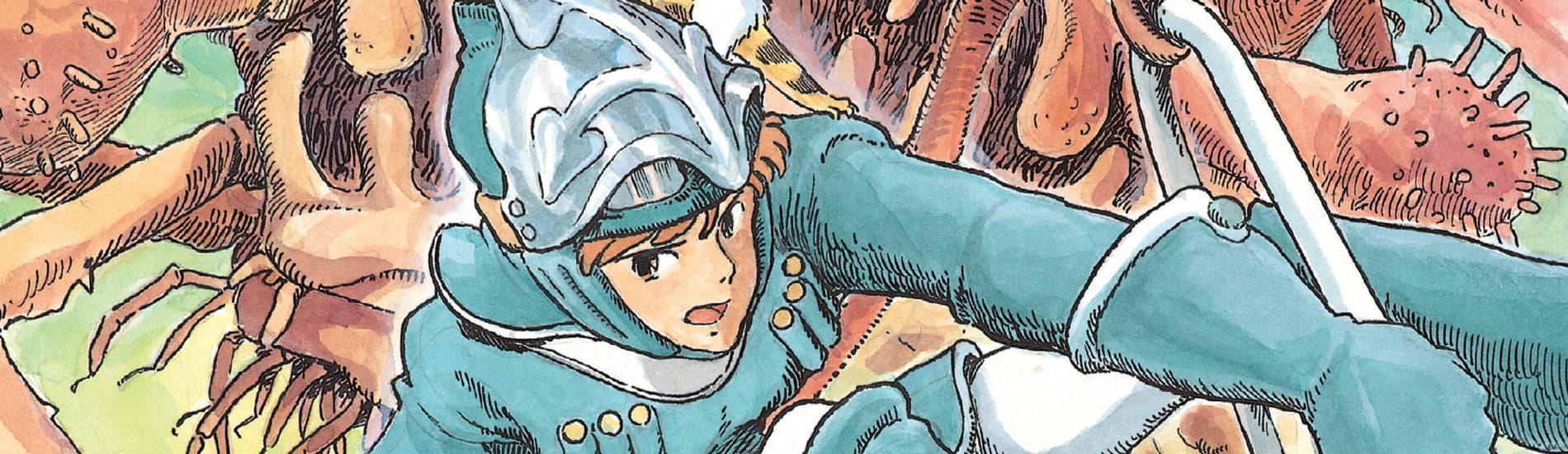
Hayao Miyazaki’s manga Nausicaä of the Valley of the Wind is far more than a conventional post-apocalyptic story. In just four volumes, it unfolds a world shaped by surviving systems after an ecological catastrophe, each claiming to do what is right – yet all failing lethally in their logic. The strength of the manga lies less in spectacular battles or visual effects than in the dense, morally complex world and the psychological depth of its protagonist.
The factions Miyazaki creates are not simple antagonists. At first glance, the Valley of the Wind appears idyllic, but it is merely a fragile balance, dependent on adaptation and caution. Torumekia represents order through power and violence: military control replaces the possibility of moral solutions. The Dorok Empire translates fear into religion and uses sacrifice as a means of stabilization. Over all of this lies the Sea of Corruption, an artificial nature that heals by disregarding humans and their habitats. In the background, the old humanity exerts its influence, with a final plan for a perfect, purified world in which the imperfect have no place.
Nausicaä initially moves as a mediator between these forces. She seeks to understand, translate, and protect, convinced that conflicts arise from ignorance and can be resolved through empathy. Yet this role collapses dramatically in the Dorok territory: civilians are deliberately sacrificed, fanatics provoke violence, and military logic responds blindly. Nausicaä herself kills – and in doing so, her previous identity as a pure, infallible mediator is shattered.
This experience leads to a phase of deep depression: speechlessness, withdrawal, and a loss of meaning. Nausicaä realizes that knowledge does not protect from guilt, that good intentions do not prevent violence, and that no system can save the world. Only the recognition of the old humanity’s plan, which envisions a perfect world at the expense of current humans, forces her into an existential decision: she rejects this perfection. She acts not to redeem or save, but to prevent a final, irrevocable decision over the lives of others.
The philosophical dimension Miyazaki unfolds becomes especially clear when viewed through Albert Camus’ concept of the Absurd. Camus describes the Absurd as the conflict between the human drive for meaning, order, and justice and a reality that does not respond to these expectations. The world itself offers no answers to our questions of right, morality, or purpose; it is indifferent, neutral, and often cruel. This state does not produce simple despair, but confronts humans with the necessity of acting consciously, even though there is no ultimate meaning.
Applied to Nausicaä, this means that she realizes no system – neither Torumekia, nor Dorok, nor the old humanity’s perfect world – is morally satisfying or just. Her efforts to mediate reach the limits of reality. She acts because inaction is not an option, yet she cannot rely on a higher meaning or an ideal solution. Her actions thus become an existential act: deliberate, responsible, but without any guarantee that they are “right” or that they will heal the world.
Like Camus’ Sisyphus, who accepts the endlessly rolling stone and yet gives it meaning, Nausicaä accepts the contradictions, guilt, and limits of her world and acts anyway. Her catharsis does not lie in moral or emotional redemption, but in this clarity and the conscious assumption of responsibility in the face of the Absurd.
Nausicaä of the Valley of the Wind is therefore an extraordinary read: a manga that breaks simple categories, places its heroine in existentially difficult situations, and compels the reader to reflect on responsibility, guilt, and the limits of idealism. It is a story that provides no easy answers – and precisely for that reason, it lingers long in the mind.
11.5 out of 12 users liked this review