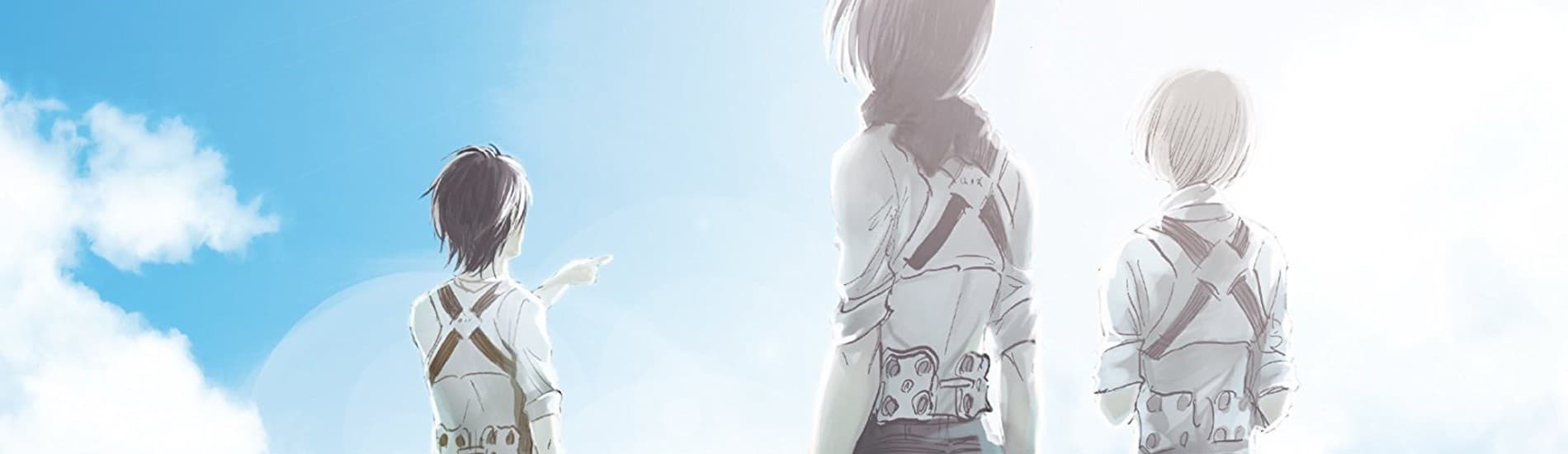
The Modern-Day Classic: An Imperfect Masterpiece that Reached the Heights Only to Be Mortally Wounded
A Retrospective on Shingeki no Kyojin (Attack on Titan)Introduction: Context of Those Days
I remember back during the first and second seasons, I didn't actually like Attack on Titan. I liked its tone and its animation style—which stood out from the average anime—but I felt the story was just a "zombie show" in disguise, with giants instead of the undead. Furthermore, considering we had to wait years for new seasons, I felt it was being mysterious just for the sake of it and that the pacing was agonizingly slow. I dropped it. It wasn't until later, around 2020 or 2021, when it literally exploded on the internet, that I returned. Seeing clips of "The Owl" and the implications of time paradoxes convinced me to watch it again, this time with four seasons already out.
What a marvelous, revelatory journey it was. Suddenly, before my eyes, was a masterpiece of writing, foreshadowing, and world-building. It transformed a basic apocalyptic anime into an incredible display of philosophy and politics that played with the fans' emotions, unveiling narratives that would make a sociologist salivate. I surrendered to the work and saw it as an authentic masterpiece. But at that time, neither the anime nor the manga were finished... and how disastrous the end turned out to be! Yes, I am one of those fans who hated the conclusion—but not for the reasons many claim. In this review/essay, which serves as a sort of closure for me, I will delve into what made this series great, why the ending feels dismal to me, and what I believe (and wish) the climax should have been.
The Packaging~~~
I’ll be brief here. Attack on Titan attracts because it has a somber tone, stripped of many "nefarious" anime clichés that often alienate a broader audience. Its serious animation style and an excelsior soundtrack are the first things that draw you in before you submerge yourself in its incredibly tragic story. Now, let’s get to the real matter: the plot and character development that took the world by storm.
The Glorious Plot Twist
Let’s be real: AoT was already great by the end of Season 3, but it ascended to the heavens when the Plot Twist was revealed. What was a pseudo-apocalyptic story about giants transformed into a philosophical, political, and terribly complex tragedy. Suddenly, the characters and everything we had experienced took on a new dimension. Like the characters, we were thrown into a new and terrible world. The "Humanity" we followed within the walls was no longer the sole unit of meaning. There was a world outside that hated them—an explicit "Other." And the Titans we thought were the enemies? They were the victims; they were the humans.
The philosophical and psychological implications of this turn magnified the characters' complexity. We were facing something entirely different, supplemented by time paradoxes once it was revealed that the Attack Titan could see the future memories of its users. It was a magnified work, yet it maintained the logic of everything seen before. When the Marley arc arrived, re-watching the series was a mind-blowing experience; the clues were always there. The show I once found boring was a masterpiece.
Impact and Consequences: The Spectator and the Sides
The humanity within the walls was no longer such; the outside world was revealed, and just like it was to Eren, it was presented to us as visceral and atrocious. Before us stood a world that hated the protagonists who had suffered so much—the very ones responsible for said suffering. There was Marley, a country with clear, openly fascist and imperialist tendencies and characteristics, which treated our protagonists—now called Eldians—as if they were sub-human. Suddenly, the story was no longer one of apocalyptic survival; it was one of oppression and a quest for liberation. In an aesthetic and temporal display reminiscent of certain 20th-century events, the cruelty of the reality within the Attack on Titan universe became closer to home—and therefore more controversial.
The way Marley treated the people of our protagonists could be a representation of how many oppressed peoples have been treated, but it resonates very clearly and uncomfortably today; the treatment of the Eldians is particularly reminiscent of how Israelis treat Palestinians, and seeing this evidenced so openly feels like a carbon copy of what is seen in Attack on Titan, which makes me wonder if Isayama was directly inspired by such case.
Faced with the blatant cruelty of the protagonists' reality—the long-awaited outside world revealed as a perverse 'otherness'—one logically takes the side of the protagonists, and it is here where things get interesting. Faced with Marley’s wickedness, through Grisha’s memories, we meet the Restorationists: a group of clandestine Eldians rebelling against oppression who possess the 'truth' in opposition to Marley’s cognitive propaganda: that in the past, the Eldian Empire had not been monstrous as the Marleyans claimed to justify their oppression, but had instead been benign, with history distorted to benefit a tyrannical narrative. At this point in the story, I was excited because I believed the author would play with narratives, exemplifying how they are often erased, distorted, or invented to justify realities and brazenly manipulate identity and historical notions.
However, although that did not remain—as it was later revealed that the Eldian Empire had indeed been atrocious—it in no way justified Marley's perversity. We, the viewers, logically position ourselves in favor of the oppressed side, the one whose story we have been following, even while choosing to ignore—oh, the paradox—that the society within the walls was not a paradise; it was a corrupt, classist, and semi-feudal society. But the spectator ignores this at this point because, despite the Titans having been the 'enemies,' they were now revealed as victims of Marley—the unmasked true enemy from beyond the walls.
Thus, we hate Marley and we hate the new characters, the Eldians of that place, because they believe Marleyan propaganda and are examples of those who support their executioners. Of course, the author makes it clear that we should empathize with them: they are oppressed and brainwashed; they are evident victims. But the radicalization of the spectator has already been triggered, and they do not care. Although the spectator should transcend dichotomies and feel pity for the Eldians of Marley, they cannot, and a phenomenon will occur which I will discuss later.
So, we are aboard the war that is about to unfold and we support Paradis, yet Eren’s words at the end of the third season still haunt us:
'
If we kill all our enemies... will we finally be free?'
This is the key question that will open and explain everything that happened from then on in Attack on Titan.
The change of scenery, the characters, and the radicalization of the spectator.
I remember what the internet became in those days. It was something as frustrating as it was fascinating, a debate magnified by the show's popularity where, without realizing it, people were discussing philosophy and politics. Once fully into the Marley arc, the dichotomy breaks, but for the worse, and becomes magnified. Obviously, at that point, we are all against Marley—those who oppress the Eldians, who, it should be noted, were suffering a genocide by being turned into Pure Titans whose only way out was to sacrifice themselves by inheriting one of the Nine. But the conflicting elements of the protagonist's side also appear: Eren and Zeke emerge with the nefarious euthanasia plan, along with the Jaegerists led by Floch.
From this point forward, both characters and spectators will divide into two very defined and antagonizing camps: the Jaegerists and the non-Jaegerists. Many—especially Jaegerists—will hate Gabi, ignoring the author’s clear intention with her: she is Eren, literally, but from the other side of the mirror. If we support Eren because we know what he went through, why not understand Gabi? Eren himself confirms this when he speaks with Reiner—a masterful moment in the show that openly confesses the truth of the matter—both are the same, manipulated by circumstances, as innocent as they are simultaneously guilty. But Eren, even knowing this—which the Jaegerist audience chooses to ignore or fails to grasp—even knowing that everyone is equal and no one holds the absolute truth or morality to act as judge, decides to act, unfolding the entire philosophical core that became the heart of Attack on Titan.
Ideological Positioning and Commentary on Certain Characters.
By the final part of the story, everything is apparently clear: Eren wants the Rumbling, having deceived Zeke into believing he supported the trashy euthanasia plan; but everyone else will logically oppose the Rumbling. Who wouldn’t? Well, the Jaegerists and the audience that has decided to identify and side with them. I remember when the internet was burning with this debate, I couldn't believe it. Do they not understand the series? Don't they realize that this is a ridiculously evil, ridiculously childish plan? It's as if Poland, in revenge against Germany and Russia, decided to murder everyone in those countries, but also, just in case, the rest of humanity. Do they not see the clear narrative the author is trying to show? Do they not see that by Eren committing genocide against the entire world, he becomes worse than Marley and those who villainized him? How can one agree with that? Well, Attack on Titan has that double magic: it is the anime that played with its audience—unintentionally—and brought to light the fascist that many people carried inside. I will explain myself by analyzing one character in particular who embodies it all.
Floch Forster: The 'Normie' Turned Fascist.
Attack on Titan has a gallery of masterful characters. My favorite character is Jean, but I won’t talk about him here; it has already been seen why he is a top-tier character through his evolution—beginning as the embodiment of selfishness and ending as one of the most empathetic characters in the series—and I have nothing more to add that hasn't been said about him already.
Regarding Reiner—probably my second favorite character, to whom I have already alluded quite a bit—he is Eren’s counterpart and the one I believed would be the redeemed tragic hero at the end of the story (it didn’t quite turn out that way). But the one I will elaborate on is a totally polarizing character, hated and loved in equal measure, and an axial figure in the ideological struggle both inside and outside the show.
If, viewed broadly, the true enemy of the story is the cycle of hatred, Floch is the living embodiment of it and, therefore, one of the primary and best-constructed villains. I don't hate Floch; I think he is a first-class character because he shows the path of a 'normie' becoming a fascist. However, what magnified his impact was the staunch defense he received from the Jaegerist spectators, which, for me, demonstrated the degree of radicalization people can reach. Let me explain: if we truly hate Marley, we must hate Floch just the same. Although in a different context, he ended up becoming—with his supremacist and imperialist rhetoric—a mirror of Marleyan ideology. Perhaps as a reflection of the trauma of shifting from believing they were a fragment of humanity to finding out that the Titans were themselves and that the world existed as an overwhelming 'Other,' Floch represents the radicalization of the common man.
Floch's ideas and Marley's are the same—identical in form and content—with Floch’s ideas taken to the next level by literally wanting to wipe out all of humanity, including those who oppose him. Those who support the Jaegerists and Floch did not understand the clear message the author was seeking; they did not understand that it was ignorance and the cycle of hatred reproducing itself. They themselves were manipulated by the vortex of narrow perspectives and manipulative narratives, for if we think about it, Eren manipulated Floch for his own benefit after all.
And we reach the culminating point, the heart of the matter: the character of Eren and his ultimate motive. It is here where the discussion is born, the polarization of the audience, and the most insane ending ever seen that makes the philosophical threads of the work evident.
Eren and the Rumbling: Why? The Question of Freedom.
In the end, everything comes down to this: Eren’s decision. Why did Eren activate the Rumbling and become an overt genocider?
- Did he want to save his people and his friends? Not really; by simply activating the Rumbling and using it as a threat would have been enough to keep the world at bay.
- Did he believe, like those in the outside world, that people were devils and therefore hated them? No. Eren knows and admits to knowing—as he demonstrates with Ramzi—that most people are innocent. This is glimpsed even in Eren’s conversation with Reiner.
- Is it because he believed it was inevitable since he saw it when he kissed Historia’s hand? Not really. Eren did it because he wanted to, driven by a twisted notion of freedom in the face of a world that disappointed him.
And here are the notions of freedom that are managed and interwoven into the fabric of the series:
The Selfish Desire for 'Freedom': The fuel that set the events of Attack on Titan in motion, driven by Eren, was his notion of freedom, which in political philosophy is called 'Negative Liberty.' Negative liberty is a political concept summarized as the absence of external obstacles or interferences. You are free in a negative sense if no one prevents you from carrying out your will; it is, basically, 'freedom from' (freedom from coercion, from walls, from enemies). Eren is the extreme and violent incarnation of this notion.
And this is the deepest and darkest reason. Since he was a child, Eren believed the outside world was a virgin paradise (like the one in Armin’s books). When he discovered that outside there was no freedom, but rather people who hated him, he felt profoundly disappointed.
The Empty World: Eren wanted the world to be a 'blank canvas.' In the final chapter, he confesses that he wanted to 'flatten' the earth simply because he wanted to see that landscape free of humans, exactly as he had imagined it.
For Eren, freedom is eliminating whatever holds him back. First, it was the Titans, then the walls, and finally the rest of humanity. In his mind, if someone exists on the other side of the sea who desires his end, he is not free. Therefore, Eren's negative liberty is only achieved when the 'other' ceases to exist, carrying the concept to a genocidal point: to be totally free of interference, he must be the only one (or among the only ones) left standing.
The irony is that this concept is in no way different from what his oppressors did to them; but instead of breaking free from that, Eren reproduces the cycle of hatred of which he is a slave.
The next point that those on the Jaegerist side failed to see is that they—Eren and the rest—are all slaves.
Eren is not free:
That is the supreme irony and the tragedy of the character: Eren is the slave of his own idea of freedom. In attempting to reach that horizon of 'freedom' he saw in his memories, he becomes a passenger of his own destiny. He does not act by choice, but to fulfill the necessary steps that lead him to that result. This is also related to the fact that Eren would never be free if Ymir was not free. Thus, Eren is the least free character in Attack on Titan.
The Nefarious Ending: The Fall of Attack on Titan
Well, you might say to me: in the introduction, you claimed the ending was nefarious, yet so far you’ve given it nothing but praise! That is what I’m getting to now. This is the painful part for me—the part that caused Attack on Titan, which had reached the highest of heights, to fall headlong; the part that makes returning to the series no easy task.
Yes, I am one of those fans who hated—and to this day continues to hate—the ending. But make no mistake, I didn't hate it like the Jaegerist fans did because Eren didn't commit total genocide and return triumphant as some 'Gigachad aura farmer' alongside Historia—oh yes,we need to talk about that later. No, I didn't hate it for that, nor because the 'idealist pacifists' won; in fact, I wanted that to happen and for them to stop the genocidal Eren, because that was what narratively should have happened to halt the cycle of hatred.
The ending was dismal, nefarious, and disastrous—not because of what happened, but because of the reasons given to explain it and the background of it all. Below, I will list the factors that, at the end of the story, ruined EVERYTHING: characters, narrative, and the experience we had lived through up to that point.
Until the end, we had lived through marvelous plot twists: the truth of the world beyond the walls, Eren's memories manipulating Grisha and therefore everything that happened, etc. But apparently, the author believed—or truly had it planned this way—that any surprise twist was valid. A monumental error, for the unexpected twists of the end ultimately ruined the grand story he had created.
The Nefarious Factors that Ruined Attack on Titan:
The Ymir Issue: The matter of Ymir is the backbone of the story and is (or was, before the nefarious revelation) linked to Eren. What seemed until the very end to be her 2,000-year-old will to seek revenge and achieve liberation turned out to be a story of 'toxic love.'
WHAT? You mean to tell me Ymir remained a slave for 2,000 years because she had Stockholm Syndrome and was waiting to see someone (Mikasa, we’ll get to that) kill their beloved so she could understand it and free herself? WHAT?
This, ladies and gentlemen, is the backbone of Attack on Titan... you can see why it’s nefarious—and extremely misogynistic—right? Not to mention that the origin of the Titans turned out to be a prehistoric parasite. Let’s move on.
The Mikasa and Eren Situation: I never liked Mikasa. Remember when I said AoT was devoid of anime clichés? Well, Mikasa is one of the few there are. Her attachment to Eren seemed mindless and exaggerated to me, even when explained by the Ackerman condition. So, if it is narratively explained that Mikasa, being an Ackerman, is 'enslaved' by her bond—narratively, by logic—her resolution would be to free herself from her obsession with Eren and triumph as a character, right? RIGHT? NO. Mikasa never thinks for herself; she remains obsessed with Eren until the end (please don't make me remember the panel of her kissing Eren’s severed head), and she never triumphs narratively. But let’s get to the real problem here. Eren loving Mikasa makes no sense. I’m sorry, it just doesn't. At no point in the work are we hinted that he loves her as more than a friend or sister, so yes, his pathetic final confession ruins his character because IT MAKES NO SENSE with what was seen up to that moment. Seeing Eren cry like an 'incel' because he doesn't want Mikasa to be with any other man was one of the most painful things I've ever seen done to character writing. The moment in Chapter 123 when Eren asks Mikasa what he is to her was ruined; before that pathetic confession, that moment had a brilliant narrative connotation that is now destroyed. So yes: the backbone of the story: ruined. Mikasa: made worse. Eren: his writing ruined.
Eren ends up being a pathetic incel, still a genocider, and with a nonsensical plan: While Eren's selfish philosophical motive remains, it is revealed that his plan to save his 'friends' was for them to stop him so they could be the 'heroes.' I won't elaborate on this; it is, by all accounts, a nonsensical, pathetic, and yes, still genocidal plan.
In the end, it was all for nothing: Perhaps on the same level of nefariousness as Ymir’s love for Fritz: the revelation that in the future nothing was resolved and the island is eventually destroyed is an abominable ending. It plays at being 'edgy' but it is beyond foul, and the reader/viewer realizes they’ve been mocked and cheated. So in the end, gentlemen, Eren's pathetic genocidal plan didn't even work. HA. Cries.
What I Expected/Believed Would Happen: My Personal Ending
Before everything was irremediably ruined, AoT was at the peak of genius. And I, like most of the fandom, believed I knew how to read where the story was heading. Here is what I believed—and now wish had been—the ending. Here is what, until the very end, I thought would happen based on the established facts. I will list it by addressing the points that were ultimately ruined.
Historia and Her Child: First of all, I’ll start with a point that led nowhere but carried immense weight before the reveal. Yes, I was one of the many who believed Historia’s child was Eren’s. Not for 'shipping' reasons, but because I believed it made all the sense in the world. It would further explain Eren’s genocidal plan, even if it didn't excuse it. This point is crucial to how I and many others understood where things were going.
Now, here is how I believed/wanted AoT to end:
The Weight of Memories: Eren saw everything in his father’s memories when he kissed Historia’s hand. EVERYTHING. In that moment, he changed by becoming a slave to the determinism he witnessed. No matter how much he wanted to change that future, his selfish desire for freedom would drive him to fulfill exactly what he saw. When he asked Mikasa what he was to her, it was with the hope that she would respond differently (a confession of love or a plea to stay together). If she changed her answer, it meant the future was not fixed and perhaps he wouldn't have to destroy the world. When she said 'family,' Eren resigned himself: the future was inevitable.
The Cycle and the 'Reset': Eren activates and begins the Rumbling. He saw in the memories that he completes his mission and returns triumphant to Paradis to Historia and his daughter, to whom he says the famous line: 'You are free.' Historia and Eren's daughter represents, in this ending, a liberated Ymir. However, following the philosophical thread of Negative Liberty, Eren realizes that this ending will not make him free. It is exactly what the determinism of fate dictates. Bequeathing a slaughtered world to his daughter and his people—with himself as the one responsible—will not make him free; he will remain a slave to destiny and his own selfishness. Thus, Ymir would find no peace, the power of the Titans would not disappear, and Ymir (or Eren with the Founder's power) would reset the timeline by sending memories to the past so the 'new' Eren would make different decisions. This would explain 'To You, 2,000 Years From Now,' where we saw the Mikasa of the 'previous cycle' saying goodbye to him before the world reset. Eren cried because his subconscious held the trauma of all the previous failed endings.
The Shift to Positive Liberty: Thus, in the middle of the Rumbling, Eren would make a decision outside of what he had seen—something that had never happened before. Ridding himself of his selfish desire for freedom, Eren would exercise Positive Liberty for the first time.
Positive Liberty is an individual's actual capacity to be their own master, to act according to their will, and to reach their potential. Unlike negative liberty (the absence of obstacles), positive liberty focuses on 'having the power to' rather than 'not being forbidden.'
The Resolution: By exercising this positive liberty for the first time—stepping off the script of determinism—Eren would contact Armin and Reiner, tell them everything, and ask them to kill him. Reiner would find redemption, and Mikasa would actively participate in Eren’s elimination, freeing herself from her 'Ackerman slave' condition. Because Eren exercised real freedom and cut the cycle of hatred at its root, Ymir would be liberated and the Titan power extinguished.
Why do I believe this version is better than what we got?
A More Solid Motive for Ymir: Ymir’s liberation wouldn't depend on 'toxic love' for Fritz, but on the breaking of a cycle of hatred and revenge. If Ymir sought vengeance through Eren, and Eren decided to stop upon realizing genocide wouldn't bring freedom to his child, Ymir would have learned something about humanity she didn't understand in 2,000 years.
Historia’s Child as a 'Moral Anchor': Eren being the father gave a narrative utility to the pregnancy that the original ending lacked. The baby is Eren’s 'handbrake.' Seeing that his child would inherit a world of ashes and a father turned into history’s worst monster would give Eren a much more harrowing internal conflict.
A Less Cynical Closure: Seeing Paradis bombed in the post-credits scenes makes it feel like nothing was worth it. In what I believed would happen, the 'reset' or Eren’s conscious decision to stop out of love for his legacy leaves a door open to hope. It is not a destiny imposed by the memories time loop, but a human choice that breaks the loop.
TLDR~~~
In short, AoT reached the absolute pinnacle of narrative, writing, and spectacle. It was insane to have lived through the years of its peak popularity, which explains why it hurt so much to see it ruined by such a horrible ending. It leaves me wondering if Isayama always intended for that ending or if he simply didn't know how to close the grand story he had created. In a way, it is the Game of Thrones of anime—exactly like that. Because it was so well-written, anything that happened at the end affected everything that came before, which is why the finale ruined absolutely everything.
Yet, the story is so good that even with a nefarious ending that hurts, one still feels drawn to it. It’s not easy to watch the first episode knowing that Eren killed his mother and that everything happened because a ghost with a parasite couldn't get over her crush on her abuser. But the writing, which was truly masterful, remains there, calling out to us.
Somehow, I needed to get all these thoughts out and put them into words, as if in this attempt I could catch a glimpse of what was and what could have been. I still love AoT because I choose to 'play pretend' and deliberately ignore the ending, choosing instead to think about what might have been.