La siguiente reseña está en Español e Inglés (traducida con el apoyo de DeepL)
La versión leída es la licenciada al español por “Ivrea España”
El potencial en la idea de una historia narrada a través de etapas generacionales demostró su valor no en la introducción de un misterio aún mayor, sino en el primer acercamiento con un joven físicamente parecido al anterior protagonista pero carente de esa personalidad estereotípicamente caballeresca. Es altanero, irascible, le gusta realizar trucos que engañen o despisten a los demás pero sí que conserva lo más esencial de su predecesor, un férreo código moral y de honor; ese es el joven Joseph Joestar, protagonista de la segunda parte de JoJos, Battle Tendency.
Araki ha dejado la ambientación gótica para adentrarse en la década de los 30 del siglo XX en diferentes escenarios, he ahí otro avance respecto a la parte previa, comenzando en Estados Unidos, pasa por México y finaliza en Europa entre Italia y Suiza. La variedad de escenarios es una buena demostración sobre el alcance más “amplio” de esta parte, su amenaza cuenta con un mayor contexto para considerarse mundial y existencial. A nivel visual le permite una variedad que impide asociarlo en completitud únicamente a una corriente, en cambio, si se notan las diferentes referencias según el momento, especialmente en su tramo final Europeo, de una época clásica que también alude en poses y expresiones.
Este es un escenario ideal para Joseph, quien ahora debe afrontar al imparable destino acompañado de diferentes personajes. Haber optado porque Joseph fuese un polo diferente a Jonathan es un gran acierto de Hirohiko, no sólo separa radicalmente ambas partes, da una base de interés al lector para adentrarse en la nueva propuesta debido a lo divertido que es leerlo, sean sus expresiones, apuntes o actitud, siempre hay una respuesta de él, inesperada y en línea con el personaje, lo que nos motivará a saber cómo va a afrontar lo siguiente que le será impuesto. Además debo destacar ese sencillo y trascendental detalle en asignarle frases que se volverían icónicas al personaje y a su personalidad.

Y contrario a la parte anterior (dicen que las comparaciones son odiosas, pero mi intención al reseñar JoJos es adentrarnos en cómo ha sido la evolución en la narrativa de Araki) el compendio de secundarios no es detrimento de la trama. Sí bien seguiremos teniendo esos pecados del autor en introducir obstáculos a conveniencia en según qué momentos, los personajes inmediatamente secundarios están alineados con el contexto y caracterización, aún si no son tan carismáticos como Joseph tampoco carecen de méritos.
Caesar es una amistad que se siente genuina porque gira alrededor de la temática constante de esta parte, el honor. La mayor motivación de Joseph es defender el honor de sus antepasados, de la misma forma que Caesar. Varias de sus actitudes les impide conectar en otros aspectos personales, en cambio se construye un respeto porque cada uno puede notar en aquel las cualidades que admiran. Y durante el resto del tiempo, la diferencia de sus personalidades permite que tengan divertidas pullas e intercambios.
Lisa Lisa siendo una guapa, misteriosa y poderosa instructora también guiada bajo el honor, Stroheim con su compromiso hasta último término con el honor en su creencia de lo correcto. Constantemente se repite esta dirección temática, inclusive con los antagonistas de esta aventura: Los Hombres del Pilar.

Contrario a la situación de Jonathan, igualar la capacidad de Dio para atraer al público si resultaba más problemático. Araki decidió no intentarlo sino presentarnos otra idea, los hombres del pilar no son villanos de maldad pura, están movidos por el orgullo, confianza, y como no, honor en su cruzada. Tienen ciertas características especiales en cada particular que les diferencia entre sí, más todos se presentan con la misma idea principal de ser casi divinos y por ende, tener el derecho de ignorar a cualquiera que no represente una amenaza.
El enfrentamiento entre ambos bandos es a Hamon contra poderes provenientes de esos medios casi mágicos, el primero es una técnica refinada desde la parte anterior, ha mutado a aplicaciones más definidas dependiendo de su usuario. Usualmente con técnicas asociadas a una idea o herramienta, al leerlo y saber el futuro de la franquicia, te resulta lógico como fuimos desde este punto hacia el siguiente. Por supuesto, sí bien la instrucción, manejo y fortaleza del hamon es fundamental, teniendo capítulos dedicados a su entrenamiento, las batallas son definidas por la estrategia de sus participantes, la aplicación de herramientas, juegos mentales y tretas para conseguir la victoria.
Son más verosímiles e interesantes en su extravagancia, instando la pregunta al lector de cómo logrará el personaje librarse en vez de sí lo conseguirá. Eso sí, aún con las diferentes tácticas e ideas, siguen dentro de terrenos de honorabilidad hacia la astucia e ingenio del adversario, de ahí que cuando es roto ese contrato en secciones específicas, se perfilan los villanos más prominentes y los castigos más certeros.

Los hombres del pilar tienen de poderes la representación de sus elementos, sea fuego, viento y luz, precisamente que las batallas tengan interés es por no apoyarse únicamente en la fuerza bruta de factor decisivo y en presentar los enfrentamientos en variados escenarios. Y por mencionar una contra, pese a su mayor duración como parte, me queda debiendo más oportunidades para que Caesar y Lisa pudiesen destacar.
En general considero sus temáticas correctamente hiladas, los personajes y sus actitudes están alineados al respecto, inclusive otras secundarias como la inmortalidad y seres cuasi divinos también conectan entre sí a otros personajes. Y la persistencia de Araki en no temer sacrificar personajes sin tampoco parecer una decisión gratuita, o para avivar una trama, sino una planificación que corresponde a las ideas expuestas.
Joseph es quién tiene un desarrollo destacable como personaje, su orgullo sí bien se mantiene a lo largo de la obra, en cierto punto crucial aprende que no puede únicamente depender de sí mismo para avanzar, también debe de creer en las enseñanzas y apoyo de los otros si quiere seguir superándose. En ese sentido su orgullo pasa de ser sólo individual para alguien que confía en sí mismo y en los demás.

En cuánto a la nueva mitología siendo introducida, es tan interesante y visualmente atractiva por las diferentes fuentes que ha utilizado Araki que resulta un poco triste no hubiese sido continuada durante sus próximas partes. Pese a gustarme la evolución que tuvo como artista, y la cuál seguiré destacando, no puedo sino echar de menos esta multidifusión mitológica divina e impresionable. Sin embargo, volviendo a Battle Tendency, podemos aquí hallar el núcleo de diferentes tendencias que seguiría desarrollando, por ejemplo su mayor “estilo” en cuánto a los personajes y sus vestimentas, también aprovechando los diferentes escenarios a su disposición, los cuáles tienen un gran detalle, ideal para ubicar a los personajes en las dramáticas posiciones propias de su estilo.
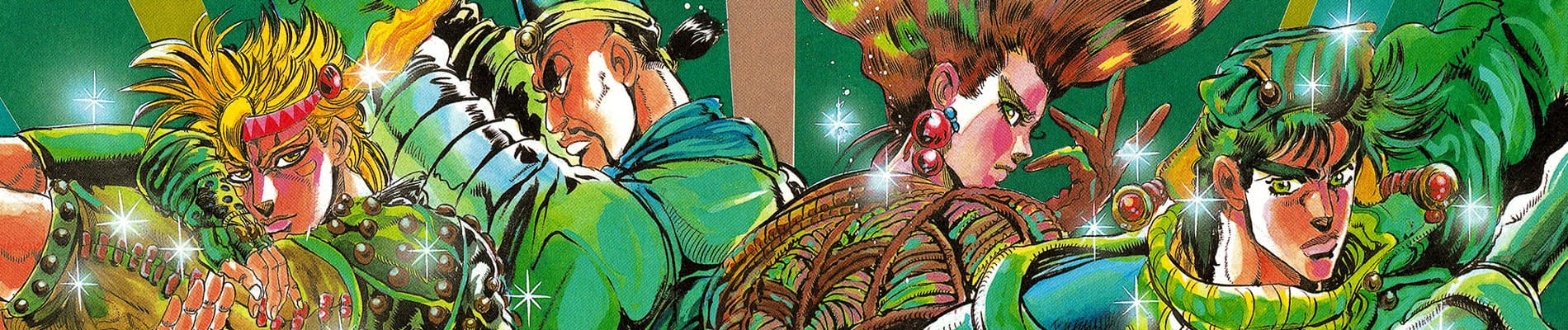
Ha mejorado la consistencia de sus diseños, sólo en momentos puntuales se sienten diferentes, del resto tenemos esa variopinta entrega entre escenarios, poses, acción y acción todavía más brutal, habiendo vísceras y desmembramientos. Las páginas dobles siguen siendo un deleite de detalle y posicionamiento, además de ser igualmente de atractivos las primeras páginas a modo de portada donde puede ubicar a los personajes con poses en el vacío como le plazca.
Battle Tendency es una secuela ideal, utilizando bases establecidas, aporta a través de sus propios aspectos en sus diferentes secciones para no sólo valerse por sí misma en una parte muy entretenida y que vale la pena analizar, sino que es un paso hacia adelante en el planteamiento en la idea de la franquicia concebida por Araki.

English
The potential of a story told through generational stages proves its value not by introducing an even greater mystery, but through the first encounter with a young man who is physically similar to the previous protagonist yet lacks that stereotypically chivalrous personality. He is arrogant, hot-tempered, and enjoys pulling tricks that deceive or throw others off balance, but he retains the most essential trait of his predecessor: a firm moral and honor-bound code. This is young Joseph Joestar, the protagonist of JoJo’s second part, Battle Tendency.
Araki leaves behind the gothic setting to move into the 1930s, spanning multiple locations—another clear step forward compared to the previous part. Beginning in the United States, the story passes through Mexico and concludes in Europe, between Italy and Switzerland. This variety of settings effectively conveys the broader scope of this part; its threat carries enough context to be considered both global and existential. Visually, it allows for a diversity that prevents the work from being tied entirely to a single aesthetic current. Instead, different references become apparent depending on the moment, especially during its European finale, drawing from a classical era that is also reflected in poses and expressions.
This is an ideal scenario for Joseph, who must now face an inescapable destiny alongside a diverse cast of characters. Choosing Joseph as a deliberate contrast to Jonathan was a brilliant decision by Hirohiko Araki. Not only does it sharply separate both parts, but it also gives readers an immediate reason to engage with the new proposal due to how entertaining Joseph is to read. Whether through his expressions, remarks, or attitude, he always delivers an unexpected response that remains true to his character, compelling us to see how he will deal with whatever challenge comes next. I must also highlight the simple yet crucial decision to give him lines that would later become iconic to both the character and his personality.

And unlike the previous part (they say comparisons are odious, but my intention in reviewing JoJo’s is to explore how Araki’s narrative has evolved), the supporting cast here does not detract from the story. While the author’s tendency to introduce convenient obstacles at certain moments remains, the immediate secondary characters are well aligned with the context and their characterization. Even if they are not as charismatic as Joseph, they are far from lacking merit.
Caesar feels like a genuine friendship because it revolves around the central theme of this part: honor. Joseph’s primary motivation is to defend the honor of his ancestors, just as Caesar seeks to uphold his own. Certain aspects of their personalities prevent them from connecting on a more personal level, yet a strong mutual respect emerges, as each recognizes in the other the qualities they admire. Throughout the rest of the story, their contrasting personalities allow for playful jabs and entertaining exchanges.
Lisa Lisa, portrayed as a beautiful, mysterious, and powerful mentor also guided by honor, and Stroheim, with his unwavering commitment to what he believes is right, further reinforce this thematic direction. This emphasis on honor is constantly reiterated, even extending to the antagonists of the story: the Pillar Men.

Unlike Jonathan’s situation, matching Dio’s ability to captivate the audience would have been far more difficult. Araki chose not to attempt this, instead presenting a different idea altogether. The Pillar Men are not villains driven by pure evil; they are motivated by pride, confidence, and, of course, honor in their crusade. Each possesses distinctive traits that set them apart, yet all share the same core belief: that they are nearly divine beings, and therefore entitled to ignore anyone who does not pose a threat to them.
The clash between both sides pits Hamon against powers derived from near-magical origins. Hamon, a technique refined from the previous part, has evolved into more defined applications depending on its user, often tied to specific concepts or tools. Reading this with knowledge of the franchise’s future, it feels logical how this stage serves as a bridge toward what comes next. While training, mastery, and strength in Hamon are essential, earning entire chapters dedicated to its instruction, the battles themselves are decided through strategy, clever use of tools, mind games, and tricks to secure victory.
These confrontations are more believable and engaging in their extravagance, prompting the reader to wonder how the character will escape rather than if they will. Even so, despite the variety of tactics and ideas, the fights remain grounded in a sense of honor toward the opponent’s cunning and ingenuity. When that implicit contract is broken in specific moments, it clearly defines the most prominent villains and justifies the harshest punishments.

The Pillar Men wield powers that embody elements such as fire, wind, and light. What keeps the battles engaging is that they do not rely solely on brute force as the decisive factor, but instead place encounters in varied settings. As a minor criticism, despite this part’s greater length, I would have liked more opportunities for Caesar and Lisa Lisa to truly shine.
Overall, I consider the themes to be well interwoven, with characters and their attitudes aligned accordingly. Even secondary ideas, such as immortality and quasi-divine beings, connect meaningfully with the cast. Araki’s willingness to sacrifice characters without making it feel gratuitous or merely a tool to artificially heighten drama speaks to a planning that aligns with the ideas being explored.
Joseph is the character who undergoes the most notable development. While his pride remains throughout the story, at a crucial point he learns that he cannot rely solely on himself to move forward; he must also trust the teachings and support of others if he wishes to continue growing. In this sense, his pride evolves from something purely individual into confidence in both himself and those around him.

As for the new mythology being introduced, it is so compelling and visually striking, drawing from the many sources Araki employs, that it feels somewhat disappointing it was not continued in later parts. While I appreciate and will continue to highlight his artistic evolution, I cannot help but miss this multi-layered, divine, and evocative mythological approach. Still, returning to Battle Tendency, we can clearly identify the core of many tendencies Araki would further develop: a stronger sense of style in character design and clothing, as well as an effective use of diverse, highly detailed settings, perfect for placing characters in the dramatic poses that define his style.
The consistency of his designs has improved, with only occasional moments where they feel off. Otherwise, we are treated to a varied blend of environments, poses, action, and increasingly brutal combat, complete with viscera and dismemberment. The double-page spreads remain a delight in their detail and composition, as do the opening pages styled like covers, where characters can be posed freely against empty space.
Battle Tendency is an ideal sequel. Building upon established foundations, it contributes its own distinctive elements across its sections, standing on its own as a highly entertaining part worthy of analysis, while also serving as a clear step forward in the broader conceptual vision of the franchise conceived by Araki.

24 out of 25 users liked this review
