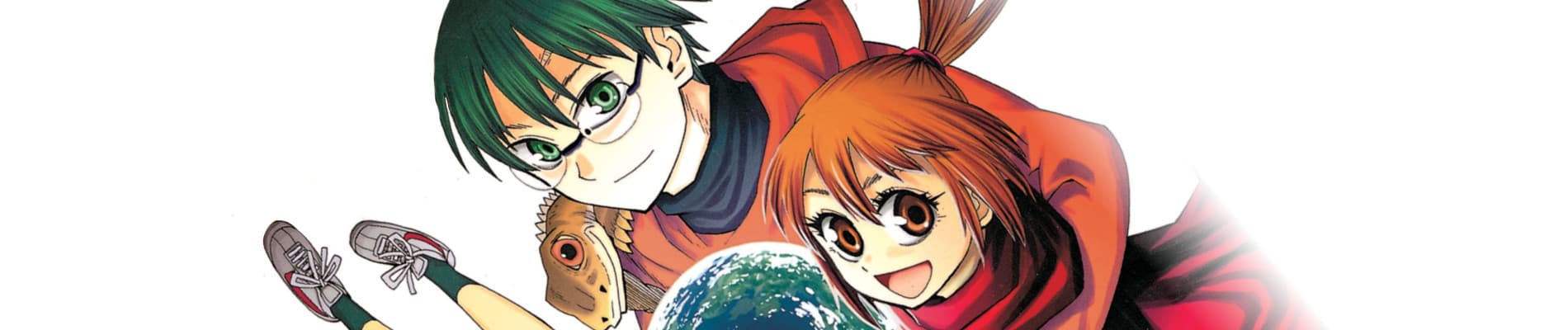
Lucifer and the Biscuit Hammer is, ultimately, a mixed bag full of parts that come together into an enjoyable but deeply flawed whole. The first half is tedious, full of gratuitous fan service and poorly-aged comedy, but it leads to an exciting, emotional second half that carries its weight and then some. It’s a series that, unless you find mid-2000s misogynistic jokes funny, will really have to grow on you; but that’s exactly what it did for me.
The plot follows college student Amamiya Yuuhi as he discovers he is a Beast Knight, someone who must fight to stop the mage Animus from destroying the earth with a powerful weapon floating in the atmosphere: the Biscuit Hammer. He must also help protect the princess known as Anima, who manifests in Yuuhi’s neighbor, Asahina Samidare. Yuuhi swears his loyalty to Samidare, who has further plans than just stopping Animus—she wants to destroy the planet by her own hand.
It’s a simple story at its core. Assemble a group of eccentric individuals with various powers to fight increasingly powerful monsters, culminating in a final showdown with their master. In that regard, it’s nothing that you haven’t seen before; and for the first 30 or so chapters that’s about all it feels like. I’m someone who is extremely picky with humor in manga, and I nearly dropped this on multiple occasions because of how unfunny it is in its beginning. Its jokes primarily consist of sexually harassing women and showing off the underwear of underage girls. However, its strengths bleed through the cracks. Strong character moments, genuine emotion under the veneer of mediocre drollery. The tone greatly, though gradually, shifts near the manga’s midpoint. The majority of the jokes are traded for building tension and strengthening bonds. Character beats that felt like they weren’t given enough gravity prior are honed in on. It starts asking the questions it always intended: How far will you go for the things you love? Is going all the way even the right thing to do? How do you move forward?
The characters are where Lucifer really shines. But because of that, they’re also where it falls flat. There’s a drastic difference in depth between the main two and the rest of the supporting cast. Yuuhi and Samidare’s relationship is the core of the manga and what carries it through to its conclusion. They get to know each other, their feelings waver and shift, they grow up. Though written as romantic (which is somewhat questionable; Yuuhi is a first year in college, while Samidare is a first year in high school), their connection is quite compelling outside of that and I found that that element felt more tacked on than anything else. Yuuhi fits into your typical trope of the glasses-wearing loner chosen for something special, but he’s quite enjoyable as a protagonist outside of his annoying perverted streak. Regardless, he fades into the background compared to Samidare, who is absolutely the highlight; I’ll always love a selfish, spunky girl with a heavy heart and too much love to hold on to.
Unfortunately, though, there’s not all that much I can say about the rest of the characters. There are a few who leave more of a lasting impression (the villain Animus, the princess Anima, the young and indecisive Akane Taiyou), but in the end most of them are entirely forgettable and fall into typical archetypes. The women are constantly sexualized, and everyone, in general, is given pointless romantic feelings that add nothing to the story. The majority of the talking animals who accompany every Beast Knight are barely even given personalities. Lamentably, this is a common issue that frequently appears in series with casts this large. It also has a tendency to focus on one character briefly, develop them, then not really do anything with them for the rest of the series. They have their little moment and that’s about it. I think, particularly in the earlier chapters, there’s a lot of missed opportunties to give them more to work with.
The art isn’t anything to write home about. It’s fun and it’s got character, but it doesn’t particularly stand out. The paneling is the same; it does its job, nothing especially notable. It’s never difficult to read or understand what’s going on. The action scenes are dynamic, read clearly, and, most importantly, never overstay their welcome. There's some great imagery, especially surrounding the Biscuit Hammer and its looming shadow over the world.
At the end of the day, Lucifer and the Biscuit Hammer is a series with remarkable highs and derisive lows. I’d be somewhat hesitant to give it a recommendation to anyone without a high tolerance for its flavor of humor and degrading treatment of its female cast. If you can acknowledge and look past that, however, it’s a fun romp with some real heart to it. When all was said and done, it left me with one question: why in the world is it called the “Biscuit Hammer”?
8 out of 9 users liked this review