Tokyo Revengers
a review by NapoJ
a review by NapoJ
La siguiente reseña está en Español e Inglés (traducida con el apoyo de DeepL)
La versión leída es la traducción al español por Joak.P del grupo “Buitres Scan”
La Suspensión de la Incredulidad está arraigada en la personalidad del espectador, en promedio suele ser “alta” en el sentido de quién está viendo no es particularmente atento a lógicas propias del mundo, con acciones y consecuencias, al contrario, está enfocado en disfrutar de la experiencia. En quienes se dedican a escribir/comentar obras eventualmente, conscientes o no, se posicionarán de cierta manera al respecto, y en mi caso, he optado por aceptar lo presentado en un comienzo.
Esto no sólo es cuánto a narrativa, también es la presentación de sí misma. Si bien la extraña premisa para algunos debía ser explicada en cierto punto, yo no hubiese tenido problema alguno si nunca hubiera sido profundizada ni un poco, hacía parte de la presentación básica y debía darla por aceptada… siempre y cuando se mantuviese con la misma lógica.
No sólo la dinámica fantástica está encapsulada en esta suspensión, sí bien me resulta ridícula la noción de una banda de adolescentes donde se disputan honor y territorio sin ningún motivo económico ni una figura adulta liderando, nuevamente, me corresponde aceptarla. Y en últimas, el autor Ken Wakui es quien estuvo en su juventud formando parte de bandas, contrario a mi persona plenamente ajeno a ambientes, épocas o lugares comparables.

Y en la misma línea, la idea de un adolescente sin que sea físicamente musculoso, derrotando sin ningún problema a medio centenar de bandidos es otra raya al tigre si lees con mediana frecuencia manga. Ni mucho menos lo iba a cuestionar.
La principal fortaleza de la obra es su protagonista, Takemichi Hanagaki. En un mundo con dinámicas ligadas, en su mayoría, a la fuerza, tener al personaje principal siendo más débil que el resto implica que debe destacar a través de otros medios. Tampoco es que sea listo, por ende la única vía es una “fuerza de voluntad”, y de eso sí tiene sobradamente.
Su evolución (hasta cierto punto) como personaje es adquirir confianza y resolución conforme supera cada obstáculo, a través de su indomable espíritu adquiere más aliados, en seguir levantándose aún cuando debería serle imposible, representando el mejor ejemplo de ese líder a quien seguir porque su espalda luce grande y su sombra es segura. Una emocionante descripción para alguien que es un “niño llorón”, y quien suele caer en depresiones o ideas equivocadas dada su propia debilidad, serán esas mismas figuras que ha cultivado quienes le recordarán quién es y su objetivo.

Los personajes secundarios inmediatos son una interesante red narrativa sobre Takemichi porque sabiendo que, en mayor término, se narra la historia de una banda, se debe contar con que los diferentes compañeros tengan un interés que resulte equiparable. Desde Hina quien es la compañera sentimental y su principal motivo de inspiración, su mejor amigo Chifuyu, la figura de hermano mayor encontrada en Draken y otros a quienes irá conociendo en el camino, teniendo capítulos dedicados para ahondar en su trasfondo que les brinda capas de interés y motivación, las cuáles suelen ser utilizadas en los enfrentamientos como motores narrativos.
Y esa amistad no es dependiente de Hanagaki, en la misma banda hay otros grupos menores que también tienen capítulos dedicados, enriqueciendo esta narrativa sobre la amistad. Duplas disparejas que en el paso de los años se convierten en hermanos.
En el trasfondo de los personajes se permiten caracterizaciones que evitan la clasificación netamente positiva o negativa de los diferentes miembros, aún sí ninguno es un ejemplo de complejidad narrativa, varios representan contradicciones internas que les vuelve interesantes de revisitar en diferentes situaciones y momentos. Y en este punto es importante la mención al reverso de Takemichi, Kisaki el principal antagonista.

Pese a que le he mencionado de reverso, de hecho comparten la base de ser débiles, la diferencia radica en el intelecto. Kisaki si es brillante, un planificador quien parece estar 3 pasos adelante sea en la dirección que sea y sin un objetivo palpable. Entre los dos se forma este tira y afloja principal narrativo que alcanza un punto máximo que no sería repetido.
Antes de concentrarnos en su infame arco final, tengo observaciones sobre sus apartados negativos presentes desde el comienzo. Mi suspensión de incredulidad no incluye la existencia de “dos” Takemichis, quien estaba antes y quien estará después. Un hecho tan particularmente extraño que pese a no afectar a la narrativa, al analizarlo es como si atentase contra el personaje, de Takemichi siendo un personaje secundario para el mismo Takemichi.
En la construcción de su universo, la lucha entre bandas implica, claramente, la existencia de diferentes bandas las cuáles tienen miembros divididos en “generaciones”. La presentación de un miembro de una anterior generación es bajo el halo de sabiduría e historia, un hito místico de tiempos pasados. Y cumple su cometido en varios momentos, sin embargo, con el pasar de los capítulos es utilizado como una especie de escala de poder, al haber personajes fuertes quienes derrotan a estos mitos “sin esfuerzo”.

Y usualmente estas presentaciones se realizan en retrospectiva, en la incoherencia de que si alguien tan fuerte existía al menos debía ser mencionado en algún momento, en cambio aparecen sobre la marcha. No obstante, este es sólo un síntoma de un problema general, el uso de recuerdos y memorias para dirigir la narrativa a donde quería Wakui. Una marcada incoherencia en que hechos, encuentros y memorias tan relevantes debían haber sido mencionados previamente, pero al contrario, sólo son recordados precisamente en el momento que lo requería la trama para avanzar.
También funciona a la inversa, la información vista en el futuro sólo sirve para cuando es el momento inmediatamente previo, cualquier rastro de investigación y preparación son disueltos bajo excusas casuales. Hasta cierto punto puedo entender que sea para mantener el interés de la historia, hasta que eventualmente se cruza esa línea en que pasa a ser sólo un encubrimiento intencional para dirigirnos ciegos hacia el siguiente suceso.
La misma amistad que he destacado, bien mencioné que funciona dentro del círculo principal, es conforme que aparecen más y más personajes se desdibujan las ideas de una banda. Puede resultar lógico que su inclusión sirve al propósito de estructurar una gran banda delincuencial, más difiero en que está era la forma de conseguirlo.

Y en cuánto a las muertes de los personajes, pocas pueden sentirse coherentes respecto al desarrollo o decisión del fallecido, en su mayoría se utilizan de golpes emocionales para, nuevamente, dirigir la historia hacia el próximo momento. Es un atentado contra los personajes que les ha dedicado tiempo para desarrollar capas y contradicciones, cuando su propósito se convierte en ser usados como motivaciones para quienes quedan.
El arco final es contrario al desarrollo conseguido a este punto, la evolución de Takemichi se lleva al extremo trastocando su merecida posición de héroe por un mártir. Sus dilemas vuelven a repetirse, y tiene decisiones que se alinean a lo aprendido, exceptuando que parten de una base débil, asociada al personaje que menos he apreciado de la obra, Mickey.
Es notable la intención de Ken en convertir en Takemichi en la figura inspiradora que debería de representar Mickey, irónicamente considero que Hanagaki es más Mickey que el mismo Mickey. Pese a que en varios momentos demuestra destellos de este liderazgo y seguridad, son sólo destellos frente a la brillante luz del protagonista en sus instantes claves. Y puede que Wakui entonces fuese un genio porque representa a Manjiro como oscuridad, de no ser por la indefendible excusa de este recurso.

Una fuerza abstracta y conveniente que incluso trastoca el sistema de viaje temporal, habiendo rota mi suspensión inicial comprometida, por ende, y destacando lo obvio: La misma base fantástica del manga está rota. Ken lo utiliza a su antojo porque no sabe de qué otra forma brindarle a Takemichi los “poderes” suficientes para avanzar la historia donde le ha posicionado.
Y para agregar otros cuántos dardos, no hay antagonista con igual fuerza narrativa ni interés, son presentados personajes sin ton ni son en una guerra que no llega a ser, y el ridículo de las muertes planteadas a conveniencia llega a su máximo punto. Sólo faltaba un último toque, un final que sólo puede describirse de insulto para quienes le invirtieron tiempo y sentimientos.
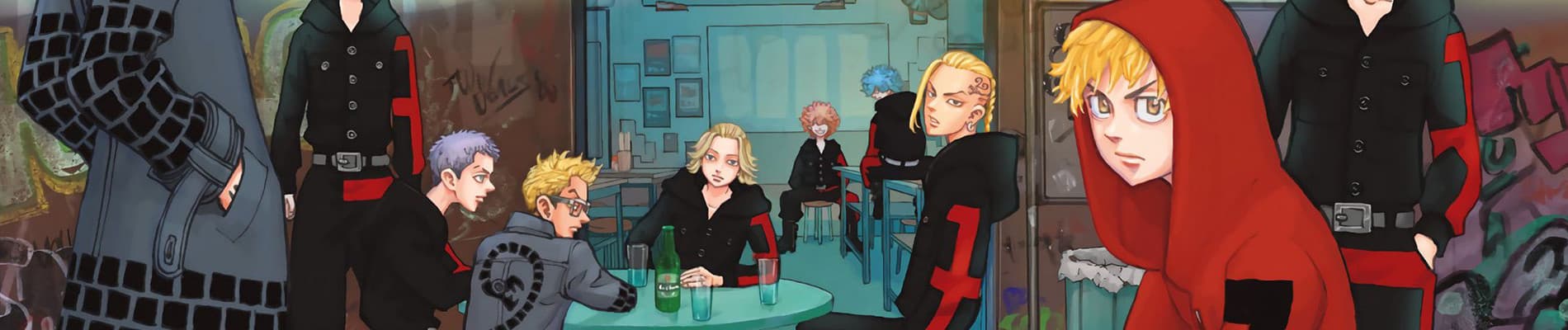
Me gusta la representación visual sobre la banda, los uniformes y símbolos visualmente constituyen una base de interés que se ve enaltecida por los diferentes personajes. Hay un variado diseño de cuerpos, peinados, y detalles particulares como aretes, tatuajes o cicatrices. Y a más alabanza, mantiene esa coherencia visual a través de la presentación de los personajes en diferentes décadas.

No es un dibujo detallado, se inclina a incluir sólo los elementos necesarios en el panel, que en sí mismo genera atractivos momentos, especialmente en las doble páginas en que a veces ubica a docenas y se siente la inherente importancia de ese instante. Únicamente en cuánto a ilustración, lo que compone su núcleo de artista está en el posicionamiento de los personajes, sus expresiones faciales y uso de las sombras. También las portadas de los mangas son muy geniales, su visión acerca del color se acomoda a la perfección con su estilo juvenil.
Los paneles tienen un gran ritmo, en vez del diálogo prefiere expresarse en reacciones y posicionamiento, lo que dicen es más un acompañamiento a la imagen. Sus batallas son entendibles y emocionantes (en cuánto al intercambio físico de golpes), permitiendo que sean una lectura fluida, inclusive cuándo salta entre diferentes puntos de vista en el mismo episodio.
Tokyo Revengers es una obra que en cierto punto tuvo un brillo, un enorme atractivo que la volvía inspiradora, más la misma “oscuridad” la termino carcomiendo, no corrigiendo sus errores sino empeorando en los mismos, para ser rematada con un final que sólo terminó infligiendo todavía más daño. Convirtiéndose en un recuerdo y suspiro de lo que pudo haber sido, en vez de lo que se convirtió.

English
Suspension of disbelief is deeply rooted in the viewer’s personality; on average, it tends to be “high,” in the sense that the audience is not particularly attentive to the internal logic of the world, actions and consequences, but instead focuses on enjoying the experience. Those who dedicate themselves to writing or commenting on works, consciously or not, will eventually take a stance on this matter, and in my case, I have chosen to accept what is presented from the beginning.
This applies not only to the narrative, but also to the presentation itself. While the strange premise might have required an explanation at some point for some readers, I personally would not have had any issue if it had never been explored further. It was part of the basic setup and should simply be accepted… as long as it remained consistent with its own logic.
The fantastical dynamics are not the only elements encapsulated within this suspension. While I find the notion of a gang of teenagers disputing honor and territory without any economic motive or adult leadership rather ridiculous, once again, it is something I must accept. Ultimately, the author Ken Wakui himself was part of gangs during his youth, unlike me, who is completely removed from comparable environments, eras, or places.

In the same vein, the idea of a non-muscular teenager effortlessly defeating dozens of thugs is just another stripe on the tiger if you read manga with any regularity. I was not about to question that either.
The main strength of the work is its protagonist, Takemichi Hanagaki. In a world whose dynamics are mostly tied to physical strength, having a main character who is weaker than everyone else means he must stand out through other means. He is not particularly intelligent either, so the only path left is sheer willpower—and he has that in abundance.
His evolution (up to a point) as a character consists of gaining confidence and determination as he overcomes each obstacle. Through his indomitable spirit, he gains allies, continuing to stand back up even when it should be impossible, embodying the ideal of a leader worth following because his back looks broad and his shadow feels safe. An exciting description for someone labeled a “crybaby,” who frequently falls into depression or misguided thoughts due to his own weakness. It is precisely the people he has brought together who remind him of who he is and what his goal is.

The immediate supporting cast forms an interesting narrative network around Takemichi. Given that the story largely revolves around a gang, it is necessary for its members to be comparably engaging. From Hina, his romantic partner and main source of motivation, to his best friend Chifuyu, the older-brother figure found in Draken, and others he meets along the way, many receive dedicated chapters that delve into their backgrounds, adding layers of interest and motivation that are often used as narrative engines during confrontations.
That sense of friendship does not depend solely on Hanagaki. Within the same gang, there are smaller groups that also receive dedicated chapters, enriching the overall narrative of friendship. Mismatched duos that, over the years, become brothers.
The characters’ backstories allow for portrayals that avoid purely positive or negative classifications. Even if none of them are examples of deep narrative complexity, several embody internal contradictions that make them interesting to revisit across different situations and moments. At this point, it is important to mention Takemichi’s foil: Kisaki, the main antagonist.

Despite being described as his opposite, they actually share a foundation of weakness—the difference lies in intellect. Kisaki is brilliant, a planner who always seems three steps ahead regardless of direction and without a clearly defined goal. Between the two, a central narrative tug-of-war forms, reaching a peak that is never repeated.
Before focusing on the infamous final arc, I must point out negative aspects present from the beginning. My suspension of disbelief does not include the existence of “two” Takemichis, the one who existed before and the one who will exist after. Such a particularly strange element that, despite not directly harming the narrative, feels upon closer inspection as if it undermines the character, turning Takemichi into a secondary character within his own story.
In the construction of its universe, gang conflicts naturally imply the existence of multiple gangs, with members divided into “generations.” The introduction of a member from a previous generation is framed with an aura of wisdom and history, a mythical milestone from the past. This works well at several points; however, as chapters progress, these figures are reduced to power-scaling tools, with stronger characters defeating these “myths” effortlessly.

These introductions are usually done in retrospect, creating an inconsistency: if someone so strong existed, they should have been mentioned earlier, yet they appear only as the story progresses. This is merely a symptom of a broader issue, the use of memories and flashbacks to steer the narrative wherever Wakui wants it to go. There is a marked incoherence in which events, encounters, and memories so significant should have been previously mentioned, but instead are recalled only at the exact moment the plot requires them to advance.
It also works in reverse: information seen in the future only becomes relevant immediately before it is needed, while any trace of investigation or preparation is dissolved under casual excuses. To some extent, I can understand this as a way to maintain interest, until it eventually crosses the line and becomes nothing more than an intentional cover-up to guide us blindly toward the next event.
The same friendship I previously praised, effective within the core circle, becomes diluted as more and more characters appear, blurring the idea of a gang. It may be logical that their inclusion serves the purpose of structuring a large criminal organization, but I disagree that this was the right way to achieve it.

As for character deaths, few feel coherent with the development or decisions of the deceased. Most are used as emotional blows to once again push the story toward the next moment. This undermines the characters that were given time to develop layers and contradictions, reducing their purpose to mere motivation for those who remain.
The final arc runs counter to the development achieved up to that point. Takemichi’s evolution is taken to an extreme, distorting his well-earned position as a hero into that of a martyr. His dilemmas repeat themselves, and while some decisions align with what he has learned, they stem from a weak foundation associated with the character I appreciated least in the series: Mikey.
Ken Wakui’s intention to turn Takemichi into the inspiring figure Mikey was supposed to represent is evident. Ironically, I believe Hanagaki is more of a “Mikey” than Mikey himself. While Mikey shows flashes of leadership and confidence at times, they are mere glimmers compared to the protagonist’s brilliance in key moments. Wakui might have been a genius in portraying Manjiro as darkness, if not for the indefensible excuse used to justify it.

An abstract and convenient force that even distorts the time-travel system ultimately breaks the suspension of disbelief I initially committed to. Consequently, and stating the obvious, the very fantastical foundation of the manga is broken. Ken uses it at will because he does not know how else to grant Takemichi enough “power” to move the story forward where he has placed it.
To add a few more jabs: there is no antagonist with equal narrative strength or interest; characters are introduced randomly into a war that never truly materializes; and the absurdity of conveniently timed deaths reaches its peak. All that was left was one final touch, a conclusion that can only be described as an insult to those who invested time and emotion into the story.
I do like the visual representation of the gangs. The uniforms and symbols provide a visually engaging foundation that is elevated by the different characters. There is a wide variety of body types, hairstyles, and distinctive details such as earrings, tattoos, and scars. To its credit, this visual coherence is maintained across the depiction of characters in different decades.

The artwork is not highly detailed; it leans toward including only what is necessary in each panel, which in itself creates striking moments, especially in double-page spreads where dozens of characters appear, conveying the inherent importance of the moment. From an illustrative standpoint, the core of Wakui’s artistry lies in character positioning, facial expressions, and the use of shadows. The manga covers are also excellent, with a sense of color that perfectly complements his youthful style.
The paneling has great rhythm. Rather than relying on dialogue, Wakui prefers to express through reactions and positioning, with words serving as accompaniment to the image. The battles are clear and exciting (in terms of physical exchanges), allowing for smooth reading, even when shifting between different points of view within the same chapter.
Tokyo Revengers is a work that, at one point, truly shone, an immense appeal that made it inspiring. Yet that same “darkness” ended up consuming it, not correcting its mistakes but worsening them, culminating in a finale that only inflicted further damage. It became a memory and a sigh for what it could have been, rather than what it ultimately became.

10 out of 12 users liked this review
