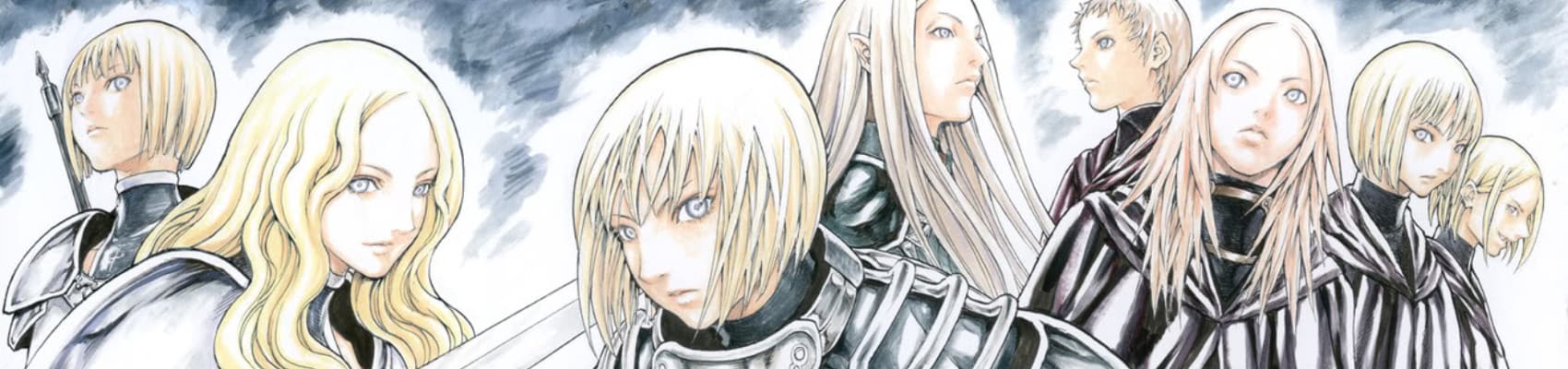
Claymore
a review by PatagonianAnon
a review by PatagonianAnon
Until I clarify that spoilers begin, I will try to summarize what gives the work so much value.
Self-contained arcs with character development, valuable relationships, difficulties, and extreme situations amidst a dark conspiracy make up the first third of the work (what the anime adapted).
As the conspiracy grows, the warriors are forced to make decisions on their own, thus growing as companions and beginning to fight more for their own well-being and that of others.
Multiple events involving both new and returning characters lead to increasingly serious conflicts that will culminate in the final battles. Along the way, all the characters will contribute within their respective roles, learn from their own dilemmas, or make poor choices and learn from their mistakes.
There is no filler except for one Extra episode, and there are no unused characters.
I would try to describe the great plot twist it has regarding the conspiracy, but it would be too obvious if I compared it to that of some well-known works.
And in case it wasn't obvious, many of the best female characters in the entire demographic. And it's also a manga without intrusive humor or filler.
I give Claymore an 8/10 for maintaining a well-paced story across several mini-arcs filled with dilemmas, developments, and honor for characters who had a way of life defined by fighting monsters, and because it sins much more for what it did not tell than for the mistakes it made in what it did tell. Without a doubt, a work nearly on par with the 3 or 4 best among battle shonen.
I have a few more things to say before getting into the spoilers:
Legacies: What did the people we once knew and loved leave us? Teachings, wisdom, helpful things? In Claymore, there is a unique sense of legacy among the warriors that influences them to learn their combat techniques, fight with the swords of fallen comrades, and even carry parts of them, as is the case with Clare, for whom both legacies and miracles will unify at a certain point.

Thus, most warriors in this story do not look back on their past because they have few and unpleasant memories. Some carry severe traumas resulting from their hatred of Yoma and the atrocious experiences they suffered at their hands. Yes, this is a story where the vast majority of female characters have lived through the same experiences, which leave them without a past and with family ties that would only bring moments of sadness. Therefore, these pasts are touched upon very little and only at the beginning of the entire work, in order to focus on their bonds with one another.
The attacks by Yoma leave different villages marked in such a way that they avoid helping children who survived attacks, for fear that any of them might be another Yoma transformed into a human. Similarly, they avoid seeking help from the warriors they call "Claymores," after the type of sword they carry, as they are aware that their bodies are half-Yoma and fear what might happen by having them nearby. This prejudice is primarily a trait of the premise, but it will be developed and resolved for the protagonist over the first two arcs.

Finally, an episode explains the immense burden that weighs on the warriors, as they are all orphans who have gone through terrible times, so that as warriors, one day their minds can no longer regulate the flow of Yoki, and they must call a comrade to kill them, so they may die in peace as humans. This chapter is primarily important for establishing the kind of past shared by all warriors, along with their lack of personal motivations in most cases, and their psychological profiles in others. And something no less important: that for them, it is sacred to rescue their comrades from ending up as monsters, which is why they mourn their deaths but are also fully capable of carrying out that task through a black card.
Even with such a long flashback, the author didn’t want to waste time and went straight into a tragedy handled with just the right amount of grief. That’s followed by an arc that keeps building the world and a friendship born from a common enemy but with real mutual respect, in a world where it really matters to connect with someone when your life and theirs are in danger and you’ve got no one else.
Then it kept a realistic pace where the protagonist couldn’t solve something beyond their reach, yet in "The Witch’s Maw" it established the character’s frustration, and by the way… a female main character! And an imperfect one! Kind of an antihero, with a personal goal the viewer understands after seeing what happened to her, and since she’s so far from achieving it, she’s got a long road ahead where maybe nothing will guarantee she gets there, like the uncertainty of the real world.
The second third of the work: many characters return at the pace of a work that has no filler whatsoever, and some of those who reappear have undergone significant development in their lives. The main warriors show that they never abandoned their dreams, and as soon as they were able, they went back after their own desires, and the narrative seeks to give them that opportunity. The world feels advanced: most individual characters, as well as the guard of the city of Rabona and the Organization's experiments, have progressed considerably. Some "pending" plot threads are closed, past events are explained, and most importantly, the biggest questions are resolved, and a chain of events occurs that leads to the developments of the final third. Some for the worse, and others for the better.

Like the other warriors who are, in their own way, persuaded by the organization's truth, Clarice undergoes a significant transformation, evolving from a warrior who feared for her life and had no ties even with other warriors, to someone who embraces her advantages and finds fulfillment alongside the people she met along the way. Dietrich, taking steady steps but maintaining her sense of responsibility to the Organization, repays the warriors and ultimately confronts the truth based on her own childhood experiences.
Even among the last warriors controlled by the organization, Roxane offers a story of how a weak warrior slowly rose through the ranks. Cassandra's spirit or remnant ended up avenging her old friend so she could say goodbye properly, as just another comrade (something she learned from her friend).
Raki and Clare are no more than 4 (maybe 5) years apart in age. Clare finished her training when she was still a bit young but already a teenager, and due to her weak level, which makes her rely on releasing her Yoki until Darkness in Paradise, it is understood that she hasn't been working as #47 for several years. Yes, Clare is a teenager at the start of the work. Raki, on the other hand, is a pre-adolescent who reaches 19 to 20 years old by the end of the story.
Many readers get the impression that the work's quality dropped significantly from chapter 66 onward. The reasons are mainly due to reading the work quickly, possibly because there is "too much action and dialogue for something important to happen."
From the timeskip onward, Claymore does nothing but characterize the new cast of warriors, reinforcing the bond formed through their training and living together, but it also exposes the vulnerabilities and flaws of both the new warriors and those we already knew: Helen's clumsiness and desire for revenge, Clare's unquestioning thirst for revenge, Miria's perfectionist and protective sense as a leader and guardian of her colleagues' well-being, Uma's feelings of inferiority and lack of purpose and talent, Cynthia's hidden sadness, and Tabitha's trust in her superior Miria.
All of this is exposed as the plot progresses, through accidents, the foolish decisions of the more immature warriors, old encounters, and all without hindering the main storyline. There really aren't many justifications for why the work supposedly declines at this point; it stems from fast reading and first impressions.
Both the bond between Clare and Raki and the influence of that bond when she half-awakens, the psychological profiles of some characters, and the powers of a few characters tied to having great hatred or great willpower, are elements that have also been used in more infamous works. They can come across as very predictable and poorly justified.
The relationship between Raki and Clare is built on two people who were almost defeated but can still move forward if they form new bonds, and on the parallel between Clare and Raki having both been rescued by someone after horrible experiences, which makes it somewhat justified. Not to mention that, from a writing standpoint, awakening is a process derived from the experimental introduction—it is very important to clarify—of a monster's energy into a human, at an early stage of the experiment where the Organization had not yet achieved the results it desired for complete control. Therefore, the mental strength required to resist the awakening process remains a mystery, and in fact, later on, it is achieved through another method. In a work about faith and perseverance in creating miracles, it is fitting to have a power system based on unknown and uncertain experimental processes, but with some fixed foundations such as improved training and careful Yoki release. Other works manage to overcome setbacks through discoveries and an established set of rules, and that is fine too.
Raki is a character who, with slight changes to his dialogue in the animated adaptation, can come across as overly sentimental, but in the manga, he uses the right words and has appropriate reasons for not wanting to abandon Clare or lose her: he had recently lost his family and had no one else in such a difficult time; he is not afraid of people, but until then, no one had helped him; he understands that Clare is a solitary person who at first does not want to open up to anyone else, and he perceives her as someone who has lost as much as he has; and he is emotionally drawn to her. Is he too sentimental? Yes, at his age of 12 or 13, during the pre-timeskip, he worries about Clare's well-being and musters the courage even to fight a warrior, because his greatest fear is losing someone again.
On the contrary, the 19-20-year-old Raki is a likable fool. He searches for Clare without worry because many years have passed since he lost his family and was separated from her; he has mustered courage, his spirits have improved considerably, and he was able to fulfill his purpose of becoming stronger to travel and reunite with Clare. He understands that the world is highly dangerous and there is not enough room to flee from threats, so he even accepts the risky task of someday killing Priscilla.
She's an apathetic person who, despite everything, prioritizes people's well-being and has friendships. Her not-very-close behavior toward Raki is well justified by the fact that she could die on any mission because she was weak, and by the frustration she carried that culminated at the end of The Witch's Maw, after which she stopped thinking about her interpersonal relationships from the moment she parted ways with her friend and entered advanced stages of training, as seen in Extra Chapter 04. That frustration is even more justified by the fact that Clare chose the difficult path, taking only a quarter of Yoma DNA, and chose to join on her own the very organization that caused Teresa's death, which makes her desire for revenge unquestionable above all else, even in advanced chapters of the story.
I won’t lie—the number of questions the work leaves behind is not small. How many warriors has the organization had? How many decades has it been in those lands? Can all warriors hold back the awakening process for several days until a comrade with the Black Card arrives? Does a warrior whose awakening was interrupted by a companion’s control of yoki also count as semi-awakened? Fortunately, I was able to see that most of these do have clear answers.
Like... Why did Cassandra have her warrior clothes if awakening destroys them?
I would add the strange sequence of scene 04. But apparently Clare didn't want to fight the yoma that followed her while she was carrying Raki, and then it walked away as she left him at the inn, losing sight of him.
img80%(https://64.media.tumblr.com/3bcfb92f02e1834e7485ac2843d85478/c162eab2e78b2491-0e/s540x810/9403ba4ed2cedb4bf9fa728d2ab985c6ea123a80.jpg)
The major villains in this demographic have motivations, malice, and accompanying characteristics, as well as a past and development or closure. The Abyssal Ones, with the few characteristics given to them, at least raised questions, but left much to be desired, as they left many stories untold and did not challenge the ideals or methods of the warriors or the Organization, even though some of them were ruined by the same Organization. And of course, the main antagonist is the Organization, an extremely dark group that, with perfect motivation, commits acts without hesitation against people they do not care about and likely see as inferior. The downside is that they have almost no direct confrontation with the protagonists since they are mere humans.
It becomes unclear whether the Awakened Beings harbor any personal resentment toward the Organization, because despite knowing it, they do not seem to have attempted to destroy it (possibly due to its ability to create new high-ranking warriors capable of facing any of them). But at the same time, it is understood that once awakened, they are not allowed to live for the sake of human lives, so like the first Awakened Being seen during The Slashers arc, they must kill the warriors sent to eliminate them. This is actually compounded by the three main Abyssal Ones, who happened to share a sense of territory in order to have people to feed on, as if they were animals, though this is never stated. Isley is the one who stands out the most, as he goes to war with other Abyssal Ones, having awakened with that goal in the first place, leaving an untold life story that would justify it. The indifference of these three toward the Organization makes more sense in that they know that as long as they are not ordered to be exterminated by a village, the Organization would not attack them. When this changed over the years during the timeskip, Isley was the first affected, while Riful sought a way to use the power of the two sisters to defeat him and Priscilla.
Of the three Abyssal Ones, both Riful and Isley harbor secrets about their pasts that motivated them to become who they are, leaving them as villains who simply participated in the story at some point.
Isley has a philosophy of strength, a sense of dominance over others, and proves to be cunning when he offers his help to Priscilla and when he takes Raki to live and train with him. His influence in provoking the War of the North makes him utterly despicable, and even more terrible when it is revealed that all he wanted was for his group of Awakened Beings to die in combat with the Organization.
Riful was the first warrior to awaken at a very young age, and she is capable of doing anything to build her own powerful army of Awakened Beings and continue living in those lands. Not only is she selfish, but she is also aware that, for humans, half-Yoma and Yoma are sometimes the same.
Priscilla, on the other hand, follows a different formula.
Her exposure time before the final stretch is limited to a few chapters where her actions and thoughts cannot be explored. It is justified in an extra chapter that the world is not being stalked by someone as powerful as her, and then we move to the moment when her empathy ends and she returns to behaving like an Awakened Being more tied to her aggressive and resentful side, going in search of an essence that was presented to us through the pleasant scent she felt from Raki. Priscilla does have a great mystery that can be overlooked in the work, because it is only mentioned once before being resolved near the end.
As a character, she is a giant threat that imposes a sense of immense danger ever since she awakened, but she differs from conventional villains for two reasons: deep down, she wishes to die, as requested in her final moments as a human, which she cannot bring into her consciousness as an Awakened Being, but she is subject to strong amnesia and a calm dual personality because her mental state as a human was unstable and her true nature was calm. Her crisis with her inner desire, however, does not lead to plans or intelligent actions, but to fights in which her personality as an Awakened Being prevails, one that does not hesitate to annihilate potential threats and seeks to remember what happened to her in her human days through force. This leaves a character complete in terms of past and goal resolution, but with little potential for decision-making and a rivalry with the protagonist that features almost no memorable exchanges.
The last thing that harms her is the fact that characters in the work believe she actively sought out her killer by directly placing faith in Clare as the successor of Teresa's flesh, rather than that her wish was finally fulfilled after so many years of feeling a remnant of the essence of that #1 warrior. This same phenomenon can be interpreted more logically and has no official explanation from Priscilla's character, so it can be salvaged.
Despite everything, the three Abyssal Ones die in situations where they long for and prioritize their human desires: Luciela embracing her sister, Riful protecting Dauf (who seems to have been her partner since they were human), and Isley with a positive outlook toward the days when he lived a more normal life with Raki and Priscilla. The construction of the average past and experiences of the protagonists helps give value to these closures, but as characters, they had little screen time, Isley's time with Raki was underdeveloped, and their motivations against the Organization and key moments from their human pasts remain unknown. Primarily, the context in which they awakened and how they built their personalities. Therefore, each of their closures could have carried even greater emotional weight, despite the irreconcilable situation between humans and Awakened Beings.
If you read all of this, I owe you a fried chicken.~~~~~~-
12.5 out of 13 users liked this review
