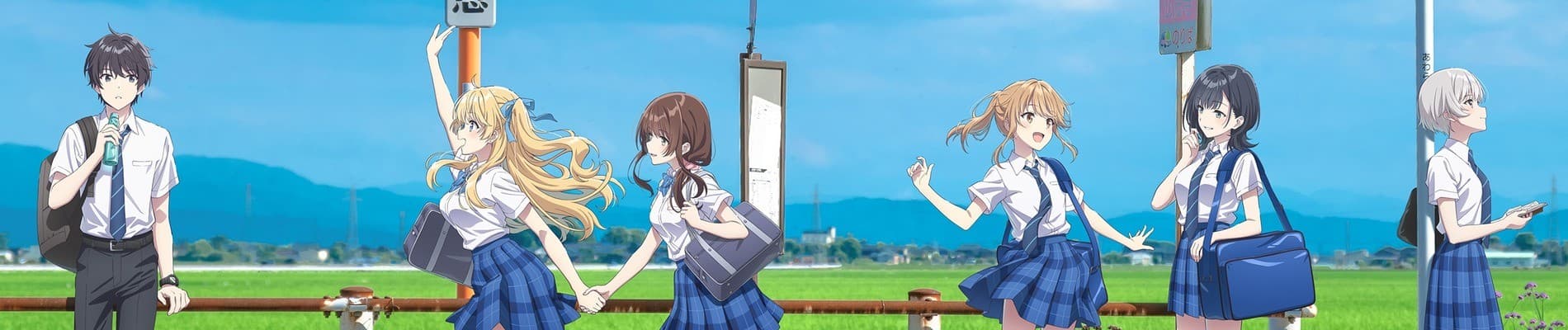

In a more well-respected medium, Chitose Is in the Ramune Bottle probably wouldn't have had to face as much backlash as it did back when it first aired. With the litany of repulsive goon slop out there, it's an understandable reaction to treat its 30-minute premiere as a failed attempt at satirising contemporary otaku-isms. Between the cheerful cast yelling nonsensical greetings to each other, to the three heroines practically confessing their love to Saku, to our hero's bombastic break-in to cap off, it's hard to put into words how obnoxiously loud and stupidly thick the introduction really is. But frankly, I think that's what makes it charming.

The central problem Chitose Is in the Ramune Bottle faces is the existence of its shitty peers. The sheer infamy of works like Oreimo or Haganai or Henneko or The Ryuo's Work is Never Done or Eromanga Sensei or Imoimo or Hensuki or Tsurekano or The Angel Next Door Spoils Me Rotten or Kimizero or Roshidere or Kurakon or Danjoru or Imouza, just to name a few, inevitably prompts skepticism towards any work that shares the "light novel romcom adaptation" label. Yet, it pays no attention. The show unashamedly employs character cliches in the genre both ironically and genuinely; it draws on the "popular guy = bad" trope as a major narrative driving force, just to break it wide open with the main cast's deep sincerity and compassion; and it embraces teenage naivete and the naval-gazing, self-important philosophies to contrast with Saku and friends sociable front.
This post-ironic approach lets the show eat its cake and have it too. By ingeniously relying on paratext to setup a fake veneer, it saves a lot of ink on exposition while also allows it to hide its true intentions: the seemingly stereotypical characters offer comfort in familiarity for the less adventurous, afford the narrative space to jump right into action without having to establish chemistry, and subvert audience expectations as each of the boys’ and girls’ masks slowly slip.
All that is to say, it doesn't take a genius to catch on to the mountain of contradictions Saku & co. contend with, and arrive at the conclusion that something is brewing under the surface, even in early episodes. The most apparent departure from the conventional is that the show constantly and deliberately understates anything important that informs the cast's personalities. With the story starting in the second year of high school, the usual back story dump that plagues the genre is curiously missing, and any effort to bring it up is immediately shot down. This lack of any significant mention of past events for a story that starts in media res creates gripping, organic intrigue that lingers in the back of one's mind.


Indeed, as the show gets to more serious themes/arcs, it recontextualises the material before it and elevates the work as a whole. Whether it is from Nanase's PTSD and the evergreen question of the line where the platonic ends and romantic starts; or Asuka's struggle with parental expectations and the anxieties of breaking out of your own bubble; or Saku's fragile facade and his wrestle with the concept of Honne/Tatemae that envelops it all, we come to appreciate the odd parts as genius: interactions feels performative at times, because to a certain extent, it is. The whole charade is a flamboyant act the whole group puts on in order to hide their insecurities and the brittle nature of their dynamic; and Saku's foolish, in-your-face idealism and philosophical waxing was never Chitose Is in the Ramune Bottle's central thesis. Rather, the show goes out of its way to actively disprove such an unsustainable way of life.
It's a bait-and-switch. Kenta's and Yuzuki's arcs aren't pointless exercises, but an noble solution a central issue with all of fiction: that your message basically never reach those that aren't already looking. Everything from episode 11 onwards is a great wakeup call to those that unironically enjoyed what was presented to them on the surface. Ultimately, instead of aligning itself with the "popular kid" escapist fantasy, the show flips the script to depict the common struggles of riajuus (aka, let’s face it, your average teenager) that are often much more complex than contrived McGuffins or the tired "love me, love me not" flounderings. The humanity it presents is perhaps ordinary, but a much-needed breath of fresh air in the landscape.
Sadly, there's just no room for charitable readings.
Context is King, and in an environment as toxic as this, any perceived misstep is a deathblow to whatever crumbs of confidence is left. The unfortunate reality is that, through guilty by association, the many brave choices Chitose Is in the Ramune Bottle made can also be readily (and reasonably) dismissed as mere authorial blunders/laziness. The natural interpretation of Saku's genuine internal conflict, of living out the ideal and reconciling self-image with societal expectations, is but your typical chuunibyou bull; his "harem" acting like the whatever-deres you care to mention only reinforces this exegesis; and the admittedly absurd ending in episode one might as well be the titanium bolt on this stainless steel coffin.
This is not to blame the script's problems all onto the extrinsic, however. Arakawa Naruhisa is a veteran of the industry and should have known better to adapt the novels into something more fitting for the weekly TV format. To this end, it's hard not to get into suggesting easy improvements:
- Drop the descriptive slurries delivered by Saku’s internal monologue. While the prose is a standout in the original novels, visuals and voice acting could have done the brunt of the work with the change in medium. The omnipresence of Saku's thoughts, important and trivial, is a symptom of failing to "kill your darlings" and diminishes the impact of moments where his thoughts do have significant bearing to the story.
- Play the first four episodes at once to soften the shock from the gamble that is Kenta's arc. The first volume mirrors the structure of the show as a whole, itself being a post-ironic bait-and-switch that compliments its central message (of not judging others by first impression) well, which works well as a single volume, but falls short when split into a story in 4 parts.
- Cut the unadulterated fan service scenes that only serve to muddle the waters.


But where parts of the weak script set it back, Chitose Is in the Ramune Bottle makes up for by doing visual storytelling well via great character acting and purposeful cinematography. At risk of committing the sin of the blue curtain, this washed out, almost artificial blue tint that the cast constantly basks under works as great visual metaphor for their unnatural relationship and symbolises an underlying sense of melancholy. More explicitly, important scenes are emphasised to get the point across succinctly without dragging down pacing or making things agonisingly obvious: focusing in on Asuka's eyes lighting up during the flashback in episode one, Nanase flinching at Saku's playful feint chop in episode five, or Saku's suspicious eyes in episode six, for example, comes to mind. And even more so, the ED paints a vivid picture of Saku's younger self that echoes his talk with Kenta in episode two, a big red flashing warning sign asking the audience to look beyond a purely textual reading of the story.

It's a slight shame that the production values aren't consistently great and there isn’t an impressive flair one can point towards. Although both the OP and ED are audio-visual treats, production masterclasses like Makeine and My Dress-Up Darling have shown the ceiling of what's possible for the genre and Studio Feel is simply no match. Facial features go off-model on occasion, movements are decent overall but are sometimes stiff in the usual way that seasonal anime almost necessitates (the football scenes come to mind), continuity rarely but do sometimes break in between cuts, and the occasional shot could use with a little more thought.

Alas, he who fights with monsters might take care lest he thereby become a monster, and Chitose Is in the Ramune Bottle clearly didn't take enough care; that much is said in earlier parts of this review. But I'm praising with faint damn here, those who are quick to judge are missing out on a story that's more introspective and intricate than it is on the surface. It ambitiously utilises its contradictory nature for characterisation and narrative realisation, crafting a story that captures the adolescent beauty/chaos in its very essence. And looking at recent seasonal charts, I feel the effort alone should be commended, if all else fails.
And don't just take my word for it, Waseda Uni professors are telling their students to read at least till the third volume for class prep, when other series like Oregairu and Makeine only require one. So you better believe it.