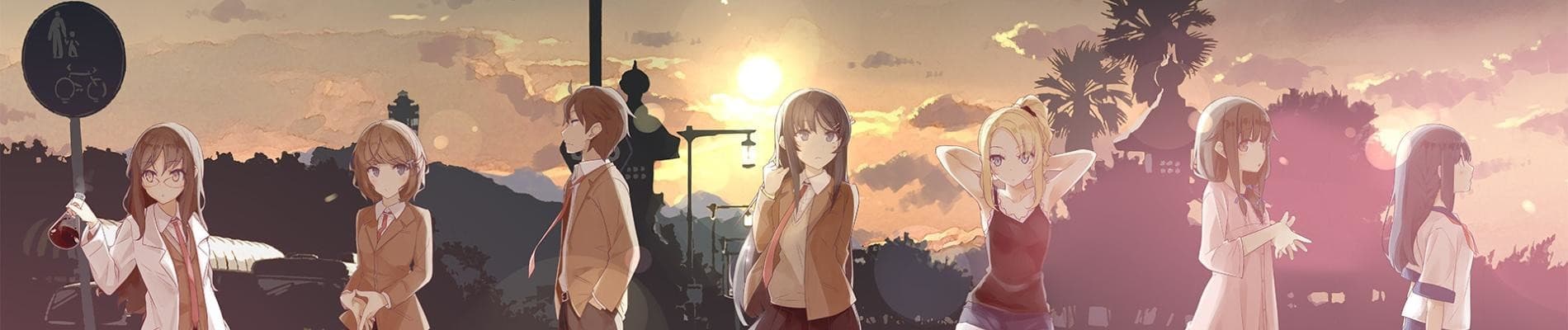
With a name like Rascal Does Not Dream of Bunny Girl Senpai (or simply Bunny Senpai), this show from the Fall 2018 anime season doesn’t instill much confidence. First, the title’s a sentence title, and whether in Japanese or in English, it’ll take you a while to get it right when searching for it online. When saying it out loud, you’ll just look silly. More damning however, is the fact that the title and promotional visuals naturally lead viewers to assume that Bunny Senpai will be nothing but shamelessly tantalizing ecchi with no substance.
However, after watching it, I highly recommend this excellent show. Looking past this book’s cover, I found pages upon pages filled with an engaging, well-executed story.

Sakuta Azusagawa is a high school student. He;s somewhat isolated from others due to a mysterious incident that happened sometime prior to the series. One day, he runs into a girl wearing a bunny girl costume— the eponymous bunny girl senpai. Her name is Mai Sakurajima, a famous actor who has suddenly become afflicted with “adolescent syndrome,” a phenomenon that affects adolescents in various ways. In Mai’s case, she cannot be seen by anyone, so she wears the costume in hopes to elicit a reaction. Sakuta is the only one who can see her. Together, they try to solve the mystery of Mai’s adolescent syndrome.
The first thing I must praise this show for is Mai and Sakuta’s relationship. The show is very fresh and original; a large part of this is thanks to the main characters. Sakuta is snarky, mild-mannered, perverted, and somewhat irreverent. He doesn’t really let anything fluster him, and unlike many MCs in anime, he isn’t ashamed about his sexuality. Overall, I’d describe him as a cynical character (at least in the beginning), yet not to the point where it’s emotionally draining. While some might not like his “don’t-give-two-shits” attitude, I found it hilarious. Admittedly, my love for Sakuta’s character is in large part due to how subversive he is in terms of main characters. It’s just one way that Bunny Girl stands out in the crowd of slice-of-life anime. Due to how well his personality was established, it’s all the more noteworthy and exciting when he acts out of character, such as when he cries.
Mai is a great counter to Sakuta, matching his snark. Under a somewhat aloof exterior is a sweet, friendly person. I was happy as their relationship progressed because Mai is subversive as well. She isn’t prone to dumb misunderstandings and in general, her actions just felt real. No getting mad at Sakuta for stupid reasons such as him talking to another girl. There are many tropes and cliches in anime, and I’m pleased to say that Bunny Girl senpai doesn’t rely on them...for the most part.

Even structurally, Bunny Girl Senpai sets itself apart. The show doesn’t drag its feet in terms of progressing its character or story, and as a result, no arc overstays its welcome. As a testament to how brisk the show is, episode three is very conclusive and satisfying; feeling like the end of a one-cour show. After this, the arc revolving around Mai and Sakuta comes to an end. However, the creators clearly know what made the first part of the story so engaging, because Mai sticks around. She’s not given as much focus as she once was, but she still is a primary character.
Each arc focuses on another character dealing with their personal flavor of adolescent syndrome. In each arc, we see the character that the story is focusing on undergo development and ultimately overcome their anxieties, the syndrome disappearing along with their dilemma. The adolescent syndrome is another thing which really makes the show shine. The adolescent syndrome is terrific because it allows viewers to understand what the characters are going through in a unique way.
While it’s not bad, the character designs are somewhat generic and the OST is quite low-key and sparse. While this would normally hurt the show, Bunny Girl senpai uses these elements to highlight the supernatural adolescent syndrome. Against the backdrop of the art and music which paint the picture of a “normal” world, the adolescence syndrome sticks out. Paradoxically, the art direction of the anime makes it so the adolescence syndrome isn’t depicted as completely farfetched. Together, these attributes characterize adolescence syndrome as a force that is grandiose, yet common — perfect for describing the seemingly insurmountable struggles that youths go through, time and time again.

The adolescent syndrome is just a manifestation of teen anxiety, and as such, it doesn’t require an explanation. There are two reasons it shouldn’t be explained. For one, it loses some of its charm as something you just have to deal with. Two, it would fall apart as soon as you try to explain it. For this reason, I groaned everytime recurring character, Futaba ,would try to explain the occurrences with technobabble. Her attempts at explaining the phenomena didn’t add anything to the show and just bogged it down, trying to explain what can’t really be explained and boring viewers. The only explanation I liked was when she explained Schrodinger's cat, just because it was informative, was actually somewhat relevant to the syndrome at hand, and was easy to follow.

I found Kaede to be another weak part of the show. After so many subversions, it felt like Sakuta’s younger sister, Kaede — with her obsession with her brother and overly cutesy personality — was added to remind viewers that, yes, this is an anime. At the very least, I was glad that she didn’t end up being clingy and jealous, but nevertheless, the referring to herself in third person and the idol worship of her brother schtick got old fast. Luckily, there’s a revelation that makes me appreciate her character more, but hindsight is 20/20.
While it's a bit unrealistic that an actor gets so chummy with just a random guy, Sakuta and Mai are just too cute for me to care too much.
While the character in each arc get development, Sakuta himself doesn’t have that big of a character arc. It's there, but it's subtle and I wish we saw him change a bit more.
There are a few loose ends that aren’t tied, leaving the last episode feeling slightly unsatisfying. Still, there’s a movie coming up, so I’m sure everything will be concluded then.
And boy, am I glad there will be a movie. With how much I loved this show, at the end of the thirteenth episode, I was clamoring for a second season. Rascal Does Not Dream of Bunny Girl exceeds expectations and handles anxiety in an engaging way with characters who feel like real people. It is a brilliant coming of age story.
9/10
A-
54.5 out of 63 users liked this review
