
FLCL
a review by Pockeyramune919
a review by Pockeyramune919


Despite being relatively new, FLCL has cemented itself as an anime classic and many anime fans got their start watching FLCL when it originally aired nearly two decades ago. Having watched the series twice now, I can see why. The show’s quality, stylized animation and mature themes, while possibly daunting, is in some ways the perfect gateway to a new world showing them all that anime can be.
As stated before, I have my own history with FLCL. I originally watched it during 2012 or so, when I was first getting into anime. While in some ways FLCL isn’t a good gateway series, I still enjoyed the show. I might have not loved it, but it snatched my attention and refused to let go. It was one of the anime that stuck with me long after I had watched it. I generally don’t rewatch/reread things. I find it a waste of time. After all, even if you loved a world, why revisit it? It’s not like you’ll experience the world in the same way. Well, after deciding to rewatch the FLCL series for the purpose of reviewing it, I’ll admit that I enjoyed my rewatch.

FLCL tells the story of Naota, a boy living in the nondescript (well, besides the giant iron that appeared one day) town of Mabase. He lives with his father and grandfather, and spends his time with Mamimi, his brother’s withdrawn and somewhat off girlfriend that he abandoned when he moved to America to play baseball. In Naota’s own words “nothing amazing happens [in Mabase]. Everything is ordinary.” As if she heard his narration, a pink-haired woman runs him over on her vespa then beats him over the head with her vintage guitar. This woman is Haruko Haruhara, and at her appearance, Naota’s life will only grow more topsy-turvy.

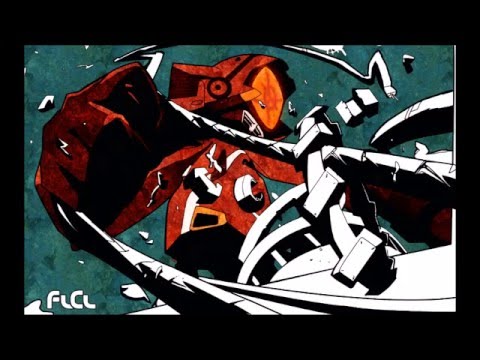
It’s nearly impossible to talk about FLCL without talking about the animation/art. The animation is a big part of the show’s appeal and you can see that a lot of care went into it. The art is downright beautiful. Episode one opens with art that is fairly realistic for an anime. It isn’t hyperrealistic, nor is it realistic to the point of being uncanny; just enough that it sticks out. This art style isn’t generic — on the contrary, you’ll seldom see art such as this — yet its purpose is to lull viewers into a sense of comfort, backing up Naota’s claim that he lives in a normal, boring town. When Haruko comes, Naota’s normal life shatters, and this is shown by the art shifts, the staple of FLCL.
It’s been said that the art shifts in FLCL were used to test several styles. No matter what their purpose was, they added a lot of energy to the series, with the very way we see the show shifting from one second to the next. Due to the jarring nature of the shifts, they’re mainly used comedically to great effect. Even knowing what was coming next, I still laughed at the inexplicable changes. Most notable are the two manga panel sequences (interestingly enough, these costed more than the standard animation) and the South Park animation. Even when the animation goes back to a more “normal” style, it’s still beautiful to look at. If there’s one thing you cannot say about FLCL is that it’s lazy.

Another big part of FLCL is the soundtrack, provided by the Japanese alternative rock band, The Pillows. The Pillows apparently were wary of scoring the anime since they hadn’t done something like that before. It’s great that they did, for they provide much of the anime’s charm. Sometimes tense, at others languid, the music is perfect for creating tone. Having an entirely rock OST is interesting enough that I’d recommend FLCL for that alone. The insert songs are greater still, injecting the anime with even more energy; if they even like rock a bit, viewers won’t help but groove to the music. All these years later and the music of FLCL still brings a smile to my face. I really should check out a The Pillows album sometime.
Before I get into the characters and story, I just want to take a moment to talk about the dub. While I like dubs in general, FLCL in particular has a great dub, with characters portraying emotions (or suppressed emotions like Naota trying to appear mature) well. Many diehard subbers also find FLCL’s dub great. This is no small part due to Haruko’s American VA, Kari Wahlgren, who voices the wacky, Haruko quite well. She also can give a more subdued performance as well. The voice actors for Mamimi and Naota are also great - nailing more “normal” voices.

Now, onto the story…
…oh no, it’s not terrible. I’m not sure that, even with brilliant art and music, something with an awful story could become such an unironic cult classic. I wouldn’t even call the story bad. I’m not even saying I dislike it. I’m not crazy about it, but it’s decent enough.
To start talking about the story, let’s say that FLCL is part coming of age, part space opera(?). It is very much more of the former than the latter. My marks against the story aren’t due to inherently enjoying space operas more, it’s just that there’s a bit of setup for something bigger, but it doesn’t really takeoff and leaves much to be desired in my mind. When watching FLCL, it’s kind of best not to focus too much about the insane robots and focus moreso and Naota’s life and struggles. Doing so will lead to a better experience, in my opinion. In FLCL, you’ll find a decent coming of age story about a child who must figure out how to mature after his brother that he idolized has left. Not helping matters is his burgeoning sexuality, acerbated by both Haruko and Mamimi.

However, this explanation is an indicator of one of my gripes. What I just told you is my take; it’s not necessarily correct. FLCL doesn’t hand you anything. FLCL Production Committee is the absolute master of “show don’t tell.” That isn’t a bad thing, but with little being explained, I find the show hard to get into at times, story-wise. It’s the type of show you will understand a tiny bit more after watching it, and you’d most likely have to rewatch it several times to get a satisfactory picture. As far as the space opera side of things go, your own interpretation should be good enough. Depending on where you look, looking it up might prove more confusing. I fully understand that I’m a moron and maybe I just don’t get “deep” things, but if I have a hard time understanding your work, the story isn’t enjoyable. It might be objectively good, but that’s moot if it doesn’t garner joy. It’s kind of disheartening when I don’t know if my understanding of the show is due to picking up more upon rewatch or simply reading what others have gleaned from the show.
On the shows Wikipedia page, it states that FLCL director Kazuya Tsurumaki responded to criticism of FLCL, stating "comprehension should not be an important factor in FLCL." Alright, I can see that it’s not really that big of a deal in the producer’s minds if everything makes sense, that the feeling is more important. Some will be completely fine with this. However, I like my stories concrete and cohesive, and FLCL is rarely both at once. Still, giving credit where credit’s due, there are a ton of metaphors which helps make FLCL a unique experience for every viewer. The show deals with mature themes such as sex in a subtle, generally respectable way.
I’ll always love FLCL’s “nothing can happen until you swing the bat” more than “you miss every shot you don’t take.”
Overall, I’d say the story is pretty good at best, fine at worst: not the best thing ever, but it’s good enough for me and pretty engaging at times.
Despite some flaws, I find FLCL a very hard show to hate.

On one hand, the zaniness and high-octane energy of the show can prove daunting, placing FLCL squarely as a Widget Series. It might be “too weird” for some viewers. If that’s not enough, I found that the story left a lot to be desired, wishing it was more cohesive and coherent and finding that it placed too much responsibility on the viewer to make something out of it.
Despite this, I’d be remiss to write off the show. Its lows aren’t that low, while its highpoints soar. FLCL has been compared to a music video, which I find quite apt. There’s great rock music abound, its highly experimental in its direction, story at times takes a backseat to mood, and it's quite short and fast-paced. I recommend FLCL for a unique, comedic anime experience that you’ll find nowhere else. At six episodes, it’s not much of a commitment; just one evening that you won’t soon forget.

19 out of 21 users liked this review
