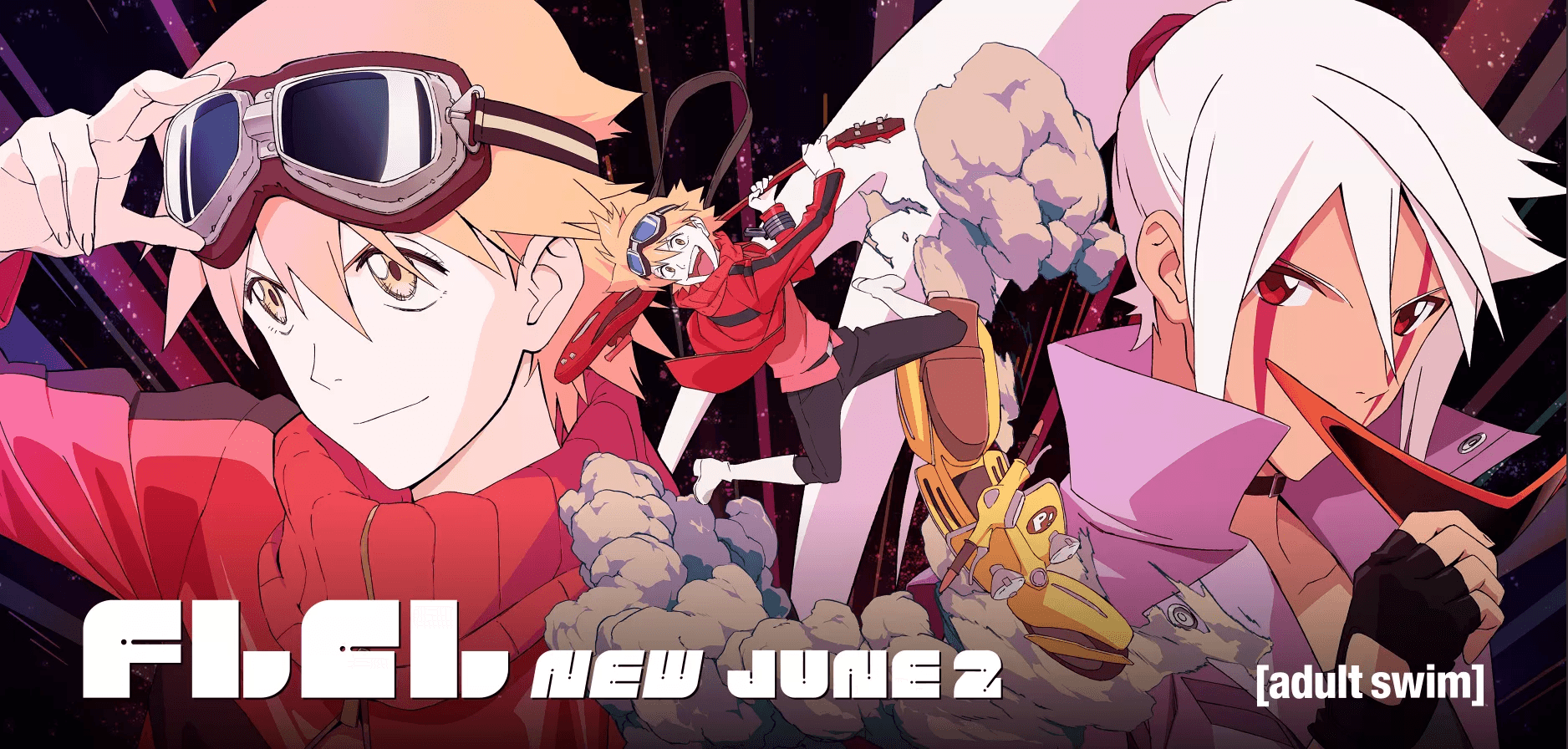




Ah, FLCL Progressive. FLCL was once one of the many works people just had to accept would be a one-off. Well, there was a novel and manga adaptation, but my point is that there wouldn’t be any sequels...until 2016 where it was announced that not one, but two sequel seasons of FLCL were going to be produced. I’m sure many were like me: filled with excitement; thinking of the endless possibilities. We wanted the where and when. Some wanted the why. No matter the answers, we were all stoked because after over a decade, more FLCL was within our grasp.
Flash forward to 2018. We had names and dates. FLCL Progressive and Alternative (both named after rock genres, thus retroactively creating FLCL Classic). The former would air in the summer, the latter the fall.
Progressive had insane expectations to fulfill. It would have to surpass, or at least be on par with the 2003 classic. It would have to be zany, gut-busting, confusing, and beautiful. It would have to quench all the theories that everyone thought up. It would have to resolve questions about Naota.

With this in mind, was good?
...yeah, I’d say so. Granted, I don’t think it’s quite as good as the original, but in some aspects, it excels. Even if it’s no FLCL, it’s quite obvious that it’s an FLCL show, and it most certainly scratched the FLCL itch that I didn’t know I had.
But to the fandom at large? That’s a different story entirely. I’ve heard people call the show an “abomination” and “soulless.” I’ve even seen someone say it “singlehandedly destroyed the franchise.” To say fan reception of Progressive was poor is an understatement. I don’t think a lot of these criticisms are fair. Most egregious is anituber Digibro’s review and I admit that part of my drive to create this review series was to organize my own conflicting view of Progressive. People are quick to hate a sequel just because it’s not the exact same as the original, which makes sense. And yes, I will acknowledge in this review that FLCL has legitimate problems, but like the original, I’d be remiss to write off the show just because of its flaws.
I’d just be slightly less remiss to do so.
For consistency’s sake, I’ll tackle the aspects of the show in the same order of last time.

The madness of FLCL returns with Hidomi Hibajiri, a fourteen-year-old junior high student who is extremely reserved. Hidomi’s the type of girl that prefers allowing her headphones to shield herself from the world. For her perfect world, this one must be destroyed, but until then, “nothing matters” and “everything is ordinary.” Conversely, among Hidomi’s classmates is the extroverted, friendly, and rambunctious Iide. These two conflicting personalities will become tied with one another as their lives are turned upside down. One day, Hidomi is ran over by a mysterious, woman in shades driving a (well, the car drives itself) blue vintage car. Later, Iide and Hidomi discover their teacher is a pink-haired woman that audiences will no doubt be familiar with.
On paper, FLCL Progressive is great. The premise alone sounds like it’s par for the course for FLCL, if not even crazier than before. Fundamentally, the story seems like it could work pretty darn well. But the story is only part of what made FLCL Classic what it is. How does the art compare?

FLCL’s art is great in some instances, but simply decent most of the times. Normally this wouldn't be a problem, but bear in mind that FLCL Classic had absolutely phenomenal art direction and animation. While Progressive’s art is never bad, the standard art unfortunately doesn’t have the amount “pizazz” as the original. I feel silly talking about it, because I can’t concretely explain it, but the difference is there. The backgrounds are more defined, the colors are brighter, the faces aren’t as detailed. Bear in mind that the art still isn’t bad. I like it well enough, but while FLCL Classic’s art was unique, I feel Progressive doesn’t do enough to stand apart from its contemporaries.
Though, of course, the standard art isn’t the only thing that makes FLCL what it is. What about the art shifts? Well, they’re beautiful and imaginative, once again. While I criticized the standard art, the first thing we see is a beautiful, yet harrowing landscape: Hidomi’s body is decaying, her white skin is glowing, and “Thank You My Twilight” plays as she narrates and walks through a debilitated city. It’s absolutely breathtaking (and horrifying) and sets up Hidomi’s outlook well (she is alone and the world is decaying). As far as first impressions go, I’d say that Progressive trounces Classic. The dream sequences make up most of the signature scene of Progressive; they’re a good way to utilize different styles. Episode 5 is notable for having art that looks as if it was made with chalk or a colored pencil. Even in episode 5 itself there are art shifts: a scene that looks like a traditional Japanese painting and a manga scene, harkening back to the original series, but changing it so it fits Hidomi more. It’s slower.

And that’s really important to note: the manga scene, something that was extremely loud and fast-paced in FLCL Classic, is slow and somber in FLCL Progressive. That’s how I’d describe the art shifts in general compared to the original: slow. They’re much less abundant and frequent. The shifts don’t serve to keep the energy high. Progressive was comedic at times, though not as much as the original and not due to the art shifts. The high-octane energy I spoke of before is gone.
Then there’s the music. The Pillows are back, so the music is still good. There are two new songs of theirs that I really love: Spiky Seeds and Thank You My Twilight. I hate to admit it, but I didn’t remember a lot of the new songs. Not helping matters is that some old songs are used, so the new songs can’t get to shine as much as they would otherwise. At first I thought there were less songs in Progressive, but it turns out that there is the same amount of music as Classic, someone just really botched the sound mixing. The music is really quiet compared to voices and dialogue. It’s a bit better with fighting scenes, but generally, the music is drowned out by the other sounds, and it really sucks because music is such a big part of FLCL.

So, with the art shifts not as prominent and with the music (even if accidentally) quieter, two aspects of FLCL are diminished. With this, FLCL Progressive isn’t as much as an experience; it’s just a show (albeit a bizarre and at times beautiful one). And with that, I must judge it as so. That means that more so than Classic, the story will make or break Progressive.
Let’s get the elephant out of the room: the characters. Haruko returns and is great as ever. It’s interesting that we get to see a much more menacing, yet simultaneously vulnerable Haruko this time around. Jinyu, the mysterious woman who opposes Haruko is cool as a cucumber and a welcome edition in my book. Then there’s Hidomi, who’s...fine. Her schtick of being withdrawn makes for an interesting concept, but poor in execution since it’s hard to get a read on her. Not to mention, she just comes off as boring half of the time. Iide is the deuteragonist of Progressive (if not officially, then effectively) and is much more animated than Hidomi, but due to most of the focus being on her, we don’t get as much of Iide as I’d want. So we run into the problem of not enough Hidomi due to the nature of the character, yet not enough Iide due to Hidomi being the main character. The other new characters don’t offer much, unfortunately.

Giving credit where credit’s due, the space opera plot is much better this time. It’s still not perfect, but it was given more focus and treated more seriously, which I appreciated. This made episodes feel like they were connected and made for a more cohesive story in terms of Medical Mechanica. Things still got avant-garde, and I appreciated these moments more because I actually was able to “ground” myself with plotpoints that I could (somewhat) understand. Some things slightly retcon the original story (such as “overflow,” a term that Mamimi exclusively used becoming a common saying for opening N.O. channels), though I didn’t find that these were glaring enough to detract from my enjoyment.

The “coming of age” plot, as a whole, took a turn for the worse, however. I appreciate the contrast in the ways Naota and Hidomi handle abandonment, with the latter trying to stay a child because she’s afraid of change, while the former tries to put on the airs of being older to make up for his brother being gone. However, more than ever, the coming of age plot is what the viewer makes of it. This is mostly due to Hidomi’s silent nature. It doesn’t seem like Iide was meant to be focused on. There are many things I’d want elaborated on to further my understanding of the plot and characters, but of course this is FLCL; we won’t get it. Overall, I felt the coming of age plot was weaker and harder to relate to. To even get a sense of what I should have taken from the plot, I’d need to sit down and do some heavy analysis. Unlike FLCL Classic, Progressive doesn’t have other aspects to make me find this venture that worthwhile. It doesn't help that there aren’t many people to bounce ideas off of. Still, at least the ending of Progressive is conclusive and quite nice.
(I have a status post about my take on the Fireworks analogy and how it compares to Classic’s “swinging the bat” if anyone wants to read that)

In short, for better or for worse, despite what some may say, FLCL Progressive is a successor to the original series. Unfortunately, it takes too little of what worked and kept too much of what didn’t. I still enjoyed the rewatch, but it’s safe to say it doesn’t hold up to the original. Progressive has too many subtle ties to the original to watch on its own. It’s a pretty decent show, but without as much zaniness as the original, the clumsy plot is made all the more apparent. I’d say FLCL Progressive is good for those who loved the original, but are open to seeing a show that’s not quite as good as Classic. It may sound silly to watch something that’s inferior, but I do wholeheartedly believe that Progressive, even if it’ll never become a classic, is still a swell show.


