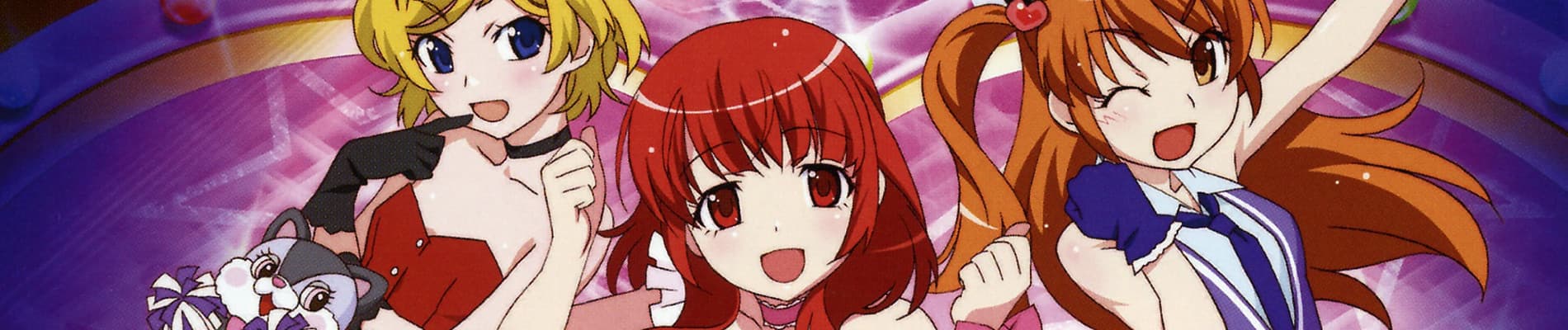

Based on Takara Tomy's successful arcade game, Tatsunoko Production's fifty-one episode anime adaptation follows the lives of Aira Harune, Rhythm Amamiya, and Mion Takamine and their journey to become Prism Queens and perform the legendary Aurora Rising.


Background
The series is directed by Masakazu Hishida, whose only directorial work previously had been on Onmyou Tai Senki as a series director and on Love Hina as the episode director for episode 8, shows his strength for long-running series. With this being Deko Akao's second job as series composer, she provides a compelling story based on the bare-bones nature of the game. The series could have been a pure commercial, however Hishida and Akao make the series into one that stand on its own without the arcade game.

Review
Girls are born to shine. They were meant to have fame and fortune!
Girls are born to dance. They were meant to flaunt their beauty on stage!
Girls are born to sing. They were meant to have a boundless future before them!
The opening lines of the series do a better job than I can at describing the central themes and message of the series, which essentially is "What can you do to improve yourself and become the person you want to be?". When I discovered the show, I was entering the eighth grade and as eighth grade is here in US, it was time of questioning for me as I decided what to do with my life. While I still battle that never-ending question, watching this series was an essential step for me on my journey for improving myself, similar to how the main trio battle their own demons and trials on their journey to becoming Prism Queens.
The idea of self-improvement is one taken on in a variety of shows, and is often one that becomes a central theme in idol series, but Aurora Dream's version of self-improvement is one that feels more real and hit me the hardest. Each girl's troubles are ones that incredibly close to me, such as Aira's self-confidence issues due to always comparing herself, Rhythm's broken family and her wanting to know her mother, or Mion's trouble of making friends due to having to grow up quicker than she should have. Most idol series tackle surface level improvements, such as their looks, or job related ones, such as their dancing or singing skills. While Aurora Dream does tackle those topics, the characters lack of these don't make up their personality or serve as quirks, but as simply a one mean to an end, that is if there is one for a topic like this.
However, the show doesn't forget that these characters are still young. They'll make mistakes, they'll fall in love, they'll get mad and say things that they don't mean, they'll make unlikely friends, and more that define being young. It's impossible to expect for them to always to make the right choices, however when they do, they're congratulated by their peers and when they don't, they're supported and told that it'll all turn out all right. You can't be expected to be perfect, but it's fine to strive towards that perfection, to strive towards what you born to do, and to strive towards what you meant to do.
The art and animation are serviceable as they aren't the main focus, and the CGI looks dated but it's not an eyesore to watch (which is important since there's a performance mostly every episode). The music in this series doesn't quite land in any of my top ten favorites for the franchise, but they are good to listen to, with some of my personal favorites being "Dream Goes On" and "Switch On My Heart". The series delivers it's desired story, and it's a great way to start the Pretty Rhythm and PriPara franchise as it provides the basis for the world and helps understand the small and not-so-small references provided in future installments. Obviously, you don't have to enter the entertainment industry to better yourself, but if you're looking for a show that shows the fruits of self-improvement, Pretty Rhythm Aurora Dream is one that I would recommend checking out.