
Hibari no Asa
a review by faktory
a review by faktory
note: this review will contain some general spoilers for the series. click the spoiler tag below for detailed trigger warnings that cover the series (but contain more significant plot spoilers). if you’re especially sensitive to this stuff, be careful, because this manga packs a real emotional wallop.
now, onto the review:
from the very beginning of this manga, i was skeptical. more than skeptical, i was prepared for the worst—i only picked it up out of morbid curiosity, of sorts. now, after my second read-through, i’ve decided to finally give this manga the review it deserves.
from the description alone, this seemed like it would be, at best, a tepid psychosexual lolita narrative. it set itself up that way, at first (in retrospect, very purposefully so—it is a deconstruction at heart, after all). the first couple chapters give relatively little insight into hibari as a character; the opinions of the people around her are essentially presented as facts about her. when her adult cousin mentioned early on that hibari had a crush on him, i took his word for it because, well, that’s what happens in these kinds of stories, isn’t it? perhaps i’m jaded from too many disappointing romanticized incest subplots, but i couldn’t even bring myself to be surprised. and yet, there is something deeply ominous stirring between the lines from the very beginning. the unsettling, looming shadow of a man on the very first page of the story. her cousin’s retrospective mantra: “i always overlook the important stuff”. i could sense that something was a little different here. so i kept reading.
and then, at the end of chapter two, the reader gets their first insight into the actual personality of the supposedly ~shy, sensual hibari-chan~:
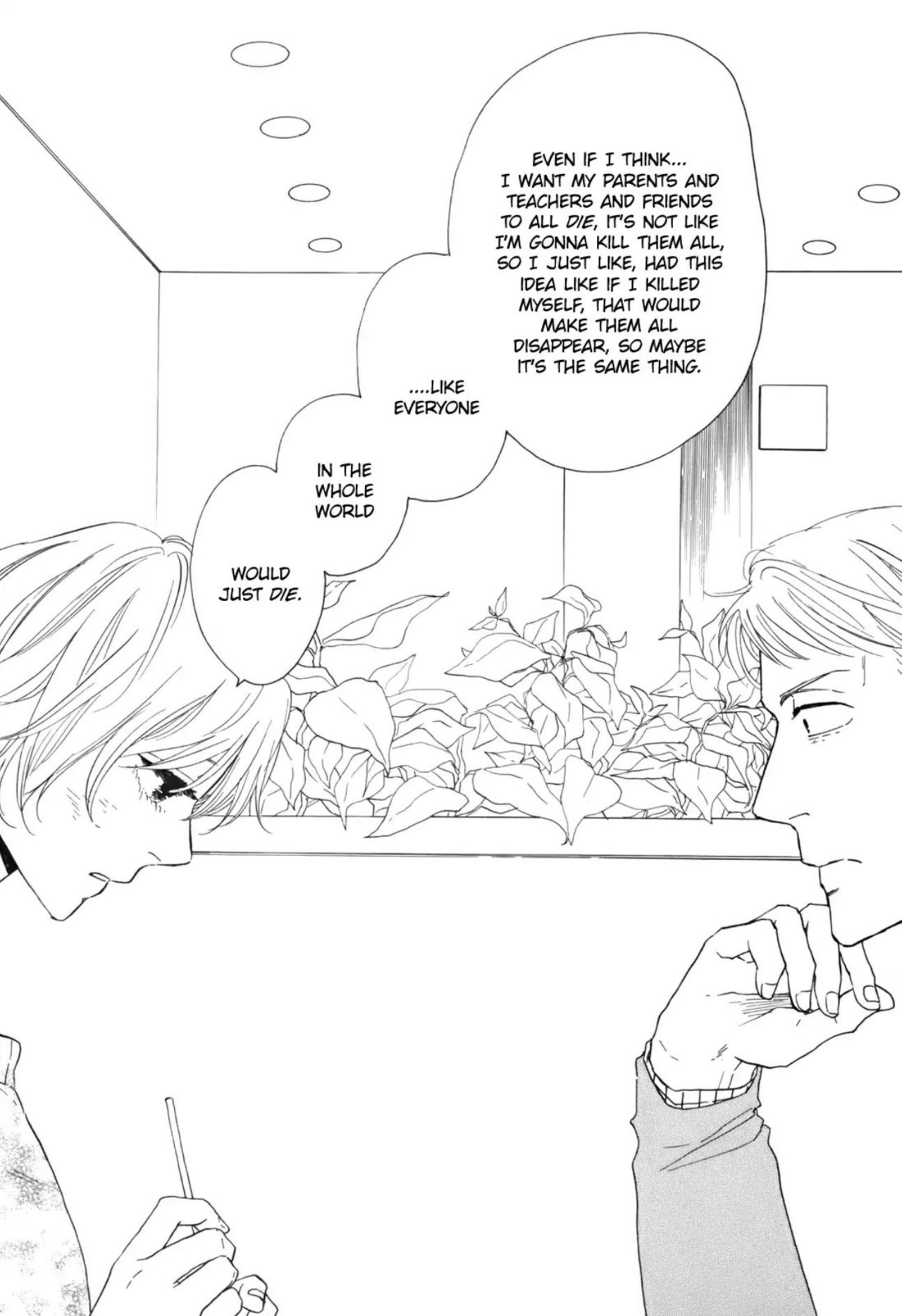
…yeah. and things only get darker from there.
this story goes on to explore the variety of roles that adults play in the sexual victimization of young girls, both through their actions and, more strikingly, their inaction. women see hibari as “the other woman”, an object of jealousy and competition. men see her as the quintessential “slutty schoolgirl”, an object of desire and temptation. no one sees her as a child in need of protection—at least, no one who bothers to take responsibility and act on it. unfortunately, everything about this rings disturbingly true to life.
one of the most remarkable things i noticed about this manga was how organic the characters’ voices felt. huge kudos to the translators for this, too—yamashita obviously has a real gift for writing natural dialogue, and using it as a tool to delve into the intricacies of her characters psyches, but that sort of thing is very often lost in translation. this wasn’t at all the case here, though. all the grammatical and tonal nuances were kept remarkably intact across the language barrier: the fearful hesitancy, the lackadaisical teenaged chatter, the dissociative apathy, the vindictive anguish. as someone who’s dabbled in manga translation myself, i know exactly how hard that can be, so color me impressed.
another thing i want to bring up is the artwork. while for the most part, the style itself is fairly standard for josei, the mangaka pays very particular attention to the facial expressions and body language of her characters. hunched shoulders, fidgeting hands, thousand-yard stares. this is especially significant for this story, where so much is being left unsaid, and what is said is often based off of misinterpretations of facial expressions and body language. appearance is everything, here: what we choose to see is what we believe. so when people talk about how hibari “looks” a certain way, the author takes care to explore what that actually means. it’s lampshaded quite clearly with this line, when a male character finally comes to realize in hindsight that his belief in her sexual attraction to him was entirely the product of his own delusions, his sexualization of her making him see desire where there was none.
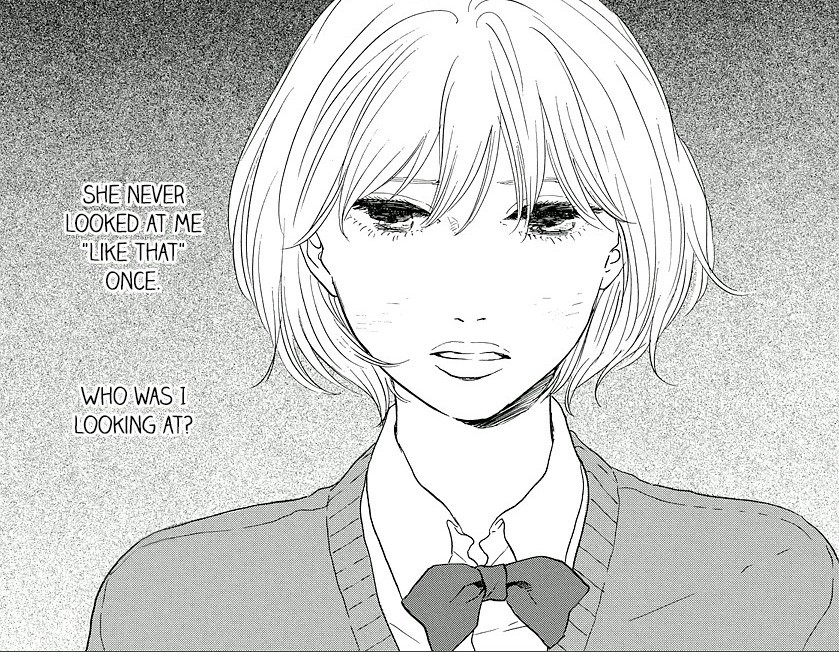
honestly, this is the only manga i’ve ever seen explore the issue of the male gaze with such clarity.
there is a significant flaw that comes to mind, however (significant plot spoiler below):
like i said in the beginning, i was expecting this manga to rely on schoolgirl sexuality for psychological titillation, like so many other manga (and anime, and books, and movies…this isn’t just a problem in japan) have before it. instead, it turned out to be a chillingly realistic tale of the deep tole that institutionalized misogyny and rape culture take on young girls. in a medium that is especially rife with the hypersexualization of schoolchildren, this is the first manga i’ve seen take such an explicitly condemnatory tone on the matter. it is heartening to see that there are such talented and opinionated creators doing their part to push back against this issue. make no mistake, though—while this story makes no secret of its social commentary, it isn’t some sort of lifeless, cardboard cutout social awareness piece. it’s a deeply nuanced, incredibly moving, strikingly well-written and well-illustrated story. it just happens to also be a story with something very important to say.
112.5 out of 115 users liked this review
