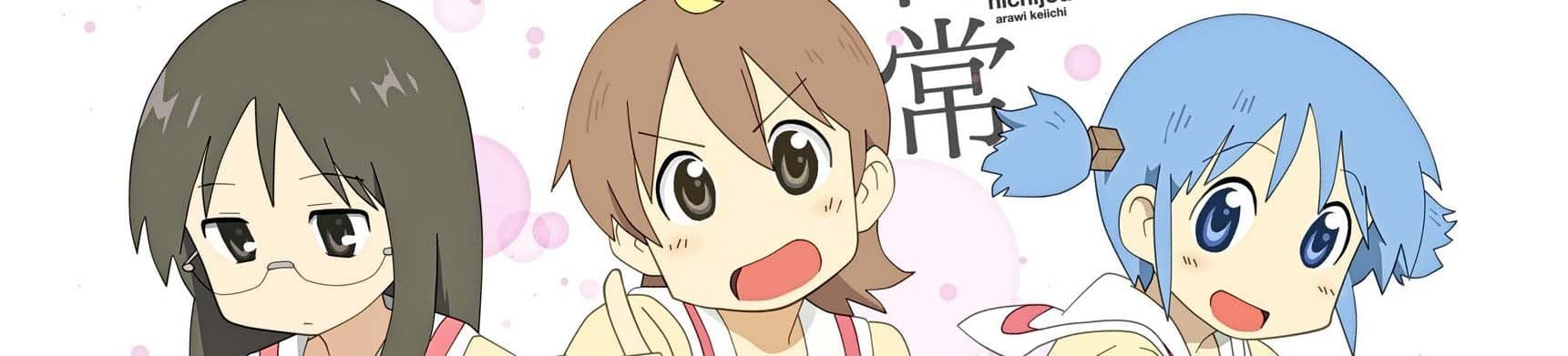
Yes, I still do these. Laziness is a powerful thing.
Synopsis: Nichijou primarily focuses on the daily antics of a trio of childhood friends—high school girls Mio Naganohara, Yuuko Aioi and Mai Minakami—whose stories soon intertwine with the young genius Hakase Shinonome, her robot caretaker Nano, and their talking cat Sakamoto. With every passing day, the lives of these six, as well as of the many people around them, experience both the calms of normal life and the insanity of the absurd. Walking to school, being bitten by a talking crow, spending time with friends, and watching the principal suplex a deer: they are all in a day's work in the extraordinary everyday lives of those in Nichijou.
Story:
Premise (2 out of 2): As the old saying goes, simplicity is the greatest sophistication. While the premise of Nichijou is incredibly simple, calling it so does not consider the incredible nuance of the lives of these childhood friends. This does not mean that the story is entirely nonsensical; in fact, plenty of the skits that it features are things one might do in their ordinary life. However, the story is unique in that it adds incredibly strange and bizarre twists to these otherwise normal events. The elevator skit is a perfect example; it encapsulates the concept of boredom at its core (through the long, silent, and slow scene of them doing nothing in said elevator) and then completely throws it for a loop when the girls mess with each other to the point of pure hysteria. I could go on, but no amount of words can describe how nonsensical, but relatable the story is. It was a very hysterical insight into how strange (and ordinary) our lives may seem to be.
Pace (2 out of 2): While one can argue that the pacing is all over the place, the inconsistency of it actually enhances the fast and slow moments of the show. In a regular setting, a faster pace is saved for scenes with lots of movement, action, or stress (e.g., a battle, interrogation, something with lots of cuts, etc.) On the other hand, a slower pace is meant for a more prolonged scene. For example, a confession of love, a death scene, or something with plenty of cathartic release would be stronger with a slower pace. In addition, scenes with a palpable amount of tension are prime for a slower pace (for more spoops). The elevator scene, once again, shows how effective a slow pace can be at enhancing the drama. The various action scenes in the show are really fast, which will make the viewer excited and engaged. Nothing is too boring and too slow, and nothing is hard to keep up with as a result of something being too fast. In my opinion, the pace does succeed in making each respective skit better.
Complexity (1.5 out of 2): I'm not sure how to approach this category. On one hand, the story is really simple; it features events from everyday life. On the other hand, the nonsensical twist at the end of each skit makes it so the story is not base and flat. It's a really awkward middle ground that I find difficult to discuss objectively. In other words, it's a simple story with really "complex" elements. I'll just give the show the benefit of the doubt.
Plausibility (1.25 out of 2): While it pains me to criticize a show that is almost objectively good in every category, I cannot ignore how unrealistic the story can be at certain points. As mentioned before, the show thrives on its ability to be relatable and nonsensical at the same time. Therefore, it would make sense if one argued that the show is plausible at some points, but not plausible throughout the entirety of the show. For example, most of the interactions between Hakase and Nano can be pretty homely considering their almost familial relationship; however, it is important to note that things such as Sakamoto (the talking cat), the fact that Nano is a robot, and other assorted things all distort the family dynamic that the show creates at times. This isn't saying that either realism or the nonsensical dominate; it essentially reaches a balance where some moments seem more realistic than others.
Ending (2 out of 2): It's really hard to judge Nichijou's ending. Spoiler warning: the show ends on a skit. There's no sort of resolution, sad ending, or room for more content. It just ends, which is not a bad thing. The journey that is Nichijou culminates into an ending fit for a show such as this: a static (for the most part) screen with the phrase "what a simpleton." What makes this ending fitting is how random and mysterious it is, which really cements how nonsensical the show is. The mystery around it comes from the fact that it doesn't really refer to any one particular thing; it is just there. This lack of reference leaves its interpretation up to the viewer. Does the phrase refer to a character? Does the phrase refer to the entire show? Or, does the phrase refer to the viewer? I'm one to go with the latter, but that's just me. It's not your typical ending; however, I would argue that it's right for a spontaneous show like Nichijou.
Overall rating: 8.75/10
Characters:
Presence (1.75 out of 2): For the most part, the cast of Nichijou find themselves involved in some to most of the skits in the show. The main characters are in every episode and the side cast appears every 2-4 episodes. Generally speaking, you see most of the cast in each episode, so there is plenty of variety with each episode. Not really any problems to note aside from that.
Personality (1.75 out of 2): Personality is a rather unique thing in Nichijou. The characters are all relatively archetypal to some degree, but they have a sort of nuance that really sets them apart from these archetypes. For example, Mai, a reserved and relatively silent girl, can be rather chaotic at times, which you would not expect from a girl of her temperament. Contrary to her archetype, she seems to revel in chaos, as she behaves in a subversive way. In fact, she occasionally initiates the chaos. In short, she's an enigma because she does things that are far from what a quintessential shy girl does. Misato can also apply in this instance, as she takes the modern tsundere trope to another level. In her case, she is rather harsh toward her love interest, as is typical of tsunderes in anime. However, her denial of affection (i.e., I.I..didn't do this for you) exists behind an incredibly volatile personality. In fact, Nichijou presents this rather regular harsh personality in a distinct way. During moments of irritability or weakness, Misato weaponizes her frustration and conflict within herself in the form of militarized weapons. Simply, she utterly obliterates her crush when her true feelings and her response to those feelings clash. In the end, she is a tsundere through and through (she isn't the only one who succumbs to her archetype in some way, like our loveable slacker Yuuko), but the show's presentation of her character (and the others) in this unique way is a true testament to how deep the characters are (personality-wise).
Interaction (2 out of 2): Nichijou is a show that is contingent upon how the characters interact with other characters, with the environment, and with themselves. Generally speaking, comedy is a genre that cannot thrive without a decently sized cast (at least in anime, I cannot think of an animated comedy that features less than 4 characters. In literature, there are exceptions, (Waiting for Godot comes to mind because of its small cast and rather strange comedy), so it would make sense for Nichijou to have a large-enough cast for greater comedic effect (more laughs and a higher overall enjoyment). The cast is rather small compared to, let's say, a typical shounen, but it is large enough to be refreshing in that the viewer is not subjected to similar skits each episode while also making sure the viewer is not overwhelmed. As a result, Nichijou's ability to be funny increases tenfold because Nichijou maintains this balance throughout its 26 episodes. In addition, the school makes for a more intimate setting, which allows the characters to interact in a more genuine way (because they are close friends, so you understand them more, hang out with them more, etc). For example, most of the interactions between Yuuko and Mio seem rather excessive, but once the viewer considers how close they are, they understand that their friendship might excuse some things that they might consider unsightly when done to an acquaintance. The intimacy surrounding this interaction, as well as others found in the show, really brings forth more compassion, comedy, and happiness overall. The more self-reflective moments are effective in making the viewer feel a great sense of endearment. Nano's quest for a normal life is one prime example, as the viewer feels almost obligated to cheer her on after constant attempts at normalcy (much to her chagrin). More specifically, her ability to take care of her home, Hakase, Sakamoto, as well as herself and her friends truly shows her dedication toward her goal to become normal. If only she didn't have a screw loose for most of the show ;)
Development (.50 out of 2): While the cast of Nichijou do not fail to make viewers laugh and cry after witnessing their chaos, it is hard for me to really call the characters deep. As aforementioned, the majority of characters in Nichijou are archetypal to some degree, which means that they adhere to common character tropes. This does not necessarily make them flat per say, but the lack of growth across the show's 26 episodes is quite jarring considering what other shows can do in that amount of time. For instance, the main trio of the show (Mio, Yuuko, Mai) are incredibly flat because they almost never deviate from their respective archetypes; Mio is always quick to anger and relatively quirky, Yuuko is always aloof and hard to motivate, and Mai, albeit strange and enigmatic, is always silent and reserved. The lack of depth here is quite astonishing, and pales in comparison to the complex jokes and deep gags that the show is famous for. I will concede that Nano's character arc is incredibly deep; her transformation from a stranger who cannot fit into the current social ecosystem into an ordinary person who can succeed in society regardless of her quirks and flaws was very inspiring and easy to relate to. However, it does not overshadow how flat the rest of the cast is.
I would like to note that Nichijou is also episodic, so it is really difficult to make a cast of characters seem round when your plot is not cohesive (which under those circumstances, would allow for characters to grow over time e.g., Kokoro Connect and Fruits Basket).
Catharsis (2 out of 2): What can I say? Nichijou's characters are hysterical. Overall, the 26 episode journey was filled with nonsensical twists, extraordinary skits, and a strange vibe that would make any viewer die of laughter while contemplating what just happened in the show. The characters, although flat, fit the show well because they really mesh well together. Mio and Yuuki are essentially polar opposites (Mio is quirky, smart, and quick to anger; Yuuki is aloof, outgoing, and clumsy), so their clashes and battles were a comedic spectacle. Even when they were not butting heads, the situations they got in will leave any viewer with a smile on their face (i.e., that really weird apology scene in class). Mai, due to her shyness and introversion, is really hard to predict, so she really complements the strange aspect of the show. In addition, her dubious nature makes for some funny moments simply because her actions are incomprehensible and downright alien to any normal person. Nano, Hakase, and Sakamoto are funny in a really tender way; they seem like that family that one might see in a sit-com because they are always messing with each other, but in the end really care for and love one another. In the end, it makes for a lovable and hilarious set of characters because they are so relatable, yet surreal enough to make people laugh. The side characters also deserve some credit, as Misato's love story and the clone skits (among other really good skits) are hilarious and fresh takes on school romance and the action genre. Very strong catharsis overall.
Overall rating: 8/10
Aesthetics (art style):
Removing the general category.
Characters (1.5 out of 2.5): Nichijou's cast is somewhat dull when one considers their visual presentation. While one can marvel at how nuanced the detail is in some scenes, the art style of the cast doesn't really stand out outside of these scenes. For example, the main trio are featured in plenty of visually appealing scenes (e.g., the fight scenes, blimp scenes, etc.) However, outside of these scenes, the cast appears rather normal and boring. Simply, the character designs of the characters are incredibly simple and mundane because the emphasis seems to be placed on animating the skits. It's not that the character designs are bad per say; they just seem ubiquitious.
Backgrounds (2 out of 2.5): The backgrounds of Nichijou are generally spectacular, especially during the more intense skits. During the tame scenes, the detail put into the backgrounds is still so great that one might find themselves lost in it. In other instances, say the Mai's manga scene, the background adds to the humor through effects like distortion and glare. The heavier scenes are filled with splendor; the colors, line, animation, and overall quality are some of the most beautiful that one might see in anime. One example that will remain vivid in anyone's mind is when Mio freaks out after her manga flies out of her bag. The colorful galaxy behind Yuuko and the black distortion behind Mio are not only beautiful but also fit the respective moods of each character and thus remain faithful to the scene. Overall, the backgrounds, when they aren't just there as a detail for the scene, are an instrumental part in establishing the mood for each skit and add a layer of depth to the already complex aesthetic that Nichijou presents. Outside of that, they just look really good.
Animation (2.5 out of 2.5): Nichijou features some of the best animation in the entire medium of anime. Kyoto Animation hits this anime out of the park (as they always do) by exhibiting a clinic in character animation, visual effects, and overall quality. It's rather impossible to think of a scene that seemed jarring, and most to all scenes were at least great in quality (very smooth, engaging, harsh when necessary, just really nice to look at). The scenes that have been mentioned already are all great examples (forgive me, memory fails so I can't remember a different example). Still, perfect animation.
Visual effects (2.5 out of 2.5): Much like the animation, the visual effects are absolutely stunning. Copy paste what I said above.
Overall rating: 8.5/10
Aesthetics (sound):
Voice acting (2.75 out of 3): The VAs staffed for this show were absolutely perfect. The ranges available for each one allowed for each character to show a myriad of moods through their tones. The fried mackerel fight between Mio and Yuuko is a good example of how diverse each VA is, as Yuuko's charismatic and warm tone suddenly becomes very harsh and masculine. Mai's softer voice is executed to perfection, which makes her unpredictable nature all the more hilarious. My only gripe with the voice acting would have to be Hakase; I know she's a child, but she's so obnoxious. Not to use the internet's favorite buzzword, but I cringed every time I heard her voice. It was really jarring.
Music (4 out of 4): Nichijou's soundtrack is absolutely magnificent. Aside from its catchy opening, the music is suited to each skit it is a part of. It is a pretty simple soundtrack, but it really accentuates the mood for each scene. The music in the elevator scene really fits because it brings forth a palpable feeling of tension and hysteria. The lighthearted tracks make scenes feel really upbeat and ecstatic. The score is just really good overall, even when compared to shows with more developed and/or expensive scores.
Sound effects (3 out of 3): Not much to say. Some animated comedies are known for their wacky sound effects, and Nichijou is no exception. Some of the skits, such as Mai's manga, are really funny simply because the sound effects complement the scene. Some effects, like a drumming sound add emphasis to a visual effect, while louder sounds are used either for comedy's sake (loud can be funny) or intensity's sake (makes a scene seem serious/be serious). Nonetheless, the sound effects are quite effective in achieving these goals. In the scene mentioned earlier, Mio's outbursts are accompanied by beats of a drum, which really make the scene funnier and more whole (compared to a joke with no visual or auditory support, which would probably fall flat for some).
Overall rating: 9.75/10
Enjoyment:
Personal enjoyment (10 out of 10):
It's extremely difficult to criticize a renowned anime such as Nichijou because it is a masterpiece. The jokes are all hilarious, the nonsensicality of the skits make the comedy unique, and the interactions between characters are so unique, yet ordinary enough to stay down-to-earth. The trio's skits were an absolute delight to witness, and the side characters had stories that were just as enthralling. The anime is not perfect due to its flat-ish characters (because of an episodic plot structure) and somewhat obnoxious voice actors, but the flaws are so miniscule that they pale in comparison to the things it does right. It truly is a fantastic comedy slice-of-life anime and it really stands out in anime as a medium. I really enjoyed every episode and felt motivated to watch more and more as time went on (when I had free time). It really is a testament to both the prowess of KyoAni to make an anime and good anime overall. Excellent show.
Overall rating: 10/10
Summary:
What can I say? I went in expecting a fabulous show, and I came out extremely satisfied. An absolutely memorable experience that revolutionizes the slice-of-life and comedy genres. A true masterpiece with insignificant flaws.
Total rating: 9/10
Would I recommend?: Wholeheartedly. A required watch for all anime fans.
48 out of 50 users liked this review