I'm personally not a huge fan of absurd comedy. My tastes align more along the situational side of humor, where the laughs are strategically placed at seemingly normal and unassuming points in the plot, rather than having the entire setting take on an abstract and irrational form in order to accommodate its comedic elements. Nevertheless, both forms of comedy have their respective merits, and when the shackles of rationality are off, the possibilities become endless.
When I first looked at the summary for the anime series Armed Girl's Machiavellism, I thought I knew what to expect. The main character, a problem student from another school, transfers to an academy where all boys are forced to crossdress in order to safeguard the girls from the ostensible toxic masculinity that emanates from the opposite sex, whilst the girls themselves are armed to the hilt so they can defend themselves from the already much-oppressed boys. At the onset of the anime, our main character is given a choice: crossdress and conform, or leave.
The summary made no mention of whether he accepted those terms, so I assumed that he did, and that the series would turn out to be something akin to Himegoto, where the effeminate crossdressing main character is constantly mistaken for a girl. I couldn't have been more wrong, and in hindsight I was actually glad that my initial assumptions proved to be incorrect, for the anime, in all its cringey and surreal glory, gave me a lesson in the joys of absurdity that greatly raised my appreciation for the wackier incarnations of comedy.
(Each major aspect of the anime is given a rating in brackets, followed by an explanation of that rating.)
Premise (3/5): On the very surface level, a brief glance at the synopsis will not tell you much about what makes the anime good (or bad). A mysterious main character arrives at a school run by powerful girls with abilities bordering on the superhuman (and in some cases fully embracing the realm of the unbelievable). The main character systematically defeats each of them and coerces them into joining his burgeoning harem, all the while making his way towards the ultimate evil: the Strongest™ fighter at the school, an equally enigmatic character who has dark ties with the main character's past. You might be forgiven for thinking that this sounds like the progression of pretty much every other magical high school harem anime, and in some ways that might exactly be the intention of the series: the most fascinating kinds of parodies are those that betray viewers' expectations where they least anticipate it, and Armed Girl's Machiavellism certainly achieves that to a degree. Depending on viewers' tastes, some may enjoy this style of satire, and some may think this particular attempt tries too hard to replicate the structure of something that it is not.
I'll admit that it was the crossdressing part of the summary that intrigued me the most, though it somehow turned out to be one of the more irrelevant parts of the story. Past the initial uproar over the main character's refusal to crossdress, the rest of the series actually progressed relatively smoothly - or at least as smoothly as you might expect an absurd comedy anime series to.
Characters (4/5): Fudou Nomura is a straight-talking, no-nonsense main character, the sort that I appreciate the most, especially in a harem anime (pseudo or otherwise). He makes it his life's goal to collect a stamp from each of the Supreme Five Swords, the five girls who maintain law and order within the campus, whereupon obtaining all five stamps he would be able to leave the school grounds on his own terms (as opposed to getting kicked out for the heinous crime of not wearing a skirt). Despite his rebellious delinquent past, he has a strong sense of honor and an admirable determination to right the wrongs of the restrictions imposed upon the male students, making it quite easy to sympathize with him and his quest.
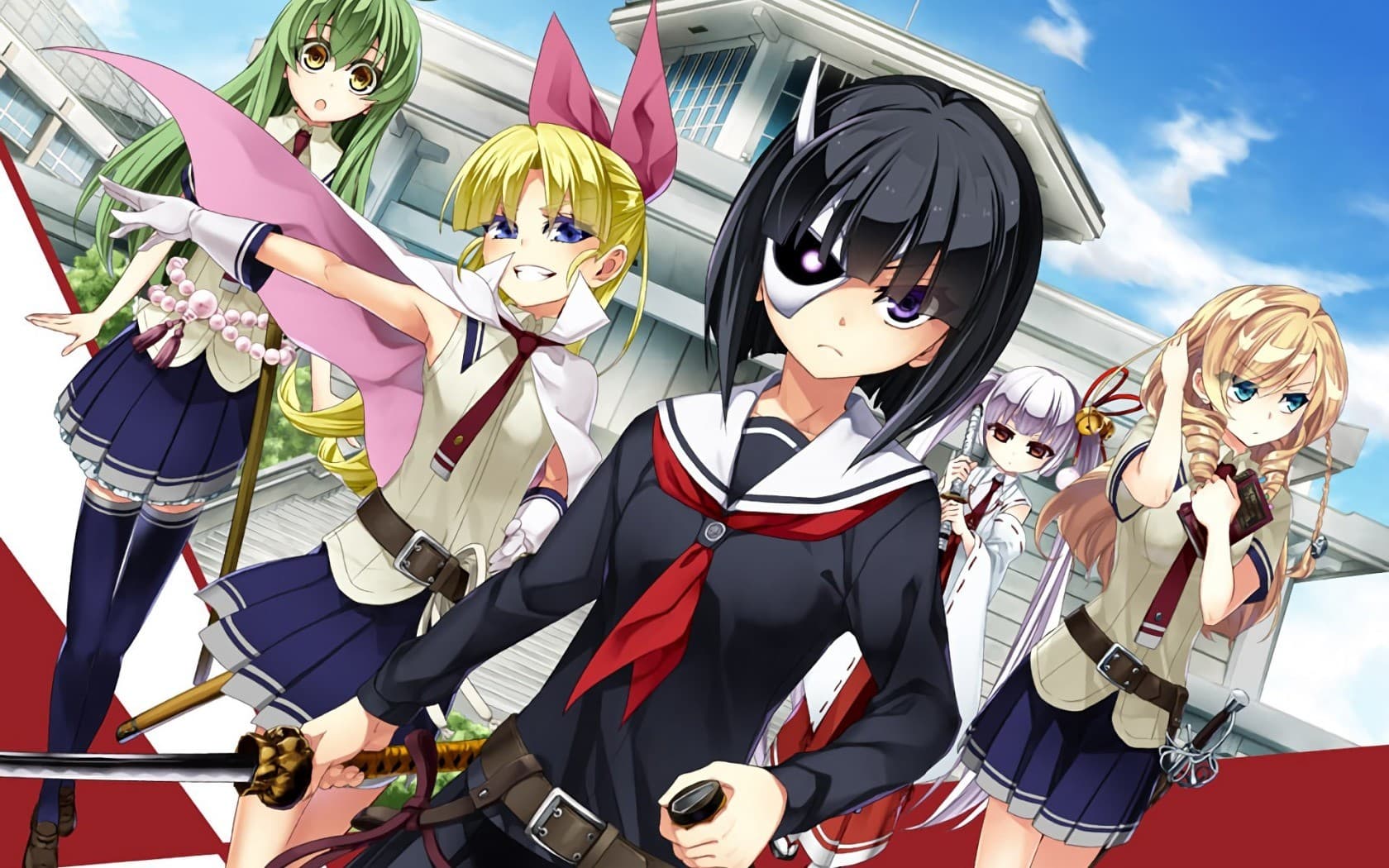
The Supreme Five Swords themselves are a collection of easily-recognizable cliches: Rin is the uptight and self-righteous tsundere who falls in love after a single kiss; Mary is the blonde, busty foreign beauty whose dignified exterior is easily breached; Satori is cunning, psychopathic, and sometimes downright evil; Warabi is the petite little girl whose closest companion is an anthropomorphic bear several times her size; and Tsukuyo is the quiet, serene figure whose unassuming features belie a breathtaking aptitude for swordsmanship. As with most comedies, the power of the stereotype lies not in the characters' interactions with each other, but the fact of the stereotype's presence in itself: the cliche is there to be laughed at, rather than to help the viewer feel familiarity with the subject. The series succeeds in this respect whilst also developing the characters enough to allow viewers to still feel some sort of emotional connection with the girls, however weak or nascent.
But perhaps the most nonsensical and simultaneously interesting female character of the lot is the self-styled Empress, Kirukiru Amou, whose role in the anime is constantly teased until the final showdown. She is a mixed bag of conflicting emotions: love and hate course through her veins in equal measure. Ultimately, it is love that wins out, and yet it is also love that drives her away from that which she most desires, a fitting end for a destructive and contradictory entity such as herself.
Audiovisuals (4/5): A series where the story is carried by its ubiquitous fighting scenes ought to serve up a visual spectacle for the masses to enjoy. The animation in Armed Girl's Machiavellism isn't at all bad, but a more cynical eye might think that it doesn't serve its purpose too well, as the action can appear stodgy in parts. Nevertheless, the character designs are cute, the fanservice is tasteful, the art is drawn at a relatively good level overall, and the frequent insertion of move names as a comedic device works as intended. The soundtrack is brash and violent, much like the characters in the series, and the opening + ending themes are catchy rock numbers that set the mood for the anime well. All in all, the audiovisuals are decently good, with some stand-out moments here and there. And that's all one really need ask for.
Execution (3/5): Given that I often have a hard time appreciating the full comedic breadth of absurd humor, it proves somewhat difficult to give the execution of the satirical elements of the story an objective evaluation. Nevertheless, there are many other aspects that I can readily acknowledge, from the adorable romance sub-plots running through the plot to the moral lessons in struggling against a tyrannical hierarchy that the series seeks to convey. The series moves at a satisfyingly rapid pace befitting the nature of its story, flitting from arc to arc with no room for fillers, and even if you might find the humor difficult to swallow, at least you'll never be bored.
The humor seems to pride itself on its cringe-worthiness, throwing up inexplicably absurd plot points to move the story forwards, such as the "Warabilympics" saga where Fudou engages Warabi's pet bear in a sumo wrestling match, or Mary's attempts at forcing Fudou into committing an act of sexual harassment against her, the failures of which somehow deepen her latent feelings for him. Whether you might think that the series is trying too hard to be absurd is, as always, purely a matter of taste - I personally enjoyed some parts of the humor, whilst feeling exasperated and uncomfortable towards other segments. There's a somewhat rushed feel to the way in which flashbacks are used to try and establish the link between Fudou and the Empress, though the flashbacks explain their secret relationship well enough that any lingering confusions regarding their interactions can quickly be worked out.
Overall (3/5): The value of a comedy series is ultimately rightfully judged on the level of entertainment it brings to viewers. Some comedies try and impart a message of some sort on its viewers, taking on more than just their burdens of distraction, whilst other series dispense with the formalities and go straight for the kill at every possible instance. Armed Girl's Machiavellism hangs somewhere in the middle of the spectrum, and ends up being neither. Its indecisiveness means that whilst its overall absurdity and subsequent comedic value suffers somewhat, it offers a greater emotional bite in terms of being more than just a series that people have to switch their brains off completely to watch. When it's at its best, it can both generate a few healthy snorts and warm the heart. Otherwise, however, it falls into the tedium of a story that isn't always sure whether to take itself seriously or revert to its comedic roots.
Although this might seem like a fairly harsh view of an anime that I honestly enjoyed quite a lot, I felt that the inherent flaws of the series were significant enough to warrant a mention. Regardless, my imaginal recollections of the anime are wholly positive, the fondest of those mental screenshots perhaps being the blushing face of Rin Onigawara as she navigates her newfound attachment to Fudou. Love, it seems, is the answer to the "Machiavellism" (or rather, Machiavellianism) of the school's authoritarian hierarchy of discrimination and dominance.
Armed Girl's Machiavellism is a silly, funny, and occasionally touching sight for sore eyes. And I wouldn't have it any other way.
30.5 out of 33 users liked this review