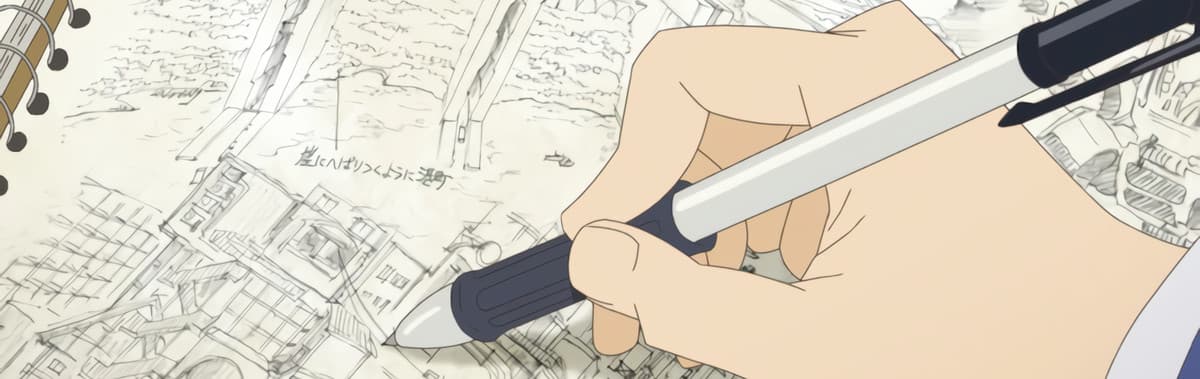

You could just kind of tell from day one with Eizouken. It was the kind of thing that almost everyone seemed to agree was worth watching, a rare moment of the popular zeitgeist lining up with a show that’s expertly-crafted, incredibly interesting, and written straight from the heart. It’s rare for this many people to agree on anything in an anime fan community that is increasingly fractious and divided.

Popular rumor states director Masaaki Yuasa found the manga by having it brought to his attention on Twitter, with fans saying he should adapt it. Those people (if the story is true) are heroes, but the idea that there was an Eizouken before the anime adaptation can feel a little strange given its heavy emphasis on anime as an artform. Indeed, it doesn’t really feel like part of the general anime seasonal cycle at all, though most of Yuasa’s work can be said to have that same quality. Being tasked with summing up Eizouken in an interesting and concise way feels like being told to write something new about those anime that have just kind of always been there. Your Ghibli movies and your *Evangelion*s.

Yet ultimately that feeling is something of an illusion. Eizouken is very much an anime of the new 20s and its consciousness of its own medium aside, it is, factually, a product of the manga-to-anime process that defines much of the industry, and some of what makes it good has more to do with that than one might assume. As such, here we are, a few months later, audience appraising the artist and their art, same as always.
But there is a little more to it than that. Criticism is piggyback expression. You are writing about someone else’s art. If we take that to be true, there must be some chain effect involved in reviewing an anime about making anime adapted from a manga about the same--effectively one person appraising someone interpreting art about making art. If you’re feeling slightly dizzy, please know we’re only just getting started.
Eizouken’s core premise is so simple it needs no introduction. Three friends. High school. Anime club. Making, not watching. That’s about the long and short of Eizouken’s actual setup. It’s easy to lose sight of this, but for everything it does that’s innovative or draws from well outside this plane, Eizouken is at its heart a school life series. It takes that simple core premise and turns it into a dual thesis; On one hand, on what it feels like to express yourself creatively and to be inspired to make that leap to expression in the first place. On the other; a look at the vast diversity of people and what motivates us to do what we do. That’s quite a lot for three high school girls to carry on their shoulders on its own. That it also gets into the nitty-gritty of how to make those dreams a reality is something else entirely. That it then also manages to be nuanced enough to not lose sight of the fact that there are a billion and one different approaches and reasons for making art, and that all of them are valid in their own way, is nothing short of astounding.
Anime about anime aren’t actually a recent development, but they can sometimes feel like one. It’s a piece of subject matter that’s seen something of an uptick in recent years. Both in series that actually tackle anime production (this one, Shirobako) and shows where anime and the real world intersect somehow (Re:Creators, Anime-Gataris). What Eizouken gets right from the jump is that wanting to make an anime is not exactly a rational thing.

Two of our leads; the short, kappaesque Midori Asakusa, and the teenage model Tsubame Mizusaki, are ultimately driven purely by passion. Midori is a talented background artist and director and Tsubame a prodigal character animator. What, or rather who, actually makes the two able to work together to productive ends is the show’s third protagonist, Sayaka Kanamori. Tall with tombstone teeth, a generally intimidating demeanor, and in sharp contrast to our other two leads, a head passionately and almost exclusively for finance. Kanamori is both the group’s glue and arguably, the show’s. Since she’s so different from the other two characters it’s through her that the series can present very different ideas of what it means to make art and sell it. It would’ve been easy to paint her as an antagonist, but Kanamori is never depicted as anything less than necessary for the continued function of the Eizouken itself.

Of course, Asakusa and Mizusaki are pretty different from each other too. In the show’s middle we explore Mizusaki’s passion not for anime specifically but for animation as a concept. Her background as a model and child actress leads to a lifelong obsession with motion. We see her as a child become fascinated with the way her grandmother tosses excess tea onto the grass outside and try to replicate it. Later, the cut of her grandmother doing that is echoed in one of Mizusaki’s own cuts in one of the Eizouken’s shorts. Saying that Eizouken has passion for its medium is not enough; the series integrates its own characters’ passions into the narratives they make, and its creators’ passions into Eizouken, thereby layering itself. We see, in this repetition, the inherent artistry of Mizusaki’s grandmother’s motion, Mizusaki’s own fascination with that motion, and, crucially, the skill and passion of the real world animator--Shuuto Enomoto--as well.
Weaving its characters’ and creators’ own passions into the visuals is one thing, but Eizouken’s strong character writing shouldn’t be ignored either. It’s cheap to say that none of the characters here feel like familiar archetypes, but they genuinely don’t. Kanamori for instance has what initially seems like a quirk--her money-first attitude--explained pretty readily by her backstory. We learn about halfway through the series that her grandparents’ liquor store closed due to a lack of visibility when she was younger. It’d be easy for Eizouken to milk this for drama, but Kanamori’s experiences shaping her character is taken as a simple fact of life. We are, indeed, all shaped by our experiences--another message the show pushes pretty hard.

The contrast between this approach and the one often used by big-ticket manga adaptations is sharp, but it’s easy to take for granted. This in fact is the part of the series that draws most heavily on Sumito Oowara’s original manga. Good writing can transcend the constraints of its format, and in keeping that element, the anime retains a strong emotional core. In turn, this is what makes the show’s exploration of the creative impulse and celebration of diverse experiences feel resonant. Every part of the series is bursting with life in that same way.
There’s nuance here too. Kanamori’s conflicts with the student council and the school itself, and a discussion in the final episode about how peoples’ sharp differences of opinion can cause conflict aren’t just window dressing or bet-hedging. The show does acknowledge that earnest expression--which is ultimately what unites both halves of its core point--can be hard.
 The show has a lot of impressive visual tricks, but this one, with almost every controversial subject under the sun depicted as part of a literal torrential downpour, might be the most purely clever.
However, the fruits of the Eizouken Club’s labor prove that it can also be worthwhile. And that, right there, is what ropes Eizouken back into the circle of broader anime discussions. The difficulty but necessity of communication is of course a popular theme for art in general, but in a certain sort of anime it has found a particularly fertile place to bloom. You can draw broad thematic lines from here to things as otherwise wildly different from each other (and Eizouken) as Symphogear and A Place Further Than The Universe.
The show ends with one of the Eizouken’s own shorts playing in its entirety. An 11 minute student film about a war between land-bound humanity and sea-dwelling kappas. A war that occurs, in-film, because of a lack of communication. Not exactly subtle, is it?

But subtlety is perhaps overrated. Eizouken is a lot more than just an “anime about anime”. It’s a celebration of the vast diversity of the human experience, arguably the thing that makes us human in the first place. If that message speaks to enough people--and I believe it has--we can stop beating around the bush and just call Eizouken what it is; the first truly great anime of the 2020s. Or, more poetically; the future.
