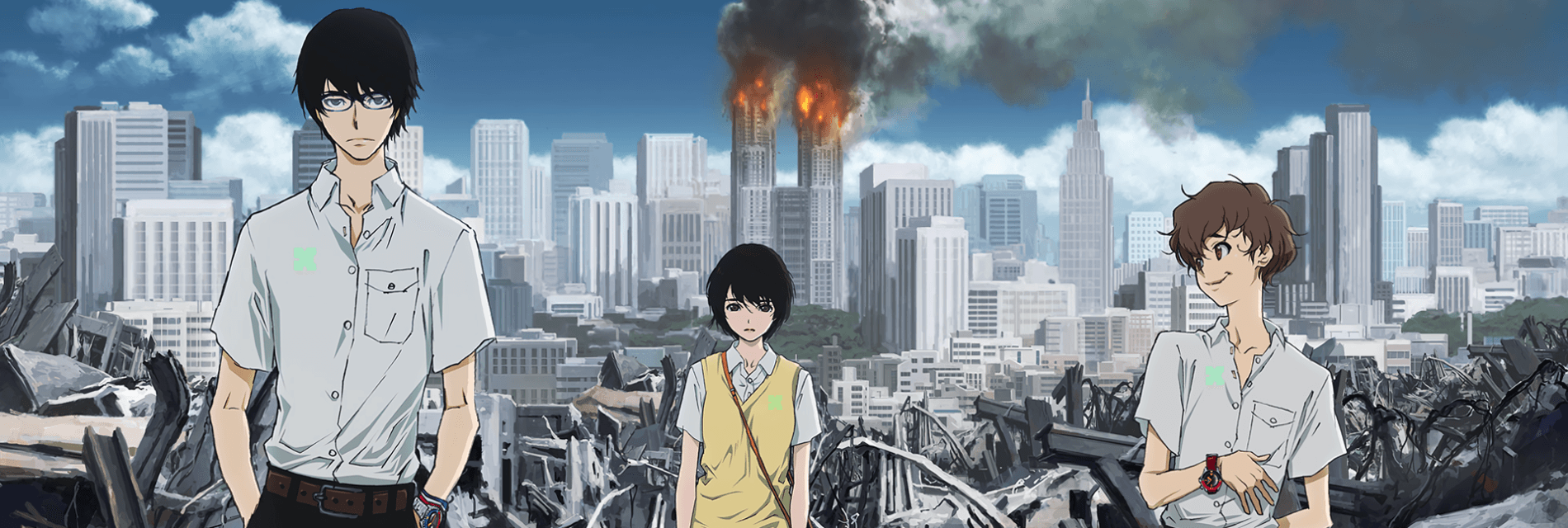

_ “On that cold summer day I met a smile as warm as the sun, and a gaze as cold as ice.”_
Our leading heroine’s first, simple thought after barely escaping from the brink of death.
By their hands.

Buckets available on request.
Zankyou no Terror, or “Terror in Resonance” takes the market by surprise in 2014. The main topic—terrorism—is not exactly a welcome topic for a very, very angry Western world. The idea of having the two main characters of the story as the actual focus can already turn it off to a closed-minded audience, as the word terrorism sparks the same sort of rage that “bastard” or “charlatan” did a century ago. Bottom line: Considering the global crisis of terrorism emanating from the Middle East, this risky topic really takes some guts to chuck on television for an already disgruntled Japanese youth.
An anime perfectly metaphorical to the suppressed rage of Japanese teenagers. (93/100)
Two mysterious bombers, Sphinx No. 1 and Sphinx No. 2 mysteriously appear in the summer after demonstrating a real intent to cause terror. Local investigators tangle themselves with historical puzzles and internet flaming. The two bombers, numbered Nine and Twelve (aliased “Hisami and Kokonoe”) are two brilliant teenagers doing all the talking, leaving just enough breadcrumbs behind for one introspective detective, Shibasaki, to see the horrible truth behind their violence. Towards the end of the series these seemingly unstoppable prodigies bare a more human frailness, as their relationship with Mishima blossoms. A story with many missions, many hopes, many failures, and disastrous consequences.
I really enjoyed the story. While I do not think my brain is fit for mysteries and puzzles, the atmosphere and believability of the characters kept a solid pace for me to confidently explore it. The layers of detailed historical figures and mythology puzzles were well thought out enough to force me to rewatch various portions of each episode to understand it myself. It would be an insult to the genre itself not to at least credit a solid high score here, even if it’s not my thing.
Meanwhile, discovering the truth about Nine and Twelve is what drew me in far more than anything else. I found myself pondering (like a good student) what sort of Japanese saying would be fitting for Nine and Twelve’s personalities. The phrase “dou shiyou mo nai,” meaning “I don’t have a method/choice” seemed to help me draw a conclusion. It is a commonplace thing in 21st century Japan for the youth to be discouraged. In fact, it’s safe to say that they believe it is necessary constantly. To restrain oneself (遠慮, enryo) is lauded as a very mature behavior, which is something that can have serious consequences with children. While this old-fashioned behavior worked well in Japan some time ago, constant exposure to our diverse, interconnected world raises some rebellious questions. It may even instigate some really detached and/or abused kids to do whatever they can to get their point across: such as destroy stuff.
This is the element in the series that appeals to us about them. While the world compels us to subjugate and annihilate terrorism, to find ourselves drawn in by two ultra-pissed Japanese teenagers is truly ironic. We know they’re angry, and we will even root for them so long as we might finally know why. Perhaps terrorism isn’t the problem but, rather, the unrealistic world we live in today? Perhaps it’s because we as well do our best to restrain ourselves from…blowing shit up, too?
Of course with a brilliant plot, 11 episodes isn’t enough time to keep equally brilliant characters. (75/100)
The strongest character in the entire show is undoubtedly Shibasaki, with perhaps Mishima in a distant second place. Both of them provide shapely personalities to balance out the coldness and dissociative traits of Twelve and Nine respectively. I am really fond of Mishima, despite her being relatively incapable of doing anything and dealing with serious personal issues. Watching her growth though shed a very different light on this series, though, since a klutzy, black duckling like her keeps the pace simple enough to prevent the series from getting riddled with complex puzzles and mind games.
Twelve’s typical personality was a big turn off for me, as I could constantly predict his words and actions. This, too, might be okay considering that both Nine and Twelve need to have some sort of connection to the audience, as their antagonistic choices already are well outside the realm of any moral compass.
And then…well yeah, things just stopped moving for a bit. Sometime after a particular antagonist shows up, Nine’s character unrealistically draws up some conclusions that don’t befit his character at all. I found his enigmatic grin and passive-aggressive behavior quite captivating, as I was certain he would go on some crazy, “Higurashi-level” sort of body bludgeoning streak at some point towards the end.
Nope.

In the end his character is reduced too greatly, a choice that I don’t think needed to happen. In fact, the events within the last three episodes of the series could have been developed completely differently (perhaps with a feasible Higurashi-level killstreak) and it still could have gotten the same marks. I’m sure that whatever screenplay it was derived from would have needed to develop another 13 episodes to do Nine’s character the justice it deserved.
Visually beautiful and characteristic of the century. (84/100)
As with all of my reviews, I try to stay objective concerning the animation choices, and focus on the development. It is not really hard to earn a 72 or higher from me, so long as the characters faces don’t become a googly-eyed mess of preschooler level quality every 12 seconds.
Some of the scenes and choices of panning helped with an outlook of modern day Japan, which intrigued me. I also am glad that the leading heroine of the series looks like she has the actual body dimensions of a Japanese high schooler—a feat rarely seen in the sperm fueled, as-many-big-boobs-at-school-as-possible genre infecting the farthest studios from Tokyo at this point.
Simply: the music makes me wet myself. CONSTANTLY. (100/100)
Yoko Kanno demonstrates her veteran prowess with captivating tunes and an endless development of style. She writes in Greek minor modes and awkward irregular meters so that the music nerds can get their fix. She shapes beautiful melodies that are pleasant for the musically inept. “walt” and “ess” from the OST are solid examples of her ability to make background music stay in the background, yet give a foreground performance. Her multi-faceted style utilizes tools and instruments from classical, jazz, electronic, rock, and polyphony—pretty much the entire spectrum of music as a whole. Her collaboration with Icelandic artist, Arnor Dan, hinted catchy new-age feel with the complexities and trivial freedoms of avant garde craftsmanship. Even the head-bopping opening theme has had her hands partially involved (listen to those weird key changes and you’ll see that those are definably Kanno’s writing). As a musician, I strive every single day of my life to voice my music as freely as she does hers, and this music clearly dictates how riveting her freedom is.
Though many of the seiyuu in this series are new on the market, the devotion to quality and creativity is kept as each character is demonstrated to their entirety. Shunsuke Sakuya delivers another outstanding performance as Shibaraki, as it is always enjoyable to hear the tension in his voice as he gets serious. The weakest voice actor at most was Mishima’s, Atsumi Tanezaki, with some airy and otherwise sloppily overexaggerated noises—though this might very well have been a choice considering Mishima’s goofy character.
Overall: A must-see anime if you love Japan. (86/100)
Not saying that your typical anime geek isn’t going to love Japan, but I feel Zankyou no Terror has a thrill to it that needs a little bit of familiarity with Japanese culture to get the whole gist. Many known holes in Japanese politics are subtly reproached here, as are allegations concerning human experimentation during World War II. While the series might be enjoyable without any familiarity with these elements, to actually know them will turn what might be a weird half-season of cat-and-mouse games into a thought-provoking demonstration of human injustice.
Lastly, the ending is a tough one. While it shook my enjoyment of the series a little bit, I respected the choice and would willingly watch it again on a whim sometime soon. The atmosphere is very much like Death Note and Ginga Eiyuu Densetsu, despite the macabre main characters; I was really convinced that the ending would be quite typical, but then of course, neither of these series has a “typical” ending, either. I highly doubt there will ever be a sequel, too, but I do have hopes to see something of this experimental caliber again.