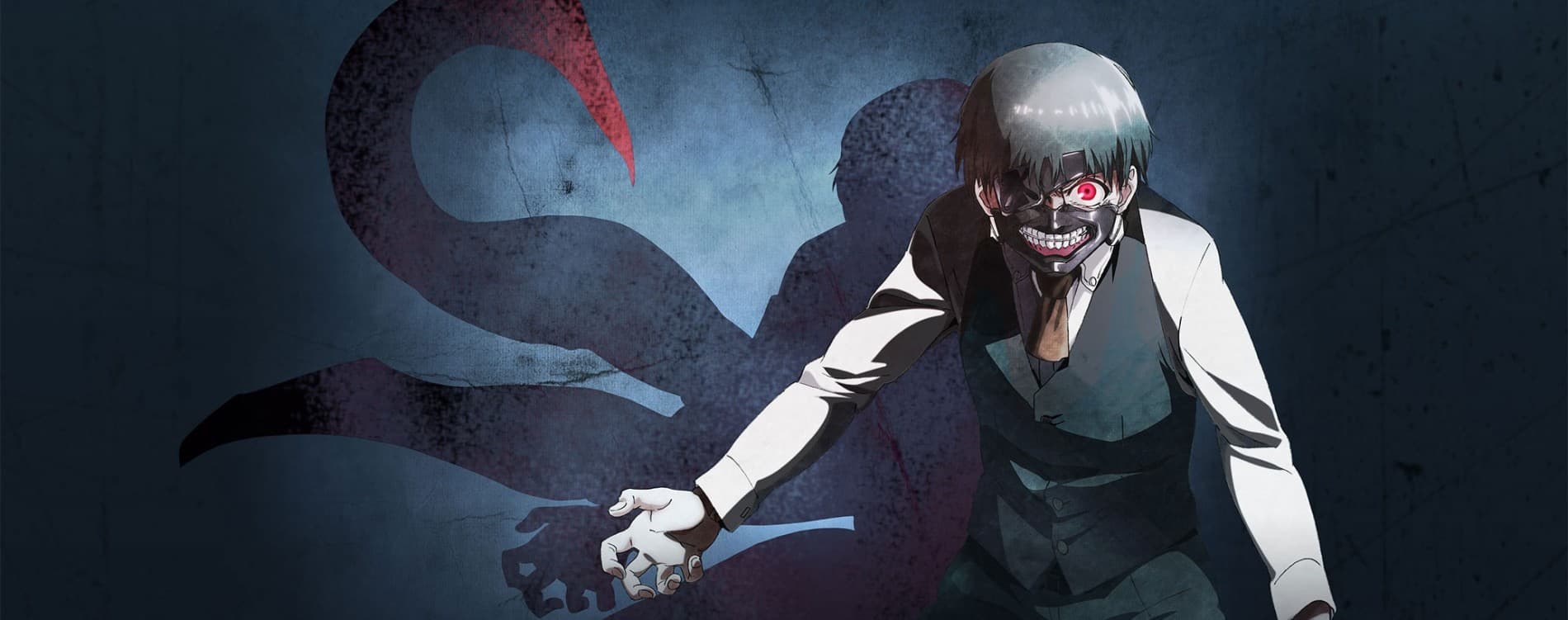
Tokyo Ghoul
a review by requiemsama
a review by requiemsama
<code>“Anything is okay, as long as everyone is harmless and understands each other.” </code>
This is the pervading philosophy of our age, rooted in Jacques Derrida’s post-structural philosophy, which has uprooted morality as we’ve known it as but a mere convention of words and attachments to their meanings.
Put all of this in the hands of the Japanese and add a dash of teenage angst? You get Tokyo Ghoul.
While I find it personally gut wrenching and unfathomable to narrate the social injustice of flesh-eating monsters, I nod in defeat as I admit this is a very well written and constructed story, drawing out empathy for me as would anyone living in this age of civil rights.
But please…let’s not eat each other; minorities already struggle with enough inequalities as is. (65/100)
Ken Kaneki is your average college student. He loves reading, and frequents a coffee shop in the 20th ward with his buddy Hide. He meets Rize, another book-lover who looks like she might have a real interest in him. Mustering up the courage to date her, it starts to look like Kaneki’s dreams will come true when he suddenly encounters a ghoul. From that point on Kaneki’s life changes drastically, as the world of ghouls slowly reveals to him the brutal world blanketed by peaceful Tokyo.
Seriously, the first 15 minutes of the show quite lackluster. There’s some weird scene where you see a lot of blood and some boobs, then it just bursts into a scene like the beginning of a romcom or hentai game. After the ghoul encounter, a strange plot takes hold simply by the perspective and the protagonist, and as such we are enticed to explore and understand the underworld of ghouls and ghoulish fiends. Several short story arcs occur over the twelve episode period, ending with what I believe to be a highly aggravating cliffhanger with the obvious intent to stir up our brains until the next season.
Though many an anime fan would be drooling here, I have seen this sort of ending literally hundreds of times now. The story was already well composed, yet (as most likely to reserve a big budget for another season) the conclusion audaciously “sells” our protagonist to us at the very end of the season after torturing us the entire time beforehand. I hate this formula from the bottom of my heart because it intends to preserve a series for bigger, more profitable business at the sacrifice of art—precisely the plague of our entertainment industry today. Had the series either reached this point sooner or drawn it out into the second season, I would have given a significantly higher score.
And yet, the most fascinating thing entirely about Tokyo Ghoul is how it deceptively leads us to a moral question while we watch people get murdered and eaten like livestock. Through Kaneki’s eyes, we now see the struggle of flesh-eating creatures fording through life symbiotically with humans. We also see another government agency filled with baddies hellbent on wiping out the poor, innocent butchers. It's literally like watching two bullies fight each other.
Does anyone else see the reflection of real life here? In the United States, the struggle for minorities is and has always been to have the same degree of equal treatment as your average citizen. To sit where you want; to eat where you please; and to work in a way that fits your highest capacity without being labeled a menace to society. This same struggle occurs among LGBTQ, Koreans in Japan, Japanese in Brazil, non-Muslims in Islamic nations, Christians in China, and even Aborigines in Australia. This list can continue on much longer, too.
The catch of Tokyo Ghoul is this: to prove the point, why not pick a topic as gruesome as cannibalism? The series works this point so clearly that we, a moral and just audience, numb ourselves to the reality in cheer for our flesh-eating heroes! The coercion itself is so convincing, that even as I reread over this review I don’t feel the bankruptcy of righteousness. But I have to remind everyone here…this is a series that subliminally condones the idea of eating other human beings, even though it is shrouded with fight scenes and super powers.
Most original character? Tsukiyama by far. Anyone else? Nope. (72/100)
Just because television screenwriting is running low on new topics does not excuse the use of stock characters! Kaneki’s attitude is somewhat between masochist Shinji Akari ( Evangelion) and innocent Allen Walker ( D.Gray-man, and even more so by the end of the series.) As a personality I think he’s fantastic, but his lack of originality made him highly likable by a larger group of people when in fact there was no reason to do so for a series this dark. I say this, for example, since Shinji’s originality made him less likable, though his character has been the most popular masochistic prototype for nearly 30 years now. Besides improving a fanbase, how is Kaneki's popularity going to keep things dynamic? I can already predict the degree of problems he will face in season two, since the entirety of his characterization will tread carefully to maximize the number of fans.
Our heroine, Touka, remains blatantly unclear and unexplained. Literally the entire season only covers what looks like 1/10 of what she's supposed to be. Whoever finalized the cut scenes decided her back story and degree of purpose is far less necessary than cramming in more CENSORED cannibalism and budget-efficient animated fight scenes. The series minimizes her character development so that she can safely stay “okay” and “cool” in our books, as her complicated relationship with everyone else keeps her safe from much criticism. It is obvious that she barely exudes a third dimension at all…it’s all probably orchestrated to draw out a gushy moment for a frenzied fanbase in season two.

"Look girl, you're cute and all...I mean even if you're drenched in human blood. You just gotta stop eating my friends, aight?"
Meanwhile, it’s characters like Tsukiyama that earn the score for this show. If anything, his personality makes enough of a believable “ghoul” for everybody else. The whole gourmet arc was captivating, and his passion and perversity is unique and compelling. It's even ironic that his demeanor is so empowering that he could draw personality out of Kaneki and Touka. I just hope they don’t kill him off in some pathetic manner to provide sustenance for narutards.
Also, not all of the stock is bad either. Nishio rounds out quite well sometime mid-season, as does Hinami. Both of their struggles really struck deeply within me in the same vein that Tokyo Ghoul hypnotizes us to accept and appreciate these characters however disturbing their lifestyle is.
Typically what I would expect of a 21st century animation. (80/100)
This is pretty much my default score, since unless it has some highly-detailed or elusive quality I cannot really make much complaint. The character designs are beautiful, as is the vividness and choice of colors in animation. In regards to fight scenes, some portions of detailed, smooth motion animation do occur, though the series as a whole focuses more on output rather than eye candy. Some of the artistic choices (such as the final episode) are really well done, but otherwise nothing really stands out to me.
Not exactly my style musically, but not bad. (75/100)
I hated the OP and ED. I love heavy metal, classic rock, funk, avant garde, experimental rock, and even a little bit of indie rock. For some reason, though, 8 beat alternative like the OP with weak vocals grate on my nerves, as does the 16 beat monotony in the ED. I understand and apologize to many fans of this sort of rock music, but I spend my life warring against this sort of narrow-minded style of writing, as it seems to just focus on being “cool” and “non-invasive.” The BGMs also are not half bad, but it’s honestly the expected quality coming from a show like this. I’d have liked to see more chances being taken, (i.e. its contemporary Selector Infected WIXOSS is an example of great musical architecture).
The voice acting is what earned all peaks in this series, though. Tsukiyama’s seiyuu, Mamoru Miyano, has won several awards and has done roles like Okabe in Steins;Gate, Kiba in Wolf’s Rain, and Light from Death Note. His craft shows well here, especially during his great deliberation scene. Touka’s seiyuu Sora Amemiya isn’t half bad, either; I could really tell that the script itself w_as well written in this manner, too.
Watch it, love it, but don’t count on it. (81/100)
I’m not going to continue blasting the series, as I’m sure I’ve already thoroughly pissed off a good chunk of my readers. I really did enjoy watching this show, even more than many of the ones that I've rated higher. In the right company this series could be great entertainment, though I do not find it to be a good series for couples—unless they want to “eat” each other. Ha. Ha ha. Bad jokes aside, give this show a shot if you’re looking for quality entertainment.
NOTE: At the time of this review Tokyo Ghoul is riddled with censorships. Much of the blood and gore is either blacked out or covered up, which to my knowledge has caused a great deal of frustration for thrill-seeking otaku. In reaction, I pay respect to the "quality vs. hedonism” principle, wherein if you cannot appreciate a series like this because of a lack of gratuitous violence, than besides also seeking counseling you might not want to bother watching this.
17 out of 20 users liked this review
