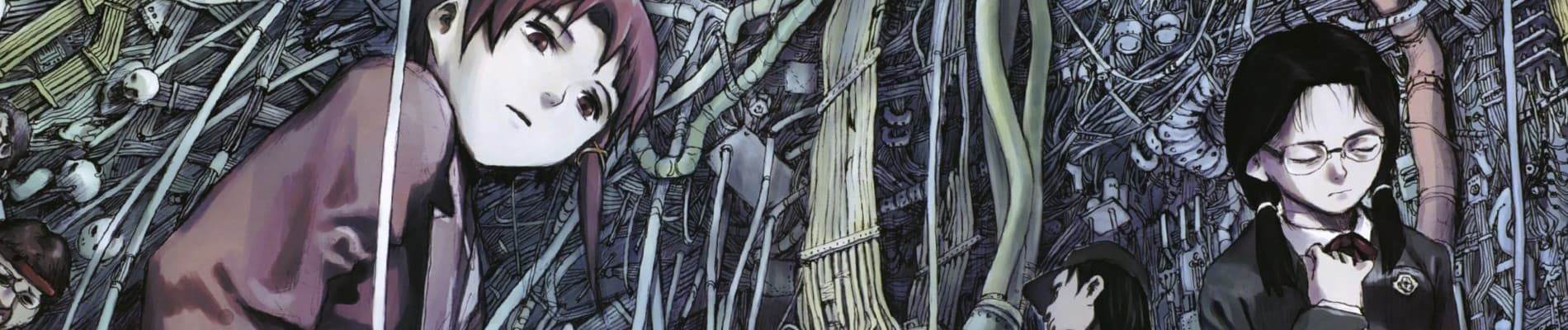
There is no place to hide. Wherever you go everyone is connected.
I was talking to a user who has failed to understand Serial Experiments Lain. It is a complex series and that everyone can understand it from different points.
It touches controversial issues like reality, identity, the collective unconscious, or mental problems such as dissociative identity disorder. Philosophical themes with high degrees of abstraction such as pure existentialism are also discussed, adding theological elements such as the existence and composition of "God". The content of the series ends up being implicit in the introspection itself that forces you to make, added to that, a plot is generated that seems immobile when in fact it is the opposite.
It is for these reasons that I consider it a completely rich, diverse, and interesting audiovisual material, but at the same time complicated, since it is not for everyone because of its complexity, it requires a concentration that does not allow you to distract yourself with what is merely explicit.
A fundamental aspect for the development of the plot in "Serial Experiments Lain" is the constant use of puns, close-ups, and silences of the series. For example "Lain" sounds similar to "Line" but it is pronounced differently: "Lain" is pronounced "Lein" and "Line" is pronounced "Lain", making explicit reference to "being on the Line". In the first chapter, whose name is "Strange", reference is made to rare and unusual events. Interestingly, "Weird" bears some resemblance to the term "Wired", which translates to "red". Therefore, we deduce that all the "strange" events that occur are directly related to the network ("wired"). All the chapters are called "Layer", referring to all the stages that our protagonist has to go through to get to the bottom of the matter.
At Serial Experiments Lain we follow in the footsteps of Lain Iwakura, a Japanese teenager who lives in a Tokyo between the futuristic and the contemporary in which technology, and more specifically computers and the Internet, are an indispensable part of the life of the entire society. Lain is an introverted and reserved girl, with evident socialization problems both with the outside world and with her family, and even with herself. One day, both Lain and several of his high school classmates receive an email from Chisa, another of the students. Until now everything was normal if it wasn't for Chisa having committed suicide and in the message she talks about her death as a transitional step to abandon "her flesh" to break her ties with the earthly world and be with God in the new world that it is part of the network. After the enigmatic event, Lain installs a new Navi, a state-of-the-art computer, backed by her father, who believes that technology can help his daughter end her social problems and be a little happier and more complete. Lain begins to use the Navi more and more, relentlessly delving into a whirlwind of technology, hackers, secret groups, conspiracies, places, and people of dubious recommendation with the aim of to unravel the mysteries surrounding the death of Chisa and its enigmatic warning from beyond.
From the first moment, this anime takes a basic premise of Socratic theories: know yourself. In this series we constantly change who we are, both for ourselves, for society, the world, or even for the time. This is a fundamental premise, since only when we know ourselves can we understand the rest of the things that surround us and that are part of reality. Lain shows us that there are several "I's", and that they do not depend only on us, since each person or environment with which we interact has a different perception of the ego that we know. That is, at the same time that there is a self in your head with characteristics and a way of being that you know and understand, there are a multitude of diverse beings who do not depend on you, but on the vision that the rest of society has of you. A way of complicating things that, however, is inevitable, since the human being cannot live far from society, he is part of it and the form at the same time that it shapes it. And at this point, the Internet, the network, comes into play, a possibility of staying permanently connected with other people and apparently freeing us from the difficulties we always encounter.
The network becomes the representation of another of the Platonic theories, which is the existence of a supersensitive world, a world of pure ideas and full freedom that is linked to the paradise governed by God. A higher level that can only be accessed by renouncing "the meat" and living entirely by and for the cyber environment, a suicide that in Lain has two ways of representing itself, both in a real way, with the suicide of Chisa or with Lain's True Social Isolation. This is directly connected with the idea of whether the soul exists or not, and if the human being is the body and soul together, and they cannot exist separately, or if the body is only a wrapper for that set of unknown things that we do who we are.
In short, Lain talks about approaches to existence, about what makes things real.
I don't know if I was helpful, sorry. I express myself better speaking than writing haha
You can find many reviews and explanations online, even when I wrote this some opinions helped me.
78.5 out of 83 users liked this review