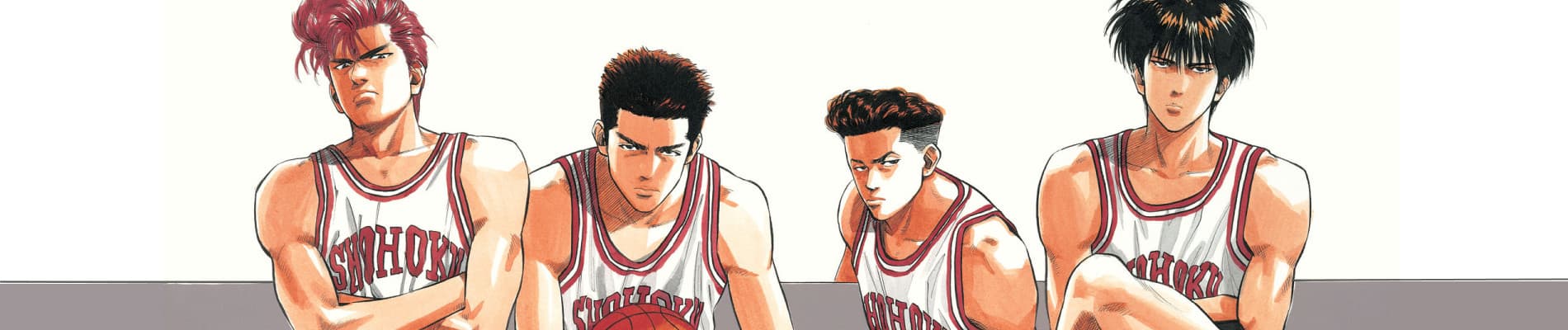

Growth is a slow, staggering process filled with confusion, humiliation, regression, determination, and acceptance unless you're a tensai. Takehiko Inoue wrote a story about a boy learning a sport from scratch in hopes to impress a girl. Through blood, sweat, and tears, Hanamichi Sakuragi and the boys grind their way through high school basketball and charm their way through your read.
The first thing I recognized about Slam Dunk's story was its ambition. Just by seeing Sakuragi be in his first year of high school and know nothing about basketball tells me all I need to know about what Japanese society thinks about a mainly American sport. It's niche and when you task yourself with explaining the basics/fundamentals of the sport to your audience, you ought to make it easier on yourself by having your main character know just as much as them about it. And throughout the story, Inoue does a nice job breaking down some of the more subtle details, rules, and calls of the game or beginners, but this isn't Basketball 101.
The story won't pause to tell you what each position does, and you are expected to have even the slightest knowledge of how the sport works, but even if you don't, Inoue does make it easy to follow along with. A newcomer may not understand why Sakuragi does is wrong, and neither does he. This leads to some of his more humble moments, much to my dismay, but I'm getting ahead of myself. Sakuragi's constant fuck-ups as a newbie give the audience a chance to get things broken down, repeated, and demonstrated. So all-in-all, if you're new to basketball, but a fan of manga, this is a great starting point for you to understand a bit about the game so you can follow along with any family members who aren't gracious or patient enough to explain things to you.

That being said, I will admit that even though I know how basketball works, I got a bit swept up in the pace of the story in anticipation of Inoue explaining things to the Jump Readers of 1990. The pacing of the games themselves is ok enough to give each of the core cast and even some antagonist some shine. Early on in the story, chapters in between games speed through opportunities for more development, leaving most of any flashbacks or sub-plots to be discovered by the audience during the games. This can break up the pace of the game sometimes, but it's not glaring.
One of the things that I do like about what Inoue does with this story centered around this sport is that there are no characters that are obsessed with winning. Does losing hurt? Yes, but it never breaks anyone. Many of the characters are more focused on getting passed the challenges that lie ahead or within themselves. They actually have fun playing basketball and proving to themselves that they can beat the obstacles in front of them. That's a wholesome aspect of stories concentrating on adolescent school activities that's always refreshing to see.
The way the story ends...
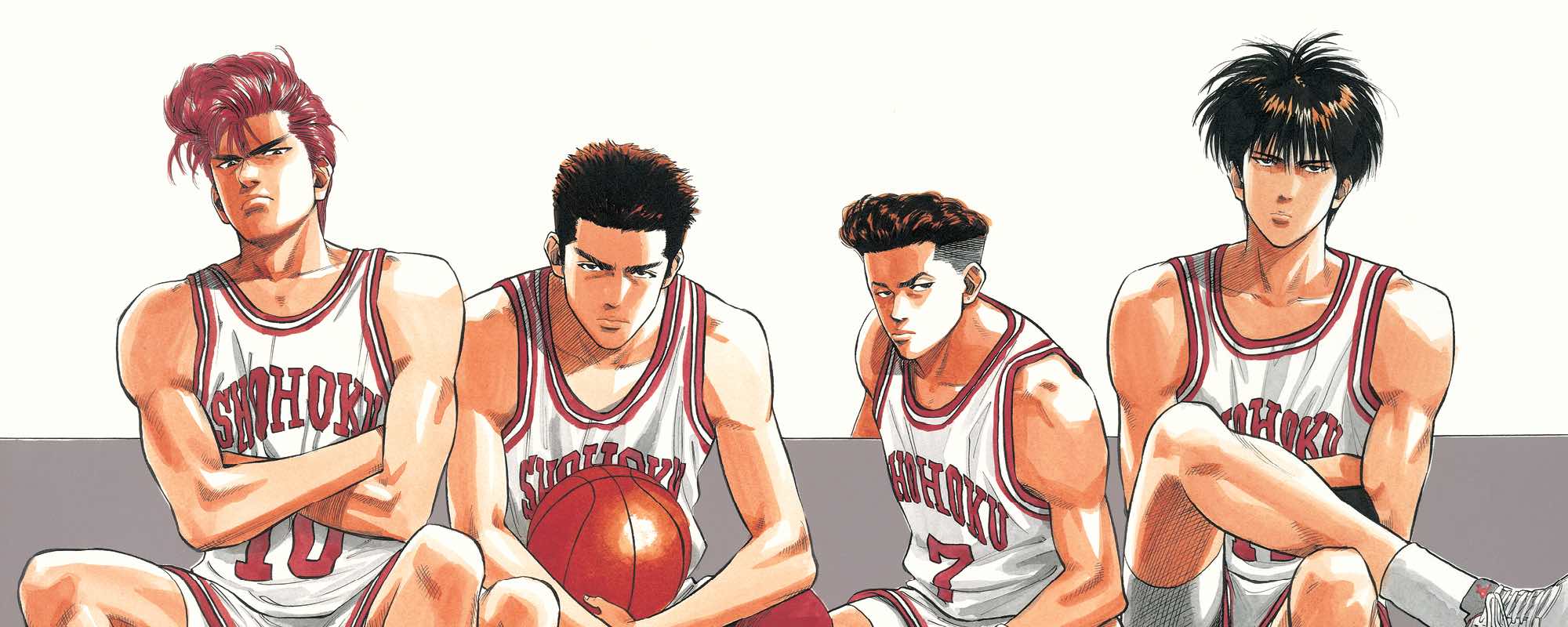
Actually out of everyone, the one that is the hardest to like is our main character, Sakuragi Hanamichi. I'm extremely aware that he's still just a 14-15 year-old-kid that almost exclusively responds to praise, can't own up to his own mistakes, and only ever wants to be around his crush. Nevertheless, most panels featuring him are eye-rolling at their best because there is a fine line between needing validation as a reward and thriving off of having your ego stroked. Moments that make me SMH and shrug as I flip the page are where other characters have to stoop down by exalting Hanamichi just so he'll shut up. He reconsiders whether he's a genius or not twice after he fucks up and I was waiting for the moment he'd stop calling himself that, but it only slightly comes when instead refers to himself as "just a rookie". His best (and kind of charming) moments come when he's being humbled by his failures and showing any kind of vulnerability.
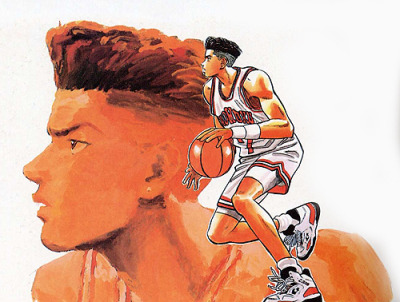
Characters that I did enjoy include Sendoh, Fukuda, Maki, and my man with the cleanest jumper in the land of the rising sun,Yoshinori Miyamasu. Characters that I don't like are mainly the rivals, Sakuragi and Rukawa. These two remind me so much of Asta and Yuno, it's impossible for me to like them. Rukawa being such a great player, it's really hype to watch him work, but he's got such a wet napkin of a personality; I can't find anything else interesting about him.

I'm not used to speaking about my admiration or criticism of artwork, so please bear with me if I don't sound very articulate about it. Takehiko Inoue, for lack of better words, outdoes himself. Look at the fucking shading on this page. I've previously read Vagabond, and I knew to expect astonishing artwork from him, but what I didn't expect was to be pulled into the excitement of the game thanks to his art a lot of the time. The way many of the characters are drawn in this story is with long limbs and wide torsos, which of course lends itself to the sport they play, but Inoue's understanding of adolescent masculinity. It keeps the characters feeling human and it conveys that the physical burden of basketball is something to be overcome, so you're always rooting for them. SO MUCH SWEAT AND BLOOD.
The first gripe I have with this manga is that a lot of characters (more so on opposing teams) suffer from same-face syndrome. Either their haircut or their faces are so similar to each other that I can't remember who it is or where they're supposed to be. Fortunately, their jersey number is usually visible so I can use it and their dialogue to follow along easier, but it's still a small nitpick. The second grip will be discussed in the Enjoyment Section.

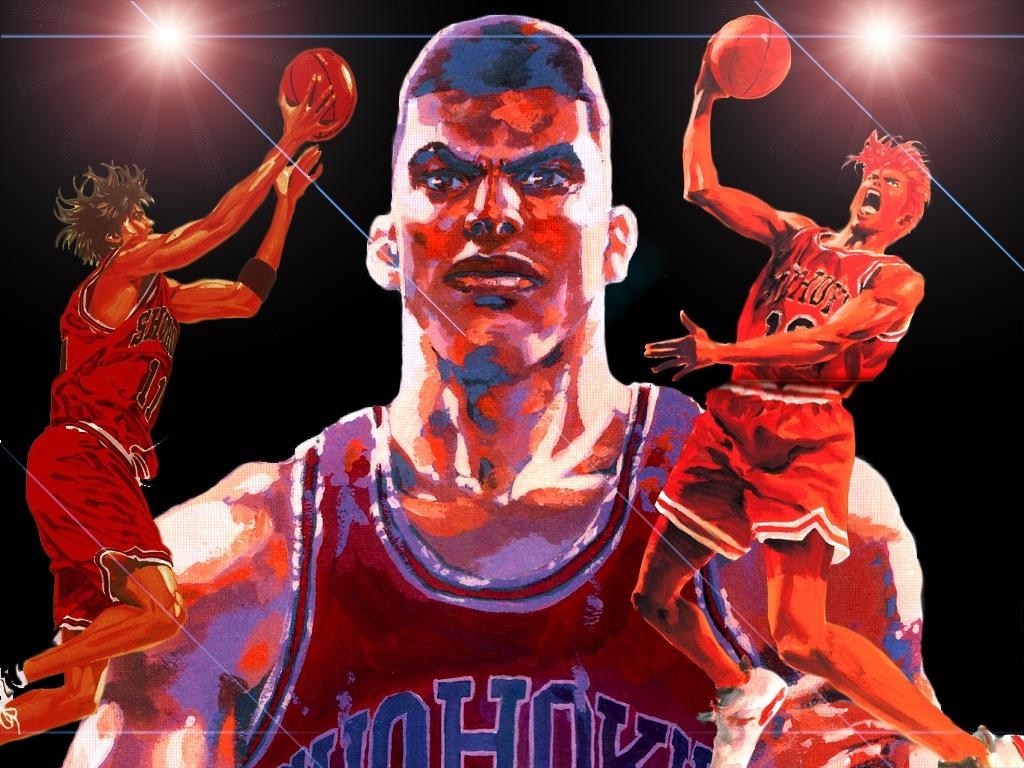
Although it is understood that all of the characters in the story are Japanese, I cannot sit here and act as though there isn't one specific character in the story that is not portrayed as a Black kid, Takenori Akagi. He's drawn with bigger lips, a flat top, and he has the darkest skin tone in the anime and much of the colored art. And if he's not drawn as a Black kid, he's drawn as a kid who is the most obsessed with a Black-dominated sport and culture. Throughout the story, Sakuragi and many of the other characters call him and other similarly drawn players Gorilla. Now, outside of the obvious racist context, I understand why they do this. He is bigger and stronger than the majority of the characters (in which I don't understand why they don't call him a bull since the school uniforms and Sakuragi's hair are literal references to the Chicago Bulls). Sakuragi and the others, most likely, don't mean anything racist by it, don't know better, and are obviously just dumb Japanese kids who are trying to be insulting and funny. Chances are that Inoue also doesn't think less of Black people by doing this, and doesn't understand the historical context of the comparison during the time of him drawing the story. I also understand that this observation is purely me projecting my understanding and personal feelings about racism.
However, it is extremely hard for me, a Black Man, to read this story where a portrayed Black character is being called a gorilla, ape king, and bald gorilla. Yes, I'm aware that other non-Black portrayed characters are called monkeys, including Sakuragi, but it hardly matters. Either way, it keeps me from focusing on the story when this very unnecessary and unfunny joke is distracting me. I thought that eventually, Sakuragi would come to respect Akagi who is the one who taught him basketball, his team captain, and the older brother of his crush, Haruko, but this does not ever happen. I can only assume that Akagi just stops being upset at being called Gorilla or Gori since he never expects it to change. I really wanted to address that and how much I can go reading this story without it. It seriously shat on my experience with the story and I would have definitely dropped this manga if it was not revered as the greatest sports manga of all time and I really wanted to get through it.

Other than that, I really enjoyed the games. There was a moment when Yoshinori shot a three-pointer and I couldn't turn the page because he just looked so damn clean. There was a moment where someone gets hit in the face with the ball, and their reaction made me actually laugh out loud. If you're planning on reading it, you'll see why. The moment of the last point of the series was hype as shit. I appreciate the respect that Jordans get in the story, and it was funny to watch people step on a certain someone's shoes.
Slam Dunk is an entertaining, charming, and many times frustrating story that gives you a solid shonen-style focus on the value of determination. I wish the story was a bit more fulfilled, but not bad for what we got. Personally, I think when it comes to sports manga, it has been surpassed by Haikyuu, but it definitely is better than the superpower-ridden Kuroko no Basket. It has set the standard among sports manga, so honestly hard comparing anything to it, but you and I both know, that these comparisons don't mean jack shit. Here's the score:
19 out of 28 users liked this review
