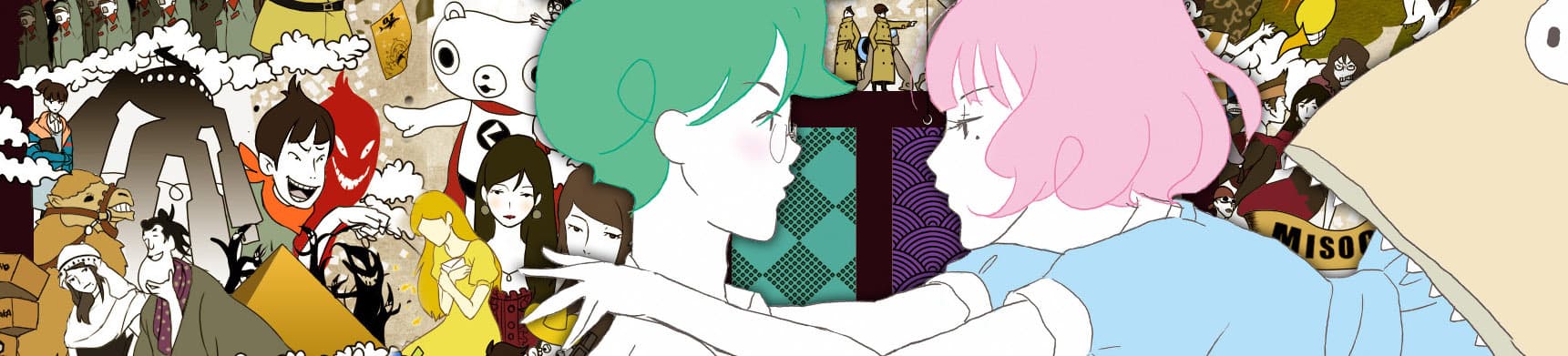

This Review Contains Spoilers for The Tatami Galaxy
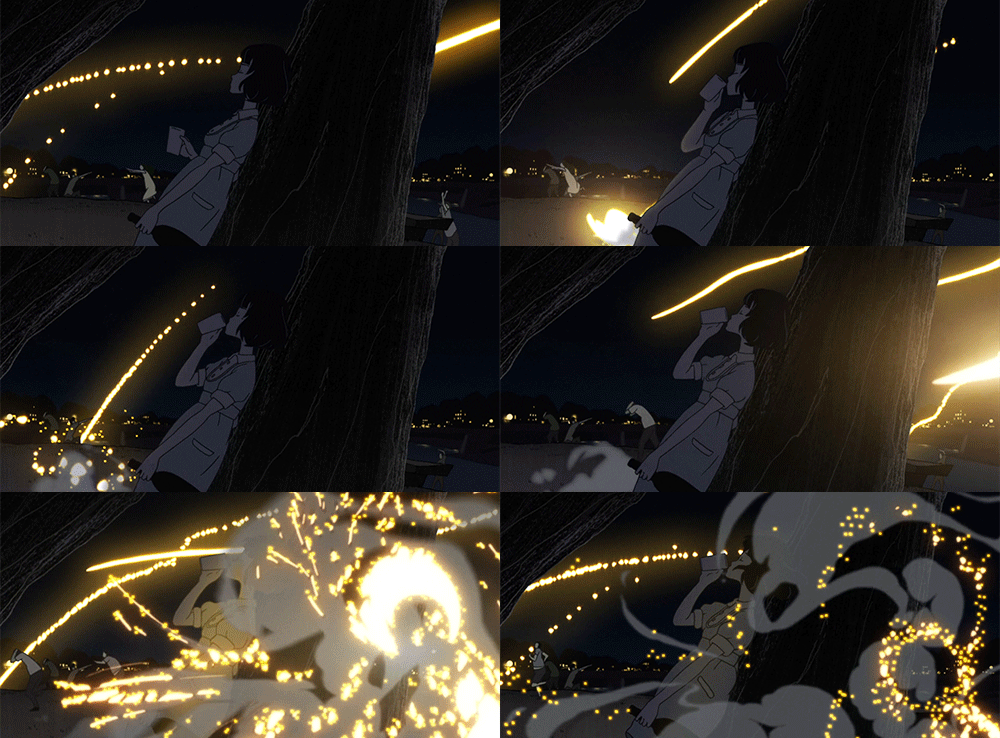
If you're a big anime fan, chances are you've at least heard of The Tatami Galaxy. If you've watched it, you're doubtless absolutely in love with it and herald it as among the best the medium has to offer. If you're a casual or moderate anime fan, chances are you have no idea what this show is. While it might not seem like it, The Tatami Galaxy is a top 100 show — on Myanimelist it sits at #66 and at #54 on Anilist. So even if it's not the most watched show, it certainly commands respect, with nary a criticism lodged against it. Honestly, this glowing reception made me feel a bit daunted while watching it, knowing that I'd have to review it and give my honest score. Tatami Galaxy somehow feels more sacred in its top 100 placement than, say, something like Fullmetal Alchemist: Brotherhood or Steins;Gate. While I can attest to their quality, their placement is unquestionably due to the sheer number of people that watched them. Criticism of them isn't unheard of, au the contraire, in some circles, it's quite normal to hear them decried as overrated, popular fluff. But The Tatami Galaxy? You seem to need a membership just to view it and those select members are happy customers. As a top 100 show, calling it "a hidden gem" wouldn't be accurate, even if it somewhat feels so. A "cult classic" still isn't quite right, but it's close enough. Either way, while not the most viewed show, it is loved.
And I have to be perfectly honest when I say that this show isn't my favorite. I like it well enough and I can see how it's a masterful work of art, but that's the thing, I simply like it well enough.
The Tatami Galaxy is a lot of things. For one, The Tatami Galaxy is unique.
A lot of this uniqueness can be explained by auteur theory. (Very) Briefly, an auteur is a director who closely watches over all aspects of a project and injects it so much with their own style that the end product is unquestionably "them." Many times, people can't tell who a director is because they fall in line as to what a studio tells them. This isn't necessarily a bad thing: I cannot tell you who directed the various Attack on Titan seasons, but Hajime Isayama's original writing shines so brilliantly that I don't mind. The point is that, in bringing their own style to the forefront, they make their particular show distinct and memorable. Examples of auteurs in anime include Hayo Miyazaki, Makoto Shinkai, Satoshi Kon, and, indeed, this anime's very own Masaaki Yuasa who not only served as the overall director, but directed select episodes, storyboarded a few sequences, and wrote the script. His flair helped make The Tatami Galaxy an anime unlike any other.
The Tatami Galaxy follows the unnamed* main character, who also serves as the narrator for the story. He's a second-year at Kyoto University and finds himself wrapped in longing and regret. As a Freshman, he entered college with lofty visions of a "rose-colored campus life" wherein his days would be filled with merriment and he'd court a "raven-haired maiden." Our unnamed main character however, quickly finds out that his reality wouldn't be nearly as "rose-colored" as his fantasies. He joins a tennis circle (or club) and has no aptitude for the sport nor meeting women. Bitter, the narrator partnered up with a ghoulish, evil member of the tennis circle, Ozu, to devote himself to breaking up any happy couple they come across. Now, the narrator is destitute and feels that, thanks to Ozu, he's been robbed of a "perfectly lovely college life." He can't spit out his feelings to the woman he's interested in, he's stuck in a rut, and worst of all, he's bound by the "red string of fate" to a selfish demon of a man. He wants a do-over of the last two years of his life.

And he gets one.
Then another.
Then another.
Then another.
Then another...
Part of The Tatami Galaxy’s uniqueness is how it handles perspective. This is actually how I was first introduced to The Tatami Galaxy. Over a year ago, I was looking for anime with a second-person perspective. The two results that I put in my planning list were The Tatami Galaxy and Flag. The latter actually does feature second-person perspective via the majority of the anime being shown through in-universe cameras (thus it's as if "you" the viewer is the perspective character), while the former is first-person, as shown by the abundance of "I," "me," and "my" (thus the perspective is achieved by a visible narrator who's an active part of the story).
This perspective is achieved largely through the existence of a visible narrator. I mean "visible" in a few ways. First and foremost, unless you're reading a book or watching a documentary, you're less inclined as a consumer, to even notice a narrator is there. When you read a book, every word you take in is visibly a voice dictating the information. For movies, this role can be attributed to the director or photographers, but we tend to just view it as a story without thinking too much about how the story is conveyed. Like a book, The Tatami Galaxy makes you keenly aware that someone is dictating the story to you. Some novels, most documentaries, and almost all work of printed non-fiction aim to make the narrator invisible by taking them out of the action, giving them no bearing or stake in the work. This is, of course, third-person narration and is signified by using pronouns such as "they, he, she, it" to describe all actions while omitting "me" and "I." The Tatami Galaxy is visible in this manner, too. The show's narrator obviously uses "I" a lot, but he's also an active participant in the story, he is the main character, after all. This isn't unheard of in visual media. Voice-over narration, while not the most common, is still employed from time-to-time. Examples I can think of include Final Fantasy X, Made in Hong Kong), and The Shawshank Redemption. The works that employ them, however, make them scarce, perhaps thinking constant narration would be distracting and detract from the work instead of enhancing it. I can probably count the instances of Final Fantasy X's voice over narration on one hand and that game has nine hours worth of cutscenes. Once again, The Tatami Galaxy's narrator isn't content staying silent. His narration is constantly peppered throughout the episode. The episodes are written around the narration and would feel hollow without them.
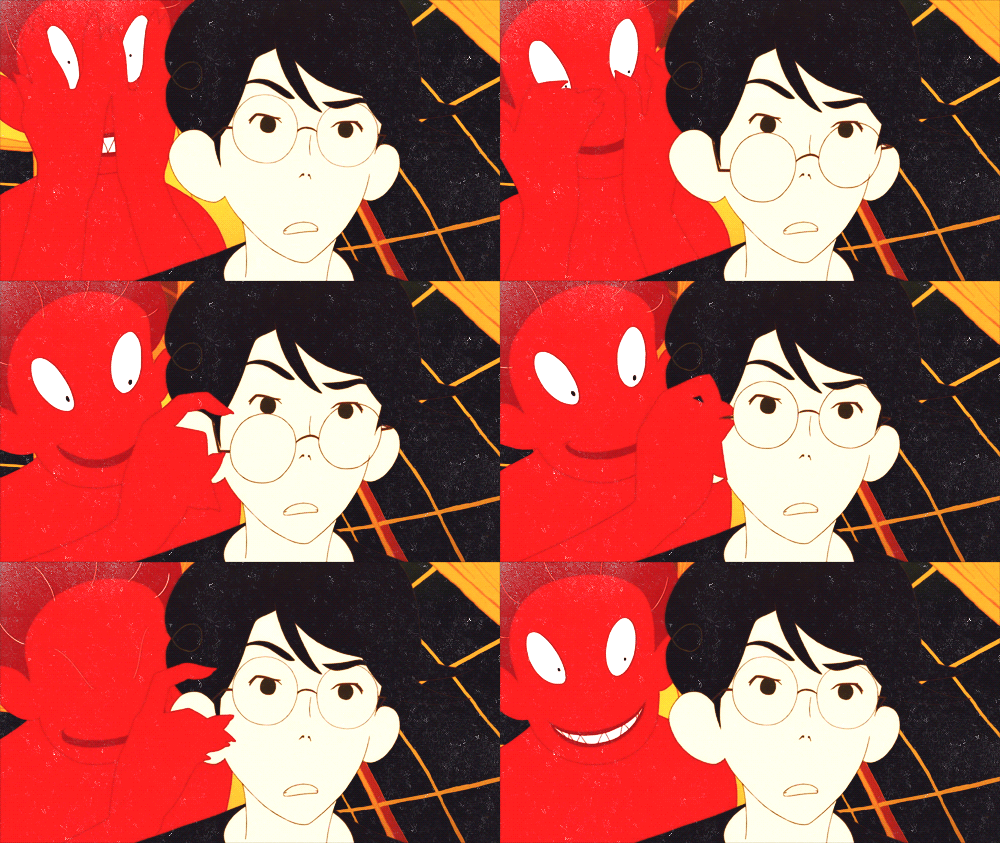
What really makes this great is the fact that the story is warped and actively changed thanks to the narration. The narrator often speaks with an overwhelming, gatling-gun delivery (if you think it's tough listening to it, put yourself in my shoes and try dubbing it for a project). You may very well need to rewind or pause to catch everything that's being said. I'm not exaggerating when I say that, unless you speak fluent Japanese, if you blink, you might miss crucial information. This high-speed delivery is the first thing we're treated to as viewers, telling us immediately that this narrator has a distinct voice and he will speak in that voice regardless of if it's the best way to relay that information. In other words, his speed hints at his unreliableness. This is made apparent by him putting the blame on Ozu for his troubles despite his own agency being shown, the diminishment of other characters to focus on him, and the description of Ozu as selfish despite evidence to the contrary. The most dramatic effect of this narration is the fact that, as our viewpoint into this fictional word, it can quite literally change the way we view things. Since his first appearance, Ozu is depicted as a demonic figure, contrasting with the more plain narrator and Askashi. At the end of the series, when the narrator's view of him has changed, Ozu takes on a more regular-looking appearance. I absolutely love this because it brings into question everything we've seen. This is an amazing way to make the development of character a part of the medium itself and I just get a kick out of it because I haven't seen anything like it before.
The narrator dictates that the show is unquestionably about him. His own views and biases dictate the show and inform the theme of life being what you make it.
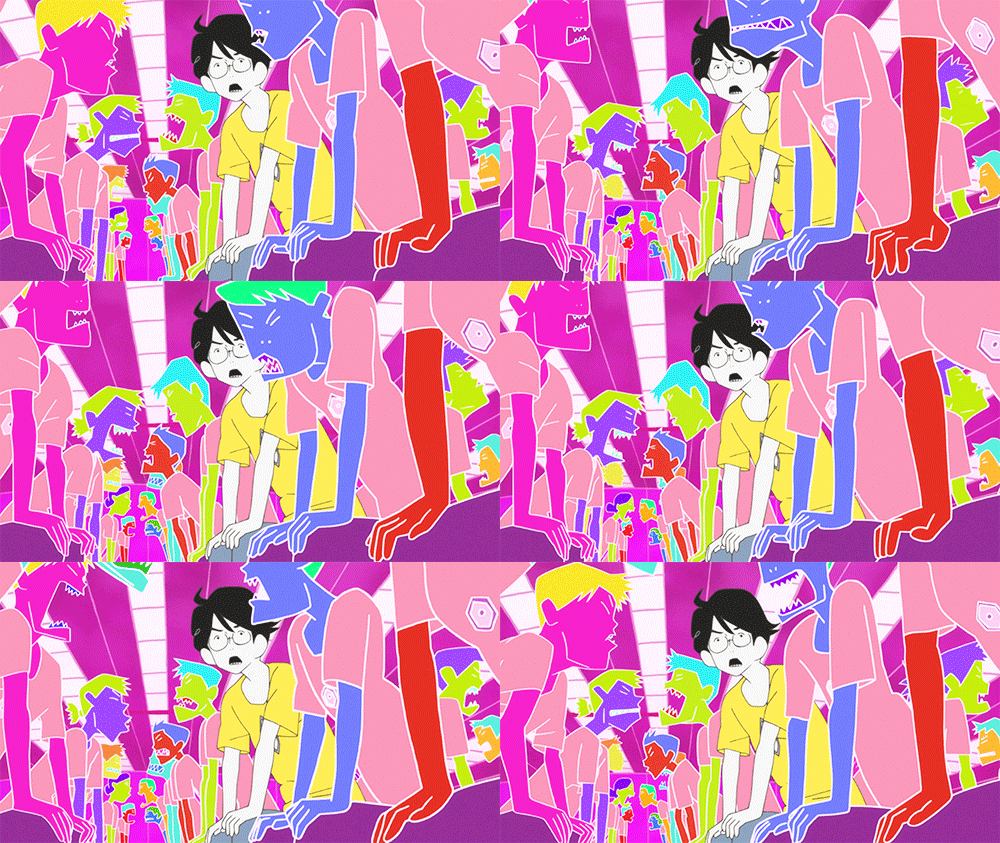
And despite being so centered on the main character, like a great work of art The Tatami Galaxy invites the viewer into its constructed world.
Like the narrator, allow me to make this about myself (not that I don't often do that, anyway). I was easily drawn to the show due to me seeing myself in the main character. He's a college student who feels that he hasn't made the most out of his campus life, I'm a college student who feels that he hasn't made the most of his campus life. He's dabbled his toes in a wide berth of clubs yet often doesn't feel at home in them, I've dabbled my toes in a wide berth of clubs yet often don't feel at home in them. He has grand delusions of being with a "raven-haired maiden", I have grand delusions of being with a "raven-haired maiden." He narrates his life by talking super fast, I narrate my life by taking super fast. And most importantly he wants to do it over, and I'd probably try to do it over. While I'm being glib about it, I really did watch this show carefully, hoping that I'd learn a lesson from it and grow as the narrator did. I felt I was at the prime age and position to get something out of this show.
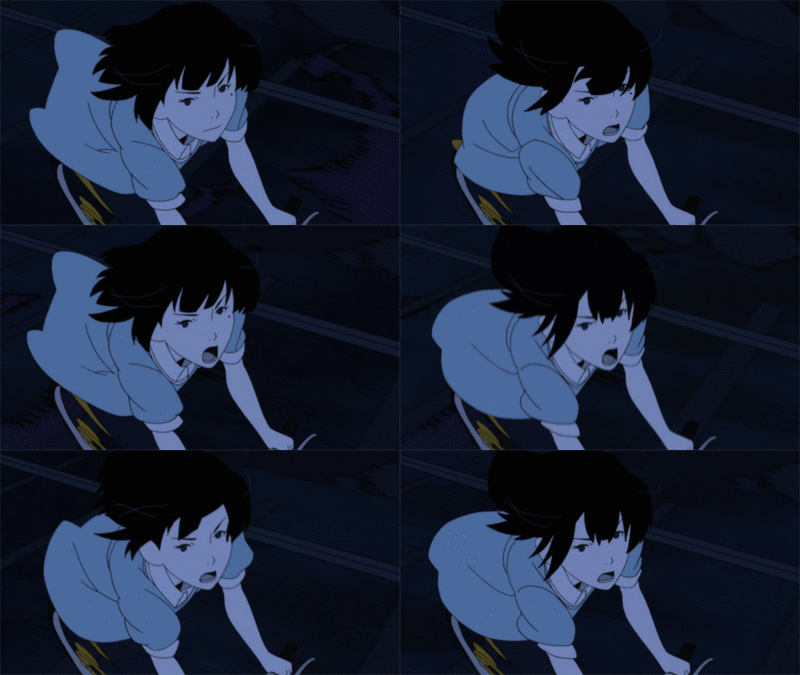
The show has a unique concept and it executes it well, revealing the story's lesson before the narrator grasps it. As stated before, The Tatami Galaxy features the main character as he chooses a different path to take each episode. While it's somewhat undefined, think parallel universe and not Groundhog Day. We are quick to learn, however, that these parallel universes aren't very different in outcomes. The narrator always meets Ozu, he pursues Akashi, and he always ends up regretting the decisions he has made. It seems that Ozu's words have some truth to them: no matter what path the narrator takes, he ends up in the same spot. The second episode features many of the same beats, giving a distinct feeling of monotonousness in spite of novelty; to flip the phrase on its head, what's new is old. Succeeding episodes change the formula more and more, but they feature many of the same gags and focal points and they all feature the narrator hitting a slump. I enjoyed the show for the fresh way it depicted the narrator's life and the (un)importance of his decisions.

There is never a dull moment in The Tatami Galaxy: from directing a smear piece on the movie club president, to joining a cult, to falling in love with a Love Doll, to training to become a birdman pilot, the narrator leads a colorful live (lives?) that will be sure to make you laugh and wonder what hijinks he'll get into next. This is certainly a weird show, perhaps dipping into widget territory, but, moreso than another show, I found it easy to find relation in the wild. This might be in part due to the narrator, who's a bit of an Ordinary Joe. This contrasts with the colorful cast he must interact with and hilarity soon ensues. With how wild his life is and with him actually finding fortune from time-to-time (like becoming ripped!), it, once again, becomes clear that his own cognition is his worst enemy.
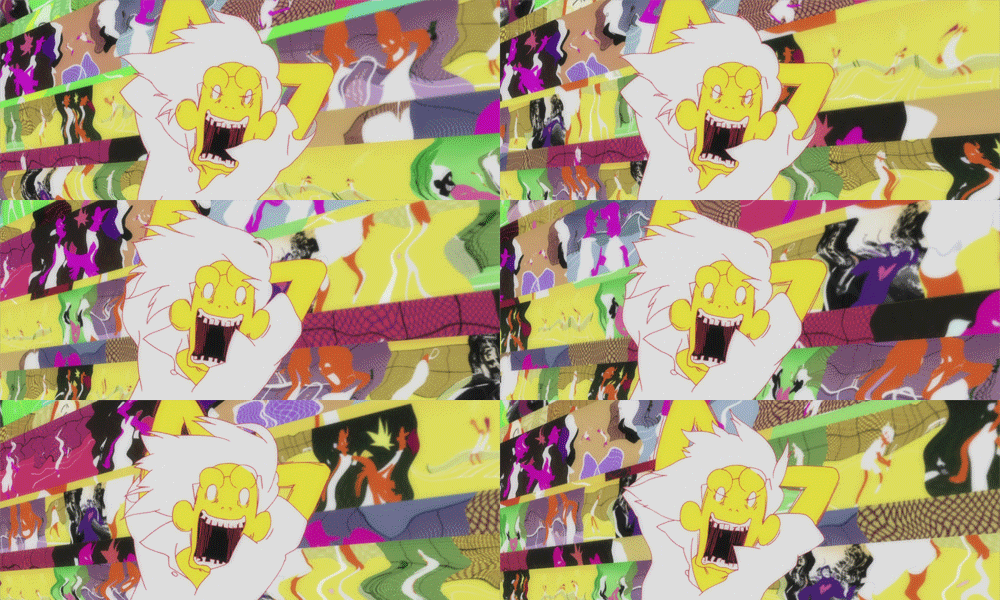
The music does its job well and blends into the scene while being pleasant to the ear. The art, however, goes absolutely above and beyond, being a shining example of what the medium has to offer. The characters look very striking — humans tend to be very white, almost porcelain in appearance, giving the impression that they were cut out from a manga page. The backgrounds are often very detailed in comparison, making it seem like these anime characters were placed in a setting that they don't fit in with. Real images are occasionally used. I'd wager this style is to give the impression of the narrator finding the world around him colorful and full of possibility while he himself is painfully unremarkable. The anime is a visual treat and I'd recommend giving it a glance because of that alone.
All this would make it seem like I’m giving The Tatami Galaxy a perfect score. But it’s not quite there for me.
I greatly enjoyed the narrator as a very distinct character and I praised the fact that the show really hammers in the fact that this is his story. If you recall, I also praised The Tatami Galaxy for its colorful cast of characters. However, these strengths all coalesce to form this show's greatest weakness for me: that being that the characters aren't too strong.
Again, I love the narrator, but the hyper-focus on him and his thoughts mean that we don't get enough as I'd like from the other members of the cast. They're all colorful, sure, but that makes it all the more disappointing that we don't spend more time with them; it's like seeing a rainbow for only a split second. And bear in mind I'm not saying I want each and every one of them super fleshed out, the narrator more than pulls the weight of the show in that regard. I just want to see more of them because they're all incredibly fun and they seem to really only be set pieces for the main character to generate narration from. Really, the only characters that I feel we see enough of are the main character and Ozu. While Akashi is the third-most seen character (unless we count the fortune teller), the narrator doesn't interact with her enough for her to be satisfying for me. One of the show’s characters is a weirdly-animated cowboy who is the personification of the main character's sex drive. Now, I'm not asking for them to use the character to delve deeply into the narrator's psyche and show how his libido complicates how he views women (though, to be fair, the show geniously begins to do this). No, I just want to see more of the cowboy libido metaphor because it's an absolutely insane concept and it brought a smile to my face.

My main point against the show, however, is a lot more nebulous. It's not as qualifiable, yet it's arguably the most important part of a work. You can be the most artistic of auteurs with the most technically and thematically sound movie, yet I can still not care for the movie. Citizen Kane is regarded by many critics to be the best movie ever made and while I can appreciate it on a technical level, it ends up not doing much for more. Somewhere in Time sits at a cozy 29% on Metacritic and would be considered by many to be cheesy schlock but man if it doesn't tug on my heartstrings. Final Fantasy VIII's story is probably objectively messier than IX or VII’s and you'll be hard pressed to find someone who will defend its gameplay as being better than either its predecessor or successor. Final Fantasy VIII makes me cry, a distinction not shared by many books, video games, shows, or movies.
What I'm trying to say is that there's an emotional factor, a "heart factor" that separates what one considers their "favorites" and what one considers the "best." I was fully prepared for this to become an instant favorite. I approached this expecting it to speak to me, to serve as a self-help guide and make me feel better about my college life going forward.
It didn't.
And yes, I know, it's pretty silly to straddle a television show with such a big, personal task, but it seemed the show was made to cater to people like me, so it's a legitimate consideration.

To understand my outlook, let's look at that ending, shall we? In the penultimate episode, the narrator decides that they won't partake in any clubs, devoting themselves entirely to their room, a 4.5 tatami. One day, upon attempting to leave the room, he walks into an identical 4.5 tatami room. Then another. Then another. He finds himself trapped in an endless sea of tatami rooms; he has entered the eponymous tatami galaxy. He is completely alone and isolated. He regrets his decision to hole up in his room for the past two years. He discovers that each room belongs to a version of him that made a certain choice during freshman year. He muses that he led very interesting lives and realizes that Ozu was his friend and not a bad person after all. Soon, he manages to escape the tatami galaxy, asks Akashi-san out, and accepts his life as great, warts and all.
I'm skipping some parts, but that's the ending. Instead of the message being "life is what you make it and your willingness to achieve your goals is the only barrier towards your happiness," it’s "life is what you make it and your willingness to accept your life as it is is the only barrier towards your happiness." It might seem like a small difference, but in actuality, it’s huge.

If we rewind a bit, the narrator says, "It's thanks to you that I've wasted my perfectly lovely college life!" The first philosophy would mean that the show is saying that it's the narrator who wasted their college life and if they want to be happy moving forward, they need to change their lifestyle in a way that aligns with their desires. The second philosophy would mean that the narrator "wasting their life" is but a matter of perspective and if they were to only objectively look at their life, they'd see that they have a pretty good thing going.
This prickled me. I thought that this was an easy, dismissive stance for the story to take. Me and other people have genuine regrets and it's not a simple matter of "not seeing the good." We're not anime characters who've been in a variety of zany clubs. We don't have someone interested in us that we're too dense to notice. Our lives actually suck and it's frustrating to watch an anime that tells us that they don't.
At the end of the day, I could acknowledge the craftsmanship but I left feeling disappointed at what the show had to say about the nature of regret and changing one's life around.
I was ready to give this show a 7 or 7.5. An 8, tops.
But then as I wrote about the show, I reflected on it and realized that I, much like the main character, was resisting any notion that my time in college hasn't been completely squandered. It really is a question of cognition; life absolutely is what you perceive of it because life as we know it begins and ends with our own individual perceptions. Maybe I'm in too deep and I'll only gain a true appreciation of The Tatami Galaxy after I graduate college and step back to take a distanced view of my time there. Or maybe I can take that view now before it's too late, I just have to have faith in my own choices. While there are legitimate reasons to regret your life, I do think that The Tatami Galaxy brings up an important point in that you can't beat yourself up over decisions you can't change and that if you confront the distortions you've placed upon your life, you'll find that things aren't all bad. And maybe something just being kind of good is all you need.

When I begin writing my reviews, I generally have a pretty accurate idea of my score. Not a clear idea, mind you, but if I disliked something going in, I'll dislike it going out, just with a score attached to it. The act of writing a review has never changed my mind on a show. The Tatami Galaxy breaks that trend.
In wrestling with this show and its themes, I gained a newfound appreciation of it. Masaaki Yuasa, like a true auteur. masterfully brings these themes to life, pushing the limits of the visual medium by being committed to the work's themes. While The Tatami Galaxy might not have completely gained the "heart factor" for me, it's got enough of it.
And sometimes “enough” is all you need.

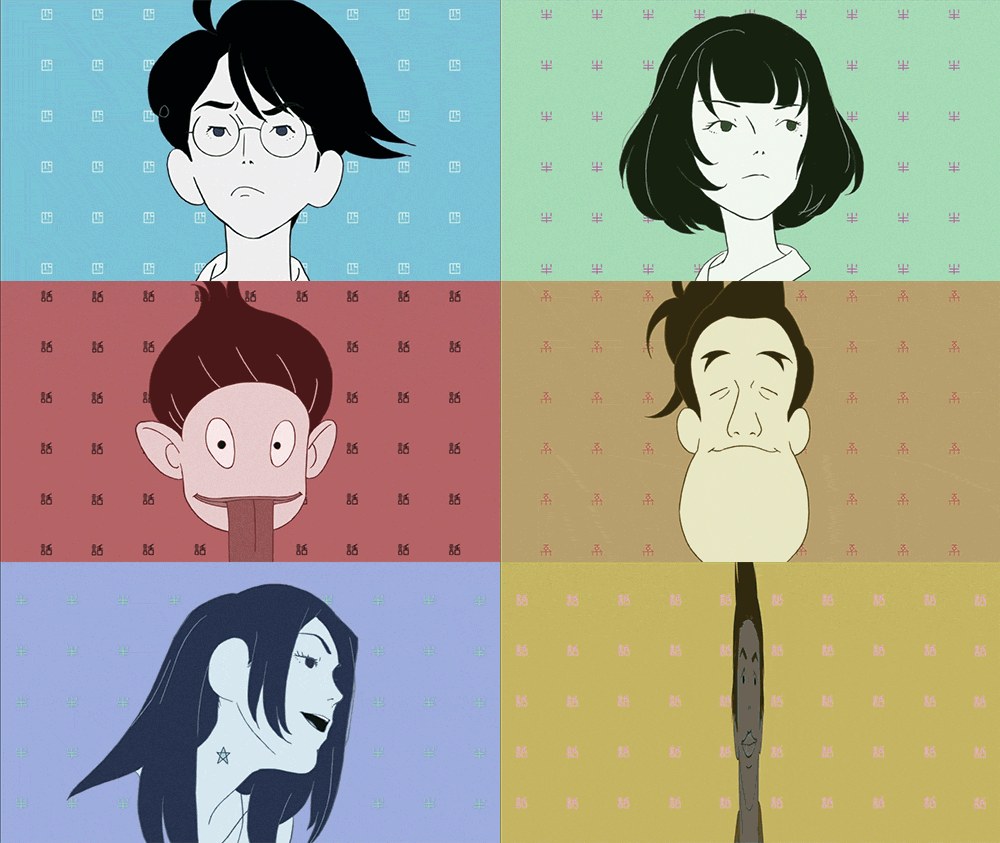
*When referencing The Tatami Galaxy, most opt to simply refer to said unnamed character as "Watashi." Since you're on an sanime site, you probably know this, but "Watashi" or "私"/"僕" simply means "I" or "me," referencing his role as a first-person narrator. So most material refers to him as "Watashi," (even though I swear he refers to himself as "boku" more often than not)[check], but I've made the decision to refer to him as the "Main Character" or "Narrator." I just find it hella unwieldly to refer to the a character as "Me" or "I."
Edit: You know, with as much as I go on about auteur theroy in this review, I'm surprised I never put two and two together to realize that Yuasa also directed, Kaiba, another visually striking anime that I loved. I don't think it detracts from my point. Knowing it, I can certainly see he wrote both and it's a testament to his status as an auteur that two of the most unique anime I've seen are attributed to him.