Zatch Bell!
a review by squeakofthefuture
a review by squeakofthefuture
It's very easy to get stuck in the idea that the more cynical, depressing and dark a piece of fiction is, the better it is. Many people tend to skew towards narratives with "realistic" portrayals and themes, holding firmly to the belief that the paths in which a story can take must be logical - according to the unsaid rules of many, focusing on optimistic ideas such as love, friendship, and willpower is something that can only hurt a narrative, rather than enrich it.
So in a world where people find themselves more jaded towards stories of overwhelming positivity and idealism, Makoto Raiku's Konjiki no Gash/Golden Gash (better known to the west as Zatch Bell for this review) is a healthy reminder of how great that kind of feelgood, kindness-makes-the-world-go-round, "I have my friends!" element can be in a story when it's handled with genuine earnestness and meaning. The heart and soul poured into this manga is only one of the many pros - enthralling battles and a fantastic ensemble cast of characters round out what is, in my opinion, one of the best battle series in the past two decades.
Zatch has a very simple, yet novel concept. Every 1,000 years, 100 mamodo (demon) children are sent to Earth to engage in a battle to determine the king of the Demon World. The catch is this: The children are (usually) powerless on their own, so their abilities are brought out once they meet up with their destined match, a human partner. The human partner is given the mamodo's spellbook, and can read spells out loud to cast abilities from the Mamodo. Mamodo must meet with each other, engage in combat, and burn the opponent's spellbook to win, and the last one remaining will become king.
The story begins with Kiyomaro Takamine, an antisocial and aloof teen genius, who became arrogant and closed-off because of his great intellect and now no longer desires to make friends or even go to school. Zatch is given to him by his father, and thus begins a great adventure that will change both Kiyo and Zatch for the better.
The series' structure is mostly episodic, owing to the tournament arc-esque premise. Chapters typically consist of Kiyomaro and Zatch running into different mamodo before a battle ensues - more often than not said battle will end in the opponent having their book burned before the story moves to the next scenario. What could easily become repetitive or boring is made interesting thanks to the fact that Zatch Bell utilizes its concept to the fullest potential. Kiyo and Zatch meet up with other duos in many different locations, and not all of them are flat-out enemies. Each chapter doesn't just give us a fight and then move along - time is also taken to flesh out the characters involved in the conflict, as well as the conflict itself. A number of chapters are dedicated purely to downtime too, with no conflict in sight - these "slice of life" chapters are actually some of the more enjoyable parts of the series, where we may simply see Kiyomaro interacting with his classmates or Zatch making friends.

With each Mamodo-Human pairing also comes a different kind of opponent, and a different kind of relationship. The Mamodo-Human duos could have easily just been over a hundred structurally-identical battle chapters ala Stardust Crusaders but Raiku manages to avoid monotony thanks to the variety in the different scenarios and how the characters interact with the mamodo pairs. In addition, as the series progresses, new spells are learned, and more pairs are eliminated from the tournament, so there is always a feeling of macro story progression, albeit faint. It's Raiku's ability to keep injecting life and new ideas into this deceptively simple core concept that prevents it from wearing thin. As the story progresses, it begins to settle into a more rigid plotline - three proper story arcs which serve to fill out the rest of the series, and while the early chapters are far from bad, these story arcs are where it picks up immensely thanks to heightened stakes, a clearer direction and a larger cast.
Easily one of the best parts of this series is its heart. Zatch Bell is a series with a strong emotional core. It could be logical, but it often isn't, and that's okay. The spellbooks in the series itself are powered by the strong emotions of the characters. Having your demon child's book burned is not actually equivalent to death (rather, it sends the child back to the demon homeworld), but it affects you still because the story places so much focus on the relationships between the mamodo and their partners. It invests you in the fact that many of these characters genuinely value each other, so when they have to go, you don't want to see their happiness ripped away. Raiku is consistently effective at tugging the heartstrings as you see characters say goodbye and persevere through the pain.
The series also has a great sense of humor, with jokes that rarely ever feel like they're overstaying their welcome or becoming grating. Enjoyable dynamics and gags make this a read that is just as funny as it is emotionally moving, and I'm grateful for that. I can't say I've ever laughed harder reading a manga!
The nature of the conflict in Zatch Bell lends to some very interesting character dynamics, and it's a great thing that Raiku understood this. The different duos shown in the series allow different relationships to be explored. Some humans only see their demon partners as tools, using them for greater power. Others are shown caring for their mamodo like their own child, having healthy mutual relationships. Half of the fun is seeing what different people have done with their mamodo and how they interact with each other.

The core duo is an utterly remarkable one, perfect for showing the series' strengths. Kiyomaro is a little irritable, and Zatch is a bit clueless and loud, but what they have in common is a kind heart and a brave soul. As the story progresses, both characters develop - Kiyo becomes kinder and bolder as his resolve is tested further, and Zatch gains a growing sense of responsibility and purpose. They're perfectly enjoyable characters on their own, but their great dynamic is what sells them both. Kiyomaro and Zatch get stronger with each challenge, picking each other up when one's down and showing genuine concern for each other. As they work together, their trust in one another and care for each other increases, and their bond is felt.
The rest of the main cast is also handled with a considerable amount of respect - there's over 4 pairs that make up the main cast not including Kiyo and Zatch, but they often get plenty of screentime, fights, and development to themselves. While not all of the humans are fleshed out to the same degree as some of the mamodo, they all have enjoyable personalities and dynamics that make them worth remembering. If you are looking for great women in a battle manga too, you'll be happy to know that this has plenty of them, from the ice-cold Sherry to the protective and loyal Tia. They all get more than enough time to strut their stuff and have highly memorable character arcs and moments, which is always great.
Even minor characters outside of the main cast are memorable, with striking designs and, as the story steps up, interesting relationships and dynamics. It's clear that Raiku cared for a lot of the characters he created, and so many of them are given a good amount of care and focus despite their limited screentime. The weakest link is the series' final villain - while I won't spoil them for people, they feel poorly set up and foreshadowed, and have an uninteresting personality and motive. They work perfectly for the series' finale, but aren't interesting in a vacuum, but I suppose they can't all hit.
Zatch hits what I believe to be a perfect balance in battles. The characters have limited spells early on, which restricts the nature of the brawls, but as the cast learns new abilities, they have more ways to deal with a situation. Battles are fast-paced and exciting, but also have a clear strategic bend as Kiyomaro finds out how to best use Zatch's powers and exploit the enemy. Teamwork elements come into play as Zatch gains more allies, and coordination becomes important as they work together to take down opponents.

Many battles also have an emotional component as well, which often overrides the "logic" involved in the strategic parts: characters often gain strength through emotional power or unlock new spells thanks to the strong emotions they feel in a fight, but it works very well because of how this series establishes its strong emotional core in the beginning and focuses so greatly on the bonds between the characters. It actually uses emotions and willpower as something that gives the fights weight, rather than to simply quick-resolve them.
A plethora of different powers come into play throughout the series. Zatch has lightning, but other characters are shown with other spell types like shields or illusions. It's fun seeing what each mamodo is capable of, and even more fun to see them unlock and unleash powerful new spells and abilities.
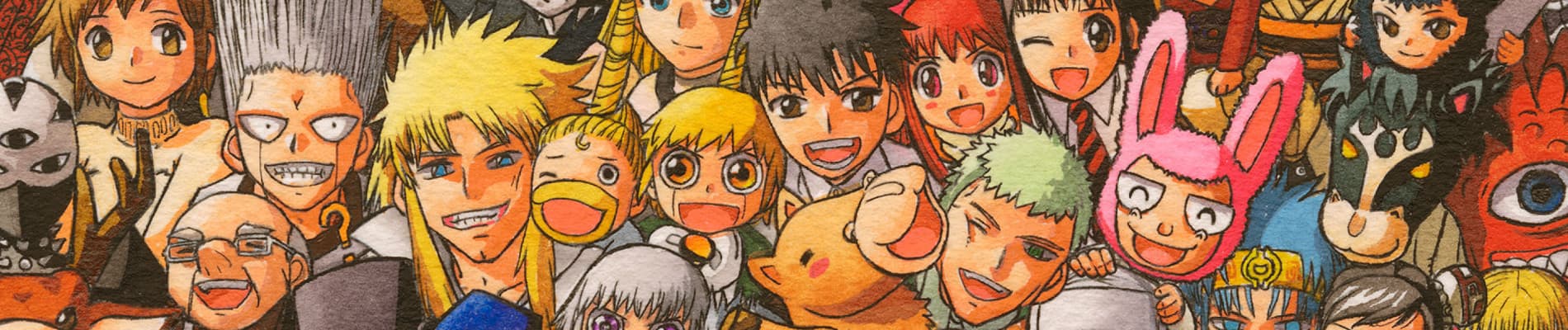
Makoto Raiku's artwork is unorthodox, but fun and deeply enjoyable. The character designs of many of the demons (and even those of some humans) feel very whimsical, with exaggerated shapes and large eyes. The action is extremely easy to follow, and doesn't get too cluttered or muddy even when a lot is going on. Raiku really flexes with the double spreads and the chapter covers, which make great use of values to show the intensity in the characters' expressions. Emotional moments are handled superbly thanks to artwork that does a great job at strongly conveying these feelings. The art in the beginning feels off at times, with facial features seeming weird, but gets increasingly more refined and consistent. If you are a fan of One Piece, the art may feel somewhat reminiscent of that series, with its caricature-like designs and light and whimsical aesthetic.

There is nothing else like Zatch Bell. A wonderful cast of characters, exciting battles, a great sense of humor and hard-hitting emotional beats all come together to make a truly unforgettable shonen experience that will have you crying with the characters when all's said and done.
The series is fairly light on fanservice, reducing one of the very few perverted jokes to an extremely minor character whose entire gag is that she has big, jiggly boobs that she uses to distract people. Designs are, outside of that aforementioned gag character, sexualization-free and consistently tasteful.
There is a perverted kid character later in the series whose schtick is that he uses his spells to try and peek at and steal a girl's panties. It's presented as both wrong and completely silly with no sexual undertones or intent to arouse, and he quickly develops out of this trait entirely, but it's worth noting because of how much attention is drawn to it initially.
There is also a later character named Rupa, who appears to be black and somewhat charicature-esque, with large nostrils, a big poofy afro and a large upper lip. However, her partner, is a blonde light-skinned guy with a similarly ridiculous appearance. They are treated as joke characters, but are given respectful closure to their appearances. Rupa is not the only character who appears to be of African descent in the series, aswell - there is also Aleshie, who hails from Africa, but he is treated very well, becoming a strong player in the fight against evil, with a great design and some pretty serious moments to boot. As a whole, a number of characters do appear to play to cultural stereotypes as far as their designs go, but are treated respectfully by the story itself and given time to shine.
The manga also has no official English release currently in print. The original releases did not even cover the entire series, and they are now rare and out of circulation. If you are looking to read the series legitimately, you will struggle. The only way to read the whole thing is through the fan translation, which, outside of a few awkward mistranslations, is perfectly readable.
Not unless you're really craving it. Zatch Bell's anime adaptation was handled by Toei and while it's not truly awful and is generally faithful, it contains some issues with filler and reused animation. It also fails to adapt what is the manga's best arc, veering into an anime-original direction halfway through that damages the involved characters and then ends on a non-ending. It actually has a very good dub if you're interested, but the dub itself doesn't even cover all of the episodes.
70 out of 71 users liked this review
