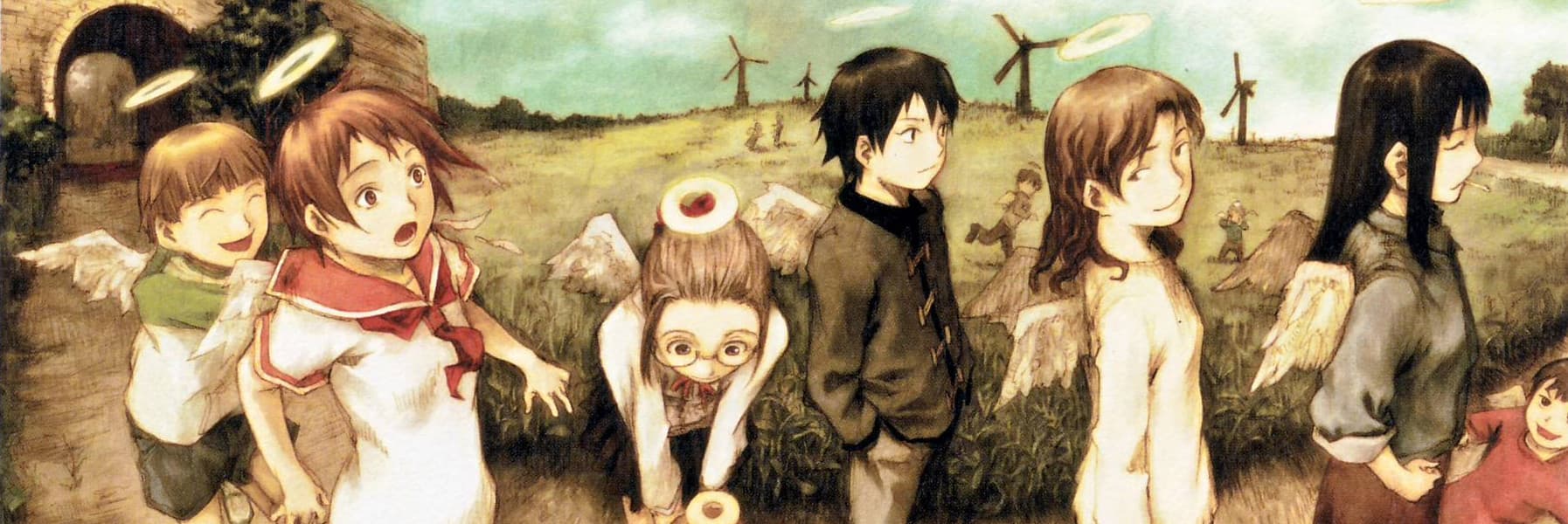


Illustrations for Texhnolyze, Haibane Renmei and Serial Experiments Lain by Yoshitoshi ABe.
Discovered by avant-garde anime producer Yasuyuki Ueda, it was quickly recognized that Yoshitoshi ABe's talents reach far beyond his stunning illustration skills when he was entrusted with increasing creative control early in his anime career. Starting as character designer for the mind-bending and introspective cyberpunk classic Serial Experiments Lain, ABe was subsequently given the opportunity to adapt two of his dōjinshi manga into animated form with the help of Ueda as a producer: first with the little-known NieA under 7, which was co-produced by ABe, and finally with his masterpiece Haibane Renmei, for which he served as main showrunner. Concurrently to his work on the latter, ABe also served as character designer for his hitherto final collaboration with Ueda, the notoriously difficult Texhnolyze, another dark and cryptic cyberpunk drama written by Lain author Chiaki J. Konaka. The creative output of the Ueda coalition has since been recognized as ranking among the most unique and groundbreaking works the world of serialized animation has to offer. It cannot be overstated how much said world has lost when this creative streak was tragically cut short by the untimely death of Lain director Ryūtarō Nakamura in 2013, who was supposed to direct a spiritual sequel by the name of Despera. Stuck in development hell ever since (though with the occasional Twitter confirmation that the project is still alive), Despera would have marked the reunion of much of the Lain crew, including Konaka and ABe.
As it stands, the Ueda coalition is mostly known for Lain, Texhnolyze and Renmei. The fact that ABe served as scenario creator and showrunner for the latter makes it the obvious odd one out: Renmei is without a doubt the most approachable of these works, although without sacrificing any of the integrity and thoughtfulness that these works have come to be known for. ABe also replaces Konaka's grim cyberpunk settings with a gentle but no less enigmatic magical realist world inspired by Haruki Murakami's Hard-Boiled Wonderland and the End of the World, and he even borrows some of Murakmai's more typical motifs such as the psychological turmoil caused by the sudden vanishing of a loved one and the symbolic power and strange allure of dried-out wells. Despite those inspirations from Japan's best-selling author, Haibane Renmei absolutely boasts its own distinctive identity and firmly stands as one of the most unique works in the anime canon.

The quiet town of Glie. Not visible are the surrounding walls, as they enclose quite a large area.
The 13-episode show tells the story of a small community of mysterious beings called the Haibane (Charcoal Feathers), who are visually reminiscent of angels and born into cocoons with cryptic dreams of their former lives as humans. Living in the outskirts of the serene, isolated, European-style town of Glie, the Haibane are tasked with integrating into human society and submitting to the ancient traditions of the secretive but not unsympathetic Haibane Renmei (Charcoal Feather Association). The symbolic character designs of the Haibane, combined with the fact that Glie is metaphysically isolated from the rest of the world by dangerous and impenetrable walls, quickly makes it clear that we are looking at some sort of liminal stage of the afterlife here, though I hesitate to use the word "purgatory" due to its associations with temporary punishment and suffering. In any case, this show strikes quite a remarkable balance between gradually revealing just enough of the layers of its fascinating world to spark the viewer's intrigue and leaving the rest open to interpretation. This may be perceived as a weakness by viewers expecting more straightforward answers, but I consider this kind of deliberate ambiguity to be an essential component for the show's tonal and thematic success.
While the first half of Haibane Renmei is mostly delivered in a slow and relaxing slice of life format to introduce the town and its characters, the second half ventures to some quite emotionally dark places, so much so that I have included a content warning at the end of this review. It also dives deep into the psychology of its two most important characters: Rakka, the protagonist in search of answers as the newest of the Haibane, and Reki, the experienced, older sister figure whose kind nature hides a troubled past. The relationship formed by these two and the subtle but profound character arcs they experience rank among the most acutely devastating but also deeply hopeful I have seen.
The thematic thrust of the show revolves around issues of sin, salvation and purpose, as well as the complex relationship between mutual dependence and support, which is expertly conveyed via outstanding character writing and worldbuilding alike. Glie is presented as a warm and comforting place, a sanctuary for lost souls to grow and learn important truths about themselves. However, it is also a stagnant and limiting place, from which always looms the danger of the Haibane growing too accustomed to the comfort and not making it to the next stage of their spiritual journey. Nonetheless, it is clear that there is nothing that this show wants more than for its characters to find the strength to reach their "Day of Flight" and ascend beyond Glie's walls, so much so that I consider it to be one of the most profoundly empathetic and earnest works in this medium.

Reki and her charcoal grey feathers.
Aesthetically, there is an understated, rustic beauty to the show's visuals that should not go unmentioned. That said, the technical quality of the production suffers a bit from the inexperience of the early days of anime's digipaint revolution, which occasionally results in sloppy animation and a generally blurred look. Despite those shortcomings, the show's visuals do a fairly good job evoking the distinct mood of ABe's work as an illustrator and mangaka, which is not easy to translate into animated form. While his illustrations prominently feature character designs that are not particularly atypical for modern anime and manga, he imbues them with an acutely spellbinding and otherworldly quality that makes his work instantly recognizable.
Unhindered by technical flaws is the gorgeous, pastoral chamber music soundtrack by Kow Otani, best known as the composer for one of the most iconic and acclaimed video games of all time, Shadow of the Colossus. I don't bring up this title in vain, as Haibane Renmei feels very spiritually connected to the unmistakable atmosphere, aesthetics, worldbuilding and thematic ambition of Fumito Ueda's Team Ico trilogy, which also includes the highly influential ICO and the underappreciated The Last Guardian. In fact, if there is one thing I wish this show had explored more thoroughly, it is the setting. I feel like there is some untapped potential for additional moments of breathtaking scenery and ancient architecture lurking in here, something that the Team Ico trilogy offers in spades. Apart from this little nitpick and the previously mentioned technical difficulties, there is really not much to critique here. Quiet, thoughtful, and deeply therapeutic, Haibane Renmei is a must-see for anyone who is feeling a little lost.
The content warning I mentioned earlier: