
Contains spoilers for "Serial Experiments Lain"
____
The Opening Theme Song
Much like my Neon Genesis Evangelion analysis, I’m going to start this review off with an analysis on the opening theme song, the first thing you’re met with when you begin watching the series. Although not nearly as hefty as NGE’s opening, SEL still boasts one of the best anime openings in my opinion, because of its strong symbolism and imagery, a lot of foreshadowing and an astounding song. The first 15 seconds of the opening are comprised of scenes that show us “Present Day - Present Time” with a snarky voiceover and then transitions into an image of Lain behind a static TV screen, an imagery that we quickly become very familiar with as it is shown on multiple occasions throughout the anime and opening itself.

These first 15 seconds have double meanings – the first one is that “Present Day - Present Time” hints at the fact that the message of the show is more prevalent now than it ever was before, always staying up to date and only becoming more and more relevant with the times. The second meaning I derived from these scenes is the foreshadowing of Lain trespassing the laws of physics and time by merging with the Wired as shown by the “Present Day - Present Time” scene followed by Lain behind a screen, hinting at the fact that she will always be here in the present. The following scenes show us Lain with her back turned, being surrounded by crows – which have been associated throughout history with and symbolize magic, personal transformation, a higher perspective, a trickster and adaptability – meaning the crows are a metaphor for the Wired and how she’s surrounded by it yet unaware. The swarm of crows then go to fly past her as her name gets typed on a static screen more and more, leaving her overwhelmed and startled for a second, but then turning to look at the crows – symbolizing her reluctance and fear to get involved with the Wired at first, but then coming to get more and more into it and looking for it. The crows may also be a metaphor for her evil trickster persona that she takes in the Wired.

The former idea is reinforced by the next 10 seconds of the opening, which show Lain walking through the Wired, enveloped in endless text and images. The following scenes that come together with the chorus of the song and go to show Lain behind a static TV screen in multiple instances, in front of multiple people and showcasing different emotions – hinting at her multiple personalities within the Wired. They also go to show how the Wired connects people, especially Lain. This neatly transitions into Lain wandering throughout the world, representing how through the Wired, Lain can be everywhere and anywhere at any moment.

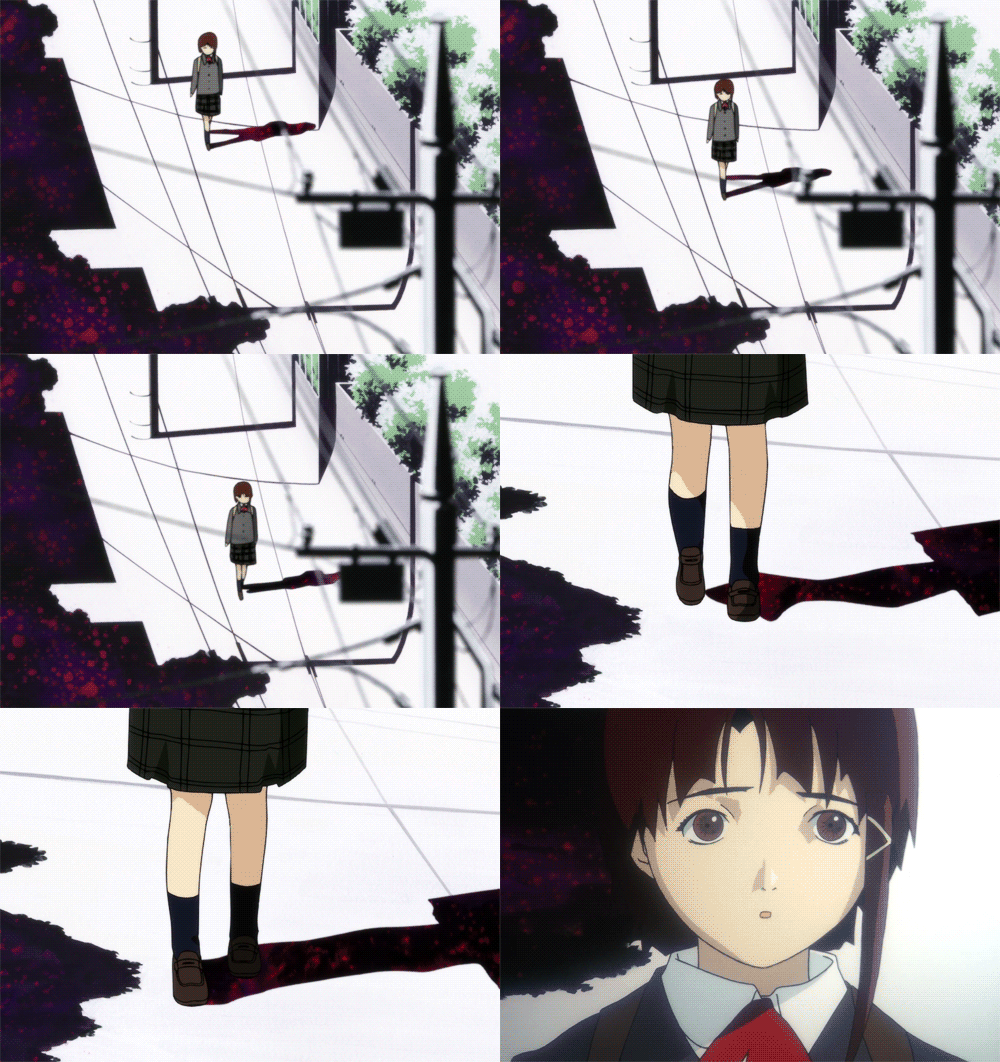
Then, as close-up images of Lain in the Wired flash, she begins to climb up the stairs that lead to an overpass. As she begins to cross the bridge more images of her in the Wired flash and after a strong wind blows, she turns to look at a crow flying in the sky once again as time stops but never minds it and nonchalantly continues to cross the bridge as a nice and calming instrumental plays. This whole scene foreshadows how Lain becomes one with the Wired as she “crosses the bridge” between reality and it, with flashing images of her in that other world go by as her driving force and finally she completely accepts it and transcends reality as time completely stops, but she continues to walk to “the other side.”

The final moments of this amazing opening both visually and auditorily only go to reinforce my previous statements as Lain blends in with the Wired and it comes to an end.

Finally, I would also like to mention how the lyrics of the song are loosely tied with the themes of Serial Experiments Lain and Lain herself. This all comes together to not only make one of my favorite anime opening theme songs ever, but one of the best the medium has to offer.
____
Piecing It All Together
Serial Experiments Lain takes a different approach on Japanese media and media in general and how its presented to the viewers. The first half of the show has an extremely cryptic, yet somewhat linear delivery, focusing more on Lain’s introduction to the Wired and her development with it. The story doesn’t tell you out-right the events that are happening, instead opting to make hints and let you yourself piece everything together much like a puzzle. This is also reinforced by the very slow, drawn out pacing it takes in the first half, as it is necessary for a proper build-up, letting the viewer get familiar with the setting, characters, story and gives them enough time to piece said puzzle together. The importance of the slow pacing comes down to its portray of each scene’s significance, taking its time in revealing said scene’s information, relying solely on each viewer’s intellect and aptitude to piece it all together.
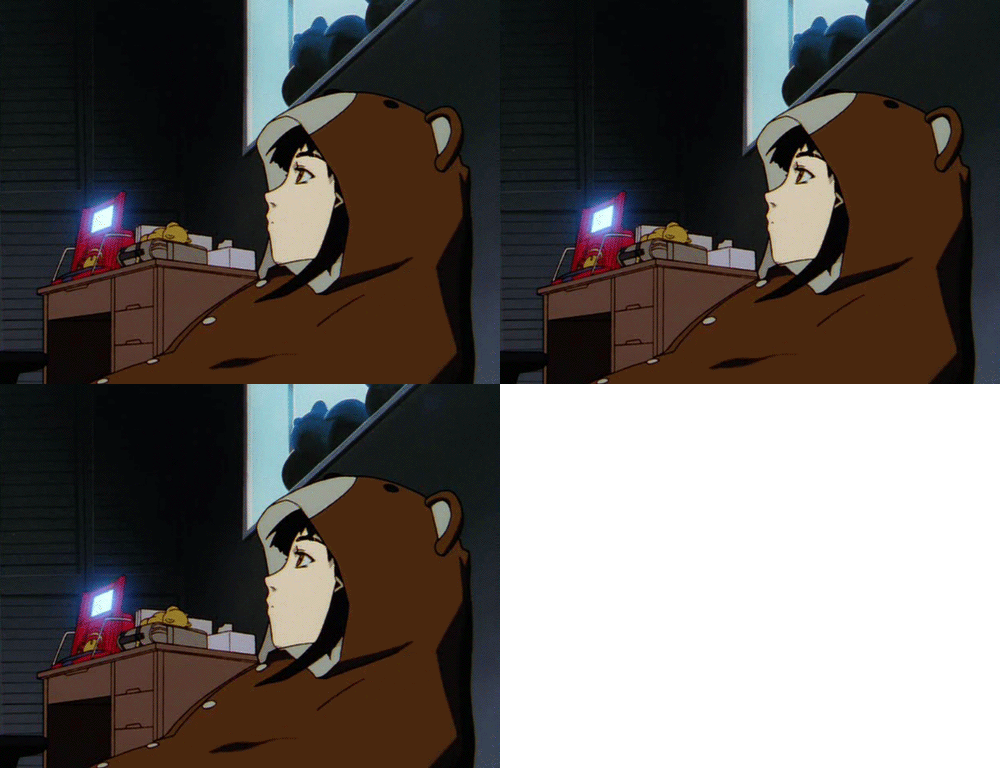
Although some people might say that some scenes are needlessly prolonged and its extremely boring, I’d argue this exposition method that involves your constant attention and brain involvement is more engaging and vastly more interesting than the usual method that media uses – spoon feeding its audience, but this will become more apparent the more you rewatch the series. The latter half of the show picks up the pace a bit, but takes everything else from the first half up a notch, being an even higher amount of intellectual exposition – no longer even hinting at the events that are happening, instead opting to leave it solely to the audience’s interpretation. The philosophical and psychological aspects of the show are never mentioned at face-value, letting the viewer’s own questioning be the answer. The implications of each idea are left to the our own aptitude to string them all together, as there aren’t any narratives or clear explanations to lead us on. All of this illustrates the unorthodox exposition method and its importance to the narrative, akin to a puzzle that you have to piece together to reveal and understand the bigger picture. This also sets Serial Experiments Lain apart from its contemporaries or rivals, being an antithesis to most of media, its mediocrity and treating its audience like dumb kids.
____
#The Inner Workings of the Wired
The first half of the show is crucial for setting up the Wired, how it affects humanity and its relationship with it and Lain in particular. It achieves this through two key factors, one of which is realism. Serial Experiments Lain attains this grounded sense of realism by utilizing the suspension of disbelief. While a lot of anime and other media as well try to exaggerate emotions and character expressions or give the world a sense of fantasy (exp. Comedies, Shounen, Shoujo), and as entertaining as that might be this makes it lose its sense of realism and thus creating a sense of disbelief that isn’t innately wrong, but it results in the series losing long-term impact. SEL throws that out the window, instead opting for a mundane, serious and real life-like initial setting, which lacks any of the typical Japanese media tropes, comedy, exaggeration and drama. This serves to ground and immerse the viewer into the world of Serial Experiments Lain, and then once the chaotic and maddening latter half of the show picks up, the idea that this could happen to real people or that it is happening to real characters never oscillates.

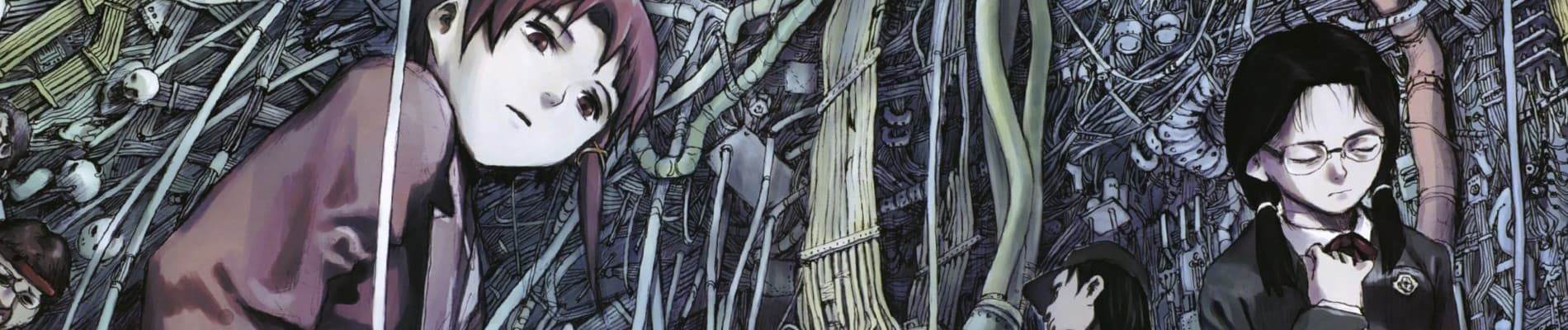
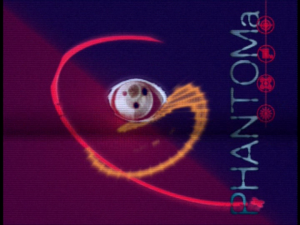
The second key factor in setting up the world of SEL in its first half are its plot elements, focusing on what the Wired is and how Lain and the rest of the world interacts with it. As mentioned before, it’s initially mundane approach to the setting is emphasized by Lain Iwakura and her small group of friends. Lain is an introverted, shy 14 year old girl and her other 3 friends are typical 8th grade girls, sometimes secretly going to a nightclub named Cyberia. The things spice up a bit after a classmate kills herself and rumors of emails sent by said deceased classmate start circulating. A short while after Lain learns this, she receives such an email and introduces her as much as the audience itself to the Wired. At first sight, the Wired seemed like Serial Experiments Lain’s version of our world’s internet, but the more you dig in and the more the story progresses you get the sense that it is on a much grander scale than the internet, especially in the aspects of connectedness between individuals and the thin, nearly indistinguishable line between the Wired and the ‘real world.’ This is all illustrated through events that take place in the first half of the anime – one of which is the aforementioned suicide, where one of Lain’s classmates gets her consciousness transferred into the Wired; another event being the incident with a “video game” called Phantoma, in which a teenage boy starts hallucinating being trapped in a dungeon video game, akin to 1993’s Doom, and ultimately ending up in the boy killing a little girl that he deemed to be a dungeon monster.
One of the first instances in which the dissimilarity between the Wired and the real world gets called into question is when Lain’s father tells her “When it’s all said and done, the Wired is just a medium of communication and the transfer of information. You mustn’t confuse it with the real world. Do you understand what I’m warning you about?” to which Iwakura Lain responds with denial, stating that the difference between them isn’t as clear-cut as he makes it out to be. This all comes together in the latter half of the series, when it’s revealed that a scientist named Masami Eiri, in search of attaining Godhood, secretly implements within the Wired the ability to connect all individuals on Earth on an unconscious level, no longer even needing a body, which, might I add, is aptly similar to one of Neon Genesis Evangelion’s aspects. This is known as “The 7th Protocol.” This teaches us that, from a technological standpoint, the Wired can affect and manipulate the psyche of everyone on Earth. In this aspect, Serial Experiments Lain likes to borrow philosophical ideas from the likes of Alan Turing and french philosopher Julien Offrey de La Mettrie, which contain the idea that there is no clear distinction between a machine and a human, saying that humans don’t even need an organic body to be humans, except for the brain, and even that doubting by going as far as to ask the question: “if one’s brain would get replaced with a functionally identical piece of machinery, would said person still be human?” to which Julien Mettrie would answer “yes.”

On a second note, SEL takes these ideas and implements them in its use of digitalization of humans’ consciousness, completely translating the aforementioned consciousness into a construct of information contained within the Wired. This is proven in the first episode by the classmate that kills herself and uploads her consciousness into the Wired, and much later in the series, when its revealed that Masami Eiri, also known as Deus or God, did the same to become a pretend God in the Wired. The second philosophical idea Serial Experiments Lain likes to borrow and implement into the Wired’s inner workings is the metaphysical aspect. In this aspect, SEL takes ideas from epistemology and especially idealism. Lain’s quote “I only exist inside the people aware of my existence” reveals this key theme that SEL likes to play with extensively. This theme is later supported by Iwakura’s conversation with Deus in which he states that he can be God because people believe in him, but Lain goes on to disprove this in the final acts of the series where she, the only one left still believing he is God, states that he is only disguising himself as a God, and is no more than a mere fake as he forced himself in that position and his followers to believe that. In episode 5 it is said that everything experienced by someone who is connected to the Wired are projections, or 'holograms', of information stored within the Wired. This further on blurs the line between reality and the Wired, as all of humanity is connected to the Wired, meaning that the entirety of experiences and observable reality is, in fact, the Wired and diminishing the reality as non-existent. This goes even beyond, meaning that even the human body and brain is nothing more than a construct of information projected through the Wired, which, as demonstrated by Lain in the last episode, can be altered, created or even erased.
____
#Iwakura Lain
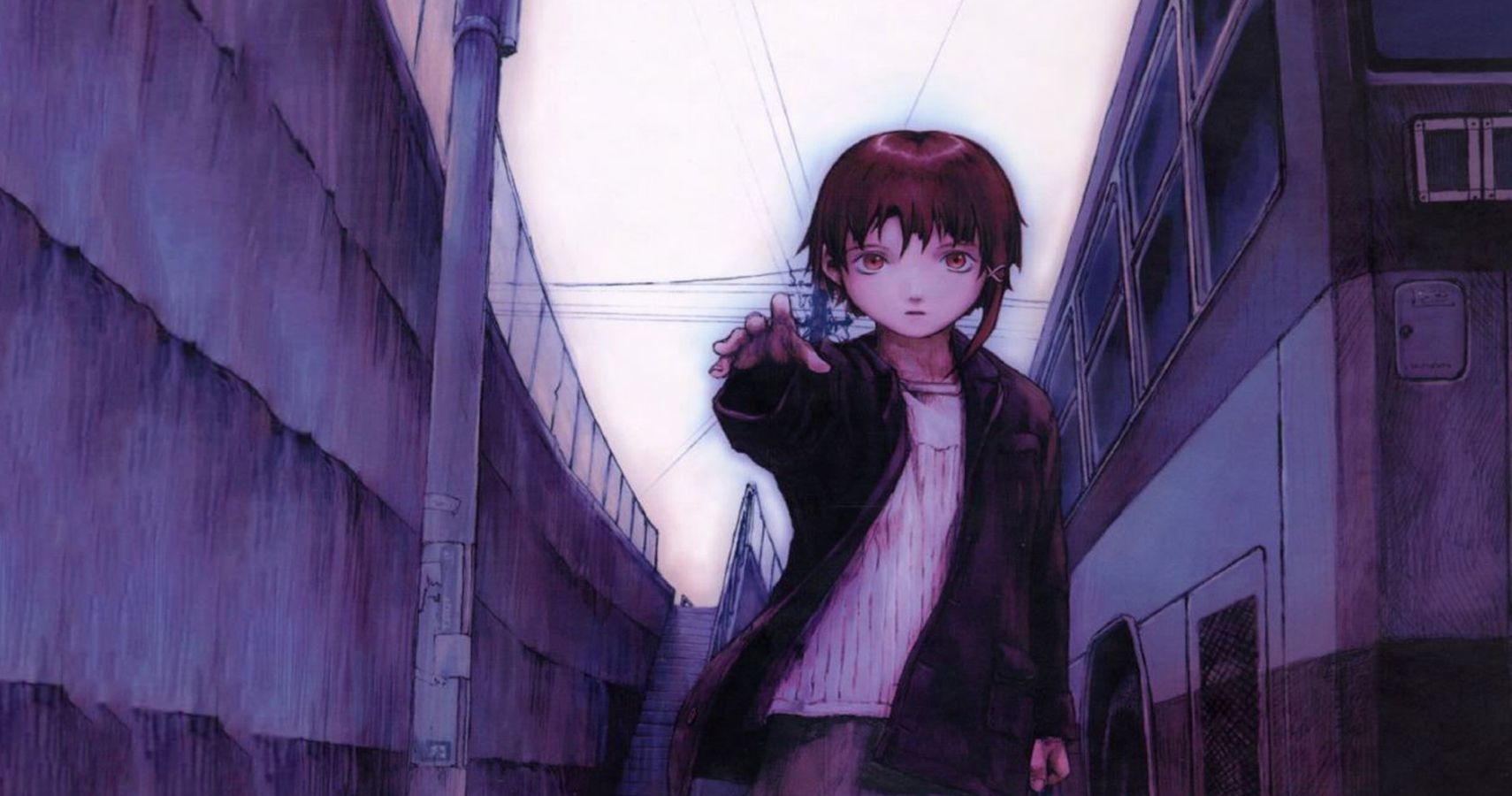
So how exactly does the story’s protagonist, which the series spends the majority of its time exploring, play into all of this? Well, Lain Iwakura is introduced as an extremely shy and detached person. She is not only detached from the world around her, but from her own self as shown by her identity crisis and lack of self-understanding throughout the entirety of the show. SEL makes the audience as well as Lain herself question Iwakura Lain’s identity as a singular being from the get-go, when her friends claim they saw her at the nightclub Cyberia making a fuss; when a young regular at Cyberia named Taro asks her to go on a date with her other, more tenacious persona; and when the DJ of the nightclub recognizes her but remarks the fact that she’s playing up the little kid persona. Lain Iwakura did have a few instances where her rumored, more assertive demeanor surfaced, first of which was when the nightclub shooter kills himself as Lain approaches him. Although this might seem like a split personality disorder at first, it goes much deeper than that, as a lot of Serial Experiments Lain does. This is first shown in the middle of the series, when for about 2 whole episodes Lain Iwakura takes the aggressive persona as she tries to comprehend the KID System and tracks down its creator. Another crucial part of Lain’s identity as a whole is her relationship with the Wired. Up to this point in the series it is hinted at and mentioned on numerous occasions that Lain possesses some sort of magnificent power within the Wired and that she is vastly important to it. The first incident to really engrave this in ours and Iwakura’s mind is the aforementioned nightclub shooting incident, in which the man recognizes Lain and in a fit accuses her of forcing him to do this then, presumably from Lain’s power, kills himself as she approaches him and says that everyone is connected in a threatening manner.

The second incident to provoke this idea is Lain’s meeting with the KIDS creator, which served as a prototype for the Wired, professor Hodgeson, in which the professor tells Iwakura Lain that she has immense power, potential and importance to the Wired right before fading and, presumably, dying. Where this identity crisis situation starts to boil is in the next episode, episode 8, where Lain is accused by her friends and the entire school of doing something terrible. Iwakura denies these allegations as she doesn’t even understand what is transpiring or what her friends’ questioning, in particular Arisu, refers to. In the last quarter of the episode it is inexplicitly revealed that this was the doing of another personality of Lain’s, the trickster Iwakura Lain. Arisu is seen being aroused, sexually stimulating herself and fantasizing about her crush, a school teacher, seen evidently by her image of him over her, as she notices with the corner of her eye the mischievous Lain sitting on her bed. This throws Arisu into emotional distress and a fit, to which the trickster Lain responds with mocking remarks and laughter, making it clear that this isn’t either the familiar shy Lain nor the aggressive Lain and that the usual shy Lain wasn’t the one that spread the rumors of Arisu’s fantasies to the whole school.

This is then reinforced, as simultaneously, the shy Lain, lying in bed, is having an apparent fit of panic as she’s forced to see her aggressive persona fight with her mischievous one inside her head, enduring it, and leading to this being a depiction of her mental breakdown. The following scene is of Lain, presumably in the Wired, talking with a depiction of Masami Eiri, aka Deus, showing him as a floating, discolored blob, in which the series once again states that she is truly powerful and omnipresent within the Wired, which Lain ultimately accepts and gives her the idea that she can simply delete the information containing her spreading the rumors about Arisu to the school, in this case meaning that she will erase those events and memories from everyone on Earth. After a scene showing “deleting…” on the screen, the normal, shy Lain is shown walking to school as she’s greeted by her friends, including Arisu, making her believe that it worked and those events have been erased from existence, but as soon as she tries to greet her friends, another more sociable and upbeat Lain comes out of her and greets them instead and the shy Lain, like a ghost only observing, is left there denying the events that are happening and watching the other sociable Lain walk off with her friends. The trickster Lain then confronts the introverted Lain and tells her “Lain is Lain, I am Me.” The Episode ends with Iwakura searching for her computers’ affirmation whether she is herself, and that the only Lain is Lain. This ultimately leaves us with the answer to Lain’s existence, as she is omnipresent and basically all-powerful, being able to create, modify and delete at will in the Wired, and as I’ve stated before, the Wired is intertwined with reality to the point of nearly no distinction, making her, unlike the pretend God that is Masami Eiri, a true God. But as to who Lain is as a person, that is completely left up to the interpretation of the audience, only leaving us with the fact that she is the culmination of a multitude of Lains, without knowing which one is the first, the last or the real one if there even is a ‘real’ Lain.
____
#Serial Experiments Lain’s Philosophy
Throughout the course of this analysis and review, I’ve already touched up on the philosophy and psychology behind Serial Experiments Lain, especially in part 3, but never extensively, which is what I’m going to do now – delving deep into the intricacies that involve SEL’s philosophy, psychology and how its applied to the story and characters. First off, I’d like to mention how said philosophies of the show, which im going to talk about more later, are used not only to present thought-provoking ideas and themes that remain to stay relevant throughout the ever-changing times, but also to further on add even more to the realism of the series, making Serial Experiments Lain more grounded and the absolute madness that transpires by the end of it more scientifically feasible and logical than it might appear like at first sight. Most of what happens in terms of philosophical and psychological horror is completely based in highly advanced levels of wireless technology, an absolute understanding of how consciousness works in the brain, which allows for its manipulation, and global-scale virtual reality. And while, truth be told, this is tenfold of what current science and technology can achieve or what it will be able to in the foreseeable future, none of the notions seem so utterly fictitious that I wouldn’t believe that they are, in fact, possibilities. The key point that Serial Experiments Lain’s fictitious aspects behind the philosophical themes and ideas get called into question is what makes SEL seem so strangely grounded, logically feasible and real behind all the seemingly incomprehensible events that take place. Now to get into the nitty-gritty details of the philosophical and psychological aspect of the series, which are implemented magnificently, seemingly connecting with each other, building upon themselves as you go further and further.

Serial Experiments Lain goes above and beyond tackling the themes of the psychological self’s perception of reality from a myriad of different angles by using philosophical themes such as the aforementioned idealism, epistemology, materialism and metaphysics as well as the concept of the self. Making the characters, as well as us, question the world surrounding us and how we feel about existence. The first and most apparent theme in Lain is the ambiguity between the Wired and reality, using metaphysical and ontological ideas as prefaces. As I’ve mentioned before on numerous occasions, the line between the Wired and ‘reality’ is so obscured, to the point that they are entirely indistinguishable from each other. One’s consciousness being transferred from reality to the Wired, thus proving that the Wired isn’t simply a virtual reality network, but it is much more, as the mind becomes a part of the Wired itself. Meaning the Wired is a reality of its own – the ultimate reality. From this idea, the show unravels a web of more dark and twisted ideas. One of the most prevalent ideas to come from this is how humans perceive reality and even further – what is reality. Serial Experiments Lain approaches this idea by introspecting on what it really means to exist in reality, or to be more precise, for an event to have actually occurred. SEL answers this by showing the ontological idea that the basis for every event that occurred, or for anything that existed, is human memory. And as proven by Lain Iwakura in episode 8, in which she erases the memories of her spreading rumors around school, and in the final 13th episode, where she erases all records of her existence from the collective memory of everyone on Earth – tamper with that memory and you can change reality itself, or even destroy it. From these events and ideas that Serial Experiments Lain presents, it exhibits a certain, grim theme: an event or object’s existence is solely based on the delicate human mind. If one’s own records of existence were to be completely erased, how would anyone be able to confirm their existence, or even further – how would anyone even be able to recognize their ignorance of said person? To the human mind, if these conditions were to be met, how could it possibly tell the difference between something ever even existing or not? If this were to happen, and all information surrounding an event or object were to be completely annihilated, it would result in a state no different from complete non-existence and complete unawareness from the collective mind – meaning it’s as if the event or object in question was never even developed to begin with. So, after everything said and done, what does this all lead to? It basically entails that memory is not only a key part in Serial Experiments Lain, but also our lives. It speaks up on the ontology behind what the human psyche comprises – meaning that all experiences that we build our lives on are, at the end of the tunnel, all based in memories. If you were to think back on what motivated you to reach a certain point and what you build your ideals up on, it all comes down to pleasant or not so pleasant memories of events, people you are intimate with and more. These things shape who you are, and ultimately, meaning that everything which dictates our self-image, self-worth, ideals and behaviours is fated to our own memory records. This is where SEL introduces one of its most frightening, Lovecraftian notions: at the whims of another being, specifically Iwakura Lain, your whole comprehension of an idea can be erased, and you won’t even realize it. Your most important, beautiful or ugly memories that shaped you as a person could get erased, reducing you to someone entirely different from who you were, and it would go totally unnoticed. This creates within the series and the viewer’s mind the sense that free will is only an illusion. But even more than it affects the side characters or the viewers, it affects Lain herself. We, as humans, see ourselves as living externally from the world around us, meaning that for something to be inherently important to us, it has to affect us on an intimate level, or in other words ‘enter our world.’ Humans require there be a fine line separating what has happened and hasn’t happened, and how important it is to us. But what happens when this line gets blurred? The one to experience this is Iwakura Lain. Each time she alters history and reality itself, she becomes more and more broken, as she realizes that there isn’t any distinguishability between her imagination of the world around her and the real world around her anymore.

The first instance of her breaking is the aforementioned event in which she deletes all memories of the nasty rumors about Arisu, and as she begins to greet her friends, the sociable Lain greets them instead, leaving the shy Lain behind. But this notion is best represented in the last episode of the series. Lain has her final confrontation with Masami Eiri, which causes Arisu, which was observing, to descend into an uncontrollable fit of madness at the unexplicable things she has witnessed before her eyes. As a response to this, Lain erases herself from humankind’s memories as she wishes everything were back to normal and the Wired to be non-existent. This leaves Iwakura Lain in a state of limbo, in which she realizes the meaninglessness of notions such as friends, family, dear memories and more as they all are at the whims of her imagination and under her control. All possible experiences can be imagined, which in turn, equate to nothingness. This makes Lain go to a boil and puts the final nail in the coffin. But after Lain’s mind ultimately snaps, she has a conversation with someone separate from Lain Iwakura’s will, presumably God, which portrays her father, the only family member that at least somewhat loved Lain despite everything. After this, the series closes on Lain realizing and accepting her omnipresence and power. This is exhibited by her seemingly chance meeting with her friend Arisu, now grown-up and with no recollection of the events that have occurred back in her teenage years with Lain. Arisu points out the familiarity she feels from Iwakura Lain and notes that they’re going to meet once again for sure, to which Lain responds “Anywhere, anytime.”
____
#The Creation of Serial Experiments Lain
Last but not least, I’d like to talk about how Serial Experiments Lain came to be, it’s influences and references, and its unorthodox visual and audio design and presentation. First and foremost, the man most responsible for SEL and its quality is Chiaki J. Konaka, the series composer and scriptwriter for the series. He always specialized in cyberpunk themes and horror stories, drawing Lovecraftian influences, which evidently become very apparent factors in Serial Experiments Lain. Prior to his work on Lain, he wrote a live-action drama in 1995 and worked on a PlayStation game called Alice in Cyberland, who’s main three characters got their names recycled for characters in Lain.

The original concept for Serial Experiments Lain was that it’d communicate the essence of the work through a total sum of many different media products. One of those media products was the PlayStation game, which had its scenario written first and was produced concurrently with the anime series, but the anime was released first. The final released piece of media was a manga chapter illustrated by the anime’s character designer, Yoshitoshi ABe titled Serial Experiments Lain: The Nightmare of Fabrication and was released in an artbook. Konaka took a large amount of influences from a wide variety of works including The Exorcist, House of Dark Shadows, Hell House and obviously some of H. P. Lovecraft’s works. As precursors to the Wired are included real life figures, counting the likes of Ted Nelson, John C. Lilly, and the first hypertext project, Project Xanadu.
Some of the more prevalent references the series includes or uses are: the nightclub Cyberia being named after a 1994 novel by the same name; notions such as the collective unconscious; the Majestic 12 and the Roswell UFO incident. Some of the smaller references are: the Navi system being a contraction of Knowledge Navigator, a term invented by Apple’s former CEO, John Sculley in his book Odyssey; the operating system of choice in Serial Experiments Lain, Copland OS, while being the name of an unreleased operating system by Apple Inc.; another reference to Apple being Tachibana Labs, tachibana being a citrus fruit; the Knights of the Eastern Calculus, usually simply referred to as the Knights, being a reference to the Knight of the Lambda Calculus, a semi-fictional group of the programming languages Lisp and Scheme hackers; and the “to Be continued” card at the end of each episode being a nod to the logo of Be Inc. a 1990 computer company founded by a former Apple Inc. executive, which dissolved in 2001.

Now back to Konaka and his masterfully done scenarios and script, I’d like to mention the fact that while working with Iwakura Lain’s voice actress, Kaori Shimizu, Konaka had to divide Lain’s dialogues into three distinctive orthographic projections, designated to three separate voice inflections and mannerisms all relating to one of Lain’s main three personas – the trickster, the assertive and the shy. Lastly I’d like to mention the amazing use of visuals and audio, contributing vastly to the atmosphere and themes of the series. The soundtrack being absent at most times, instead being replaced by complete silence or ambient noises such as footsteps, keyboard clicking noises, and most prevalent, the buzzing sound of telephone poles. When a soundtrack is used though, it is done so exceptionally, by using electrical guitars, distorted, unsettling or ambient noises resulting in a highly atmospheric and weird soundtrack that perfectly fits each scene. They all come together to form this surreal and fever dreamish atmosphere that the series encapsulates perfectly. This is also helped by the excellent sound mixing, chaotically using filtered voices specific to the Wired that also get used in reality and diegetic, nondiegetic and metadiegetic sounds, making both the characters and the audience question what sounds are in their head, reality, or the Wired, emphasizing the ambiguity between the Wired and reality to which I’ve gone to great lengths to explain. From a visual standpoint Serial Experiments Lain stands its ground just as well, although it does have some clankier animation in some parts. Lain has some clean and realistic yet simple character designs by Yoshitoshi ABe that manage to blend in with the surroundings and add to the realism the show presents. While some of the facial expressions the characters make may seem awkward or weird, I’d argue it is done so intentionally to emphasize the creepiness of the show and its themes, as well as add to the unsettling nature of the world of SEL. The shadowing and lighting in the series is utterly amazing, using a huge contrast between blinding white light akin to a screen and dark large shadows with strange patterns on them, both representing the Wired.