
"I don't necessarily believe that dictionaries are the be-all, end-all."
"What do you mean?"
"I just mean that they're made by people. You can't gather every word. And words are alive, so their uses and nuances change with the times. When you think of it that way, you would say there's no real correct definition. Even so, those who make dictionaries continue to try."
This review is a love letter, to a love letter, about a love letter.
I started watching Fune wo Amu on impulse. Long story short, I wanted something brief and uplifting to put my mind at ease. I'd been hearing relatively good things about Fune wo Amu since it first aired in 2016. I'd also seen it likened to both Shouwa Genroku Rakugo Shinjuu and Kaze ga Tsuyoku Fuiteiru - two of my favorite anime. Therefore, I came in to the show with high expectations.
Fune wo Amu was a joint project, written by Shion Miura and illustrated by Haruko Kumota - which explains the comparison to Kazetsuyo and Rakugo. Miura wrote the former, and Kumota the latter. Each author's respective brilliance unite beautifully in this tale of stubborn passion and unrelenting struggles.
But more on that later.
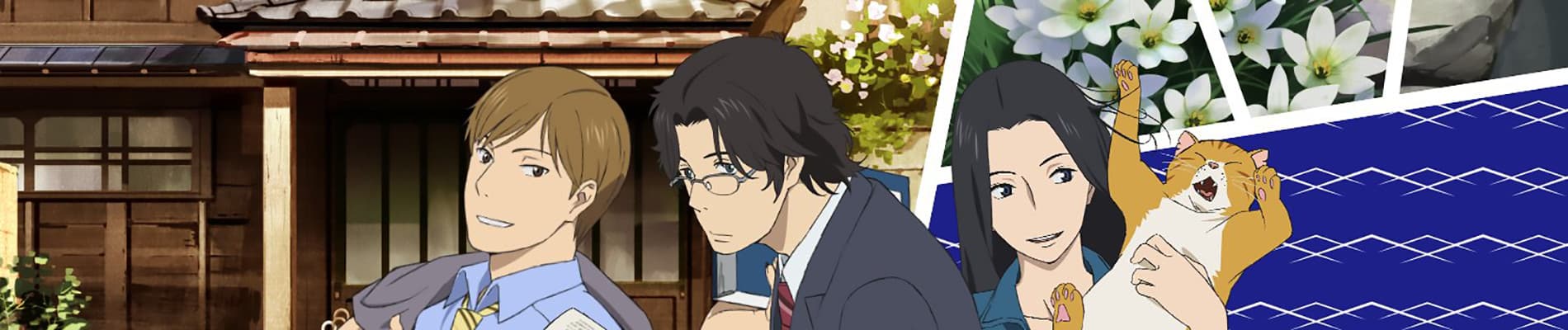
Fans of Haruko Kumota will immediately pick up on some familiar motifs in Fune wo Amu's plot. Rakugo's exploration of complimenting yet opposing forces, for example, is channeled through Mitsuya Majime and Masashi Nishioka, our two main leads.
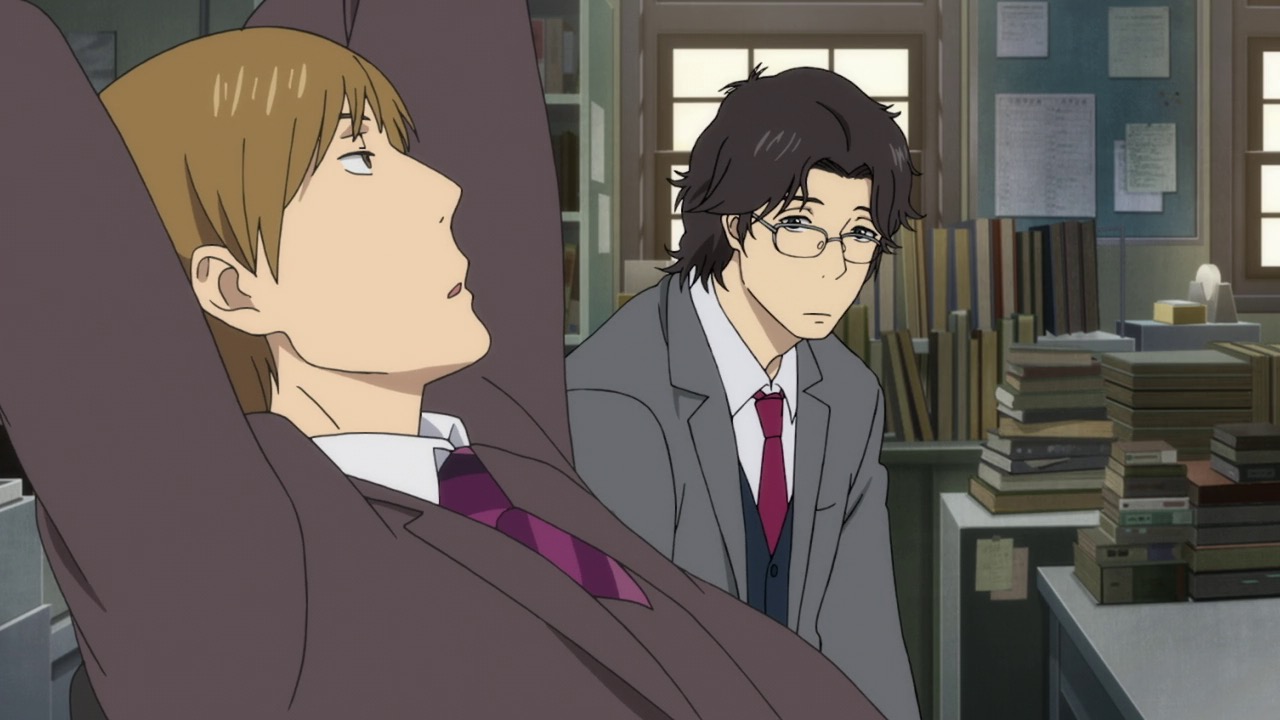
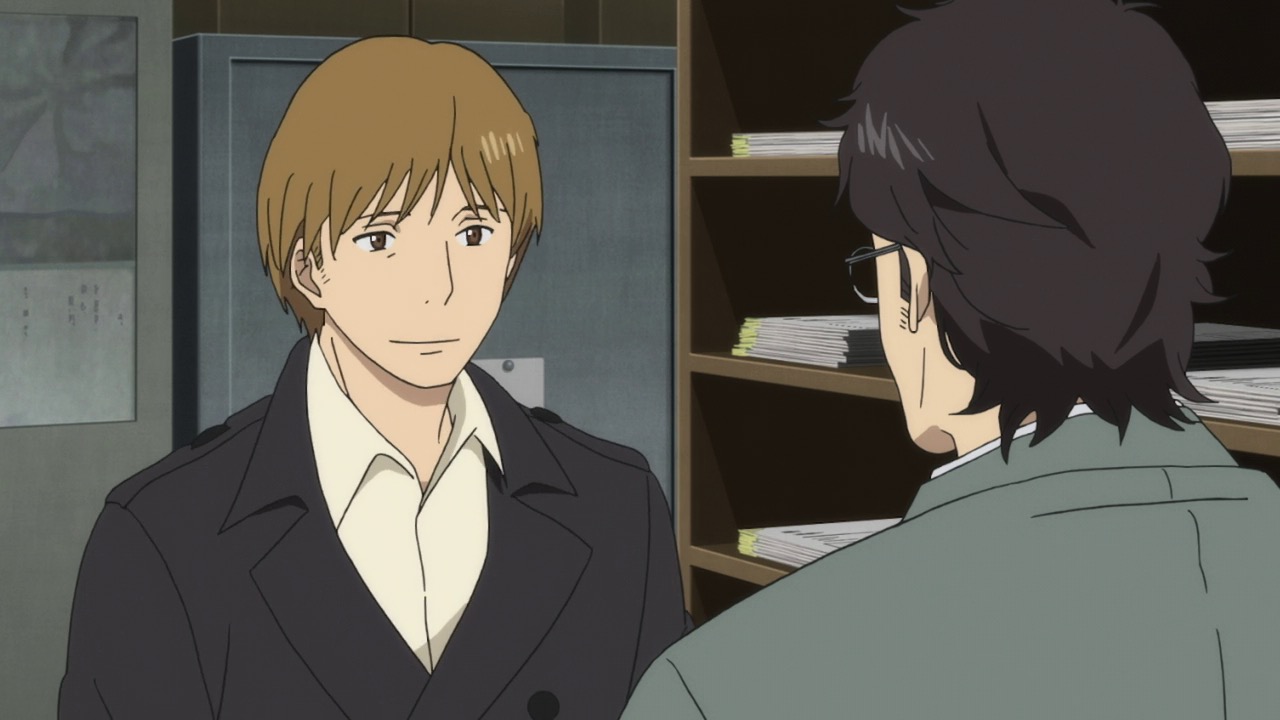
Nishioka is a frivolous fast-talker and go-getter. Originally, he applied to be in his company's PR department, but somehow ended up compiling dictionaries. He doesn't bemoan his placement. At the same time, he won't pretend to be passionate about something he has no interest in. He does his job well for a sense of self-satisfaction and pride, nothing more. While he lacks in overt passion, he more than makes up for it with likability, uniting the rest of the office in a strong bond.
In contrast, you have the socially-inept Majime. He originally starts out in sales, but fails quite spectacularly due to his timid and obtuse nature. Just like Nishioka, Majime is not one to complain about his job. Rather, he's the kind of person to flounder in an ill-suited position his entire career and never once dare to dream of something better.
The one solace in Majime's life is found on the pages of a book. Not so much the stories themselves, but rather the language piecing them together. Majime loves words. In that sense, he is a walking contradiction: a man who intimately knows words and has their various meanings memorized, yet can never express himself competently.
Only through a chance encounter do the two foils collide. When Nishioka witnesses Majime thinking over the myriad interpretations of 空気 (kūki, or air) he can't forget he strange encounter. Off-handedly, Nishioka describes Majime to his co-worker Kouhei Araki, a veteran of the department searching for a suitable apprentice. Nearing his retirement, Araki knows he won't be able to see their latest project through to the end. Upon learning about Majime's fondness for words, Araki is determined to recruit him into their ranks, convinced he will be the one to carry the torch in his stead.
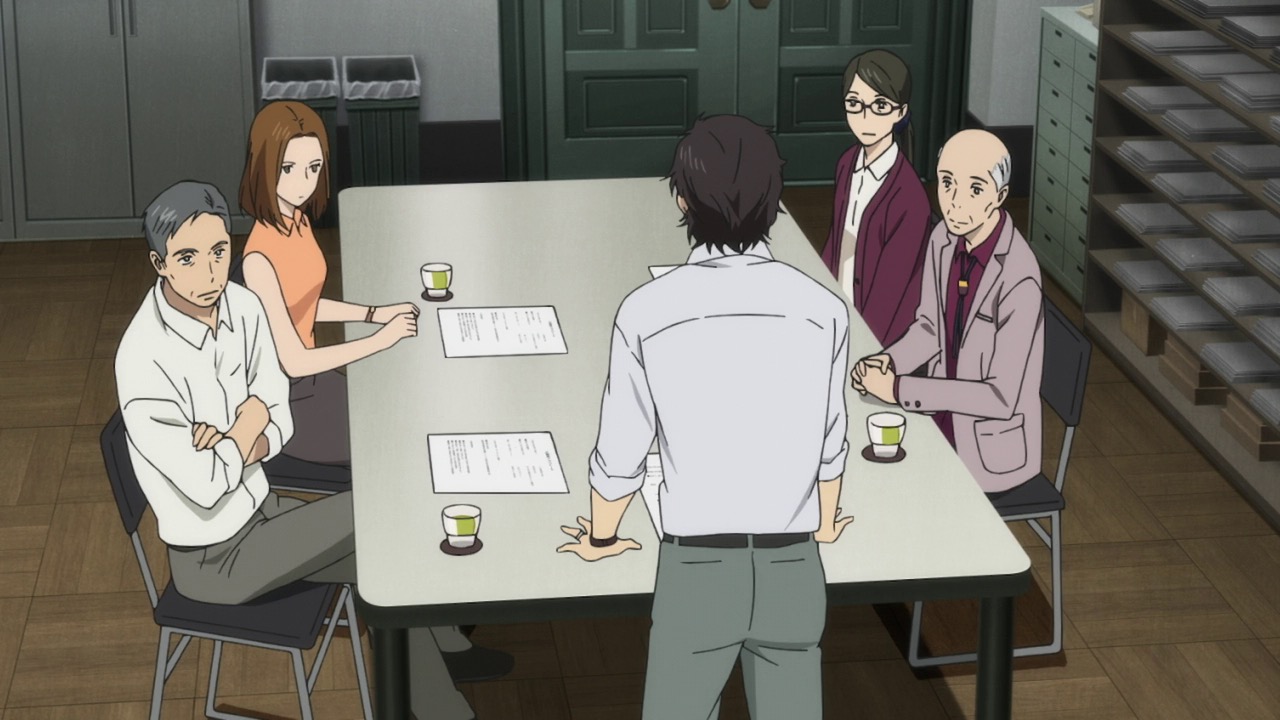
The rest of the show tackles 13 years of effort and strife, as the dictionary department take on all kinds of obstacles standing in their way of eventual publication.
Exciting content, right?
I'm joking, of course. Exciting is honestly the last word I would use to describe Fune wo Amu. That might be a damning statement for some. If that's the case, then feel free to stop reading now. I'm not going to try and sell you on the premise. Really, there's nothing to sell if you already haven't been sold. It's an anime about making a literal dictionary - there's no amount of sugar coating that can sweeten the facts.
For those of you with piqued curiosities, however, hear me out. I mentioned earlier that what led me to Fune wo Amu was a desire for something short and uplifting. Those two adjectives are quite fitting. At a mere eleven episodes, this anime can be devoured in one sitting. Personally, I spread the experience out over two nights. Part of this was because I'm a working adult with worldly obligations. Mainly, however, I didn't want the show to end.
Both narratively and technically, Fune wo Amu is near flawless. It's solid production and thoughtful writing had me hooked immediately. By episode two, I was jotting down quotes and researching it's conception. And come episode seven, I was ready to profess my undying love.
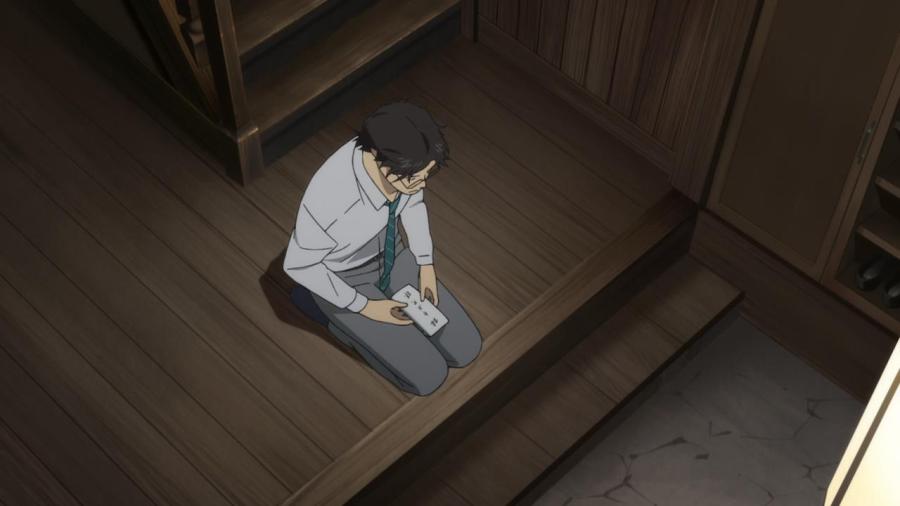
The most apt word I can think of to describe Fune wo Amu is "adult". Typically, I don't like throwing around such an inane platitude. Something being "adult" means about as much as something being "deep". That being said, I will break this rule for the sake of discussing how Fune wo Amu handles mature topics.
When I say mature, I don't mean in the mainstream context. Fune wo Amu isn't an adult story for any gratuitous reason. It simply features adults as they go about their lives and tackle setbacks with careful consideration. If you've ever worked on a professional team, I can guarantee you will find these characters familiar and relatable. Similarly, if you've ever had to deal with bureaucracy in your job, certain scenes will ring painfully true. I've never seen the dichotomy between well-intentioned individuals and the corporate agenda so skillfully portrayed - and in an anime, of all mediums.
Bureaucracy seems like a big word to be throwing around, but truly this anime tackles the issue with surprising nuance. It takes a look at what happens when genuine passion is confronted with people who just aren't interested. And that's a pretty heavy topic to cover, especially when it wears the guise of something inspirational.
It's important to note that there are no real antagonists in Fune wo Amu. If you pressed me to name an opposing force, I might say time or apathy or human error or miscommunication. But they're all abstract threats that come as a natural course of life.
The obstacles in Fune wo Amu aren't really what matter. What matters is how the characters overcome them, and more importantly, why.
As a side note, I'm typically not a fan of media where authors preach about the importance of words and story-telling. Sometimes it works, but most of the time it comes off as overly-indulgent and self-congratulatory.
In many ways, Fune wo Amu feels like an answer to these frustrations. It walks a thin line, for sure. But never once was I off-put by this anime's enthusiasm for language. It always came off as earnest, and pure.
This anime isn't about the power of stories or the brilliance of orators. Instead, Fune wo Amu removes people entirely. Meaning is found in words alien from the author's intent, for words aren't tools. They can’t be controlled by humans, and Fune wo Amu denounces those who try.
Rather words are alive, vibrant and free. As living beings, they are born, evolve over time, and eventually fade from existence.
That's honestly the closest thing this anime gets to a thesis...words encompass a vast, ever-expanding sea, and the feat of capturing them in a cohesive collection pretty much goes against all logical reason. Why compile a dictionary when eventually, inevitably, it will fall out of use and submit to the ebb and flow of time?
Well, that brings us back to the why. Why do these characters spend 13 years of their lives compiling and editing over and over again? Even if the dictionary does manage to get published, they must continually return to it for the rest of their lives, reviewing and updating it as needed. Why do they suffer through the endless revisions? The endless set backs? Why not just give up?
Because, fickle as they may be, words are necessary for human connection. Hence the title of the dictionary. The Great Passage refers to a ship, built to navigate the expansive sea of language and communication.

The main cast recognizes this truth. They know intimately the power that words possess, as they've experienced it themselves. A clumsy and meandering love letter can lead to a lifelong connection. Two contrasting personalities can learn to appreciate the others strengths through communication. And a carefully curated dictionary can be one thing to bridge human understanding.
Look at me, waxing about the importance of words, like the hypocrite I am. I would say more, but honestly half the joy of this anime comes from listening to the characters yourself.
On the topic of human connection, let's quickly talk about love. Along with "adult", I would also describe Fune wo Amu as "loving" in all facets. The characters are well-intentioned and passionate. They assume the good in humanity always, and do their job to the best of their abilities. Watching them work tirelessly makes me want to surround myself with people like that in my own life.
Beyond work, they are loving in their philosophies. They are constantly reflecting on their efforts, and reaffirming their purpose. These people fully believe in the weight of their work. Never once do they succumb to apathy - it doesn't ever occur to them not to care. And ultimately, those are the characters that mean the most to me.
One other thing I was not expecting from Fune wo Amu was fulfilling romance. The two love stories featured only take up only about 30% of screen time. Even still, this anime's handle on romance has to be some of the most competent and fulfilling I've ever seen in josei. I don't want to dwell too much on this aspect, because ultimately it's not the most important part of the show. I just wanted to highlight that fact that Fune wo Amu treats even it's minor storylines with deft care.

In terms of visual presentation, I can't imagine many sakuga enthusiasts will love this series. Not to say that it doesn't look great - it does. The character animation and backgrounds are especially pleasant. That being said, the aim of Fune wo Amu is not to be flashy. The entire show is incredibly grounded, animated almost as if it were a live action drama (actually, very little would be lost or changed if it had been live action).
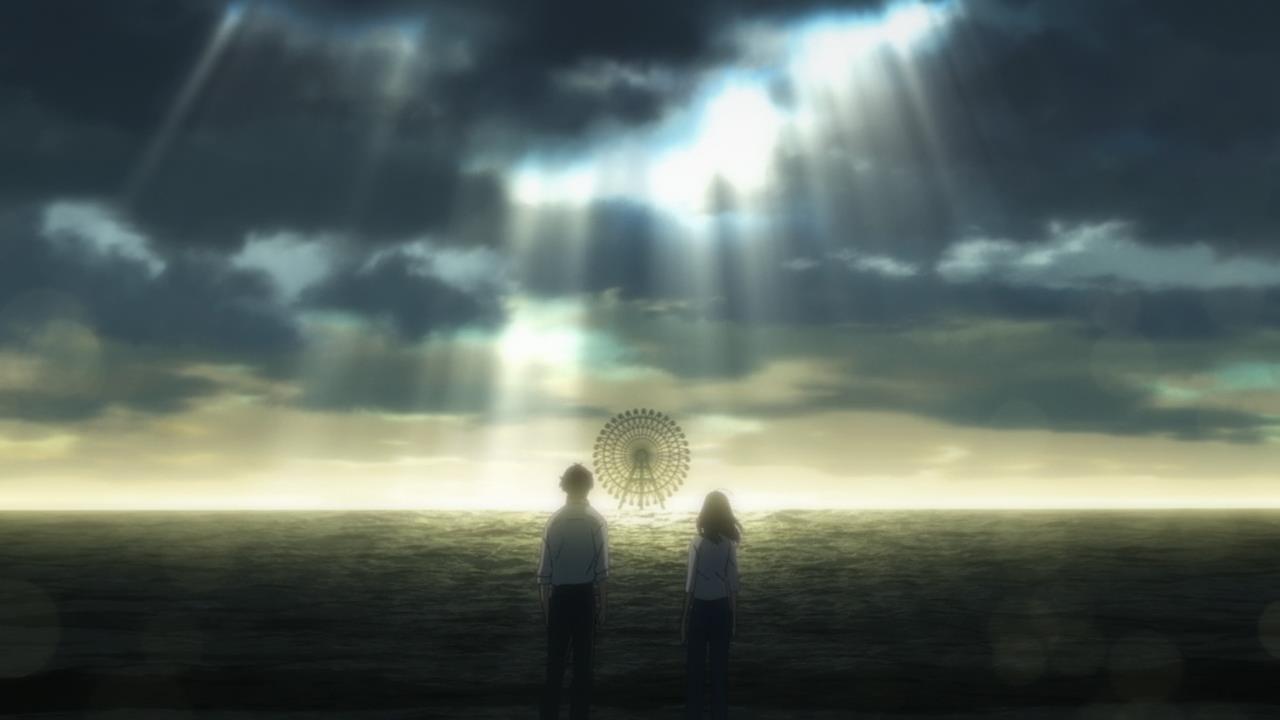
The only reprieve from this realism comes during brief moments of visual metaphor, where two recurring motifs are featured: a literal ocean to represent the vastness of language and a far-away, ever-turning Ferris wheel to represent the circle of life.
The music is also phenomenal. Composed by Yoshihiro Ike, it acts as a perfect compliment to the show's feel: uplifting and hopeful.
And then there is the setting. If the characters of Fune wo Amu feel reminiscent of Haruko Kumota's other works, then it's the settings that undoubtedly belong to Shion Miura. Miura is especially talented when it comes to creating memorable locations. The dorm from Kazetsuyo is a good example of this. Chikusei-sou felt real and lived in, like a character in and of itself. By the end of the series, you develop a real attachment to the rundown building, for you've spent so much time there alongside the characters. Moreover, in the beginning of the story, Chikusei-sou is the only force unifying our cast, acting as the literal glue keeping them together.
Like the dorm in Kazetsuyo, both Majime's building and the dictionary department offices serve to enrich the narrative. The former offers clear insight into who Majime is as a character. When we are first introduced to his living situation, we learn he is unmarried, messy, and surrounds himself with a wall of books.
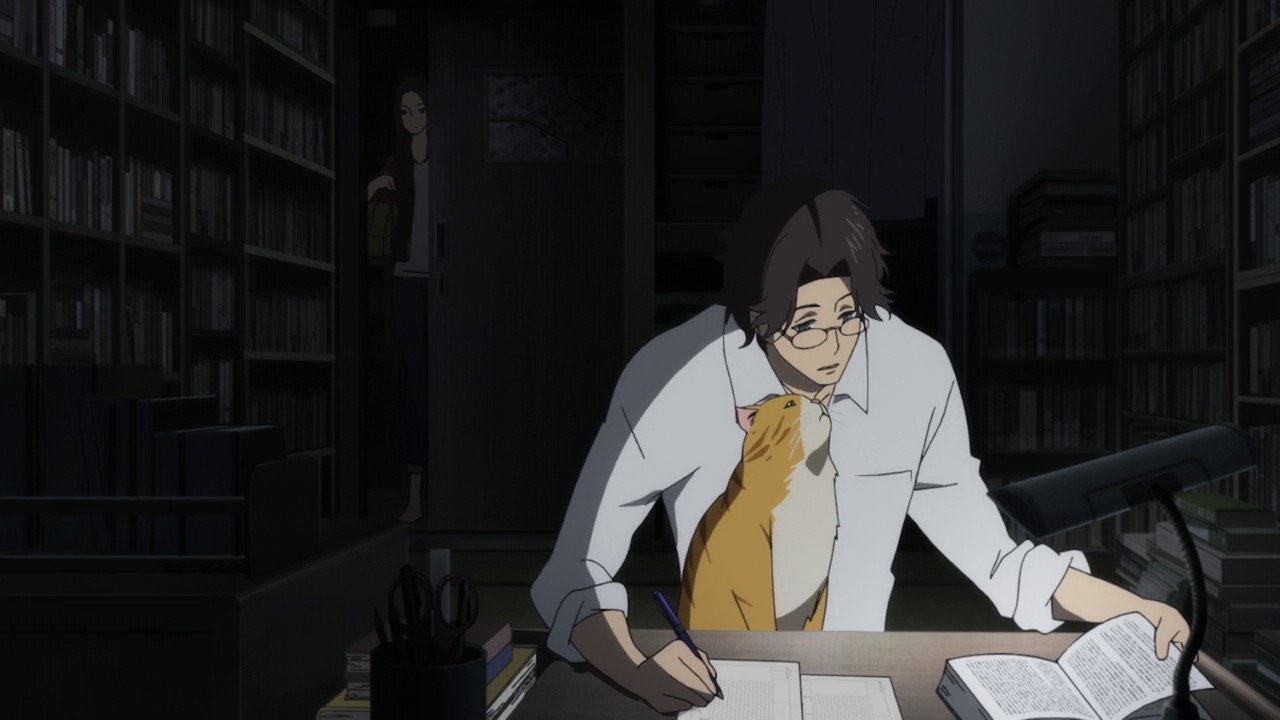
The astute viewer will also notice that this clutter follows him everywhere, even to the office.

In terms of that office...well, I'll just let the characters explain its significance...
"It's an old building, isn't it?"
"Yes....er, I mean no."
"It may look like the dictionary editorial department was relegated to the corner, but this was the main building around the time I first started here. The company has put in effort to making dictionaries, so we weren't relegated - we remained."
The dictionary department offices are a physical embodiment of the effort and passion of the people who work there. They've managed to prove their worth time and time again, stubbornly refusing to be defunded or dissolved. The building is old because making dictionaries is old; it's a practice that's been preserved against all odds. Passionate people will keep it alive, like that ever-turning Ferris wheel, working hard to pass on the baton.
One final thing I feel compelled to praise is the voice acting. To begin, the characters are phenomenally well-cast, especially our two leads. Takahiro Sakurai is flawless as the well-meaning yet awkward Majime. He can so perfectly balance the moments of whimsy and kindness with charming humor and quirky mannerisms.
Playing off his performance is another legend, Hiroshi Kamiya. I've always thought his voice was well-suited for a fast-talking businessman, and Nishioka's flippant personality allows him to have fun with the delivery. You can always expect quality performances from these two actors, but combined this show's realism, their voices are given new life.
“Perhaps dedicating your life to something frees you from the world somehow.”
I don't know exactly when I stopped being fun - perhaps sometime in college? Who can say.
The point is, I'm gradually losing interest in stories that are not grounded. Obviously, there's a time and place for shenanigans. And occasionally I'll turn off my brain for bit of fun. But more often than not, I want something feels real and relevant to my now.
But that seems rather ill-fitting for a medium like anime, no? A medium that's known for it's over-the-top story-telling and irreverence.
The truth is, as an adult anime fan, I've become very picky. I only have so much free time, so I want to invest wisely. That's why I'm thankful for Fune wo Amu. Not only was this anime wonderful, it gave me much needed motivation. While watching, I was simultaneously overwhelmed by work - so much so that this review was delayed by a week. But ultimately, it was for the best. Because watching these people work so damn hard and never once waver in determination made me re-evaluate my own intentions.
For someone younger, this might not be a good enough reason to watch Fune wo Amu.
If you've ever felt yourself lose purpose in your professional life, however, I highly recommend this anime. The only critique I have is that it's far too short. I would have happily watched 50 more episodes detailing those 13 years of effort. But I suppose that's a telling flaw: when a show is so good that you never want it to end.
In summary, Fune wo Amu won't be for all, but it was definitely for me.