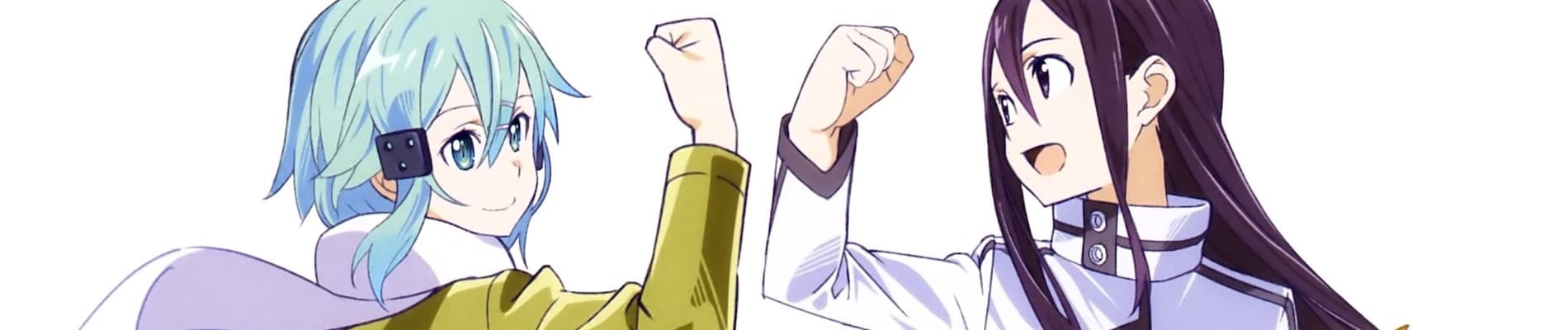
spoilers for a show you’ve likely seen by now
Prologue
There are a plethora reasons to lament the current reputation of Sword Art Online. For fans, it's because they often have to be on their back foot when talking about the series. Even if they aren't ridiculed by casual and veteran snobs who claim that to be a fan of SAO is to have shit taste, they're likely put in a defensive position by default. SAO's perceived flaws are as well-documented as Sonic 06, after all. For others, the reputation keeps the conversation alive years after many wish for it to end. Even when the Ordinal Scale film aired in 2017, people were lamenting the ubiquity of the franchise and so they couldn't shut up about its flaws just as fans couldn't shut up about defending it. For me, it's because I'm left thinking SAO II is an improvement when its reception is somehow the worst of the entire series barring a fucking recap film!
The reception of SAO II has always been puzzling to me. Despite not being very good --this is SAO we're referring to-- it's a far cry from the dumpster fire that was the first season. None of its arcs are as widely despised as the latter half of S1, otherwise known as the infamous Alphein arc. In fact, the Mother's Rosario arc which makes up the last 7 episodes of this show is widely considered to be one of if not the best arc of the series. Then I remember: despite the improvements it made, not only is it still SAO at the end of the day with a terrible first arc, but it doesn't contain a lot of what made people invested in this series in the first place.
There's a reason some still claim the franchise peaked in the Aincrad arc and that it should have ended there. The idea of being trapped in an expansive death game MMORPG is as fascinating as it is ripe with opportunities for exploration and worldbuilding. You'd get to see how it takes a toll on countless individuals' psyches. You could witness people come to terms with this new reality and make their own societies to indulge in the escapism the game promised. The idea of watching someone overcome their own reclusive tendencies as they open up to other people despite watching some of whom they care about die in front of them is as if not more compelling than watching people find love in this digital hellscape. That can't carry over to other arcs on principle, so the magic that catapulted the series to the mainstream can't be recaptured by a continuation. The time to really explore the immediate fallout of being trapped and exploring the kinds of IRL drama that led to people fleeing to such a world has long since passed. Even if SAO II had significantly better writing than its predecessor, it would need to have a brand new main draw for the series. That's a much harder sell when the first season exhausted and wasted those main points of interest in the first place.
That doesn't mean this show didn't try, lord help me, it tried. Unfortunately, it may have done so in perhaps the worst way imaginable.
Part 1: The Gun Gale Online arc is about as bad as Aincrad
Around ⅓ of the way into the Gun Gale Online arc, Kirito is visited by a Laughing Coffin member. He then recalls an event in which he, Asuna, Klein, and a bunch of guilds got together to get ambushed by Laughing Coffin, resulting in a battle that killed several of the dark guild’s members and arrested the survivors. While Kirito has killed a Laughing Coffin member before in self defense, this battle results in him taking down 2 more. He has never thought about any of them until now, and that’s for one reason: this entire flashback was never in SAO 1. This event is an instance of SAO II performing retroactive storytelling just so we would be given a “compelling” reason for Kirito to feel even a modicum of the trauma that the Alphein arc in S1 should have explored. It’s also done so that Kirito could expound onto Sinon, the deuteragonist of this arc, thematic relatability. I don’t have to tell you why this unnatural form of storytelling is a bad idea, right? We should all be able to look at this and go “ok but why didn’t Reki think of this before and why should we care now?”, right? We’ve long since passed the point where one should even care about exploring the direct effects escaping from Aincrad would have on any of the characters given that season 1 didn’t even try to do so.
Kirito himself is still an odd character. He is almost certainly overpowered with how he immediately accomplishes feats no GGO player has done before. However, it feels like they’re trying to scale it back more and more as the arc progresses as the tactics he uses start endangering him or otherwise not working once he fights more opponents. In fact, the only reason he wins the final fight in the arc is because he figures out exactly who Death Gun was back in SAO when he refused to let the man tell Kirito who he was. Additionally, Kirito’s smarmier, more teasing, and more beleaguered sides have all been expanded on in this arc. As a result, he’s certainly more entertaining to watch than he was before. However, the handling of his trauma is incredibly clunky for aforementioned reasons. As such, his attempts at relating to Sinon and her struggles are rather dodgy.
Speaking of Sinon, she starts off as one of the few bright spots in the arc. While she initially comes off as stoic, battle-hungry badass and hardass, we begin learning of her traumas and why she wants to become stronger through exposure therapy to a game she finds herself getting good at. While the moment of her shooting and killing a drugged-up armed robber was laughably overplayed, the idea still gives us a reason to care about her. The most interesting scene in the entire arc is when she’s talking with her friend, Kyouji, who is in love with her. In it, she responds to his query of becoming lovers with how she wants to work on her emotional and psychological baggage before diving into a relationship, and that she hopes he’ll wait for her until then. It’s a genuinely mature and interesting decision that one wouldn’t expect SAO of all franchises to write.
Unfortunately, this is not the story of how Sinon is the one good character in SAO. While the arc of her being traumatized and effectively utilizing exposure therapy at the suggestion of a friend sounds neat, the devil is in the details. This is Sword Art Online, after all. Sinon’s major problem is the terror that incident caused, as she remembers the blood spilled by the crazy guy who effectively haunts her to this day. As a result, she fears guns, and I assume she doesn’t fear blood because it’s not written to be relevant to the arc in any way. Unfortunately, they start adding the idea that she was constantly being bullied by being called a murderer. You’d think that being bullied and effectively guilted over your traumatic experience would create even more psychological problems like depression or suicidal tendencies, or at least cause her to feel awful for saving people’s lives by taking down the burglar. However, that doesn’t come about. If it did, then what Kirito does at the end of the arc would make perfect sense.
Throughout the arc, Kirito finds himself relating to her struggles over killing someone to save others as his past comes to haunt him. Setting aside the horrid catalyst for this, it’s a neat idea in theory. She offers him reassurance, he does the same for her later on. We’ll cycle back to how they handle that, but it all culminates in him and his friends tracking down the post office lady she saved that day so she and the daughter she was able to have due to surviving, could thank her. Midway through the arc, Kirito was reassured that his actions saved the lives that were about to be taken, so he uses this opportunity to give that lesson to Sinon. If Sinon was wrapped up with any kind of guilt instead of solely being ruled by fear and trauma, this would have been the logical next step once Sinon was out in the real world and she dealt with some random bullies that kept triggering her PTSD. Unfortunately, this isn’t the case, so it comes off as a bit emotionally manipulative considering she had already taken her first steps to compat her PTSD in the real world, and she was seemingly never looked at by her family and friends outside of a certain rapey guy we’ll get to, as some kind of hero or brave kid for stopping an armed robbery.
By the 2nd half, all of Sinon’s agency is effectively stripped from her as she finds herself paralyzed by her traumas as Kirito rescues her and gives her a shoulder to cry on for multiple episodes while generally coming off as better put together in the situation. While he still harbors his PTSD over what happened, he does all of the counseling and reassuring to Sinon as he’s the big strong man who has to save the day while she’s the less strong woman who has to be helped. Considering that she initially found him somewhat of a sexist asswipe, you’d think the show would have more self-awareness regarding the kinds of situations its characters are put in, and what the implications of those scenarios might be. The 2nd half of the arc is dragged on and on by these kinds of scenes as Sinon’s character and agency are further diminished amidst the constant repetitive monologues of her wanting to become stronger because of her PTSD. Sure, Kirito was petrified in the first half and got a pep talk by someone else, but it would have been better if their traumas affected them simultaneously and we got to see them both try to push through it and get each other to snap out of it together, creating an ebb and flow of desperation. Alas, Kirito lets her talk first about her trauma before opening up about his, long after she already figured out what was going on. Actually, it’s odd that a character who quickly opened up to anyone and everyone in the first season is so hesitant to reveal why he’s here and what’s troubling him to someone when it would benefit the two of them to learn about each other and why Kirito is investigating the Death Gun situation sooner rather than later.
There are a bunch of directions I can go in, meaning we’ll need to circle back to this a few times, so for now let’s head in the direction of Death Gun making no sense on any level. In the beginning, we are treated to one vengeful edgelord entity using a “Death Gun” to shoot people so they somehow die in real life. As a result, Kirito reluctantly goes in to find out who Death Gun is and how their actions tie in with the seemingly coincidental deaths of the players he shot in-game. A few episodes later, Death Gun intimidates him because he’s a Laughing Coffin player who wants to torment him. This incites his PTSD and causes him to go ballistic in future matches before eventually logging out halfway into the arc. We have a visual on what Death Gun looks like and that he’s from the biggest murder guild in SAO, so why doesn’t Kirito inform the guy who hired him and ask him for a list of all the surviving Laughing Coffin members so they can search to see if any are playing GGO? Why they never tried to track them down IRL and try to get them imprisoned for murder is its own, less relevant query. If Kirito did this, he would have the knowledge necessary for him to know who went into GGO and what their name is now that they know what he looks like. This entire arc could have potentially ended halfway through the length it ended up actually being.
On top of that, the reasoning for why no one talked about this in GGO is beyond aggravating. At the end of the arc, it’s revealed everyone thought it was a hoax...except for Sinon who didn’t even seem to know about Death Gun much. You’d think some people would be discouraged and that rumors would be floating around all over both the playerbase and the internet at large. Even if the Japanese had no way of contacting the American game company or devs, this would still be a scandal in its own right and people would almost certainly keep track of what Death Gun looked like. The fact that it doesn’t means that somehow Death Gun is this mysterious nobody that no one cares about except for Kirito, who eventually comes to the realization that there must be co-conspirators watching a livestream of the game somehow --on their smartphones I guess-- while they break into people’s houses and wait for their cue to poison them with medical serums they stole from a hospital that can cause heart failure at lethal doses. There are so many questions that have to be asked here, so here are some of them before we tackle two more major aspects of why this arc is horrible. If Death Gun misses, do they just stand there, waiting patiently for their target to get shot, or do they just leave and fuck off to the next target? There are 2 IRL guys waiting, so that must mean they stay at their post, correct? What kind of coordination must happen for them to absolutely make sure they don’t apply the syringe until they know for sure the bullet has made contact so they don’t kill a target that avoided getting shot? Since these are all regular break-ins where unfamiliar people just let themselves in, wouldn’t that be remotely suspicious?
Actually, it turns out that Sinon’s friend who was in love with her, just so happened to be one of them, explaining how he could let himself in her home without it coming off as suspicious. He gave off red flags in terms of being unstable about wanting Sinon, which coupled with a shot of the mysterious Death Gun player caressing a photo of Sinon and the OP spoiling it for everyone, should clue the audience in on the obvious. Already, the mystery is a joke, and this is until we learn that there are co-conspirators we never heard of because Reki Kawahara must’ve realized too late that “oh shit, I only have one suspect so my mystery is ruined!” It turns out that one of them was the guy Kirito didn’t let tell him his name after he was arrested post-Laughing Coffin ambush. His motivation of wanting to keep his identity as a murderer thanks to the role he played in Aincrad is interesting, especially compared to that of Sinon’s friend, Kyoyji, who poured too much time into GGO only to get pissed off once the metagame seemed to lean away from his kind of build. That has nothing to do with his love for Sinon other than the fact that he’s a deranged lunatic, so of course he comes on too strong regarding Sinon.
He then tries to rape her and pull a double suicide.
Ah, yes: the albatross around the franchise’s neck has returned in a far more laughable incarnation. It’s somewhat less sexually exploitative than before in terms of cinematography, but Kyouji’s frothing of the mouth as he screams “ASADA-SAN ASADA-SAN ASADA-SAN” while trying to rape her turns a potentially upsetting and vomit-inducing scene into unfortunate comedy gold. It is an absolute dumpster fire of a scene at the end of episode 13, and the beginning of episode 14 doesn’t resolve it in a way that’s any better. Kirito busts in, fights the dude, then gets injected only to be saved by a spare electrode that didn’t come off from when he played GGO in the hospital with a heart monitor, just in time for Sinon --or Sino Asada, whichever you prefer-- to slam a boombox on Kyouji’s head to knock him out. It’s such an over the top, hilariously metal way to defeat the rapist and it would have been way better if that was done before any of this absolutely contrived nonsense about Kirito’s deus ex electrode occurred. Then again, the arc is over and we’ll never see these guys play this game again.
Good. The game fucking sucks. Why is there an SAO type boss in a Virtual Reality Massive Multiplayer Online First-Person Shooter Role Playing Game? Is this like a separate story campaign thing divorced from PVP multiplayer? I get this is basically the Aincrad source code, but still. In fact, why is a VRMMORPG also an FPS? Why are there randomized avatars with their own rarities when they seem to effectively determine your build in a VRMMOFPSRPG? What kind of sense does that make on any level? How is such a game capable of being popular enough to have pros that make money off an in-game to real-life currency system? How is such a system allowed? How is it the only VRMMO with pro players?
With all the damning questions consistently raised in this arc and how badly it fucks up several key aspects on fundamental levels, GGO proves to be no better than season 1’s Aincrad arc. Keep in mind, that was also an arc that required tons of suspension of disbelief in order to accept anything long before the game itself turned out to be utter nonsense and the 2nd half fell off a cliff. It’s slightly better than the Alphein arc that made up S1’s latter half, as is Aincrad, but that’s a miserably low bar. So, does SAO II get better from here? Yes, but that doesn’t exactly happen for a while…
Part 2: SAO II’s Alphein arc --i.e the Excaliber arc-- is a waste of time with only 2 minor purposes, so let’s make this quick
The Calibur arc is an neo-Alphein side story that SAO II decided to cram in because the Mother’s Rosario arc alone would probably not have been long enough for the show to reach 24 episodes. As such, it could be considered canon filler in the truest sense as all it really serves outside of this is to make sure Sinon isn’t completely written out of the show’s 2nd half, and to give Kirito a sword he will use in a big damn heroes scene in the Mother’s Rosario arc. It’s relatively inoffensive in a vacuum, but it represents just how much SAO II feels like a bunch of random arcs stitched together with little in the way of decent structuring or pacing. It’s also the point where they’ve entirely given up trying to set significant stakes for now, given that we’ve lost all reasonable and earned sense of tension since midway through the first arc of season 1. It’s certainly better than SAO 1’s Aincrad arc, and is probably better than the other arcs by virtue of not being as broken. However, it’s even more of a dull, annoying waste of time.
The main problems come down to how boring it is and how the main SAO cast does not make for a fun group dynamic. Sure, Lisbeth gives Kirito enough shit while being bubbly, but she’s really the only one providing chemistry. What, do you think Klein ‘s capable of doing that now that he’s been reduced to a comic relief character who goes after any and all women? God, no! Even Sinon has been reduced to a somewhat stoic groupie who still has time to flirt with Kirito in front of his girlfriend and the other girls who never had a chance with him. Of course, with absolutely no tension or chemistry, it’s hard to really be engaged when they dick around with a quest that pretends like “oh no, we’re on a time limit” when at the start of the 2nd episode, the pendant they’re carrying has almost entirely faded in color despite being fully green at the end of the previous episode. It also tries to pretend Kirito isn’t absurdly overpowered by saying he technically can’t dual wield since he can only use one of his two swords at a time, but then he blocks with and uses magic spells with both. With an excuse this flimsy and easily contradicted, they should just give up all pretenses and let him do whatever he wants. He does have a cool golden sword he’s been wanting now, and that’ll come in handy later.
Part 3: Mother’s Rosario is the best arc in the series, not that it says much
The first episode of Mother’s Rosario is on par with the cave portion of Gun Gale. It’s a tedious mess where characters talk endlessly about things that could easily be cut down while also providing flashbacks that aren’t telegraphed in the slightest. It’s legitimately annoying to keep track of time in this episode as we only get the flashback date and not that of the current events in the episode. I never thought SAO would fuck that up, but here we are. The only positive was when Kirito and Asuna are having a date in Agil’s cafe while the former riffs on Agil, agitating him. It also introduced a new issue where Kirito and Asuna are receiving bits of characterization that should have been present in Aincrad. Kirito says that the need to get back to his family helped motivate him to clear the game, which was never once indicated in the art itself. Meanwhile, Asuna brings up a sense of disdain for her immediate family, which you’d think we’d have seen Kirito and Asuna talk about back when they were married in SAO. The latter ends up being the start of Asuna’s character arc this season.
That’s right, Asuna has her own personal storyline in this arc, as she’s arguably the main character for the last 7 episodes of SAO II. The initial deuteragonist of the series gets more focus, agency, and exploration than she ever got in Aincrad, let alone the arcs she was basically absent for. For once, she isn’t just some generic tsundere or a boring nice girl who happens to be Kirito’s girlfriend. Much like Kirito, who starts realizing his own personal ambitions as a technological innovator blending the real and virtual world together, Asuna finally reveals herself as a person with insecurities. Specifically, she’s angsting over the lack of real agency she has over her life compared to her time in SAO thanks to her parents effectively trying to control her life because they supposedly think that’s what’s best for her. Suddenly, her VRMMO gaming is shown to be an escape for her as it allows her to be a badass who is truly in control of what she does. It's not exactly much, and the lack of real chemistry or affection she and Kirito share in their long-standing romance is lame. However, it's something, and that's infinitely more than I can say about the show and its treatment of Asuna most of the time.
The entire conflict with Asuna's controlling mother who may or may not be resentful of her parents not birthing her into a higher class she ended up having to work for is rather underdeveloped and one of the weakest aspects of the arc. Nonetheless, it’s refreshing to see Asuna finally come into her own as a character as she meets up with Yuuki and her guild known as the “Sleeping Knights”.
Yuuki is by far the best character in the series. While Asuna coming into her own was interesting and somewhat satisfying, Yuuki is the heart and soul of the final ⅓ of the show. She’s a rather striking character for how genuine she comes off. She’s both bubbly and cavalier, yet simultaneously reserved to the point of guilt. She’s innocent, youthful, and generally direct while still being one of the most layered and likable characters to date. There are other aspects about her character that we learn of over time, such as how she became a stepford smiler to appease her parents for so long that she effectively made herself happy and energized to smile for herself. The relationship she forms with Asuna is perhaps the most solid in the show as well, as in this short span of time, we’re already given enough reason to care about her. That makes it all the more impactful when we and Asuna both learn that she’s dying of AIDS. It’s a rather difficult subject matter to tackle given that it could come off as obvious emotional manipulation centered around a boring waifu-bait character the story is forcing the viewer to care about on the sole basis that they’re going to die and that has to make you sad. However, SAO handles it with infinitely more tact than it has with any other subject matter it has focused on, partially because we’ve seen the reservations Yuuki and her guild had with Asuna throughout the arc. We knew they were hiding something that could devastate Asuna, though like her, we didn’t know exactly what was preventing them from getting closer to her.
This actually serves as a mark against the show as well as a strength for the arc. Yuuki herself was handled surprisingly well given the awkward pacing of the arc and the subject matter on display. However, said pacing made it so we only got to learn about her while the rest of the guild remained largely unexplored and came off as relatively blank nice guys with at most, one personality trait to differentiate some of them. There’s the shy guy, the cute and spunky girl, the almost big sister-like figure, and some other dude. Until the penultimate scene of the show, that is all we know about them, and what we do learn is that one of them felt like she had no purpose in life thanks to her Leukemia before meeting Yuuki, a 15 year old girl, and realizing that she should buck up like the young one before her was doing. Contrast this with what was said about Yuuki and how we learn of her borderline self-loathing regarding being born to die while strapped to an expensive VR medicine machine, and it’s night and day. If we got another episode or two to explore the rest of the guildmates, then learning that most of them are next on the chopping block would further add devastation to the news of what’s going to happen to Yuuki. At the same time, it would probably make it more maddening when we learn all of them ended up being fine sometime after Yuuki’s death.
Yuuki’s death scene is perhaps the most powerful moment in the entire series. Surrounded by her friends who swore not to see her off or cry while doing so, she’s met with the sight of hundreds of fairies in the sky as the waves of people who have come to know her as a legendary swordsman in the new Alphein game. The lot of them provide a gorgeous sendoff for her as she dies in Asuna’s arms, handing her a parting gift before succumbing to her disease. It's a genuinely moving scene, far beyond what the franchise was even conceivably capable of before this arc came around. It’s serene, tranquil, beautiful, and most importantly, earned. Sword Art Online has never truly earned a moment like this before, so it’s staggering in its own right. Hell, even in this moment, Yuuki lets us and Asuna in on another secret, that being how she felt like she was born to die, causing her to feel guilt and some semblance of self-loathing over using the expensive medical VR prototype and worrying so many such as the girl she’s dying in the arms of. In fact, she’s finally learned to let go of all of that as her sendoff gives her some semblance of closure to her life and worries, now that she’s surrounded by all the people she’s touched without realizing how much she means to so many people. It’s at this moment where the arc and the character who embodies it solidify SAO II as a substantially better show than its predecessor.
Part 4: Minor audiovisual improvements and major directorial negatives
Yuki Kajiura returns as composer, and her work is about as good as before. Unlike season 1, no track gets annoyingly overused or awkwardly misused, and there are several standouts just like before. “Crooked Mind”, while playing in one of the worst scenes of the show, is a strong dread piece that uses its guitars and violins perhaps better than any other track in the show. “This Psychedelic World” may contain some less than stellar techno passages, but still makes an interesting, somewhat eerie futuristic tonesetter with digital bell-like chimes. All 3 versions of “You Are Not Alone” are either very quaint, relaxing pieces, or some of the most somber tunes in the series. They all capture the bittersweet nature of the Mother’s Rosario arc quite well. Lastly, there’s “Desolate Landscape”, a mesmerizing tone piece that really helps the frost-ridden locale from the Excalibur arc really shine. There are more tracks that are memorable compared to last time, especially in the second half of the season.
As far as OPs and EDs go, this show might also be a bit of an improvement. "IGNITE" by Eir Aoi is a solid first opening to the season, capturing some of the dread and danger the arc fails to properly instill before transitioning to the chorus. "courage" by Haruka Tomatsu is perhaps the weakest OP of the first two seasons, but is a solid sentimental piece. The ED are where things get more interesting, as "Startear" by Luna Haruna is perhaps the most emotionally resonant and heartwarming ED of the bunch, while feeling somewhat bittersweet. The 2nd ED, "No More Time Machine" by LiSA, is my favorite song of hers, with its incredibly upbeat energy, though the edits this TV version makes are somewhat awkward. The last ED, "Shirushi” by LiSA, is a far more melodramatic piece befitting the Mother’s Rosario arc, and is a solid song as well.
A-1 Pictures has returned as the chief animation studio behind SAO II and it’s about as mediocre and volatile as before. The one unequivocally good thing about the show’s visuals which I never really noticed in season 1 is the texturing. The environments in the sci-fi cityscape of Gun Gale Online stand out in ways that combine with the almost cyberpunk neo noir lighting to make that digital setting come to life as the most gorgeous location in the franchise. SAO can be really good with environment texturing, such as with pavements in daily life or in some of the medieval-esque locations of the new Alphein Online’s SAO maps. Compare this to a lot of other anime like Hero Academia which have hideous indoor textures, or shows like Bunny Girl senpai which have fugly CG gradients, and it’s no contest.
The fight scenes are typically about as mediocre, or at least slightly better than before. There is still a fair amount of reused animation, such as when Death Gun’s myriad of stabs on Kirito are identical to Asuna’s rapier attacks from season 1. Most sword clashes have almost no weight to them, either. However, there is a fair amount of fluidity behind Kirito blocking bullets with a laser sword or cutting people in half, making for a couple of really solid animation cuts. Almost nothing is quite as fancy as some of the cuts in Alphein where magical fire and explosions are thrown in, but SAO II’s action does feel a little more weighty than before. There’s no better example of this than the fight between Asuna and Yuuki in episode 19, where the sword clashes finally convey a sense of impact instead of looking like largely limp pieces of metal tapping each other while sparks fly all over the place. Sparks don’t feel so cartoonishly spilled out anymore, either.
Unfortunately, SAO’s production is still middling for a variety of reasons. The CGI work is about as bad as before, and far more persistent in the first half of the show, to boot. The artwork was never the most stable aspect of season 1 but might actually be even more inconsistent here regarding characters’ faces. Most importantly, Tomohiko Itou’s directing is not much better than it was before. SAO 1 had some baffling shots and usage of shortcuts, even outside of reused animation, but here, things are sometimes even worse. The Mother’s Rosario arc does have a few decently shot scenes that are a tad more attention-grabbing than most scenes in the show, but the Gun Gale Online arc might be Itou’s worst work on the show to date.
This is where we circle back to problems with tone and how Sinon is handled. Any time she is scared, we get shots of CGI blood cells to suggest that she’s pertirifed and her blood pressure has gone up. Could they not have used a more natural or interesting way of showing her feeling terrified, like watching her facial expression go from normal to horrified? Even more distressingly, outside of the constant flashbacks both major arcs pull, is how the camera treats Sinon. SAO has always been one of the more heavily criticized shows in terms of being obvious with its male gaze, as the camera points to girls’ asses during dramatic or comedic scenes for no real reason. The GGO arc takes this negative and runs wild with it, as there are about 30 shots squarely focused on SInon’s “assets”. Hell, that’s how she’s introduced before we even get to see her face, and sometimes the camera swivels to get a view before panning back up. It’s almost comical in how wrong this whole thing is, and it makes it much harder to take Sinon or her emotional trauma seriously. Keep in mind, SAO II, while still being a teen-marketed crowd-pleaser kind of title, is generally more self-serious than its predecessor. That’s why we need to pan to Sinon’s buttcheeks every few minutes and hilariously oversell senses of fear with Death Gun’s presence or the arc’s main duo’s terror. It’s kind of funny how Death Gun is an overly theatrical loon who uses an edgy persona and phrases from different languages as his catchphrase and moniker to look more intimidating, and the director just treats it 100% seriously. I’m not even sure if Reki Kawahara wanted us to take Death Gun as seriously as Tomohiko Itou does.
Epilogue
Sword Art Online II is only really an improvement in so much as it actually has something going for it outside of Yuki Kajiura's score. If you were to remove the last arc, the show would be only marginally better than the first season, as the show has barely learned a thing since Aincrad while containing problems unique to itself. The pacing is as terrible as the narrative's structure and lack of believability. It continues to shaft key characters it brings back or introduces. Even the lukewarm and inconsistent production values haven't improved much. For the most part, SAO II is every bit the erratic mess the first season was for similar and different reasons.
That being said, the final arc is what makes all the difference. The first time the show tries to tackle escapism in interesting ways that affect the characters and setting is the first time the protagonist baton shifts for a while. It's the first time we get a fully-realized character and deuteragonist on Yuuki, and she's too dead for a subsequent arc to try to ruin her later like Alphein did with Asuna and the 2nd half of GGO did with Sinon. While rushed and inelegant in execution, this arc lets the show have a moment of sincerity where emotional moments are earned. SAO II is not a good show by any means, and it's not worth trudging through 42 terrible episodes across 2 seasons just to get here. It also barely contains much of what seems to have brought people to SAO in the first place, so it being better doesn’t mean much when it can’t completely reinvent itself for the better and keep everyone hooked. However, the last arc proves that this second season is at least not as bad as what came before it.
68 out of 88 users liked this review