

It’s Murder on the Orient Express, except instead of a transcontinental train ride we’re in ancient Mesoamerica with demon gods and magic, and instead of a carriage of bourgeoisie tourists we have six heroes selected to defeat said demon god.
▶ Video 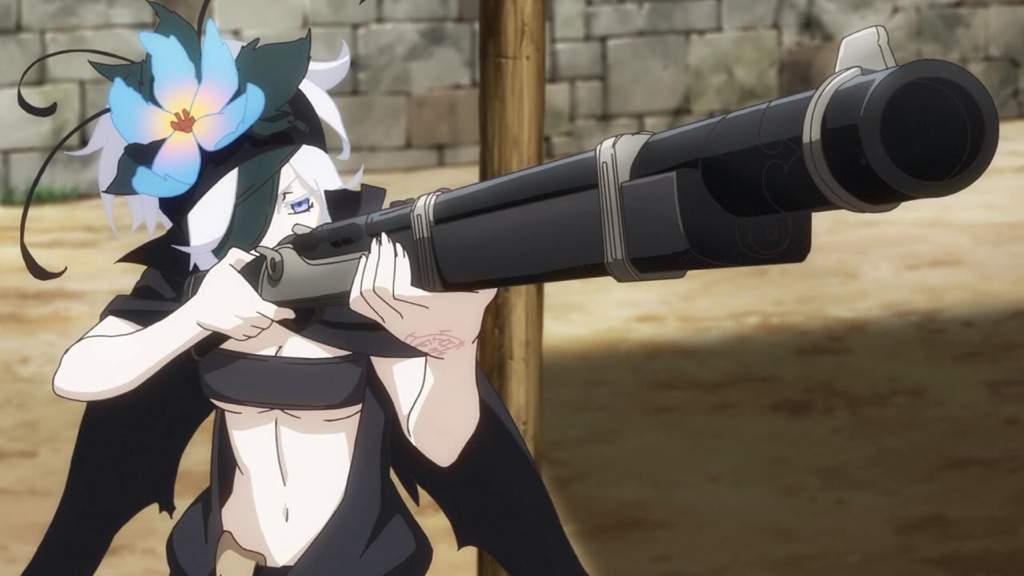
▶ Video
The whodunit mystery is a genre sure to peak people’s interest. And, when done correctly, can be both an infinitely frustrating yet infinitely gratifying experience. Unfortunately, Rokka no Yuusha was far more of the former than the latter.
A demon god has been resurrected and is threatening to destroy the world. As with each time this apocalyptic threat has occurred in the past (you’d think that they’d have thought of a more permanent solution by this stage), six mighty heroes have been chosen to save the world. Among those selected is our protagonist: a charismatic, artful, and dare I say foxy young man specially trained to dispatch of fiends and other demon-nasties; the ‘strongest man in the world’, Adlet Mayer. The only problem is, when Adlet and the rest of the gang gather, there’s seven of them. We have an imposter on our hands! And, given the circumstances, Adlet is the group’s prime suspect.
The key to any good story, but perhaps more so for something which aims to be as immersive as a whodunit, is to treat the audience with the respect. Greats of the genre such as Agatha Christie and Rex Stout did just this: the crime is set, we are given the clues and maybe a couple of red herrings along the way, but in the end, whether we successfully solve the mystery or not, we are satisfied with a well thought-out, reasonable and comprehensive ending.
By Rokka no Yuusha’s conclusion, however, I did not feel as satisfied as I did insulted. The flaws of the series are diverse, but the fatal failing lies in the construction of the mystery itself.
The actual structuring of the series was the first problem. The actual mystery isn’t introduced until the end of the fourth episode (in a twelve episodes series). Up till that point, we had some pretty average world-building and exposition and were introduced to four of our potential impostors, including Adlet. One of these characters wasn’t given nearly as much screen time, backstory or development as the other three were. To put it simply, he was one-dimensional. Like, seriously – his single defining character trait is his loyalty/love-borderline-possessiveness of another character. And this is an issue with the three remaining characters introduced post-episode four: they simply aren’t as fleshed out as what is our primary trio, mainly due to their relative lack of screen time.
What we’re left with is a couple of semi-interesting characters and a bunch of bland archetypes. Consequently, we as the audience are quickly able to eliminate majority of the cast from suspicion, simply due to their lacklustre characterisations. In fact, I found myself trying to decide between two of the suspects for most of the series.
The second problem was the actual reveal. It wasn’t surprising at all, especially given the aforementioned formatting of the series and the inequality of screen time allocation given to the various characters. In fact, it was nearly too simple. But that wasn’t my primary gripe. Nor was the ridiculous, deus ex machina-esque clue that catalysed the resolution – it was so far-fetched that you literally need a degree in meteorology to even have a chance at identifying it.
Rather, it was the motivations of the perpetrator. A plot twist is a common device in whodunits. Except, Rokka no Yuusha’s big twist was as ludicrous, arbitrary and down-right stupid as something from an M. Night Shyamalan movie. In fact, that’s exactly what it felt like. A character does a near 180-degree reversal and we learn things about him/her that come straight outta left field.
The resolution was as dumbfounding as it was ridiculous. You might even find it laughable. But, all things considered, it was insulting.
There’s also an equally frustrating and ludicrous ending post-the big reveal that sets things up for a sequel, but for all intents and purposes, I’m just going to ignore it.
It’s unfortunate, because in spite of the easily dismissible characters and asspulls near the conclusion, the mystery element was fun. The various clues, red-herrings and logical conundrums posed, for the most part, all lend themselves to continuously peak the curiosity and engagement of the viewer. The suspense was aptly maintained, largely due to the cliff-hangers that every episode would finish on.
As mentioned, the characters are a definite weakness of the series. Apart from Adlet, whose charisma alone makes up for his rather cliché tragic backstory, I didn’t really care much for any of the characters. Other than a couple of nuances here and there, the vast majority of the cast were cardboard cut-outs, and some were just plain despicable. As such, whilst the suspense in the series is superb, there’s no real tension in the action sequences as none of the characters make an emotional impact. That, and plot armour.
Which was another issue. The series had a difficult time choosing if it was a whodunit or a fantasy action series. That’s not to say the two have to be mutually exclusive. Only, the action sequences didn’t really add anything to the series, and if anything, detracted from time that could have been spent forging better-rounded, developed characters, thereby elevating the mystery aspect.
The inconsistent animation quality didn’t help either. The budget limitations were distractingly obvious at times – as in, it occasionally looked really awful. The CG fiends were plain ugly. The ancient Mesoamerican setting, whilst intriguing at first, quickly lost its appeal as the setting stagnated and we were treated to the same background-types over and over again. Namely, jungle and the interior of a temple. Character designs were pretty cool though.
It’s a shame, really. Rokka no Yuusha was, for the most part, a fun, engaging, suspenseful watch. The issue is it doesn’t treat itself or the audience with intelligence. Poorly thought-out episode formatting, bland characters and a farcical conclusion make this an asinine series - which is the last thing you want a whodunit to be. That said, if you can ignore the pure doltishness the show eventually degrades itself to, you might end up enjoying Rokka no Yuusha a lot more than I did.