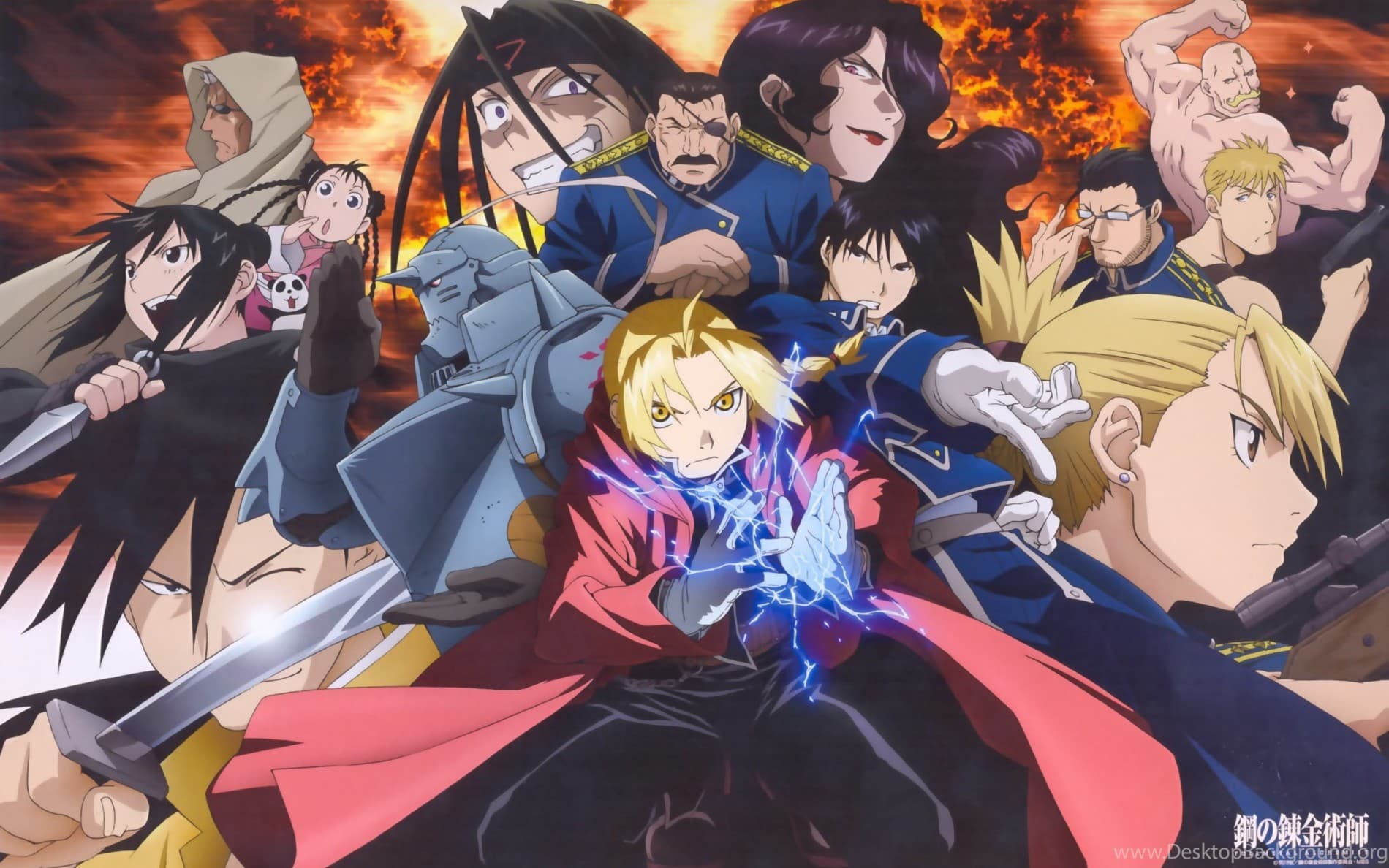
Fullmetal Alchemist: Brotherhood
a review by Edison

Edison
5 years ago·Nov 30, 2020
100
/ 100
a review by Edison
5 years ago·Nov 30, 2020
This part is just a bit of a foreword about how I got into FMA. You may skip this part since it has nothing to do with the review, and it’s more of a personal statement.
I’ve been an anime fan for over a decade, and I’ve constantly heard people talk about Fullmetal Alchemist: Brotherhood for years on end. However, I never watched it until recently, mostly because I was afraid of the endless hype the show has gotten over the years. After overcoming my irrational fear, I can confidently say that Fullmetal Alchemist: Brotherhood totally deserves the positive reaction it gets. It will sound a bit funny but let me tell you a short story. Before I even sat down and finished the series, FMA reminded me of ‘Avatar: The Last Airbender’ that I completed months before watching the anime. The reason behind this comparison is the audience response; FMA has always been seen as universally good, just like the American cartoon. Apart from this, both FMA and Avatar share the incredible world-building process, memorable characters, and overall outstanding story-telling. However, comparing these two shows a story for another day (and I would like to be brief with this personal introduction to the review).
It is no secret that Fullmetal Alchemist: Brotherhood is popular. FMA: Brotherhood still gets overwhelmingly positive feedback from the anime community, although it finished airing over ten years ago. However, being a popular show does not always mean that it is good. That is why one of the most remarkable things to note about Fullmetal Alchemist: Brotherhood is how it is recognized and acknowledged by the community. It is either included in hundreds of ‘The best anime of all time’ lists all over the internet or ranked by thousands of people as the best show on several platforms, specifically on AniList, MyAnimeList, and Anime News Network. What makes it so special? What does Fullmetal Alchemist: Brotherhood have that the other similar shows lack? Why do thousands of people all over the world love it? So, in an attempt to answer those questions, let’s dissect the show and figure out together why this title is so heart-warming yet bitter-sweet and overall fantastic and amusing shounen. Although this anime might not need an introduction, I’ll still start with the basics for the people who have never heard about FMA or are not familiar with the series.
Fullmetal Alchemist: Brotherhood is the second anime adaptation of Fullmetal Alchemist manga written by Hiromu Arakawa. The show first aired in April 2009 and continued its run until July 2010, finishing with 64 episodes in total. It was developed by the studio Bones that gave us such popular titles as Ouran High School Host Club, Soul Eater, Noragami, MHA, and many other decent series. The remake of the 2003 anime is known for following the manga as close as a show can. That is why the fans fell in love with the Brotherhood even more since there are only two filler and four mixed cannon episodes out of 64.
In the world of Fullmetal Alchemist: Brotherhood, alchemy plays a crucial role in multiple major aspects of the show, including its most basic plot. Alchemy is presented to us as this ancient scientific abstract art of manipulation and alteration of matter by using natural energy. What alchemy essentially does, it comprehends, deconstructs, and reconstructs. While this technique sounds amazing, there is one golden rule, the basis of all alchemy, "In order for something to be obtained, something of equal value must be lost". Our two protagonists, young Elric brothers, Edward being the oldest and Alphonse being the youngest, learned this Law of Equivalent Exchange the hard way after attempting human transmutation, the taboo of all alchemists. As a result of the violation, the older brother loses his left leg, while the younger one his body. Scared of his brother being completely taken away from him, Edward sacrifices his right arm to attach Alphonse’s soul to a suit of armor. Now, their main goal is to return to their normal, human selves, since Alphonse is now connected to a huge body armor suit and Edward gets mechanical replacements, automail, for his missing limbs and becomes a state alchemist carrying the name Fullmetal Alchemist. As mentioned above, this is the fundamental plot of the series. Now, what makes FMA: Brotherhood such an incredible anime is not how multidimensional the show is but how multilayered it is. While on a 3-year-long dangerous adventure to return their original bodies, the Elric brothers discover the existence of a powerful artifact called the Philosopher's Stone, which allows alchemists to overcome and ‘break’ the above stated Law of Equivalent Exchange. In return for learning about the Stone (yes, I just referenced the Law), Edward and Alphonse learn the shady story of their own country by getting caught in a governmental conspiracy while uncovering the real nature of the Philosopher's Stone.
As you can see, the bedrock of this show is quite diverse and includes a bunch of food for thought starting from something as basic as the significance of family relationships and ending with a dreadful question about what makes one human. However, the most crucial aspect that separates FMA from many other shounen anime, in my opinion, is the existence of the Law in the show’s universe. I noticed that a lot of shounens nowadays fail to set up any ground rules, which leads to complete absurdity, overpowered characters, and nonsensical tropes. It was nice to see Fullmetal Alchemist lay out the basic principle of its universe for the viewers and stick to it, instead of coming up with random explanations and ‘breakthroughs’ on the fly just for the sake of amusing the audience.
I strongly believe that the overall plot of this anime is incredibly interesting, starting from the brothers’ desire to have human bodies again and ending on the discourse about the military conspiracy that is rooted so deep into Amestris, the country where the action happens. In my eyes, even if we put aside characters, their development, and other aspects aside, it is safe to say that FMA is definitely one of the top-notch anime because of how it explores and builds the world of its universe, how it unpacks all of the enigmas through tiny details not only in dialogs or flashbacks but the animation itself, how it makes you, the viewer, question what is good, what is evil, or do these definitions even exist. Clearly, there are so many moments where you feel so happy for the ‘good’ characters in the show but what makes Fullmetal Alchemist: Brotherhood a part of an amazing-anime-club is how it creates the connection between the viewer and the ‘bad guys’. Speaking in a bit of a harsh and general manner for the sake of avoiding spoilers, the show plays with your feelings to a certain degree and makes you wonder if the villains deserve the punishment or not.
Fullmetal Alchemist might seem to be kinda fast-paced at times but it makes up for it by staying consistent, regardless of the speed at which we are being told a story about two brothers, their family, friends, and comrades. It might seem like we are moving really fast at a certain point because the show tries to unpack a million different topics in a very short period of time, sometimes it’s reversed. However, it is essential to remember, everything that happens on the screen happens for a reason. As mentioned above, this anime has little to no fillers but even those are tied to the story smartly. Therefore, if the event seems to have no meaning behind it or it feels rushed, my advice would be: trust the process; it will all make sense in the end.
FMA: Brotherhood is a shounen after all, so you get a lot of breaks from or during serious moments when staff decides to input some funny animation or dialog to kindly remind us to have fun while watching the show instead of constantly being focused on the seriousness of it. From my perspective, it is a nice touch to the anime because at the end of the day it is an entertainment medium. I see FMA get criticism for inserting banters because they ‘don’t fit the mood of the scene’, however, I personally disagree with that. FMA can get very intense at times and those funny moments are used in really clever ways to reduce our, the viewers, tension.
I’ve briefly mentioned some characters’ aspects above, so I’m going to dive deeper into characters and their ‘quality’ in this section, which is a quite difficult topic to dissect. It is difficult mainly because this show creates a narrative where it plays with your head, emotions, and rationale, making you believe that nearly every character is the main character of the show. I know, it sounds a bit strange and overwhelming but FMA does it in such a shrewd manner where you don’t really notice that you care so much about this specific side character and actually treat it as the main one for a second. The show usually achieves this effect by, for example, giving you their backstory, analyzing (in a way) someone’s dialog, manners, values through other characters. Obviously, the majority of the screen and storytime goes to the Elric brothers but it would be inexcusable to not mention how well this show treats its side characters, how much love goes into them (both good and bad guys). Each character has a personality, there are no clones in the interest of adding some extra faces to the cast. Although there is a somewhat clear separation between what the good and the bad guys want and need, it can be said with confidence, there are little to no characters that lack some sort of identity. Some of the cast wants to return to their original bodies, others want to rule the country, others want to restore their family’s honor. Therefore, I dare to say that FMA has slim to no one-dimensional characters.
Much like the plot, now and then it might seem as if there are a lot of characters in the show but they are all there for a reason. From my standpoint, Fullmetal Alchemist is the anime where the side characters build up the main ones, the Elric brothers, and intensify the plot. I think that this is something you rarely see in the shounens nowadays because the main character(s) is/are expected to carry the weight of the show, while FMA in some sense splits the story baggage and puts it on everyone included in the show. By doing so, the series can explore multiple characters without really overwhelming the viewers because (almost) every single one of them has some significance to the show that they carry, subtle or not. Therefore, Fullmetal Alchemist gives us so many characters to choose from that we might be able to relate to and connect with on a deeper level. Not only that but, in some cases, it makes our empathy for not-so-good-but-also-not-really-evil characters to get through and questions our own humanity through the Elric brothers’ eyes.
While we are talking about subtleties, this show has a huge number of small, tiny details that bear immeasurable value that is hidden not only in physical objects in that universe (actually drawing/animation wise) but in the personalities, specifically in regards to villains. Those little elements don’t really affect the plot that much since it is not a big deal if you don’t notice them. However, this is why FMA: Brotherhood has such massive rewatchable potential. Trust me, after rewatching the show at least once, you will notice something that you never observed. Although this show doesn’t disappoint you, has a well-written ending and everything falls into place, there still will be a moment in your head when everything just falls into place even more after you rewatch at least the second half of the show. It feels incredibly empowering (in a way) when you realize and detect certain tiny things in the show. It makes us, the viewers, feel like we have truly emerged into that universe and are a part of it. It allows us to continue creating and building that universe in our heads. That is what makes this show an incredible piece of work.
I am personally not a very artistic person and I prefer to focus on other things about the show, so it’s somewhat difficult to talk about animation or music. However, one of the things I would love to say is that FMA’s animation aged very well. While I was watching it, it was really hard to believe that this anime was done in 2009. There were multiple scenes throughout the series that I am pretty sure were money-shots. The color palettes follow the ‘mood’ of the series, the timeline is set in as well as the atmosphere of different scenes. I really enjoyed watching the fighting scenes since they were not as obnoxious to the eye as other shounens scenes nowadays (I’m blind as a bat and sensitive to light because of chronic headaches).
Soundtracks, openings, and endings were incredible, although some of the openings were inconsistent in their structure (when they introduced characters) and animation (coloring wise) but the animation itself saved those ones. The music fits perfectly (to my tastes) and doesn’t feel disconnected from the show. My most favorite part about this show is when they insert the ending song when something really important starts to happen, and then it is slowly transitioned into the regular ending animation sequence.
The bedrock of this show is quite diverse and includes a bunch of food for thought starting from something as basic as the significance of family relationships and ending with a dreadful question about what makes one human. In my eyes, even if we put aside characters, their development, and other aspects aside, it is safe to say that FMA is definitely one of the top-notch anime because of how it explores and builds the world of that universe, how it unpacks all of the enigmas through tiny details not only in dialogs or flashbacks but the animation itself, how it makes you, the viewer, question what is good, what is evil, or do these definitions even exist.
Each character has a personality, there are no clones in the interest of adding some extra faces to the cast. Although there is a somewhat clear separation between what the good and the bad guys want and need, it can be said with confidence, there are little to no characters that lack some sort of identity. Therefore, Fullmetal Alchemist gives us so many characters to choose from that we might be able to relate to and connect with on a deeper level. Not only that but, in some cases, it makes our empathy for not-so-good-but-also-not-really-evil characters to get through and questions our own humanity through the Elric brothers’ eyes.
FMA’s animation aged very well. The music fits perfectly and doesn’t feel disconnected from the show.
69.5 out of 73 users liked this review