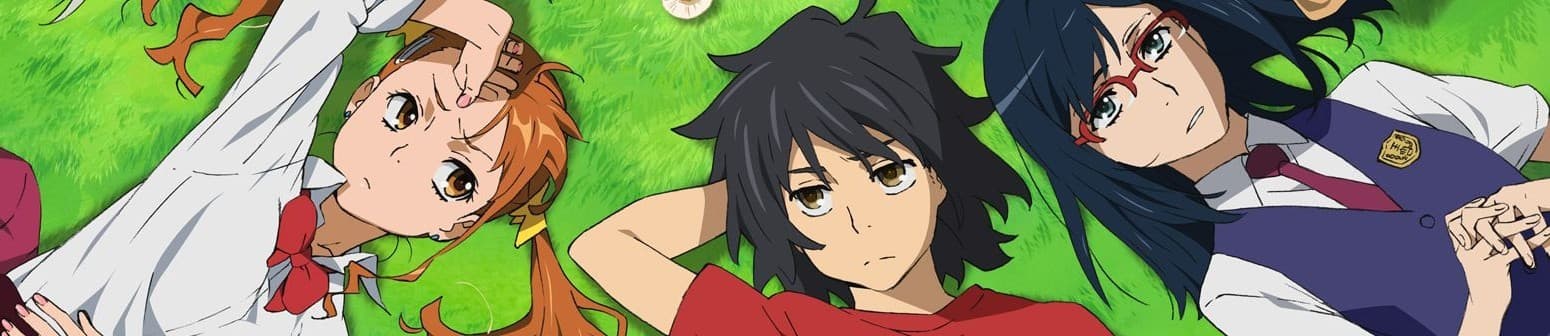
Death is like the wind, its always by our side, yet we never acknowledge it until we have to. For AnoHana, that is different. Ano Hi Mita Hana no Namae wo Bokutachi wa Mada Shiranai, or AnoHana: The Flower We Saw That Day is a masterful amalgamation of subtle musical storytelling, art styles, and character development that caps off with an absolute climatic and tear-wrenching ending episode. It tells the story of five friends-the Super Peace Busters- 10 years after losing one of their members, Menma, and how they each subsequently coped with her death. Right off the bat, it should be no surprise to anyone interested that this anime intends to get your waterworks flowing. And flow it did.
Story
The story is actually rather straightforward in terms of plot. One day in the hot summer, Jintan, our protagonist, is hard at his games when a grown-up version of his late friend starts annoying him. Upon realizing that he isn't having a heat stroke, he sets out to figure out what brought her soul back into our realm and gathers his old friends in the process. In terms of originality, it's low, not very creative. However, as the story moves on, the execution of well-placed flashbacks, character interactions, and a step-by-step-like approach to resolving Menma's troubles allow for each "layer" of emotions built up to subsequently crash into the ending episode, which I guess was definitely intended. You feel every high with the group, and cry with them at every low. It's almost like you're part of the Super Peace Busters as well.
Art and Sound
AnoHana did a fantastic job with art. Every single detail is important, and each character and background is drawn to be crisp and reflective. Each flashback and "childhood memory" is drawn to be distinctive and separate yet same. It's top-quality art you can usually only find in KyoAni works or Ghibli works. Props to A-1 for that perfect execution.
As for music, the memes speak for themselves. Anohana's OP: Aoi Shiori is light and bouncy, reflecting the nature of the Super Peace Busters, yet at the same time deep and touching, there is honestly a slew of things I can cover. But for anyone wondering I'd recommend watching the Mother's Basement: What's in an OP? Video covering the topic, as he dives into way more depth that I can possibly manage. The ED, secret base ~Kimi ga Kureta Mono~ is on a level of its own. It either plays right when the credits start rolling or a few seconds before it to do a cliffhanger-esque end (sorta like Jojo's Roundabout). With each time the ED comes early, it conveys that someone has struck a nerve and tears were going to fall. Therefore making your brain permanently associate this theme with sadness. This is especially true on the final episode, but that is major spoilers so to save you interested weebs who are viewing this review because you're interested about the anime, I won't spoil it :3.
Characters
Oh man, I can go on for hours about the characters, as each one developed their own persona around Menma's death. I'll go one by one for a more in-depth explanation.
As I mentioned before, each member of the Super Peace Busters was negatively affected by Menma's death. Jintan's is the most obvious of the bunch. The former leader of the Super Peace Busters descended into a deep psychological trauma after the event. Unable to come to terms with how his last words to Menma was calling her ugly. He has since stopped going to school, his grades dropped, and does nothing but be an indoor shut-in all day. This effect is further doubled because his mom died around the same time as Menma as well. Meaning that not only has he lost his dearest friend, but his mother. With the double slap of their deaths hitting him, its not surprising Jintan because a ghost of himself.
Next up is Anaru, a distinct tsundere, Anaru was someone who was very malleable to societal norms. This malleability and vulnerability to influence is a major driving force behind her decisions and subsequent mistakes. Menma's death made it only worse for her. Because with Menma as a role model, Anaru was partially blocked from outside influence due to her looking to Menma as an idol, but with her gone, she has no one to base her image off of, and subsequently becomes a ball of clay for her friends to play with.
Third is Poppo, he's actually the oddest of the bunch, because it appears that he was basically unaffected from Menma's death. However, take into context of his timid nature, slightly younger age compared to the group, and the fact he dropped out of high school to tour the world afterwards and it becomes clear what he is. His character development may not have been plenty, but it served enough to connect the reader to what Poppo truly felt when it is finally revealed of why he's been his cheery self.
Yukiatsu suffered from bottling up his emotions. It becomes clear that he is a calm and collected tactical genius, with flying grades and a school to prove them. However, anyone who's seen enough shows in general knows that its these types of people who are the most susceptible to bottling up their emotions in an attempt to keep their outer image intact. As of such, the calm and collected Yukiatsu dealt with Menma's death in the most unique of ways. However, once the group manages to break his jar of emotions, they come flooding out, revealing everything Yukiatsu has felt from the morning of Menma's death to the present day.
Tsuruko is the hardest to gauge, she's your typical ice queen, and doesn't break out of that shell for most of the anime, however, like Yukiatsu, once you break her ice barrier, she spills everywhere.
Menma doesn't have much character development, and remains mostly flat for the anime, this is most likely due to her being a catalyst for change in the other characters. I feel that this is a logical move because it would ultimately be useless to develop her since she is a ghost. However, they still put in just enough of her bouncy personality to make it hit hard at the end.
Due to the fact each character reacted a different way after Menma's death, the majority o the anime focused on the interactions each of these characters had, playing around with their personalities under the influence of each other, and ultimately creating a vibrant group that we can empathize with.
Ultimately, AnoHana was a great way to demonstrate change and the effects of death on people, and it dove deep into how we feel and manipulated them to create the rich anime that is AnoHana
64.5 out of 68 users liked this review
