
"Horror, by nature, is a personal touch -- an intrusion into our comfort levels."
When we think of Horror, we immediately think of it as scary. We fear the element of the unknown and the buildup towards it. But horror as a genre in anime is not scary. Anime can't be scary, but what it can be is creepy. There are many titles out there that choose to represent horror in the standard way that we view it, often becoming repetitive and cliché, but then there's this small grain of salt. The gold in the rubble. An attempt to portray Horror through art: Mononoke.
Story:
The general story is that of an enigmatic wanderer who goes by the profession of an Apothecary or Medicine Seller. He wanders off to different locations and even time periods, looking for Mononoke or in other words, hostile spirits. Mononoke are a type of Ayakashi that roam the human world due to the grudge, hatred and regret that they hold. The medicine seller does not only go looking for Mononoke but also exorcises them. The only way he can do that is by knowing the Form, Truth and Reason of the Mononoke. The only way he can get that information, however, is by learning about the Mononoke's past.
Mononoke is a spin-off of the final arc (Bake Neko Arc) in Ayakashi: Japanese Classic Horror. It is perhaps because of the last arc's appeal, that a spin-off was created. For those who are confused about Mononoke and Ayakashi, only the last arc of Ayakashi is connected to Mononoke. This means that there are three options.
Anyway…I must say that the execution and approach taken towards the subjects was well done. If there was one thing that I really liked about the stories, it was the aspect of individualism. Each arc is individual in a way that each of them has a unique approach towards the subject matter. With no overarching storyline, Mononoke focuses not on the Medicine Seller, but the Mononoke shown in each arc, hence the title of the show, Mononoke. Each arc offers an individual approach yet manages to retain the same formula and that is mainly due to its narrative restraint. The narrative restraint being the fact that the form, truth, and regret are needed. Without those three things, the Medicine Seller cannot exorcise a Mononoke. Without that narrative restraint, there would be no tying element for the individualism that each arc offers. There are five arcs in total, covering a wide arrange of dark and emotional themes. At the end of it all, I definitely believe that it deserves more episodes.

Art and Animation:
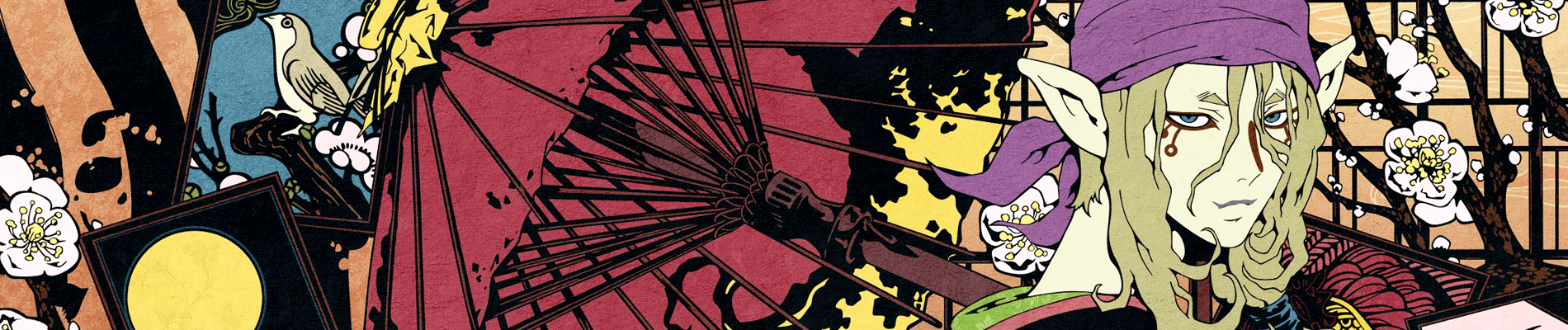
Albeit it may not be everyone's cup of tea, Mononoke is definitely unorthodox and takes a dynamic approach towards not only representing its story but also its world. The bump-like textures of paper and the art style makes each scene appear like a painting. Not only that, but they also make use of several cinematic methods. From flip books, fast transitioning, 3D objects, and still/silent scenes (I once thought I accidentally paused the show), Mononoke definitely made a big risk. They also utilize the aesthetics and color palettes to their max potential, creating the individual approach that each arc has. One example is the Nue Arc. It starts off with gray and pale colors, but later turns into an explosion of colors based on the feelings of the characters. Another example is the final arc in which the train station is represented with darker palettes to show how monotone the industrialized world is. The show goes full on with imagery and does not restrain itself even during disturbing moments. The only complaint I have with the visuals are the character designs. Some character designs look ugly and repetitive, but it doesn't become a major issue because the anime doesn't last very long.

Sound and Music:
Various personalities in Mononoke are well shown through not only the visuals, but the voice acting and dialogue as well. The seiyuus did well especially Takahiro Sakurai, the voice actor for the Medicine Seller. The sound and the visuals also support each other well whenever one of them is limited. The sound in particular plays a key role in creating that tense atmosphere which we have grown accustomed to in the Horror genre.

Characters:
Various characters that appear in the series do have a background story good enough for what is needed. The Mononoke themselves also have stories. The protagonist, however, doesn't. Despite being a recurring character, we are left not knowing exactly who the Medicine Seller is. He doesn't speak his name and neither does he show any real emotion. The show does take advantage of its narrative restraint because the only way to find the form, truth, and reason is by fleshing out the details of each supporting character that is necessary to the story.

45 out of 50 users liked this review
