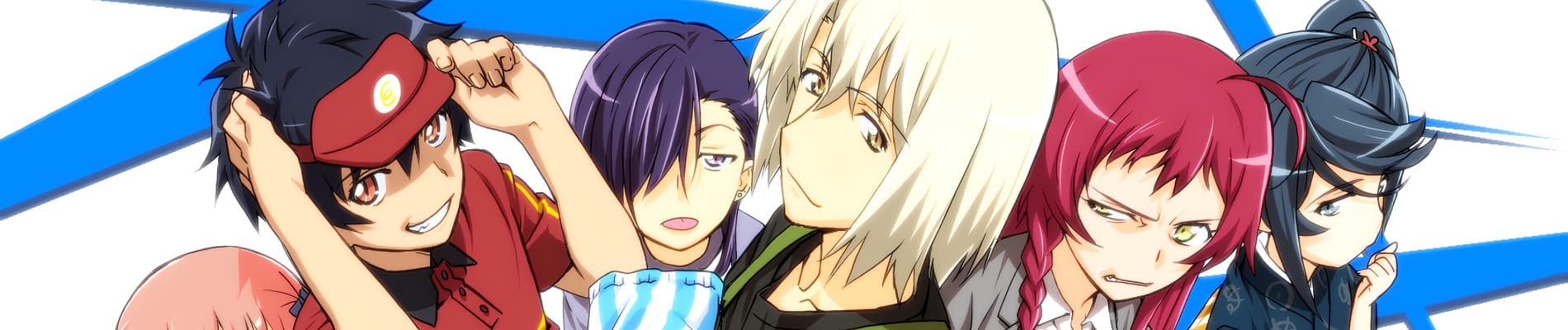

TheOdd1sOut once said, "Everyone at some point in their life should work in a fast food or a retail job." In all honesty, that statement couldn't be more true. The rush of the service industry gives young up-and-coming future entrepreneurs a taste of the world they'll be stepping into when they leave their high school/university doors. So what happens when you take that maxim and apply it to someone who's obviously never even heard of the concept of hard work? You get a (fairly) original Reverse-Isekai anime that becomes the talk of the season and many more after that. The Devil is a Part-Timer places a lighthearted tease on many aspects of life a fresh-out-of-college youngster would experience, and it illustrates an interesting story of how a person as potentially powerful as Maou overcomes it all while finding time to get into classic Isekai anime shenanigans.
Plot
The story immediately starts with something most Isekai animes don't even dare address in the name of character development — the downfall of the villain, or in this case, our protagonist. Overlord Satan's armies are being driven back at every frontline, the Hero Emilia and the church's knights are closing in on his fortress, desperate, he and his general Alciel escape to modern-day Japan to regroup, only to find that our Earth lacks magic ability and they are therefore forced to settle down here and bide their time until they can get back. They set up identities (so I'll also start using their alias names), rent a home, and start working in the workforce. The anime immediately shows its attempt to break the mold by starting with this premise, usually, when animes attempt at motives that break the mold such as this one, they usually end up flopping. But not this one, and for reasons we'll soon see, because the Hero Emilia had followed them through the portal, and just like them, she finds herself trapped and forced to bide her time as well. The two sides are given just enough screentime to display that they have gotten comfortably used to their new lives before they encounter each other. And from there the anime really takes off, showing each character trying their best to address the clear differences between their past and current selves. Maou is now a prominent shift manager at his local fast food chain and Emi is now a hardworking service centre call employee. The anime does a phenomenal job of painting how easily foreigners can come to enjoy our world. Having hailed from a world that is technologically behind than our world, we see Maou and Emi respectively learn how to adapt to our society, as well as learn to love it. Maou starts garnering the attention of his coworker and potential love interest Chiho, Emi starts making friends - something she wasn't able to do as a Hero, and Ashiya learns how to assert his dominance both as a successful homemaker and Maou's financial manager, all while being his go-to right hand man. Their attachment to our world only deepens when more characters start joining in, as we see significant developments in their personalities, but more on that later.
 Dullahan the bike MVP
The fact that this show managed to cram so much into 13 episodes and still make the ending feel whole and complete is impressive by any standards, in around 400 minutes we not only see wholesome world development and progression, but also significant development in not only the main cast, but also several supporting members who join in later on, and we still have time for a ~~beach~~ pool episode that meets, by minimum, my rule for any filler episode: it can't slow down the plot. Overall, the ending didn't leave me feeling empty and desperate for a second season, but satisfied and curious to see what a second season would be like. Unfortunately, given that this was released quite a while ago, it's safe to say this anime will start rotting into the fabrics of time along with No Game No Life...
Characters
This anime excelled very strongly at their character development. As I mentioned earlier, in just 13 episodes it made, at the very minimum, its main characters feel very rounded and well-developed.

Maou's character development is the definite highlight of the show, as his attitude towards the world took a complete 180, which is the entire reason why all the character interactions in this show occur. In the first episode, he's seen as apathetic towards our world, deciding to only bide his time for the sake of returning as fast as possible. However, while the anime doesn't mention it explicitly, Maou has quickly grown attached to our world. Through working up the corporate ladder to getting to be able to comfortably talk face-to-face with other people without them fearing him, he realized that normalcy is really a blessing. Because of this, he's reluctant to return to his home of Ente Isla, preferring to live out his life here as just another citizen of Japan.
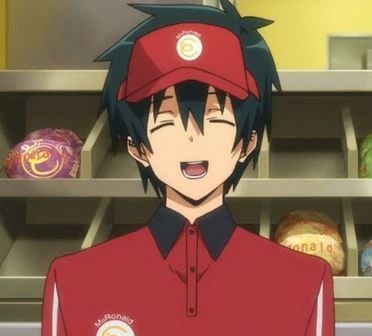
We see this love for our world in action every time someone from the Church faction of Ente Isla encounters him, as all of them are surprised at how soft he's grown and how willing he is to expend his limited magic power to save other people instead of causing even more chaos to absorb more magic. This development also gives the anime a new underlying story, it's now also a redemption story for Maou, he has a new start and he wants to start fresh and no longer be on the receiving end of hate.
This interaction also causes Emi to question her reasons for fighting against him. Sure, back on Ente Isla he was a ruthless dictator who killed thousands, but here he's just a normal person. This judgement of him is where Emi's personality takes off, she's shown to be cold and steel-hearted because of the way she was brought up, but upon seeing Maou happily living his life here in Japan, and fight for its safety without even batting an eye, Emi is lead to balance her values as a hero. Does she put an end to this former ruthless killer? Or do they just live and let live and enjoy the qualities of our world together? Her character arc is entirely based on her question just what she's fighting for, and its through that internal turmoil where her character blossoms.
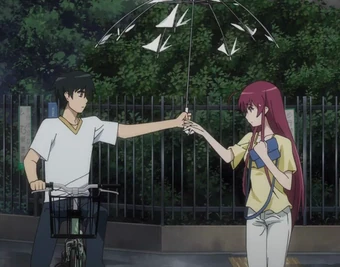
The change in these two's previously contrasting personalities generates a whole new perspective for everyone for their morals, as more people arrive in Japan, they find themselves also enjoying their lives here, painting another underlying motive of just how much we take our wonderful world for granted (of course, the show is set in one of the most technologically advanced cities in the world, but we'll let that slide)
Art and Music
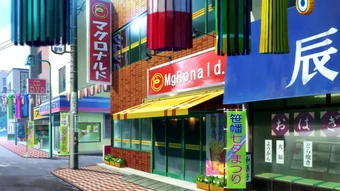
I honestly cannot complain at all about the production quality. The world feels crisp, real, and I swear I've never seen a sexier Big Mac, and the music shines through in so many flavors. Scary when it needs to, dramatic when it can. But in my opinion the true MVPs of this part of the review would have to be the VAs. They did a great job highlighting the best parts of each character. Hikasa-san did a phenomenal job of bringing Emi's tsundere-ness to life, and Oosaka-san clearly had fun while voicing Maou's parts, you could hear the anguish in his voice laced with that underlying tone of happiness coming straight from his heart every time poor Dullahan falls prey to another's malicious acts of destruction of property.
Overall, Maou was a phenomenal take on conventional unconventional Isekai twists, it was thoroughly enjoyable like Konosuba, Phenomenal with its slice of life like Kobayashi and Senko, and, dramatic in its zeniths like Shield Hero. Definitely worth watching, and I hope that a second season won't be impossible.