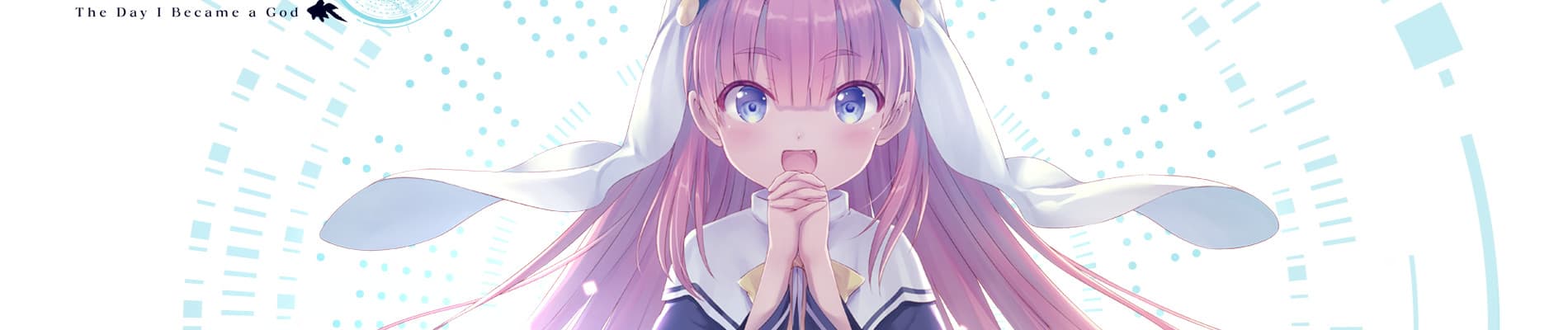
How on earth does an original Key anime, helmed by none other than Jun Maeda himself, struggle to barely crack the Top 10 for Fall seasonals on AL? How did a promising premise from a strong first episode morph into a completely different show in its second week? Also, why was I OK with that? Also also, when did I stop being happy with where things were going?
What in god's name is going on?
If you're looking for answers, you've come to a terrible place; but I'll do my best to give my take on all the above points and more. This review contains mild spoilers, so feel free to skip ahead to my Tl;Dr if you'd like to go in blind.
KS introduces the audience to Hina, an odd girl dressed like a nun. She approaches the unassuming protagonist, Youta, and nags him to let her crash at his place (this isn't a sus thing, I promise.) You see, Hina claims to be a god capable of predicting future events, and has foreseen that she'll be staying over at Youta's for the time being. Obviously our baffled MC has no reason to believe her audacious claims, but several demonstrations of her divine abilities force him to accept the improbable: that the mysterious Hina really is a god, and that she's offering to act as his personal genie during her stay. But there is a catch: in 30 days, the world ends. It's a great hook to kick off a series, one with limitless potential. Youta is allowed to live life in any way he chooses, with no consequences. And as a title card counted us off towards the impending apocalypse, I was left with several questions. What will Youta do with this power, and what adventures will he end up on? How exactly does the world end? Just who is Hina anyway?
KS' second episode, in stark contrast with the ambitious series pilot, goes as far as to sideline Hina and spend 15 minutes doing budget parodies of '90s Hollywood blockbusters. KS only kept up this trend in the coming weeks, putting aside its promising story in exchange for an episodic sitcom. Short asides, featuring a gifted hacker tangled in a mysterious corporate investigation, would serve as the only reminder that KS actually had, y'know, a plot. The Doomsday Clock continued to wind down with every episode, but I'd never feel like KS was headed anywhere.
As the kind of critic who finds himself with the bad habit of lamenting over missed storytelling potential, I was uncharacteristically forgiving towards KS' first half. That's because the show still managed to pack some elements that kept things enjoyable from week-to-week. The first idea that seemed interesting was the series' usage of fatalism. The world is coming to an end in 30 days, yet no one in the cast seems to care. There's something pretty funny about Youta encountering a deity, only for him to continue spending his summer in the most vanilla way possible - studying for finals and playing video games. While the characters aren't complex enough to acknowledge these philosophical ideas, I did find this theme amusing all the same. The threat of Armageddon is never depicted as a depressing existential tragedy or anything, but leans towards a somewhat optimistic direction instead. Sure, there are circumstances fated to happen, beyond our control. So let's just focus on making the present the best it can be. Another highlight worth praising is the entertaining comedy. This caught me off guard, given that it wasn't particularly an aspect of the script I was looking forward to. My previous run-ins with Jun Maeda shows involved the borderline sleep-inducing first episode of Clannad and the absolutely absurd energy of Angel Beats. Neither were really to my liking, but KS brings the best of both worlds together for a winning combination. The show walks a fine line between realism and absurdity, with a mildly-heightened reality that snowballs its lunacy to hilarious effect. KS uses Hina's powers to account for some silly contrivances that ensure each episode feels different from the next. Sure, the gags don't make a ton of sense at times and they can often drag throughout an entire episode's runtime. Yet the show makes itself really easy to enjoy, taking inspiration from Love Is War through the use of dramatization and pop culture references. Hina and Youta's VAs complement this chaotic energy well, with great line delivery from both.
Memories are part-and-parcel of the human experience. Some of them are fun and enjoyable, and those happy moments can bring all sorts of people together. But, as explored in Ep 5^, other memories can be dark and murky, causing pain as they linger in your mind. KS looks at how memories influence our thoughts and motivate us to take action. It's in those bleak places where we need to seek closure and look ahead, clinging to our past while seeking out the future. And in overcoming those obstacles with those we love, we strengthen our bonds and make new memories to look back on. This theme offers an explanation for why the show was willing to forego the big plot teased in the first episode. KS was more concerned about putting together a wild summer filled with adventure, fun and heart. Those days of sun were presented really well, thanks to great work from P.A. Works. The studio hadn't quite topped themselves or anything, but average P.A. visuals still look more stunning than most studios' best works. Na-Ga makes a comeback with KS' character designs, so be sure to look out for those if you're a massive fan of Key instalments. Personally my favorite inclusion to the show was its soundtrack. Nagi Yanagi shines with all her song performances and accompanies the cast on their Summer holidays. As the world neared its end, these friends made great memories, which geared them to face the uncertainty of KS' second half.
And here's where things start to fall apart.
If I were to summarize KS as a whole, the phrase I'd come up with is "don't worry about it." There's no need for a grand overarching plot that fully utilized Hina's powers, there was no need to worry too much about generating big conflict. It's all about having a good time! It's a chill approach that I could get behind, and didn't turn out all that pointless either. However, a couple of problems persisted, taking this thoughtless construction to an unhealthy extreme. Characters felt largely one-dimensional, and the unnecessarily large ensemble cast made matters worse. Youta is a boring blank slate who's in love with his childhood friend, and has to rely on gimmicky stage-impersonations (ramen connoisseur, mahjong prodigy, etc.) to disguise his one-dimensional nature. Not too much I can say about Hina^^, but the other main characters don't fare all that well; given that Izanami and Kokuhou are supposedly Youta's best friends, it never feels like he gets a lot of time with them. Things get sillier when we look at the rest of the ensemble, which feels even more inconsequential. The biggest offender is Miss Tengan, who adds absolutely nothing to the story. All she does is act grumpy and show up for the most asinine of reasons. Sora's entire, like, personality is totally based off, like, how a boomer author thinks pre-teens talk IRL. Oh, and there was this loan shark dude who started off as a bad guy, had his entire character arc take place off-screen, and showed up uninvited and reformed a handful of episodes later. Having the core characters underwritten isn't a huge gripe for me, but seems mildly puzzling given that Maeda is supposedly an expert at tugging the heartstrings. This problem, coupled with the overbearing number of side extras, means that the script has no choice but to give important characters rushed flashbacks that introduce their backstories. Speaking of the script, it follows the aforementioned trend of not really giving a shit. Due to the nature of the first half, there's little in the way of objectives or goals that Youta and the gang need to work towards. Maeda's idiosyncrasies as a writer also means he takes any and every opportunity to elicit an emotional response, at times to the detriment to the story. But eh, subtlety is kinda thrown out the window sometimes. If there's an extreme road to take, you can count on Maeda to stack his chips and go all-in. Suspension of disbelief doesn't really matter, "don't worry about it."
The guise of a "turn-your-brain-off" comedy comes apart quicker than one of Youta's silly impersonations, leading me baffled at several of the show's writing choices. As it turns out, the reason why Maeda overstuff KS with cast members is for a big attempt at emotional payoff in its penultimate episode, reinforcing the message of finding strength through good memories. But while thematically sound on-paper, it landed pretty weak within the show, because the characters that shared those moments with Youta didn't create much connection with the audience. Poor pacing made me feel that the show was still spinning on its heels, even in the most vital of moments. The script doesn't go full-Charlotte, and the final episode manages to stick a somewhat satisfying landing. However, it does find ways to go off the rails in other areas. Hina's powers are far from the dumbest plot contrivances in the show, which Maeda crams in arbitrary conflict and bizarre choices that only serve to further pad the runtime^^^. A couple problems that could be solved with a simple conversation instead are dragged out across 15 minutes, and other obstacles are thrown in a messy way to generate artificial issues that are less tense than confusing. These strange issues distract from what would otherwise be powerful moments on their own right.
Props to him for the attempt, but his questionable writing makes me wonder if those emotional beats ever reached their fullest potential. With all this being said, I've decided that the biggest weakness of KS is a lack of direction. Outside of its central theme, audiences don't have much to latch onto other than a mystery box hanging over their heads. Unfortunately the box is opened far too late into the story and forces Maeda into a corner, resulting in poor writing choices that ensures that the entirety of KS is lesser than the sum of its parts.
Kamisama is unquestionably at its best when spending its carefree time in the summer. A neat theme about cherishing memories is accompanied with entertaining laughs. While seeing a wasted premise felt somewhat disappointing, this unexpected approach made me curious to see how KS would balance its more emotional elements later on. However, the script by Jun Maeda appears ill-equipped to deal with the storytelling potential teased since Episode 1, favoring to leave aside a majority of its hefty pacing responsibilities to the very end. This "mystery-box" storytelling necessitates weird plot contrivances and limits the places our story could go. Our already-messy script then undergoes more padding, which leaves more questions than answers and distracts from the emotional moments. There's no clear goal throughout the series, and it's a trick that worked… until it didn't. 5/10~
And that's all I have to say about Maeda's latest work. Apologies if I seemed a little too hard on the guy, his reputation really precedes him for all the right and wrong reasons. Although given how entertaining some of this show was, I may finally be inclined to give his older works a second try. If you happen to like my verbose rants, feel free to check out my other reviews for seasons past and present, peace~
66 out of 72 users liked this review