

This Review Contains Spoilers for White Album 2
 I love love.
Yet I hate seeing so many people loving love.
Does that make sense?
No?
Okay, well let me try that again.
I consider myself a hopeless romantic. I believe in love at first sight, I dream of having an opulent marriage ceremony, I think sex is best used as a melding of two souls who love one another; all of that jazz. That said, I'd also consider myself a supremely unlucky person, romantically, to the point where Sweetest Day and Valentines are more than likely to put me in a major funk. When you fear that your heart will never again find another, seeing countless depictions of characters finding love can prove tiring. While you can live vicariously through characters, there's a point when you become jaded and even the sweetest of romance hot cocoa becomes a bitter love story coffee. I've found myself desiring a romantic work that more caters to love's bitterness as opposed to its sweetness. I don't want every single romance to be a depress-fest, but I don't think a little affirmation — something to tell me I'm not alone — is too much to ask for.
This is largely how I approached 2013's White Album 2, an adaption of a visual novel of the same name. I had been pretty disappointed to discover that my melancholic, realistic romance turned out to be as sickeningly sweet and escapist as your run-of-the-mill love story. As me and other fans of the show stood amidst the wreckage that was the finale, I heard the title White Album 2 thrown around quite a bit. Many are of the opinion that White Album 2 provides the more realistic romance that viewers of Yesterday were looking for. I had already heard of White Album 2 before — on the r/anime subreddit, it's largely lauded as a realistic, subdued, bittersweet character-focused romance with at least two popular "watch this" threads to its name.
However, I found out that some of the fine folks at Anilist were less warm towards the show. So which is it? Is this the Best Thing Ever, blowing every other romance out of the water in its realism, or is it a tepid show that only stands out among the crowd because so few other romances take the sad route?

As with most things, the truth of White Album 2 is somewhere in the middle. Watching the show, it's undeniable that, as a whole, White Album 2 is more effective than Sing Yesterday — unlike the shoddily-ended romance of nigh-yesteryear, White Album 2 commits to its themes throughout and its ending is a sight to behold. That said, ever the Goldilocks, I must admit that it didn't feel "just right." I really don't want to say "heart factor" because I feel the more I say it, the more insane I sound, but that simply could be it. Save for the ending, White Album 2 never resonated with me the way Sing Yesterday for Me did. Perhaps we can work through exactly why I feel the way that I do.
White Album 2 tells the story of Haruki Kitahara, a third year highschool student who has dreams of elevating his light music club to the next level by performing at the annual cultural festival. Through his passion, friendliness and love of the eponymous White Album, Kitahara recruits the high school idol, Setsuna Ogiso and a talented yet aloof pianist, Kazusa Touma. As anyone in a band knows — getting good enough for a gig is only half the battle, maneuvering with the other members is another. Kitahara soon finds himself strumming the chords of a heart instead of a guitar.
This isn't quite as high-concept as something like the last work I reviewed, but it's nowhere as near as low-concept "Sing Yesterday For Me." Let's just call it "upper-middle" concept. This "upper-middle" concept is the best of both worlds, being more character-focused than high-concept works, yet still giving you enough of a plot to latch onto if the characters aren't quite up to snuff. I won't say the band element was the most gripping thing in the world (and good thing for it, as it's essentially dropped during the final fourth of the show) but it was interesting enough and I liked seeing the trio progress as a musical group. The band plotline provides a nice hook for the characters to begin interacting with one another. And as I alluded to before, the band plotline knows how to make itself scarce to focus more on the characters. When the characters finally perform, there's a sense that the "real" story is just beginning.
It would be a shame if a music-focused anime had a bad OST. Fortunately, that's not the case. While I won't say every piece is a bop™, the insert songs are fantastic and the songs that the trio actually play are a treat.

White Album 2 has a pretty good atmosphere — the character designs are realistic enough and while the colors aren't muted, they're not the most vibrant either. For these reasons, the anime doesn't wear its down-to-Earth nature on its sleeve nearly as proudly as Yesterday. This is an anime that, at first glance, may seem fairly run-of-the-mill. It's part of the 95% of anime that takes place in high school, the first episodes will occasionally employ silly cliches like a character getting jealous due to a misunderstanding, and as I'll get into, at first glance, the three leads can come across as cookie-cutter. It's only when you stick around that you realize this is something more real, more grounded than your standard anime fare.
This realism is mostly due to White Album 2's main characters, Kitahara, Ogiso, and Touma. Since the story becomes increasingly focused on the trio and their interactions with one another, your enjoyment of White Album 2 ultimately comes down to your interests in the characters, moreso than your interest in the band plot. I'm pleased to say that I found them interesting throughout. Even if I disagree with their actions towards the end of the show's run, there's never a moment where I think "these characters don't work."
On the outset, the members of the trio come across as simple — simple enough that you can seemingly distill the characters into a few lines. Kitahara seems to be your standard high school anime protagonist — nice, friendly, bland and inoffensive; a white bread slice of a character. Ogiso is your genki, friendly, slightly scatterbrained popular girl. Touma is the aloof ace, the few words she spares only seeming to affirm her coldness. The benefit of such seemingly simple characters is that they're easy to identify and latch onto. Not too long after meeting Touma, I knew that I wanted Kitahara to end up with her instead of Ogiso. The drawback to simple characterizations is that they come across as shallow and generic — if you've seen a romance anime before, you'll assume that you've immediately seen all these characters have to offer and be turned away from them. That's where the beauty of White Album 2's characters come in. Like transformable robot-to-car toys from the eighties, they are more than meets the eye.

For as bland as he appears, Kitahara does have things to latch onto. His kindness and tenacity seem to go above and beyond what's required of a quasi-harem protagonist. His earnestness, such as when he shimmies across the ledge of a window to try and procure his last bandmate, has to be seen to be believed. I ended up admiring his gumption. Therefore, he deserves to be upgraded from "white bread slice." I won't go crazy and call him "cinnamon raisin bread," but he's at least "sourdough."As I'll describe in more detail, like similar protagonists, he unfortunately does end up disgustingly hurting people who care about. Even while I end up hating him for it, it seems different somehow — less calculated. It comes across less like he's actively behaving in a way that's untoward and more that he's such a reactive moron when he's impassioned that he doesn't think. It's still awful, don't get me wrong, but there's a cause distinction between "ignorant" and "malicious" even if the effect is largely the same.
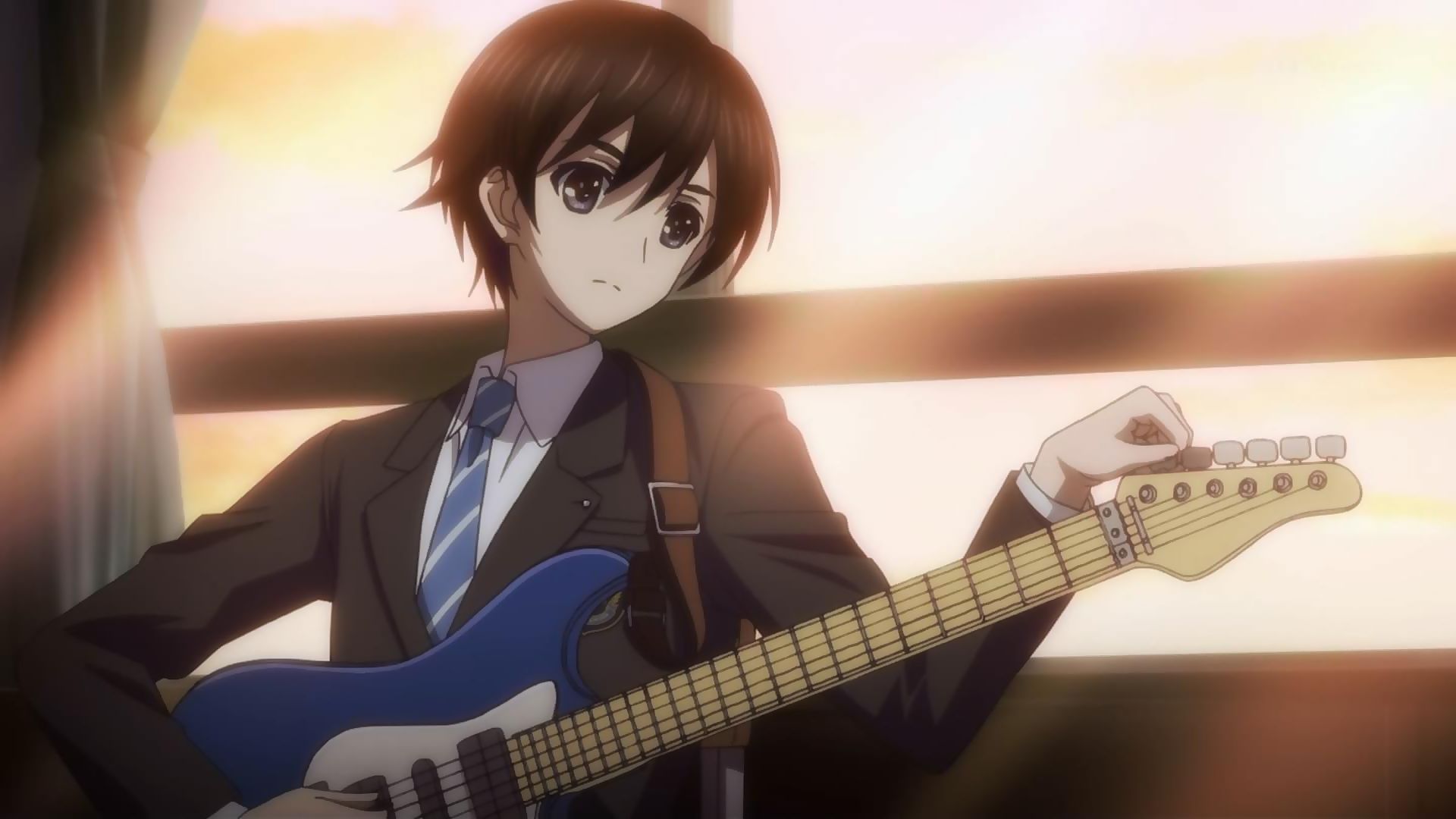
Touma has a somewhat sad home life in which she's always trying to surpass her famous mother. She's an ace when it comes to playing music, but we soon see that her grades are poor. Her coldness and aloofness are recontextualized — it seems as though she's less intentionally aloof and aloof as a product of not being able to interact with that many people. Her coldness seems to be more directed specifically at Kithara; it's the teasing someone does when they're close to another. While she may seem haughty at first glance, in truth, she's quite insecure. Ogiso, is brighter than one may assume, and suffers from loneliness perhaps more pronounced than Touma. From this, her desire for the trio to always be together ends up coming across as more sad and desperate than it would from someone else — she needs this. After all her friendliness, she can be surprisingly self-serving and cutthroat.
These expanded personalities all serve White Album 2's theme in some fashion. If the first half of the show is dedicated to showing the beauty of platonic and romantic love, the second is committed not only to showing love’s hurtfulness, but its messiness as well. When love hurts, it sometimes doesn't just hurt you, it hurts others connected to you, as well. Sometimes when love hurts, it doesn't leave a clean wound that can be patched up; it's sometimes damaging enough to destroy an entire relationship. Simply put, love is often less like a bullet and more like a frag grenade. In White Album 2, loving actively hurts others due to multiple people loving someone (both Ogiso and Touma fall in love with Kitahara), bad timing (Touma has loved Kitahara for some time now but by the time she realizes it, Ogiso has made her move), and entanglements (Kitahara realizes he loves Touma, but by the time he does, he's already in a relationship with Ogiso), among other problems. This is a place where I think the love triangle works — there's no clear-cut best option — all characters are introduced around the same time and are given roughly the same amount of importance and screen-time, and it's depicted as realistically messy, with no "clean up" at the end.

That said, one of my biggest gripes with the anime is the fact that it seems not to trust love hurting being compelling enough of a drama. No, instead, it felt the need to make its characters actively despicable. Come the end of episode 11, Kitahara realizes he loves Touma and passionately kisses her. She reciprocates for a bit before breaking away and slapping him. This reaction is due to the little tiny detail of Ogiso being his girlfriend at that point. If this wasn't enough, the two then have sex in episode 12, still while he's with Ogiso, mind you. Infidelity of any sort is a sure-fire way to make me hate your character with the fiery passion of a thousand suns. In an instant, I was turned off from the character due to how scummy he was. And yes, as I said, you could make the argument that he wasn't really thinking, but it was still a horrible thing to do. Even if I don't hate him as much as, say, Kido, it was still disgusting and rubbed me all sorts of the wrong way. Touma having sex with Kitahara robbed her of any goodwill the slap granted her. If that wasn't damning enough, a flashback reveals that before she knew of his feelings, Touma kissed Kitahara in his sleep, a fact which the anime frames as cute since she's a woman, but it would justifiably acknowledge as creepy if the genders were flipped. After building up liable characters, White Album 2 destroyed them. I get flawed characters, but these people are just plain gross.

People say the kiss is shocking, but I couldn't garner any shock at someone being a jerk — just anger. Granted, I was spoiled about this development. I concede that, perhaps if I experienced this scene the "right" way, I'd be more shocked. I still stand by the showrunners not needing to make the characters act so badly in order to drive home the point that love is messy.
Besides that, the biggest mark against White Album 2 is that, more often than not, I find it kind of boring. I know I said I found the characters interesting; I stand by that. I also stand by me liking the band plot. I hate that I can't really put my finger on why I found things so boring. This feeling of boredom was most prevalent during the second half, so ultimately I think it's just because there's very little to keep you coming back. Say what you will about Yesterday's overly-sensational cliffhangers; at least they give you an incentive to come back to a very chill show. Without that, there's very little reason to watch episodes in quick succession. White Album 2 is generally compelling, but it's never gripping especially when the plot exits stage left. While it's a drama, it's slice-of-life pacing can be somewhat dull. Perhaps it's due to me not being able to immerse myself in the world as much. I was very excited to follow college-age characters before realizing that the characters of the first White Album are in college, not these ones. Maybe it's because there's not that much character development? I think the characters are more layered than deep. It's nice getting to peel back the layers and see who they really are, but without actual, large change, they can still come across as a bit shallow, if not still interesting.

Even with my criticisms, I have to continue giving White Album 2 credit where it's due. Unlike Yesterday, it absolutely sticks the landing. While I hate how Touma and Kitahara turned out, their absolute disregard for others' feelings made the ending possible. Touma has decided she'll leave overseas to study with her mother. Ogiso and Kitahara go to see her off. Despite Ogiso knowing of Kitahara's cheating, she isn't mad at him; the poor girl thinks it's her fault. The two make it to the airport. Touma and Kitahara embrace and kiss goodbye in full view of Ogiso who watches on, broken. The two then watch as her plane departs. Ogiso talks throughout, her denial showing in how she hopes the plane will turn back and acting like her and Kitahara still have a future. I didn't cry, but I'm not sure that was the intention — I felt empty. Empty knowing that despite her best efforts, Ogiso's friends will drift apart; empty knowing that love didn't prevail and Touma essentially ran away from the pain she felt in Japan; empty as I realized that Touma and Kitahara's passionate love was destructive and selfish; empty knowing that there isn't a happy ending, just a bittersweet one that's more the former than the latter; empty seeing the flurry of snow the characters find themselves in — beautiful, yet cold. White Album 2 adapts the introductory chapter of the visual novel and, honestly, I don't think I want to see how the story concludes. Sure, it could be better, but it will more than likely be a sappy ending that tarnishes the sad beauty of this moment.
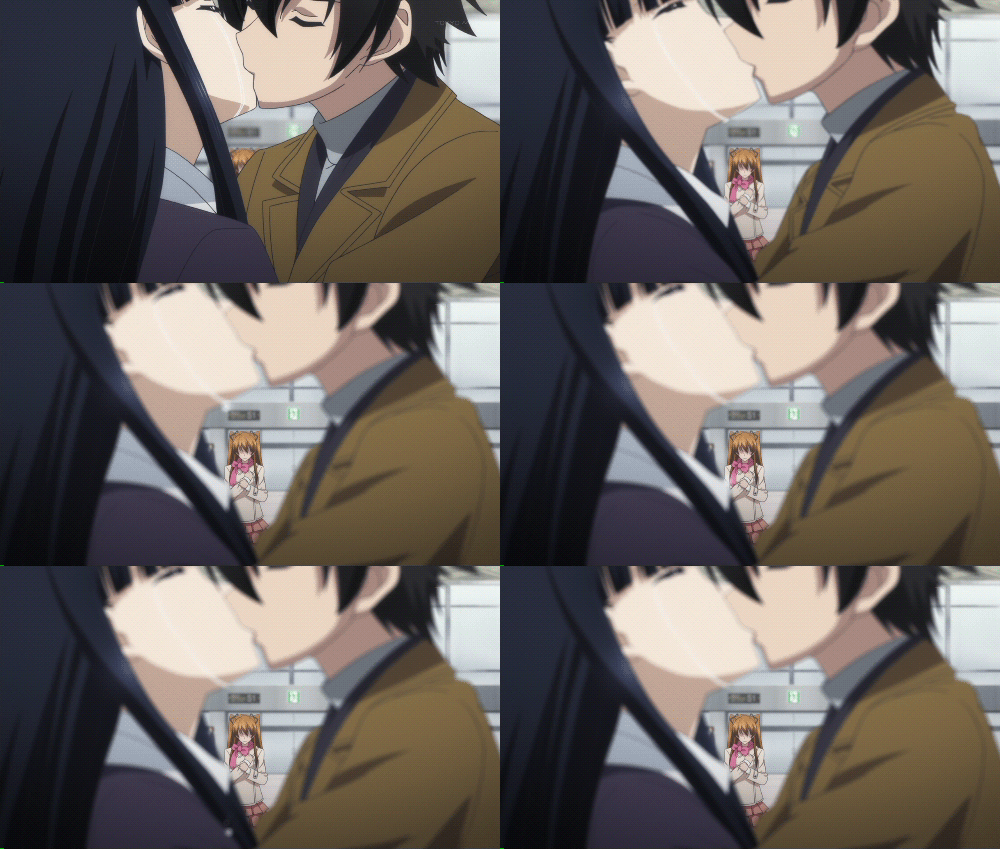
It's a bit hard to reconcile the boredom and anger I felt before with the beauty that came after, but I'll try my best. White Album 2 is a show where both the journey and destination matter. The ride isn't always smooth, but it's pleasant enough and the destination is good enough that you'll be glad you stuck with it. In concept, White Album 2 is nothing special, but it makes up for it in consistency and execution. Yesterday is something that squandered its potential while White Album 2 is something that made do with the little that it had and I admire that. While it's certainly not my favorite and never really resonated with me until the end, White Album 2 ends up being so competent that I have to score it well on technical grounds. I just wish it was a bit more exciting, a bit more daring in concept and setting, a bit more trusting of love itself to be the bad guy. But even if the chair isn't quite "just right," before I go shopping for more, I'll lean back and accept "good enough."
8.0/10
B-
