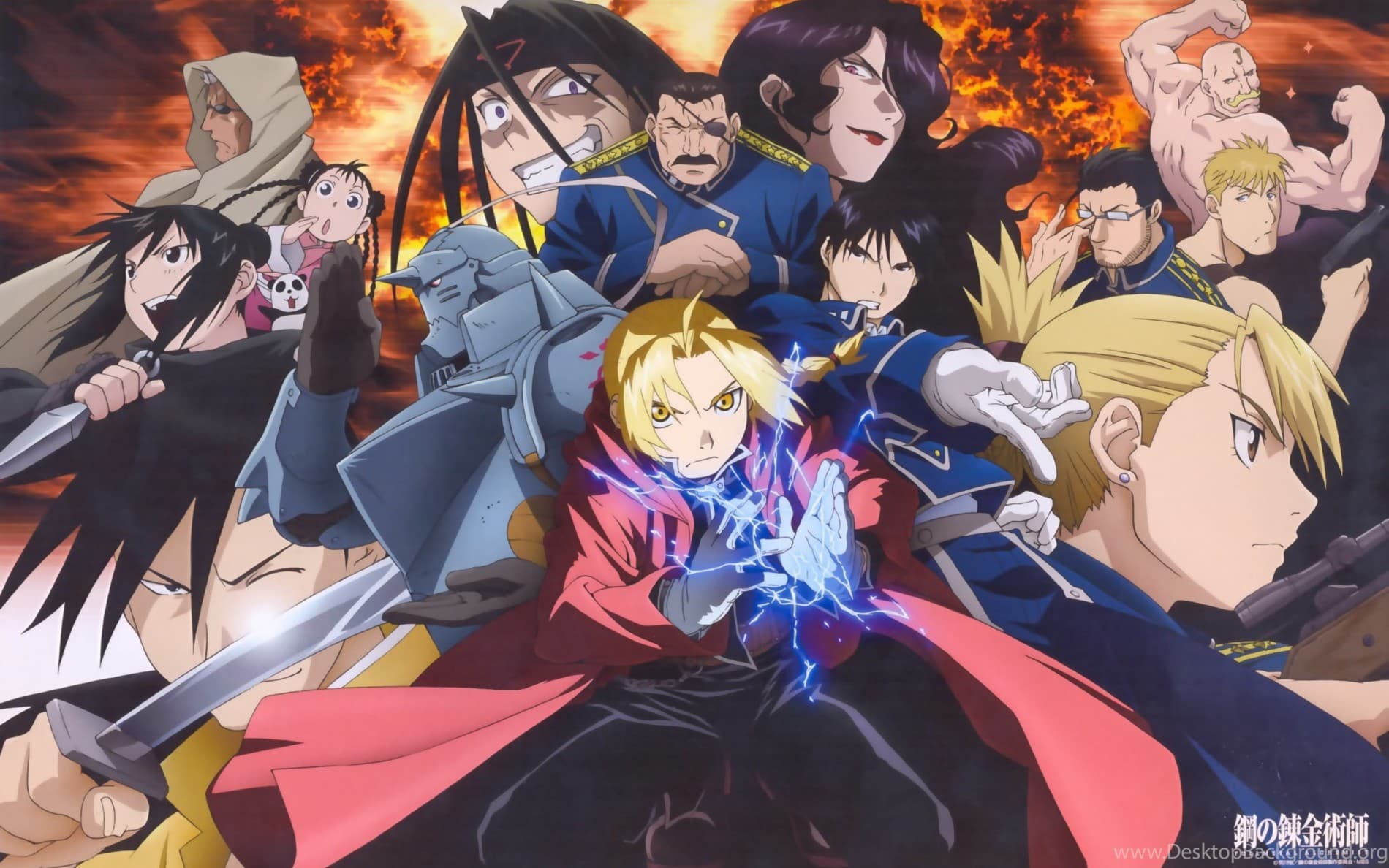

As always constructive feedback is appreciated. If you want to talk with me about something, even if not about this review, feel free to hit me up on DMs or discord. The first half of the review is spoiler free, except for two marked spoilers but the second half is not (I have a warning at the beginning of the second half so don't worry).
Being a series that introduces many to anime, I might've went into Fullmetal Alchemist: Brotherhood with my expectations higher than I would normally prefer, believing that it should represent the medium in the best way possible. Fortunately, these naturally high stakes didn't end up affecting my experience in a negative way, because at the time I'm writing this I can say that I'm glad I thoroughly enjoyed it for what it was.
#How to build an ambitious work

I've always appreciated epic works with ensemble casts of well characterized characters. If their little stories and perspectives end up coming together to promote one main theme, all the better. In this case, this type of narrative allows for the viewer to experience all kinds of manifestations of human nature, making it so the battle against the non human faction has more meaning and feels more fulfilling. It was impressive how every sub-plot made sense stand alone yet also fit perfectly with the main plot.
Spoiler, click to view
Through the course of the series we get to meet a big variety of characters with different backgrounds, ways of thinking and experiences and the series reunites most of them by the end, promoting this idea of connection that the antagonists' side doesn't have.Despite this, I can't help but feel like some of the characters were not focused enough due to how spread out the narrative of the series is. Scar's development for example felt very sudden and shallow, even if I loved the idea behind his character.
#Its efficient setting
I adore complex settings in which every element adds something of substancial theme wise, and in that aspect FMAB did not disappoint either. The world of the series feels realistic, diverse and alive, with all groups of characters and plot lines intertwining and interacting with one another, giving birth to one of the most enthralling narratives I've come across in the medium. I'll be analysing the setting on the second half of the review.
#A wide variety of genuine characters
It's a story that comes off to me as both an analysis and love letter about humanity's traits, as the characters are diverse in terms of psyche and feel authentic, presenting to the viewer multilayered individuals with their own dreams, values and flaws. A good example of this would be Mustang, with his dream to ascend in hierarchy in order to make his values change the country. And even as noble as he may look at first glance he has his own faults, letting wrath take over him at some points. Even if I appreciate role model characters who represent certain noble morals without ever acting wrong, flawed characters are obviously very important to add a layer of realism and a more human touch to a work.
#A work's atmosphere can be key

Something I believe the series achieves that a lot fail to is how its atmosphere aids its message.
Sure the series has its more melancholic moments, because some ideas can only be analyzed truly with more tragic depictions, but it manages to create a good balance with more heartwarming moments, so binge watching it never felt emotionally draining.
Spoiler, click to view
It's a series that knows how to handle its tone so, for example, by the end of the series, when it wanted to portray a positive message, its mood was more wholesome, which really helped to deliver a hopeful and warm lasting impression.Despite this, I do have to point out that the comedy, a lot of times, was annoying and unnecessary. I'm okay with giving the series a more light hearted tone but it could've been better achieved. I feel like the huge amount of jokes about Ed's stature shows that.
#Intelectual and emotional impact
FMAB is filled with pertinent themes, most of which are timeless, even if not unique. The series dissects most of its setting and characters in a relevant manner and most of the elements of the plot are there for a good reason. I think the only theme that didn't click with me was that of the existence of a soul, as my knowledge on that topic is scarce. I don't really believe in the existence of a soul, I think our existence results on a state of consciousness, whereas the existence of a soul would result in our state of being, which doesn't make much sense from a scientific stance. However, I'm okay with the idea the series builds around this theme because even if I don't agree with it, it's still a plausible theory, and a setting is always allowed to have its own set of rules so long as it is consistent with them (which it was).
On the other hand, on an emotional level, I feel like the series shows to be able to create a good connection with the viewer most of the time, even if there were also not-so-excellent parts. For example, there were some battles in which I felt invested in, because they provided me more than just a physical clash, but also a clash of ideals, such as Scar vs King Bradley and the humans vs Homunculus. I felt a deep connection with these action scenes because something on a spiritual level was at stake, while other battles, such as those against the immortal dolls and Pride didn't really entertain me. You could argue that they have a deeper meaning to them since they are clashes between humans and non humans/those that don't value humanity, but Pride personally didn't really resonate with me as a character, and the immortal dolls are, well... not really characters. I would say that, despite these moments in between climaxes, the series knew most of the time how to manage its pacing. Besides this, I think a part of why certain plot lines didn't impact me as much as they could, such as Scar's development, is also due to the series' habit of presenting its themes through dialogues, something that occurred too many times for my liking. Because of this, at times i couldn't help but feel like the vast runtime of the series could've been better used. However, "nitpicks" aside, FMAB mostly shows to be capable of characterizing cast, creating both emotionally and intellectually competent conflicts and establishing a somewhat consistent connection with its viewer.
#Analysing its setting and characters (SPOILERS AHEAD UNTIL "END OF SPOILERS")

The main setting is the country of Amestris. Focusing on a authoritarian militaristic superpower allows for lots of realities to be tackled such as questioning of authority, the power of scientific progress and the cycle of hatred.
Humans vs Homunculi
Spoiler, click to view
Working in the shadows of the government, we have the homunculi, constituted by "Father" and his creations, each one of them possessing one of his seven emotions, which he had detached from, deeming them unnecessary, as he sought to become something above normal humans. These individuals, specially Father, Envy and Wrath, seemed to look at humans as lowly creatures, and to me served as the perfect antagonists in a story that, in my headspace, highlights both humanity's weaknesses and strengths. I love series that oppose characters who value the human being as it is with characters that want to be something greater. Father's desire to get detached of all seven emotions that represent the deadly sins will probably resonate with the practical side of yourself. Who hasn't once wished to be perfect and not be subjected to "bad" emotions? What I mainly materialized from this series was how I can be so much more fulfilled experiencing life as a sensitive human being, helping me accept myself as I am. I like how the series promotes what makes us human and why we should value our many sides, as the nihilistic part of me can take over a lot of times. I think the scene with everyone cheering Ed on in episode 62 really comes to show how we have the ability to empathize and create connections, something only humans with all kinds of emotions are capable of.Spoiler, click to view
Still within Amestris, the Ishvalans are an ethno-religious group identified by their ethnicity but unified by common religious beliefs. They are key thematically, as they bring cultural diversity and allow for the series to approach its implications, such as the cycle of hatred. Hatred is a part of being human because we care and create connections, but we can't let it consume us, nor let the vicious cycle continue. The series made a really important statement when having Winry not shoot Scar when she could've, because humans are at their best when they create, not when they destroy. Winry's job as an automail mechanic in on itself is a noble work, because she helps others rebuild themselves and get back up. Scar's redemption and Mustang's commitment to not go down the wrong path on the last few episodes are further proof of this. Promoting endurance and acting like an example in order to bring about change in the mentality of those around us, besides education and government intervention, is one of the most effective ways of combating both prejudice and hatred, Miles being the embodiment of this belief. I'm personally a very hot headed person so watching series such as this one that promote peace and tranquility is always good for me as an individual.Neither religion nor Science are absolute
Spoiler, click to view


FMAB also made me consider about religion's implications as even before Scar appears it seems to portray with episode 3 how relying too much on it can stagnate an individual. Through Rosé the series shows how we should find power within ourselves to move forward and evolve after losing something/someone.
On the other hand, Scar is an intriguing character, as I'm not sure if he truly believes it when he says he is killing for Ishvala. Maybe he just tries his best to believe it in order to give his revenge filled actions a deeper meaning, something we as humans are used to do.
I don't believe the series antagonizes religion, it simply points to alarming realities tied to it, such as relying on it too much or covering murderous intents with some sort of nobility to it. Because just like religion can be misused, science can also give birth to inhuman acts. I'm not religious but I obviously still respect those who are, and I think we can believe in God and still be amazing individuals.
If religion is often criticized or looked down on for not going according to rationality, if one relies too much on laws (such as the equivalent change) we may forget what makes us human: our morals and emotions (like when creating philosopher stones and Shou Tucker's case) or come to think we can solve everything with said laws (like Ed and Al did). In the wrong hands, science can also be weaponized, and Amestris is a great example of that. The country developed greatly due to the appearance of "The Philosopher of the East", who introduced alchemy to the region. With scientific progress comes power, and that power, in the hands of a militaristic state, might be used to subdue poorer countries and create conflicts. The series portrays alchemists in the Ishvalan war as pretty much weapons of mass destruction.
Questioning authority
Spoiler, click to view

On the border between Amestris and Drachma lies the Fort Briggs, an installation made to protect the former. I'm highlighting this specific point in the map of the series because of the independent mentality of its soldiers, which was key to execute the coup d'état. I really liked Major Armstrong's individualistic way of thinking. I feel like it's fundamental in a human being to think and act for yourself, and she definitely had no fear of going through with her own ideals. Other examples of questioning authority come to mind such as Mustang's dream to overturn the government and Hawkeye's internal turmoil over the inhuman acts that came with the Ishvalan Civil War. In a nationalist dictatorship it's harder to go against the flow and think differently, so these cases of rebellion had a significant impact on me.
Immortality
Spoiler, click to view
To the east of Amestris is located the country of Xing, from where Lin and Mei are from, both looking for the secret to immortality. They add another layer of humanity to the series as the desire to delay or even cancel death is common in humans since ancient times. The series only seemed to scratch the surface on this topic, and I wish it had delved deeper into it. The questions that I would raise would be "should immortality be desired?" and "would our perspective change because of it?". I'm simply theorizing, but since life wouldn't have an end, maybe we wouldn't bother to evolve as individuals. Perhaps since death is inevitable, we try our best to live each day to the fullest and end up evolving because of that, and maybe that's another flaw our antagonists were faced with when going against our heroes. I don't believe, however, that life has meaning because of death. If we end up finding a way to be immortal, I don't think we would get tired of life. I feel like most of the consequent issues would be more related to socioeconomic aspects.Spoiler, click to view

Ed as a character is overall quite inspiring. Since the antagonists looked down on human nature he had to be the representative of humanity. He lost his mother, tried to get her back only to end up failing and losing two limbs and his brother's body. It's only human to want to revert the world's cruelty, but he got punished for trying to alter how the world works. It was a harsh penalty, but we as humans can't alter the cold laws of the universe that surrounds us. Our role is to give meaning to where is none, it's not to alter reality to our advantage, and he learned it the hard way. I can only imagine what kind of hell he must've went through. Life put him down on his knees but he got back up, because that's what humans do. I like to think that our time spent in the dark is not a waste, so long as we develop as individuals. Ed's automails, to me, are like a symbol of human resilience. Even when everything seems hopeless, we don't give up, because we have the opportunity to feel fulfilled, because we give meaning to the meaningless, and we evolve, another sign of humanity's strength represented by a lot of our heroes, as they ended the series as different individuals than from the beginning, as opposed to Homunculus, who stagnated as an individual due to how desensitized he became, showing again how the narrative helps to further portray the values of this work.
At this point Ed is already favorite character material, but he is further characterized with exemplary morals. I'll forever appreciate his willingness to not kill anyone so long as his life is not in danger. I really like how he treats all human lives as precious, and how it lines up perfectly with the message of the series.
Giving up alchemy was a nice last touch, and it shows his development, from a kid that had to rely on science to alter what didn't go in his favor, to a strong individual that doesn't feel the need for it anymore.
An obvious choice but Ed is probably my favorite character for how genuine and kind he feels.
King Bradley is not just a pawn
Spoiler, click to view
Wrath is probably my favorite homunculus not for how much of a badass he is, but for what he represents. He seems to portray deep hatred for humans for most of the series, specially for how pathetic they are in his eyes. As someone who always relied on himself, when confronted with religion in the Ishvalan war he couldn't help but look down on individuals that depended on external factors to live their lives instead of grasping what they want with their own power. This is a strong basis for an antagonist already, but what made me like him even more was how, through many battles with strong willed and resilient individuals, he ended up appreciating humans for what they are and for how strong they can be. His final battle with Scar was a perfect ending to his character, as he fought head to head with someone he once looked down on, and ultimately died in piece because of humanity's fascinating nature.The duality between two immortals
Spoiler, click to view


Hohenheim's death has to be one of the most emotional moments ever. His final moments meant so much because he was the ultimate opposite of Homunculus. They both shared the same blood and thirst to live life in the most meaningful way, but while one of them sought to discard his humanity in order to become "perfect", the other took his time to spend his life among humans, have children, save those dear to him and ultimately feel fulfilled. Even if I like the idea the series emanates that the human experience is valuable, it's also only human to want to play god so I think Father should've had some kind of redemption or a happier ending.
Thematic conclusion
We are weak, and that's what makes us so strong. Yes we will make mistakes, we will get into conflicts with one another, we will go to war, we will feel pain, we will feel powerless, but as long as we are not numb, we will find happiness.
#(END OF SPOILERS)
#Final word
Reading more reviews has made me realize just how much I still have to grow as a reviewer, which is not a bad thing. Having lots of room for development is kind of an exciting idea in a way.
I've also noticed how I lack the experience in analyzing audio and visuals. Really frustrating to not know what to write on that area since anime is an audiovisual medium.
I do think this second review is better than my first at least in terms of how complete it feels, since i had almost only analyzed themes on my last one. I hope this review is not "just another one" and actually adds something meaningful to the already existing reviews. One thing I can take from this at least is how FMAB grew on me even more as I wrote this.
thanks for reading, even if not everything.
