I first watched Wolf Children many years ago when I was just getting into anime, long before I started writing about the medium. When I sat down to re-watch it for this review, it marked the third time I’d seen it. I’ve watched this film more than any other anime film- hell, more than most movies period, animated or live action. It’s been with me pretty much since the beginning of my journey into this wild, wonderful medium. And yet, I still haven’t gotten tired of it. In fact, every time I go back and re-watch Wolf Children, I find myself loving it even more. Even when I first watched it, I knew it was a masterpiece, but as time’s gone on and I’ve returned to it over and over again, that love and respect has blossomed into something closer to reverence. This is a movie that endures and grows ever stronger in my subconscious, a memory that refreshes and glows increasingly bright the more times I choose to recall it. Wolf Children hasn’t just endured the passage of time; it’s flourished under it. And by the time this third watch was over, it had grown from an excellent anime film into one of the most beautiful pieces of art this medium has ever given me.
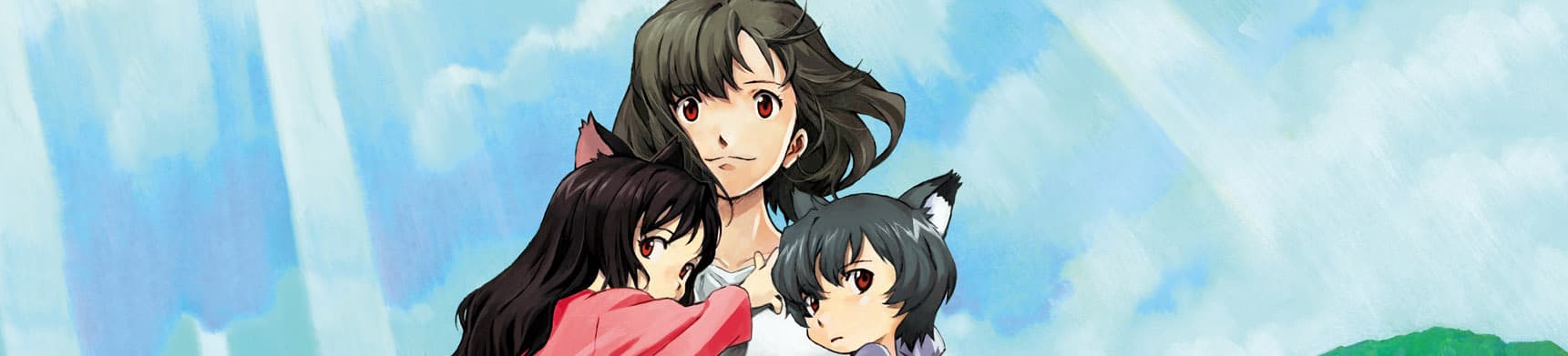
Simply put, Wolf Children is a story about life. More specifically, it’s the story about the life of an ordinary, unusual family. College student Hana meets a mysterious, unnamed boy in one of her classes, and in short order their relationship has progressed enough for that boy to share his secret with her: he’s a wolf. There’s a brief explanation about his backstory and where he comes from, but the mechanics don’t really matter; this is full-on fairy tale logic where there are magic wolves that can transform into humans and live among us. Luckily for him, it seems Hana doesn’t mind going full furry, and their marriage soon bears two children: older sister Yuki, born on a snowy day, and younger brother Ame, born on a rainy day. She’s energetic and rambunctious, he’s sickly and withdrawn, and they’re able to transform between their wolf and human selves at will. But then, tragedy strikes, and Hana finds herself left with the task of raising these two unusual children alone. She has few resources, no support, and no one she can turn to for advice on how to be a parent and pet-owner at the same time. All she can do is roll up her sleeves and face life head-on, holding fast to hope and joy even in the darkest of times to come.
From there, the film follows Hana and her kids through thirteen years, as they grow up, move to a new home in the countryside, experience hardship and happiness, and content with an uncertain future growing ever closer. Structurally, it bends the traditional three-act structure in favor of something closer to a two-act play. The movie’s first half, almost to the minute, focuses on Hana as she undergoes suffering, shoulders on in the face of it, and works her ass off to grow into her new life in the countryside. The second half shifts the focus to the kids as they grow older and start going to school, navigating the thorny question of which life they ultimately want to live: human or wolf. The kids are still important in the first half, and Hana’s story continues through the second, but the overall point of view definitely shifts around the hour mark, and the questions that were bubbling under the surface of the first half leap to the forefront as Yuki and Ame’s paths start to diverge, both from each other and that of their mother. Thankfully, the script makes good use of every last second of its lengthy two-hour runtime. We get to see this family grow and change through so many different periods of their life, grappling with issues that hit close to home whether they’re the metaphorical concerns of half-wolf puberty or the familiar concerns of growing up and processing hardship. This is a fairy tale through and through, but in typical Mamoru Hosoda fashion, the fantastical elements only make the story’s underlying realism that much more poignant.
And my god, what a magical tale it is. Over the course of Hana, Yuki and Ame’s story, we’re pulled through the entire spectrum of the human experience. The joy of finding new love, the intimacy of making a home together, the horrific tragedy of losing someone close to you, the long, difficult stress of being a single parent, the contented exhale of a new beginning, the fear of your family falling apart under the judgmental eyes of a world that can never understand them, the dread of feeling your children grow up and grow away from you as they start walking their own paths, the desire not to give up in the face of despair and meet every obstacle with your cheeriest smile... this isn’t just a movie, it’s a goddamn chronicle of life itself, all its highs and lows and sidetracks and unexpected developments. It’s a series of interconnected vignettes that tell this family’s story from every lens and every angle across the many, many years we spend with them. And every moment, from Hana learning how to farm from her crabby old neighbor to Yuki’s embarrassment over not being sufficiently “girly” for her classmates, is earnest and honest and bursting with the joy of living. It is astounding how multifaceted Wolf Children is, how perfectly it straddles so many different emotional states and builds them all upon each other as time goes on and colors the characters’ experiences in increasingly complex shades. There’s more humanity in the smallest details of this film than some anime manage to achieve over a full 12-episode season.
It also can’t be overstated just how fantastic the movie’s craft is. Hosoda’s previous works were evidence enough of his talent as a director, but the way he weaves this story is nothing short of remarkable. So many sequences show time passing in montage, often wordlessly or with scant narration from a grown-up Yuki, but you never feel like you’re missing out; you feel like you’re every last second every last second of that time passing by, watching Hana navigate her new life as a single mom, or watching Yuki and Ame grow up through elementary school as their desires grow increasingly distant, or watching Hana get to know her new neighbors as they come to respect this resilient city slicker who’s willing to tough it out in the boonies. It genuinely feels like we’re living these characters lives, experiencing every last second of them, even the ones we skip over. I honestly don’t think I’ve ever seen such incredible use of montage, and it’s clear now that this is another of Hosoda’s finest talents. Add to that his predictably amazing character animation and a gorgeous soundtrack from Tagaki Masakatsu, and Wolf Children becomes an absolute wonder to watch. It’s sweeping and majestic, it’s soft and intimate, it’s joyful to the point of tears and it’s heartbreaking to the point of sobs. Every time I return to this movie, I am astounded by how breathtaking it is to behold.
And when all those elements come together? When the spooling emotional build-up finally peaks and the magic and wonder are allowed to just burst free? Good fucking god, there’s nothing else like it. The climax of the movie’s first half sees the entire family break into a sprint through the snow-covered woods, reveling in a moment of happiness so pure and soaring it makes me break down crying every single time. It’s a moment of sheer, unadulterated joy, scored with one of the most staggeringly beautiful pieces of music I’ve ever heard, and the sense of freedom and release as the white snow erupts against the blue sky captures something so impossible to capture it’s honestly kind of terrifying. And then it tops itself all over again for the actual climax, which I won’t dare spoil, but suffice to say, it grabs all the movie’s themes and sends them rocketing into the sky for a finale that will stick in my subconscious until the day I die. It’s one of the most beautiful endings to any piece of media I’ve ever experienced, and it never fails to leave me a sobbing wreck. This movie is the joy of life itself personified, a tapestry of what it means to live and grow and change as family and individual alike. I don’t even have any idea what it’s like to be a parent, but watching Hana persevere and thrive makes me want to hug my mom and thank her for doing such a great job raising me. That’s how sappy it gets me.
I suspect this won’t be the last time I watch Wolf Children. I may find myself coming back to it for the rest of my life, always finding new things to love about it. More than simply being Hosoda’s best film by a country mile, this is one of those films that sets the bar for what storytelling can accomplish. Movies like Wolf Children are the movies that transcend their time and place, becoming timeless masterpieces that will still matter decades down the line. The fact that it’s only gotten better and better the more I’ve watched it is testament enough to that. So if you haven’t yet seen Wolf Children, now’s the time to fix that. I promise you, you won’t regret it for a second.
103.5 out of 108 users liked this review