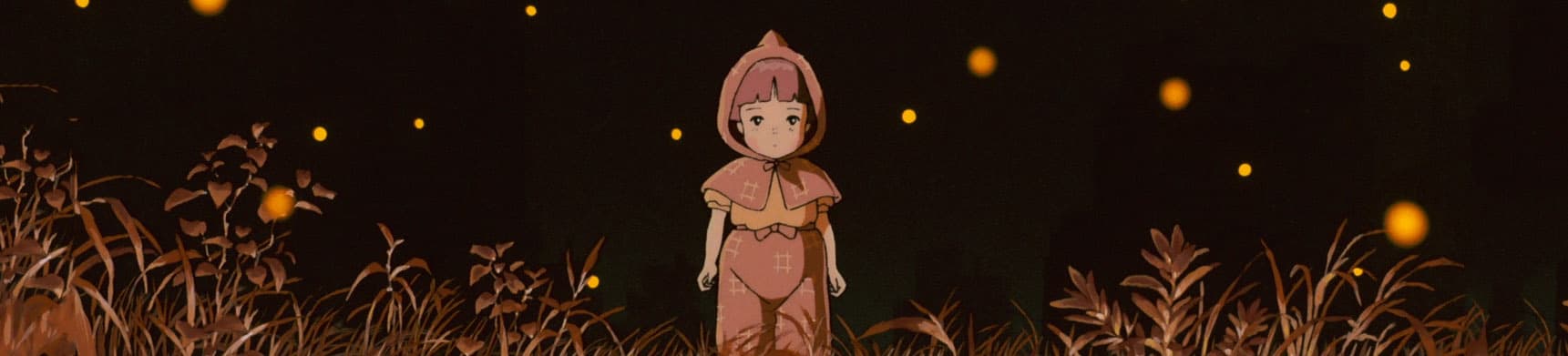
This admittedly is not a review of the film. If you want a solid review, you should look at Grassman's review (the top-voted review of this film on this website). This is instead a defense against one of the main criticisms of the film, the idea that there is a major flaw in the plot due to a decision made by the main character Seita. Honestly, your perception of the film will most likely depend on how you view this one "flaw", so I thought it would be useful to write a full article addressing it (along with a few other criticisms).
Obviously, this review contains spoliers.
The biggest criticism that I see regarding this film is the decision by Seita to leave his Aunt's house and live in a cave with his sister. This ultimately results not only in his death but also the death of his 4-year-old sister Setsuko.
DrowZgam3r's review (the second-highest voted review) says it best,
If neither of them had a place to go to from the start this story might have been better, but the constant knowledge that this tragedy could have been avoided is what killed this film.
Another reviewer from MAL also writes,
Thus, Seita is a completely callous, idiotic monster, responsible not only for his own death but the death of his sister as well. That's my first problem with "Grave of the Fireflies". That the main character is responsible for the entire tragedy that ensues.
To these criticisms, I will say "yes, that is the point of the film". The entire point of the film is that it was an avoidable tragedy. If Seita went back to her Aunt and begged for forgiveness they might have been able to live. Hell, if Seita decided to swallow his pride and not leave his Aunt's house, then they would have lived. But he decided not to, and that is the point of the film.
To answer this question, we need to look over the film's historical context.
December 7, 1941 the Japanese Imperial Navy gained a major victory against the United States, crippling her Pacific Navy, via a surprise attack at Pearl Harbor. And yet by then, the war was already lost. The simple fact of WW2 in the Pacific is that the Empire of Japan had absolutely no chance of victory against the United States. No amount of brilliant strategy or willpower would change this conclusion. The industrial capability of the US was higher than all the major powers combined at the time. As such America was capable and eventually did defeat the Japanese using only half of its strength. By 1942 after the conclusion of the Battle of Midway, it was more than clear that Japan stood no chance. Yet they kept on fighting. Even as all their cities were obliterated by firebombings, they kept on fighting. It took two atomic bombs, an invasion by the Soviet Union, and the intervention of Emperor Showa (Emperor Hirohito) to end the war (and even then the military attempted a coup against their Emperor).
So to those that say that the film is unrealistic due to Seita's decision to leave his Aunt (who treats him unfairly) and pursue his own rugged independence, it is realistic because that is what Japan did during WW2 (and basically the first half of the 20th century). Even as Seita saw the death of her sister in front of his eyes, he never once considered the idea of letting go of his pride and surrendering even though to him it was unfair.
This is my favorite film of all time. I watched this film when I was a kid. Even though I probably watched tons of films when I was a child, Grave of the Fireflies is the only one that I have a fond memory of watching. Of course, back then I didn't have any understanding of the history or the culture of Imperial Japan. Now that I am older and have a far greater understanding of the film's historical context, I have come to appreciate the film much more. This film is not just a typical Anti-War flick. This is a movie that tells a moral that is seldom taught. Sometimes the right move is to give up. Sometimes you have to make peace with an unfair system. Sometimes you have to surrender instead of just saying "I have to fight harder".
Another criticism that I hear is regarding Seita's "laziness" which is why the Aunt justifies her decision to give better food to her immediate family over Seita and Setsuko (yeah, people seem to forget that the Aunt also treats Setsuko, a 4-year-old, badly by giving her porage while her family eats well). I defiantly understand that Seita is somewhat "lazy" in the sense that he doesn't work or volunteer or whatever. I would like to ask though, "what job should Seita get exactly?" I'm sure people are experiencing how difficult it is to get employment during this pandemic. Imagine how more difficult it would be if every city in America was flattened to the ground. Add to that the fact that Seita is 14 years old (hasn't finished his education) and lost both of his parents. Even though the Aunt's frustration is understandable, it doesn't excuse her behavior in treating Seita and Setsuko as basically second class people compared to her family. And technically, Seita did contribute to her family by giving her all the food that he buried at the beginning of the movie.
This is a side note that is much more important. This film only tells one side of Japan during the Second World War. It paints a picture of two largely innocent children dying due to American bombs. While this is a story that did happen (the deliberate targeting of Japanese civilians by the US did happen) and it is important to understand this perspective, it is not the entire story of Japan during World War 2. Imperial Japan was an evil regime that committed countless horrendous atrocities against her neighbors in order to pursue her imperial ambitions. Lookup the Nanjing Massacre if you have the stomach for it (not safe for life). It is incredibly important that people get a complete picture of historical events. Many people are ticked off at the movie for propagating this false idea that Japan was an innocent victim of the Second World War. I personally believe that this is not the fault of the film but the fault of those who see the film and assume that there is nothing more to understand or learn about Japan's involvement in WW2. This film is not a piece of propaganda as the experience of Seita and Setsuko certainly did happen and it is a crucial part of WW2. It's just important for people to understand that it is not the entire story.
This ultimately leads to the importance of historical context. Historical context is important when analyzing or understanding any work of art. But for this movie, I think that the historical context is particularly important. The Wikipedia article on Grave of the Fireflies gives an interesting point of trivia:
After the international release, it has been noted that different audiences have interpreted the film differently due to differences in culture. For instance, when the film was watched by a Japanese audience, Seita's decision to not come back to his aunt was seen as an understandable decision, as they were able to understand how Seita had been raised to value pride in himself and his country. But, American and Australian audiences were more likely to perceive the decision as unwise, due to the cultural differences in order to try to save his sister and himself.
I think that fact alone speaks wonders about how so many people fail to understand the film. In the film's theatrical trailer, it says "[I] came to deliver something you have forgotten". That thing that was forgotten (or more accurately, beginning to be forgotten) was the memory of the Second World War. The film was released in 1988 and even then people were afraid of the next generation forgetting. I fear that as this past becomes more and more distant, more and more people would see this "flaw" in the story, and more and more this film will be misunderstood.
So in all, this film was an absolute masterpiece of a film (especially since I am Japanese and have family members who experienced the War). I believe that anyone can watch this film and enjoy it (or get something out of it), but to truly understand the movie, I believe you need to understand what life was really like for Setsuko, Seita, and the Japanese people during that time. This film was made for people who still had a memory of this. But for us who never experienced this particular time in history, taking the time to learn Japan's history will make your viewing even more enjoyable.
317 out of 325 users liked this review