
Modern society does not necessarily reward quality over quantity. The current atmosphere for pop culture, by and large, seems to incentivize pushing out content that is enjoyable while it’s being consumed but has no real staying power. Oftentimes when something is complete it gets shoved to the back of the audience’s brain and forgotten about; as the guys at RedLetterMedia satirically put it, “Don’t ask questions. Just consume product and then get excited for next product.” That is not the case with Girls’ Last Tour. This is one of the most introspective, beautiful and creative anime series that I have watched, and, in my opinion, there is no higher endorsement I could give than “I can't stop thinking about this”.
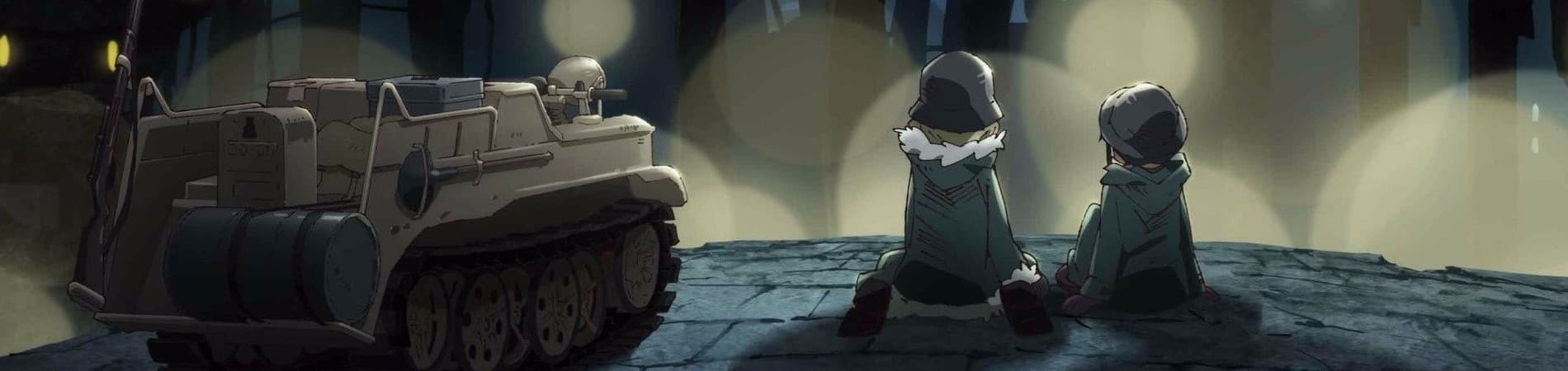
Girls’ Last Tour is the story of two girls, Chito and Yuuri, and their journey across a post-apocalyptic, barren wasteland almost entirely devoid of life. Traveling in their kettenkrad (essentially a small, World War Two era halftrack motorcycle), the two girls struggle against the elements, scrounge for food and gasoline, and occasionally come across other people and living creatures. This is a slice of life with cute, moe blob girls that has been dumped into an environment that is the opposite of normal for the genre. But rather than becoming some bleak, nihilistic tale of innocence being lost, the journey of Chito and Yuuri becomes a refutation of nihilism, full of hope, adventure and discovery.

There are over seven billion people on the planet, hundreds of billions of stars in the Milky Way, and over a hundred billion (observable) galaxies in the universe. For one individual, that knowledge is often enough to make them feel completely insignificant and like their life can’t possibly have significant meaning, which is the feeling that nihilism as a philosophy attempts to capture. If, in the grand scheme of things, we are all insignificant, nothing we do matters and we’re going to die, why bother caring about anything? Girls’ Last Tour counters by asking very basic questions: why can’t individuals ascribe their own meaning to life? There may not be an intrinsic, universal meaning, but what if individuals find their own purpose? Isn’t that meaningful, and doesn’t that make life worth living? One of the characters the girls run into, Kanazawa, is a map maker. In the grand scheme of things, making maps of a dead world that nobody will ever see or use could easily be called meaningless. But it gives him a purpose and keeps driving him forward. To Kanazawa the fact that nobody will see his maps doesn't bother him, and he doesn't really care when the maps do end up being useful. He just wants to map the world and preserve knowledge.

Another character, Ishii, is driven by her desire to build a plane so she can fly. She’s building this plane in the ruins of a dying world where planes used to be commonplace, but her desire to fly isn’t erased by some looming sense of universal insignificance or futility; Ishii’s purpose is to build a plane and fly, and that gives her life meaning. The philosophy of Girls’ Last Tour is beautiful, not bleak; regardless of the state of the world or the significance of what you want, finding something to drive you forward is enough to make life worth living. Yes, as individuals we may not have much impact and yes, we’re going to die one day – but those two things only emphasize the importance of the time we have.

That “something” that keeps driving people forward can also be a relationship. Although both Chito and Yuuri have other interests – such as Chito’s love for history and Yuuri’s love for fun and food – it becomes clear by the end of the show that the bond these two share is what keeps them looking forward to the next day, no matter how low on food they may be running or how cold it may be. They may be nothing alike (despite each having moments where they come to understand the other’s point of view), but they want to experience the world and new things together. Chito and Yuuri also contribute to the brilliance of the setting being post-apocalyptic; things the viewer may find quotidian or unexciting, such as a shirt button or radio, are treasures to the girls who have never seen these things before. A fish, something I could go to the grocery store and buy in less than five minutes, is something the two have no prior knowledge of, sparking mundane, almost childlike, babble about living in water and living creatures that aren’t human that’s utterly brilliant.

Girls’ Last Tour touches on many other themes besides purpose and meaning. Religion, art, death, war, literature, culture, and really what it means to be “human” are all examined to some degree. As someone who is deeply interested in science-fiction, however, the most interesting topic to me, and the one I want to use as an example for what the show does, was the attempt to define “life” using artificial constructs. Two of the few characters I haven’t yet discussed to some extent are two robots, one made to maintain buildings and the other made help at an aquarium and maintain fish. To the people who made them, they were tools, created with the intention of making the lives of humans easier. They would never have been considered “alive”. To Chito and Yuuri, however, they’re much more than just tools. The conclusion they reach isn’t that life is determined by biology, or what physically keeps one’s body moving, but is instead determined by whether or not a something has a purpose, can adapt or change, and has the potential to die. This definition seems ludicrous and runs contrary to basically everything someone who has taken even a high school level biology course will tell you – but after watching what happens, it’s hard to say Chito and Yuuri are strictly wrong. This exploration of a few core themes is what makes the writing of Girls’ Last Tour so great; Chito and Yuuri stumble across things that we, the audience, feel we understand but they are clueless about. They then proceed to draw conclusions that are radically out of line with our preconceptions, but at the same time make total sense and can cause the audience to question whether or not the way we think is “correct”.

Girls’ Last Tour threw characters that belong in a slice of life into the apocalypse to examine deeper themes, and visually the show plays with that dichotomy as well. Whether the setting is a dank factory littered with boilers and pipes, a haunting cityscape that’s long past the brink of collapse, or an eerie open area with a fresh cover of snow, Chito, Yuuri and their kettenkrad stick out like a sore thumb. The background art is amazing, but regardless of how detailed and how vast it seems the spotlight is placed on the two girls, and they are always impossible to miss; this is their story and their journey through the world, and we just have the privilege of watching from afar.

I also just love the character designs themselves, which are surprisingly complex. The eyes are the most notable feature of the girls, with Chito’s large, round pitch black irises and Yuuri’s oblong, sky-blue retinas telling the audience everything they need to know about the two girls – Chito is inquisitive, constantly taking in her surroundings and potential meaning, whereas Yuuri couldn’t care less about anything other than exploring, eating and having fun.
I want to also touch on the sound design, because it’s amazing in its own right. The actual sound effects of the show are spot on – the grinding of gears, hissing of steam, everything just sounds perfect and contributes so much to the atmosphere. But shows have had good sound design before and future shows will have it again. I can count on one hand, however, the number of shows with OSTs that even compare to that of Girls’ Last Tour. First of all, the OP, ED and several insert songs are sung by the actors for Chito and Yuuri (Inori Minase and Yurika Kubo respectively), both of whom do a fantastic job not only in their roles but also with the music. Every single song is perfect. The opening, “Ugoku, Ugoku” (which features cute anime girls dabbing), and ending, “More One Night” (which was literally drawn and animated by the mangaka and is amazing), are both up-tempo and poppy, relying heavily on electric instruments and clean sounds.
However, it was “The Song of Raindrops”, an insert/one episode ending, that totally blew me away. To people today, raindrops plinking outside can be perceived as a hindrance. It means sports games get cancelled, that the volume on the TV needs to be a little louder, that it might be a little harder to get to sleep. To Chito and Yurri, however, the sound of raindrops plinking against different metal objects is the some of the only music they’ve ever heard. There are no traditional instruments, it’s just the plinking of metal and singing. Even without the singing though, it’s once again hard to say Chito and Yuuri were wrong to call the falling rain music – The Song of Raindrops stands out to me because, in addition to being a genuinely touching song, it represents one of the fundamental ideas of the show, finding beauty in the benign.

If you asked me “what movies have you seen in theatres over the last five years”, I’d be hard pressed to answer. I remember going to the theatre dozens of times, but what I remember is the experience of being at a theatre, not the actual film. A lot of media today is just in one ear and out the other – you watch it, think “oh that was nice”, and then forget about it until the inevitable sequel. After I finished the final episode of Girls’ Last Tour the show was still stuck in my head (and its music on my Youtube playlist). So a few weeks later I went and read the manga. And then a few weeks after that I read Shimeji Simulation, the other work of the mangaka tsukumizu (side note: worth checking out). And then a few weeks after that I rewatched the show. I loved basically every second of Girls’ Last Tour. I wouldn’t call it the best show of all time, or even my favorite, but I will call it unique, brilliant, uplifting, unforgettable and a masterpiece.